BookBrief
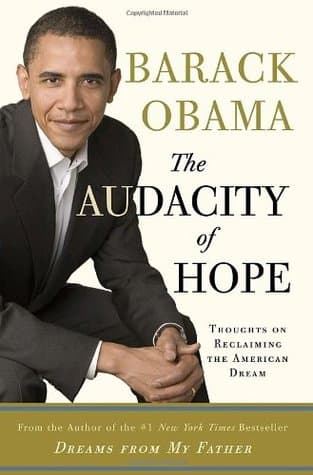
The Audacity of Hope: Thoughts on Reclaiming the American Dream cover
Archivist's Choice

The Audacity of Hope: Thoughts on Reclaiming the American Dream

Barack Obama (2006)

Genre

Politics / Biography / Memoir / History

Reading Time

12 Minutes

Key Themes

See below

Track Your Reading

Sign in to track this book

Barack Obama shares his vision for a united America, blending personal reflections with calls for a politics rooted in shared optimism and a pursuit of the American Dream.

Core Idea

In "The Audacity of Hope," Barack Obama articulates a vision for American politics that transcends partisan divides, advocating for a return to common values and practical solutions. He explores the challenges facing the United States in the early 21st century, from economic inequality to cultural polarization, and proposes that a renewed sense of civic responsibility and a commitment to dialogue can bridge these gaps. Obama emphasizes the importance of empathy, hard work, and a belief in the American Dream as achievable for all, arguing that these principles are essential for reclaiming the nation's promise and fostering a more perfect union. The book is a call for a more inclusive and less acrimonious political discourse, urging Americans to find common ground on issues like healthcare, education, and foreign policy. Obama shares personal anecdotes and reflections on his own journey, illustrating how his experiences have shaped his political philosophy, which is rooted in a pragmatic idealism. He suggests that hope, when combined with action and a willingness to engage with differing viewpoints, is not merely a sentiment but a powerful force for positive change in a complex and often cynical world.
Difficulty
Medium

Core idea

The central argument and framework that powers the entire book.

In "The Audacity of Hope," Barack Obama articulates a vision for American politics that transcends partisan divides, advocating for a return to common values and practical solutions. He explores the challenges facing the United States in the early 21st century, from economic inequality to cultural polarization, and proposes that a renewed sense of civic responsibility and a commitment to dialogue can bridge these gaps. Obama emphasizes the importance of empathy, hard work, and a belief in the American Dream as achievable for all, arguing that these principles are essential for reclaiming the nation's promise and fostering a more perfect union.

The book is a call for a more inclusive and less acrimonious political discourse, urging Americans to find common ground on issues like healthcare, education, and foreign policy. Obama shares personal anecdotes and reflections on his own journey, illustrating how his experiences have shaped his political philosophy, which is rooted in a pragmatic idealism. He suggests that hope, when combined with action and a willingness to engage with differing viewpoints, is not merely a sentiment but a powerful force for positive change in a complex and often cynical world.

At a glance

Difficulty

Medium

Key Takeaways

1

Beyond Red vs. Blue

America's true strength lies in its shared values, not its partisan divisions.

Quote

I serve as a reminder of the American Dream, a constant reaffirmation that in America, all things are possible.

Obama argues that hyper-partisanship in American politics hides a deeper, often unacknowledged agreement among citizens. He believes most Americans, regardless of party, share core values like hard work, family, community, and opportunity. The book criticizes how media amplifies division and how politicians are encouraged to demonize opponents, creating a 'culture war' that distracts from solving problems. This is not a naive call for unity, but a strategic claim that recognizing shared values is necessary for effective government and...

Supporting evidence

Obama reflects on his experiences campaigning in diverse communities across Illinois and the nation, observing that everyday Americans often express more nuanced and less dogmatic views than their political representatives or pundits. He recounts conversations with farmers, factory workers, and small business owners who, despite voting differently, articulate similar hopes for their children and communities.

Apply this

Voters should actively seek out candidates who demonstrate a willingness to compromise and build bridges across the aisle, rather than those who solely appeal to their base. Individuals can foster this by engaging in civil discourse with those holding differing views, focusing on shared goals rather than intractable ideological battles.

2

The Imperfect Union

America's founding ideals are aspirational, requiring continuous effort to achieve true equality.

Quote

The American story, like all human stories, is a story of contradictions, of triumphs and setbacks, of moments of great generosity and moments of tragic meanness.

This is a strong insight in the book, acknowledging the tension between America's founding principles and its history. Obama addresses the nation's past injustices, especially concerning race, not as a permanent blemish, but as problems to overcome through ongoing effort and moral improvement. He emphasizes that the 'American experiment' is never finished; it is a constant process of working toward a more perfect union. This view encourages a critical patriotism that recognizes flaws while staying committed to the nation's ideals, a m...

Supporting evidence

Obama delves into the legacy of slavery and Jim Crow, contrasting it with the Declaration of Independence's promise of equality. He uses his own biracial identity and family history as a microcosm of this ongoing American struggle and evolution, illustrating how personal narratives intersect with broader historical arcs of justice and injustice.

Apply this

Citizens should engage with a nuanced understanding of American history, acknowledging both its triumphs and its failures. This means advocating for policies that address systemic inequalities and working towards a society where the promise of 'all men are created equal' truly applies to everyone.

3

Faith and Public Life

Religious belief can be a powerful force for social good, if not weaponized for political ends.

Quote

To say that faith has no role in public life is to ignore the lessons of history.

Obama explores the role of faith in American public life, arguing against both completely secularizing politics and imposing one religious view. He recognizes that religious motives have driven social movements, from abolition to civil rights. However, he warns against fundamentalism and its potential to demonize opponents and prevent compromise. His own journey of faith, from skepticism to finding spiritual grounding, informs his belief that while individual faith is personal, its ethical demands can inspire civic action toward justi...

Supporting evidence

He cites the examples of Martin Luther King Jr.'s use of Christian principles to advocate for racial equality and the role of faith-based organizations in providing social services. Obama also describes his own spiritual evolution and how his Christian faith informs his ethical framework for public service, emphasizing empathy and a commitment to the common good.

Apply this

Individuals of faith should seek to translate their moral convictions into broad principles of justice and compassion applicable to all citizens, rather than attempting to enforce specific religious doctrines through law. Non-believers should recognize the potential for faith to be a positive force for social change, fostering dialogue rather than dismissal.

4

The Pragmatic Idealist

Effective leadership balances lofty ideals with the messy realities of political compromise.

Quote

Progress is always messy. It's not a straight line, but a series of detours and dead ends, of small victories and hard-won compromises.

Obama addresses the tension between his idealistic vision for America and the practical needs of legislative politics. He acknowledges that major change often requires difficult compromises that may not fully satisfy anyone, including himself. Some might see his emphasis on compromise as a weakness, but Obama frames it as a strength—a recognition that governing in a democracy means building coalitions and finding common ground, not maintaining ideological purity. He advocates for leadership that is based on strong moral principles but...

Supporting evidence

He recounts his experiences in the Illinois State Senate and later the U.S. Senate, detailing the painstaking process of negotiating bills, forming unlikely alliances, and accepting less-than-perfect outcomes to achieve incremental progress on issues like ethics reform or healthcare. His description of the legislative process demystifies it, showing the grind behind the grand pronouncements.

Apply this

Voters should appreciate leaders who demonstrate both a clear vision and a willingness to engage in principled compromise. Citizens should temper their expectations for immediate, sweeping change and support incremental progress that moves society in the right direction.

5

The Global Citizen

America's influence is best projected through diplomacy and collaboration, not unilateralism.

Quote

The world is too interconnected for us to retreat into isolation.

Obama argues for a foreign policy based on working with multiple nations and engagement, contrasting it with the unilateral approach common when the book was published (during the Iraq War). He believes America's moral standing and long-term security are strengthened by working with international partners, respecting international law, and addressing global issues like poverty, disease, and climate change together. This is not a call for American weakness, but for a smarter, more sustainable use of power that recognizes how connected ...

Supporting evidence

He discusses the importance of alliances like NATO and the United Nations, and the need for diplomatic solutions in regions like the Middle East. Obama recounts his travels abroad and conversations with international leaders and citizens, highlighting a global desire for American leadership that is collaborative rather than domineering.

Apply this

Citizens should advocate for a foreign policy that prioritizes diplomacy, international cooperation, and humanitarian aid alongside military strength. Understanding global interdependence can inform consumer choices and support for international development initiatives.

6

Reclaiming the Dream

The American Dream requires both individual effort and robust public support.

Quote

The American Dream is not a lottery ticket; it's a social contract.

Obama challenges the simple idea that the American Dream is only about individual effort. While acknowledging personal responsibility, he strongly argues that a strong public sector—including quality education, affordable healthcare, a social safety net, and infrastructure—is essential for creating the conditions where individuals can truly succeed. He points to the decline of these public goods and the resulting increase in inequality, suggesting that the 'dream' is becoming out of reach for many. This is a strong counter-argument to...

Supporting evidence

He draws on his own family's story, noting how public schools, scholarships, and a relatively strong economy provided opportunities for his mother and grandparents. He contrasts this with the challenges faced by working-class families struggling with rising healthcare costs, stagnant wages, and declining public services in the 2000s, illustrating how the 'rungs on the ladder' are disappearing for many.

Apply this

Advocate for policies that strengthen the social safety net, improve public education, and ensure affordable healthcare. Recognize that personal success is often intertwined with societal support systems, and work to ensure those systems are available to everyone.

7

The Power of Story

Politics is fundamentally about narrative and finding common ground through shared stories.

Quote

In a democracy, we don't just vote for policies; we vote for the stories we want to tell ourselves about who we are and what we believe.

Obama, a skilled speaker, understands how stories shape political identity and action. He argues that effective politics is not just about presenting facts or policies, but about telling compelling stories that connect with people's experiences and hopes. He criticizes current political narratives that emphasize division and fear, instead advocating for stories that highlight common humanity, shared struggles, and collective potential. This understanding is key to his own political success, as he consistently tried to create a shared ...

Supporting evidence

He often refers to the 'American story' as an ongoing, evolving narrative that citizens collectively write. He recounts how his own life story, as the son of a Kenyan father and a Kansas mother, became a symbol of America's diversity and potential, connecting it to broader themes of immigration and opportunity that resonate with many different groups.

Apply this

Actively listen to and try to understand the narratives of others, even those with whom you disagree. When communicating political ideas, focus on crafting inclusive stories that appeal to shared values and aspirations, rather than relying solely on abstract arguments or statistics.

8

Youth and Hope

Engaging the next generation is vital for renewing America's democratic spirit.

Quote

The true meaning of audacity is not simply to hope, but to act on that hope.

Obama emphasizes the role of young people in renewing American democracy. He believes that cynicism and disengagement threaten the nation's future, and that inspiring the next generation to believe in change and participate is crucial. He sees youth not just as future voters, but as current agents of change, able to bring new perspectives and energy to solve complex problems. This highlights his belief in idealism, especially when directed into constructive action, and his concern that younger generations might inherit a political sys...

Supporting evidence

He discusses the energy and idealism he encountered among young volunteers and students during his campaigns and Senate work. He recounts stories of young people organizing for social causes and expressing a desire for more meaningful political engagement, often frustrated by the status quo but still holding onto hope for a better future.

Apply this

Mentors and educators should actively encourage young people to engage in civic life, critical thinking, and community service. Younger generations should seek opportunities to participate in political processes, volunteer for causes they believe in, and hold leaders accountable.

9

The Weight of Leadership

True leadership demands self-reflection, humility, and a deep understanding of human complexity.

Quote

You can't lead people if you don't know who you are and what you believe.

Beyond policy, Obama discusses the personal qualities needed for effective leadership. He shares his own struggles with ambition, doubt, and the constant public scrutiny. This transparency humanizes the political figure and shows that leadership is not just about charisma, but about ongoing self-assessment, moral grounding, and empathy for others. He argues that leaders must confront their biases, listen to different perspectives, and make tough decisions that may not be popular. Some might argue that such introspection is a luxury in...

Supporting evidence

He shares anecdotes from his early political career, his marriage to Michelle, and his experiences as a father, illustrating how these personal dimensions inform his approach to public service. He candidly discusses moments of self-doubt and the constant tension between personal life and political demands, offering a glimpse into the internal world of a burgeoning national figure.

Apply this

When evaluating leaders, look beyond their policy positions to assess their character, capacity for empathy, and willingness to admit mistakes. Aspiring leaders should cultivate self-awareness, seek diverse counsel, and prioritize ethical decision-making over political expediency.

10

Hope as an Action

Hope is not passive optimism, but an active commitment to make the world better.

Quote

Hope is not blind optimism. It's not a guarantee of success, but a belief that something better is possible if we work for it.

The book's title, 'The Audacity of Hope,' captures its main message. Obama redefines hope not as a naive wish, but as a deliberate choice and a call to action. It is the courage to believe in progress even when facing huge challenges, and the willingness to do the hard work needed to achieve it. This is a powerful message that goes beyond specific policy debates, arguing that a resilient spirit and collective effort are fundamental to overcoming obstacles in both personal and political life. He implies that cynicism, while understanda...

Supporting evidence

Throughout the book, he recounts numerous instances where seemingly insurmountable problems were eventually addressed through persistent effort and collective belief. He draws on historical examples of social movements that succeeded against long odds, emphasizing that change rarely comes easily but is always possible with sustained commitment.

Apply this

Cultivate a mindset of active hope, recognizing that personal and societal progress requires sustained effort and resilience. Engage in actions, however small, that contribute to positive change, rather than succumbing to fatalism or apathy.

Critical analysis

Notable Quotes

Quiz

Test Your Knowledge

Ready to see how well you understood this book? Take our interactive quiz with 10 questions.

10
Questions
~5
Minutes
?
Best Score

Key Questions (FAQ)

The Audacity of Hope is Barack Obama's call for a new kind of politics focused on shared understandings that unite Americans. It emphasizes optimism and a vision for America's role in the world.

About the author

Barack Obama

Barack Obama is a former President of the United States and the author of the bestselling memoirs "Dreams from My Father" and "The Audacity of Hope." His writings explore themes of race, identity, and the American experience, reflecting his background as a community organizer and constitutional lawyer. His work is characterized by its thoughtful prose and insightful analysis of social and political issues.