BookBrief
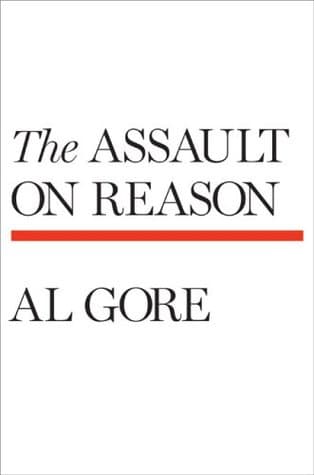
The Assault on Reason cover
Archivist's Choice

The Assault on Reason

Al Gore (2007)

Genre

Politics / History / Science / Philosophy

Reading Time

270 min

Key Themes

See below

Track Your Reading

Sign in to track this book

Al Gore explores how the decline of rational discussion in American public life harms democracy.

Core Idea

Al Gore argues that American democracy is threatened by a steady decline in rational discussion and critical thinking. He believes this 'assault on reason' comes mostly from commercial television, which favors entertainment over real debate, promotes distraction, and uses fear to shape public opinion. This problem grows worse with the dismissal of scientific knowledge, the spread of false information, and the use of public fear for political gain. This leaves citizens less able to make informed decisions, which is vital for a working democracy.
Reading time
270 min
Difficulty
Medium
✓ Read this if...
You are concerned about the decline of rational public discourse, the influence of media on politics, or the marginalization of science in policy-making, and are interested in a critique of these trends from a political insider's perspective.
✗ Skip this if...
You are looking for an impartial academic analysis of media effects, are uninterested in a politically charged critique of modern American society, or prefer solutions-oriented texts over diagnostic ones.

Core idea

The central argument and framework that powers the entire book.

Al Gore argues that American democracy is threatened by a steady decline in rational discussion and critical thinking. He believes this 'assault on reason' comes mostly from commercial television, which favors entertainment over real debate, promotes distraction, and uses fear to shape public opinion. This problem grows worse with the dismissal of scientific knowledge, the spread of false information, and the use of public fear for political gain. This leaves citizens less able to make informed decisions, which is vital for a working democracy.

At a glance

Reading time

270 min

Difficulty

Medium

Read this if...

You are concerned about the decline of rational public discourse, the influence of media on politics, or the marginalization of science in policy-making, and are interested in a critique of these trends from a political insider's perspective.

Skip this if...

You are looking for an impartial academic analysis of media effects, are uninterested in a politically charged critique of modern American society, or prefer solutions-oriented texts over diagnostic ones.

Key Takeaways

1

The Erosion of Rational Discourse

How the public sphere has been degraded by a shift from reason to emotion and spectacle.

Quote

The 'marketplace of ideas' has been corrupted by a constant bombardment of triviality, sensationalism, and manufactured controversy, making it increasingly difficult for reason to prevail.

Gore argues that the core of democratic self-governance—citizens' ability to debate rationally and make informed choices—has been systematically weakened. He points to less critical thinking, a preference for entertainment over substance, and the deliberate manipulation of public opinion through fear. This decline is not accidental; it results from a media environment that prioritizes ratings and superficiality, combined with political strategies that exploit these weaknesses. The outcome is a public less able to tell truth from false...

Supporting evidence

Gore cites the rise of 24-hour cable news cycles, the increasing dominance of visual media over print, and the strategic use of 'wedge issues' in political campaigns to divide and conquer rather than foster consensus.

Apply this

Actively seek out diverse and credible news sources, critically evaluate information for bias and accuracy, and engage in respectful dialogue with those holding differing views, even when it's uncomfortable. Prioritize understanding over immediate agreement.


media-fragmentationcognitive-biaspublic-sphere
2

The Power of the 'Television Mind'

How the medium of television shapes our perception of reality and diminishes rational thought.

Quote

The principal instrument of this assault is television, which has a powerful and often unconscious impact on our capacity to reason.

Gore states that television, a main source of information for many, changes how we think. Its structure—short segments, constant visuals, and focus on emotion—creates a 'television mind' that is less patient for complex arguments and more open to simple stories. This constant flow of images and short information discourages deep analysis and promotes passive consumption of reality, rather than active engagement with ideas. He suggests this medium subtly but powerfully trains us to value spectacle over substance, and feeling over fact,...

Supporting evidence

Gore discusses studies on how repeated exposure to television news can lead to a reduced attention span and a preference for emotionally charged content over factual reporting, creating a 'hypnotic' effect.

Apply this

Limit passive television consumption. When watching, actively question what you're seeing and hearing. Prioritize reading and other forms of media that encourage deeper engagement and critical thought. Engage in 'media fasting' to reset your cognitive patterns.

media-literacyattention-economycognitive-load
3

The Assault on Science and Expertise

How scientific consensus and expert knowledge are deliberately undermined for political gain.

Quote

When science and reason are dismissed as mere 'opinions' or 'beliefs,' the very basis for addressing complex societal challenges evaporates.

A major part of the attack on reason, Gore says, is the systematic criticism of science and expertise. He argues that politically motivated groups often try to create doubt about established scientific facts, especially concerning climate change. They do this by spreading misinformation and attacking scientists' credibility. This strategy aims to confuse the issue, create a false sense of debate, and prevent policies that might threaten powerful interests. The result is a society that struggles to tell credible evidence from political...

Supporting evidence

Gore details the Bush administration's efforts to suppress or alter scientific reports on climate change and environmental issues, and the broader campaign by certain industries to fund 'contrarian' research to create doubt.

Apply this

Actively verify the credentials and potential biases of sources. Prioritize information from peer-reviewed scientific journals and reputable academic institutions. Be wary of claims that dismiss broad scientific consensus without robust, verifiable evidence.

scientific-literacydisinformationpost-truth
4

Fear as a Political Weapon

How politicians exploit fear to bypass rational deliberation and consolidate power.

Quote

Fear creates a powerful incentive to abandon reason in favor of perceived safety, even if that safety is illusory and comes at the cost of liberty.

Gore carefully explains how fear, particularly after events like 9/11, became a main tool for political manipulation. He argues that by always bringing up major threats and creating an atmosphere of constant crisis, leaders can bypass rational debate, justify controversial policies, and gain more power. When people are afraid, they think less critically and become more open to authoritarian appeals. They are also less likely to question authority. This tactic not only undermines democratic processes but often leads to policies that ar...

Supporting evidence

Gore points to the Patriot Act and the justification for the Iraq War, arguing that fear of terrorism was strategically leveraged to gain public support for policies that might not have withstood rational scrutiny.

Apply this

Recognize when fear is being used to manipulate. Question narratives that rely heavily on 'us vs. them' rhetoric or existential threats. Prioritize critical analysis over emotional reaction, especially during times of crisis. Demand evidence and transparency from leaders.

authoritarianismpropagandaemotional-manipulation
5

The Rise of the 'Fake' Consensus

How manufactured consent and echo chambers prevent genuine public deliberation.

Quote

The public square is no longer a place for genuine debate, but a carefully constructed stage where a 'fake' consensus is presented as reality.

Gore highlights the concerning trend of 'fake' consensus, where a specific viewpoint is amplified through selective media coverage, partisan think tanks, and coordinated messages. This gives the impression of widespread agreement even when it does not exist. This manufactured consent is further strengthened by echo chambers and filter bubbles, especially online, where people mainly see information that confirms their existing beliefs. This environment makes it very hard for different opinions to be heard, for alternative views to gain...

Supporting evidence

Gore discusses the role of talk radio and specific cable news channels in creating insular information environments, and how political strategists exploit these channels to disseminate specific narratives and marginalize opposing views.

Apply this

Actively seek out information and perspectives that challenge your own. Diversify your media diet beyond your usual sources. Engage in respectful dialogue with people who hold different views, aiming to understand their reasoning rather than to convert them.

echo-chamberfilter-bubbleconfirmation-bias
6

The Cost of Indifference

The perilous consequences of allowing the assault on reason to continue unchecked.

Quote

The degradation of our public sphere is not merely an inconvenience; it poses an existential threat to our democracy and our ability to solve pressing global challenges.

Gore argues that the ongoing attack on reason is not just an academic concern; it directly threatens democratic society and our ability to address critical issues like climate change, poverty, and global security. When truth is subjective and rational debate is ignored, collective action becomes impossible. Ignoring these trends allows false information to spread, empowers demagogues, and ultimately makes societies unable to correct themselves. The long-term cost is a public that is uninvolved, misinformed, and unable to hold power ac...

Supporting evidence

Gore links the inability to address climate change effectively to the deliberate creation of doubt and the erosion of scientific consensus, demonstrating a direct consequence of the assault on reason.

Apply this

Recognize the high stakes involved. Take an active role in promoting rational discourse in your communities and online. Support independent journalism and educational initiatives that foster critical thinking. Demand accountability from media and political figures.

civic-engagementdemocratic-erosioncollective-action
7

Reclaiming the Public Square

The imperative to revitalize rational debate and critical thinking in public life.

Quote

We must reclaim the integrity of the public square and restore the role of reason as the foundation of our self-governance.

Despite his bleak assessment, Gore offers a call to action: we need to actively reclaim and rebuild public spaces for rational discussion. This involves many steps, beginning with individuals committing to critical thinking and media literacy. It also requires systemic changes in media practices, focusing on substance over sensationalism, and a political culture that values truth and compromise over partisan conflict. Reclaiming public discussion means creating environments where real debate can happen, where evidence is respected, an...

Supporting evidence

Gore advocates for strengthening public broadcasting, promoting media education, and encouraging political leaders to engage in substantive debates rather than 'soundbite' politics.

Apply this

Support media outlets committed to in-depth, unbiased reporting. Advocate for media literacy education in schools. Participate in local civic discussions and demand that your elected officials engage in respectful, evidence-based debate.

civic-renewaldeliberative-democracymedia-reform
8

The Moral Imperative of Truth

Why upholding objective truth is not just political, but a moral duty.

Quote

The assault on reason is ultimately a moral assault, for it undermines our capacity to discern right from wrong and to act on our shared values.

Gore elevates the discussion beyond mere political strategy to a moral level. He argues that the systematic disregard for truth and reason is not just ineffective; it is unethical. A society that cannot agree on basic facts or engage in rational discussion loses its moral compass. Without a shared understanding of reality, it becomes impossible to address injustices, uphold human rights, or make ethical choices for the common good. The decline of reason thus connects with a lowering of public morality, as individuals and institutions ...

Supporting evidence

Gore connects the erosion of truth to the justification of torture, the denial of climate science, and the widening wealth gap, arguing that these are not merely policy failures but moral failings stemming from an inability to confront reality.

Apply this

Commit to personal integrity in seeking and sharing information. Challenge falsehoods respectfully but firmly. Advocate for transparency and accountability in all institutions. Recognize that truth is a prerequisite for ethical action and justice.

moral-relativismethics-of-informationaccountability
9

Digital Age Challenges and Opportunities

How the internet amplifies both the assault on reason and the potential for its restoration.

Quote

The internet, with its vast potential for knowledge and connection, also presents unprecedented avenues for the spread of misinformation and the fragmentation of shared reality.

While Gore's book came out before social media's full impact, his analysis of television's influence is relevant to the digital age. He implicitly shows how the internet, especially social media, can amplify the 'television mind' by prioritizing emotional, short-form content and algorithms that create personalized echo chambers. This speeds up the spread of misinformation and tribalizes discussion on an unprecedented scale. However, Gore also acknowledges the internet's great potential as a tool for sharing knowledge and connecting gl...

Supporting evidence

Though written before Facebook's dominance, Gore's concerns about media concentration and the speed of information transfer directly foreshadow the challenges of online misinformation and filter bubbles.

Apply this

Be a discerning consumer and producer of online content. Actively curate your online feeds to include diverse perspectives. Support initiatives that promote digital literacy and fact-checking. Use online platforms to share well-reasoned arguments and engage in constructive dialogue.

digital-literacysocial-media-impactalgorithmic-bias
10

The Call for Active Citizenship

Individual responsibility as the ultimate defense against the degradation of reason.

Quote

The future of our democracy depends not on politicians alone, but on the active, informed, and courageous participation of its citizens.

Ultimately, Gore places significant importance on the individual citizen's role. He argues that while systemic issues are deep, the final defense against the attack on reason lies with an engaged, informed, and ethically aware populace. Passive information consumption, disengagement from civic life, and an unwillingness to challenge falsehoods only make the problem worse. Active citizenship means not just voting, but also critical thinking, media literacy, respectful dialogue, and a commitment to seeking truth. It means holding leader...

Supporting evidence

Gore champions historical examples of grassroots movements and citizen advocacy that successfully pushed for societal change, emphasizing that collective action, rooted in reason, is powerful.

Apply this

Commit to lifelong learning and critical thinking. Participate in local governance and community discussions. Support journalism and educational initiatives. Vote based on reasoned analysis, not just emotion. Be a proactive force for truth and civility in your interactions.

civic-responsibilitydemocratic-participationcritical-thinking

Critical analysis

Notable Quotes

The accumulated wisdom of the past is no longer a guide to the future.

Discussing the rapid pace of change and its impact on traditional knowledge.

The marketplace of ideas is supposed to be a place where the best ideas win out, not where the loudest voices or the most well-funded arguments dominate.

Critiquing the current state of public discourse and media influence.

When the most powerful medium of communication in history is now routinely used to distort the truth, rather than reveal it, the assault on reason is well underway.

Highlighting the role of television and media in shaping public perception.

The constant bombardment of images and sound bites has created a culture of distraction, making it difficult for citizens to engage in thoughtful deliberation.

Analyzing the impact of modern media on cognitive processes and civic engagement.

The greatest danger we face is not from the outside, but from the inside: from our own complacency, from our own willingness to surrender our critical faculties.

Emphasizing internal threats to democracy and rational thought.

When citizens are deprived of the capacity to distinguish between what is true and what is false, the very foundations of self-government are threatened.

Arguing that truth is essential for a functioning democracy.

The scientific method is not merely a set of procedures; it is a way of thinking, a commitment to empirical evidence and logical inference.

Defending the scientific method against skepticism and denial.

We have fallen into a habit of confusing what is entertaining with what is important.

Critiquing the prioritization of entertainment over substantive issues in media.

The suppression of dissent, even when well-intentioned, ultimately weakens a society's ability to adapt and evolve.

Discussing the importance of open debate and diverse perspectives.

Reason is not just a tool for solving problems; it is a moral imperative, a commitment to seeking truth and justice.

Elevating reason beyond mere utility to a matter of ethics.

The erosion of public trust in institutions, including the press and government, is a symptom of a deeper crisis of reason.

Connecting declining trust to the broader themes of the book.

The future of our democracy depends on our willingness to reclaim our capacity for critical thought and to demand truth from those who seek to lead us.

A call to action for citizens to engage more critically with information and leaders.

We have allowed the trivial to displace the profound, the immediate to overshadow the enduring.

Lamenting the shift in societal focus from long-term importance to short-term gratification.

Quiz

Test Your Knowledge

Ready to see how well you understood this book? Take our interactive quiz with 10 questions.

10
Questions
~5
Minutes
?
Best Score

Key Questions (FAQ)

'The Assault on Reason' by Al Gore explores how the degradation of our public sphere, particularly through the media and political discourse, undermines the foundational principle of reasoned debate essential for self-governance in a democracy. Gore argues that this decline threatens our ability to address critical societal challenges effectively.

About the author

Al Gore

Al Gore is a former U.S. Vice President and environmental activist. He is the author of the best-selling book 'An Inconvenient Truth' and 'The Assault on Reason,' which explores the decline of rational discourse in American politics. Gore's work often focuses on environmentalism and the challenges facing democracy.