BookBrief
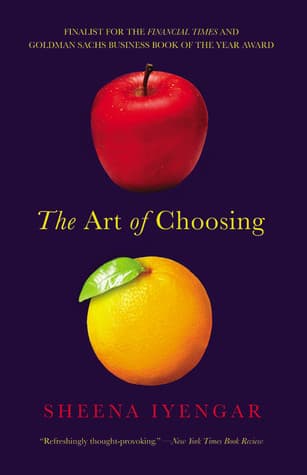
The Art of Choosing cover
Archivist's Choice

The Art of Choosing

Sheena Iyengar (2010)

Genre

Business / Economics / Science / Philosophy / Self-Help

Reading Time

9 hours

Key Themes

See below

Track Your Reading

Sign in to track this book

Explore the science and philosophy behind our daily decisions, revealing the hidden forces that shape our choices, from small to life-changing.

Core Idea

Choice, while seemingly a universal good and a foundation of freedom, is a complex and often contradictory human experience shaped by many factors beyond individual will. The book argues that our understanding and use of choice are greatly influenced by culture, thought, and situation, leading to both empowerment and paralysis. It examines how the brain handles options, the mental costs of making decisions, the strong role of defaults, and the illusion of control. Ultimately, it shows that choosing well means understanding these underlying mechanisms, not just having more options.
Reading time
9 hours
Difficulty
Medium
✓ Read this if...
You are fascinated by the psychology behind decision-making, want to understand why having too many options can be paralyzing, or seek to make better choices in your personal and professional life.
✗ Skip this if...
You prefer prescriptive, step-by-step guides for making decisions, or are not interested in the academic and scientific underpinnings of choice.

Core idea

The central argument and framework that powers the entire book.

Choice, while seemingly a universal good and a foundation of freedom, is a complex and often contradictory human experience shaped by many factors beyond individual will. The book argues that our understanding and use of choice are greatly influenced by culture, thought, and situation, leading to both empowerment and paralysis. It examines how the brain handles options, the mental costs of making decisions, the strong role of defaults, and the illusion of control. Ultimately, it shows that choosing well means understanding these underlying mechanisms, not just having more options.

At a glance

Reading time

9 hours

Difficulty

Medium

Read this if...

You are fascinated by the psychology behind decision-making, want to understand why having too many options can be paralyzing, or seek to make better choices in your personal and professional life.

Skip this if...

You prefer prescriptive, step-by-step guides for making decisions, or are not interested in the academic and scientific underpinnings of choice.

Key Takeaways

1

The Paradox of Choice

More options don't always lead to better decisions or greater satisfaction.

Quote

The more choices people have, the more they prefer to put off making a decision, or to make no decision at all.

Iyengar's 'jam study' shows that many options might seem appealing at first, but they often lead to decision paralysis, anxiety, and less satisfaction with the choice made. Too many choices increase our mental load, making it harder to weigh each option. This can result in delaying the decision or making a choice we are less confident in, leading to regret. The freedom of abundant choice can become a burden, which highlights the need for curation and limits in decision-making.

Supporting evidence

The 'jam study' where consumers were presented with either 6 or 24 varieties of jam. While the larger display attracted more initial interest, the smaller display led to significantly more purchases (30% vs. 3%).

Apply this

When facing a major decision, intentionally limit your options to a manageable few (e.g., 3-5). For presenting choices to others, curate the selection to avoid overwhelming them, focusing on quality over quantity.

decision-paralysischoice-overloadcognitive-load
2

Cultural Lens of Choice

Our perception and value of choice are deeply shaped by cultural context.

Quote

The American ideal of choice as an inherent good is not universal; other cultures prioritize different values.

Iyengar argues that the desire for individual choice is not an inborn, universal human trait. Instead, she shows how different cultures define and value choice differently. Western cultures often emphasize individual freedom to choose, while Eastern cultures might prioritize group harmony, duty, or choices made by trusted authorities for the common good. This cultural conditioning affects how we make decisions, our expectations of choice, and our reactions when those expectations are not met. Understanding these differences is importa...

Supporting evidence

Studies comparing choice behavior in individualistic (e.g., American) versus collectivistic (e.g., Japanese) cultures. For example, American children performed better on tasks when they chose their own anagrams, while Asian-American children performed better when their mothers or teachers chose for them.

Apply this

When working in diverse teams or interacting with people from different backgrounds, recognize that their approach to choice might differ. Instead of imposing your own choice framework, seek to understand their cultural values around decision-making.

cultural-relativismindividualism-collectivismcross-cultural-psychology
3

The Illusion of Control

We often overestimate our control over outcomes, especially when we've made the choice.

Quote

When we make a choice, we tend to feel a greater sense of control, even if that control is largely an illusion.

Humans need to feel in control, and making a choice often provides this feeling, even when outside factors heavily influence the outcome. This 'illusion of control' can have both good and bad results. On one hand, it can empower us and increase engagement. On the other, it can lead to overconfidence, a failure to prepare for unexpected events, and too much self-blame when things go wrong. Recognizing the limits of our control, especially in complex systems, is important for realistic planning and building resilience against uncertaint...

Supporting evidence

The study where lottery players who chose their own numbers felt they had a greater chance of winning than those who were given random numbers, despite the odds being identical.

Apply this

Before making a significant choice, list the factors truly within your control versus those that are external. This helps manage expectations and reduces post-decision regret if outcomes aren't perfect.

cognitive-biaslocus-of-controlself-efficacy
4

Defaults as Powerful Nudges

The default option significantly influences choices, often without conscious awareness.

Quote

Defaults are not just choices; they are powerful tools for shaping behavior, often without people realizing they are being influenced.

Defaults are choices automatically selected unless someone actively changes them. Iyengar shows that these pre-selected options greatly impact outcomes, from organ donation rates to retirement savings. People tend to stick with the default due to inertia, the belief that the default is the recommended option, or simply to avoid the effort of making an active choice. Understanding the power of defaults allows for ethical 'choice architecture,' where defaults can guide individuals toward good outcomes while still allowing them to opt ou...

Supporting evidence

Comparison of organ donation rates in European countries. Countries with 'opt-out' systems (default is donor) have significantly higher donation rates (90-99%) than 'opt-in' systems (default is non-donor, 4-28%).

Apply this

When designing systems or presenting choices, consider the default option carefully. For personal decisions, be aware of pre-set defaults and actively evaluate if they align with your best interests, rather than passively accepting them.

nudge-theorychoice-architecturebehavioral-economics
5

The Cost of Making Choices

Decision-making itself consumes valuable mental resources.

Quote

Every choice, no matter how small, exacts a mental toll.

Beyond the 'paradox of choice,' Iyengar highlights the mental effort involved in making decisions. Each choice, whether small or big, requires mental energy, attention, and often emotional processing. This 'decision fatigue' can reduce our mental resources, leading to poorer choices later in the day, more impulsivity, or avoiding decisions altogether. Recognizing this cost shows the importance of automating routine decisions, creating habits, and saving mental resources for truly important choices. It's not just about what we choose...

Supporting evidence

Studies showing that judges are more likely to grant parole earlier in the day and after meal breaks, suggesting decision fatigue influences their rulings later in the day.

Apply this

Automate routine decisions (e.g., 'uniform' wardrobe, pre-planned meals) to free up mental energy for more critical choices. Schedule important decisions for when you are well-rested and have peak cognitive capacity.

decision-fatigueego-depletioncognitive-load
6

Internal vs. External Locus of Choice

We can choose to focus on what we can control, even when external options are limited.

Quote

Even when external choices are constrained, we always retain the internal choice of how we respond.

Iyengar moves from external choice structures to the internal aspect of choice. While we often focus on the number of options given to us, a powerful part of choice lies in our internal response to situations, especially those beyond our direct control. This echoes Stoic philosophy: we may not choose our circumstances, but we always choose our attitude and interpretation. This internal choice is especially empowering when external options are few, such as during adversity or extreme limits. It emphasizes resilience and the ability to ...

Supporting evidence

Examples from individuals in highly constrained environments (e.g., concentration camps, chronic illness) who find meaning and agency through their internal choices and attitudes.

Apply this

When feeling overwhelmed by a situation you can't change, shift your focus from 'What can I do?' to 'How can I choose to perceive and respond to this?' Practice reframing challenges as opportunities for growth or learning.

stoicismresilienceagency
7

The Feedback Loop of Choice

Our choices shape our identity, and our identity influences our future choices.

Quote

Every choice we make, no matter how small, is a brushstroke on the canvas of our identity.

Choices are not isolated events; they connect and form a continuous feedback loop that defines who we are and who we become. Each decision strengthens certain values, beliefs, and behaviors, solidifying our self-concept. Conversely, our existing identity guides us toward choices that match our perceived self. Understanding this dynamic allows us to be more intentional about our choices, recognizing that they are not just transactions but are fundamental to personal growth and self-authorship. It's a reminder that we are always choosin...

Supporting evidence

The idea that 'identity-based' choices (e.g., 'I am a healthy person, so I will choose the salad') are often stronger motivators than outcome-based choices (e.g., 'I will choose the salad to lose weight').

Apply this

Before making a significant choice, ask yourself: 'Does this choice align with the person I want to be?' Actively choose behaviors that reinforce your desired identity, creating a positive feedback loop.

self-identitypersonal-growthself-authorship
8

Learning to Choose Well

Effective choice-making is a skill that can be developed through deliberate practice.

Quote

Choosing well is not an innate talent but a cultivated art, requiring awareness, strategy, and reflection.

Iyengar concludes that while choices are complex and influenced by many factors, the ability to choose effectively is a learnable skill, not a fixed trait. This involves understanding our biases, recognizing the influence of context, and using strategies to manage choice overload and decision fatigue. It requires moving from impulsive reactions to more thoughtful and intentional decision-making. By practicing mindful choice, seeking different perspectives, and learning from past outcomes, individuals can greatly improve their ability ...

Supporting evidence

The entire book serves as evidence, synthesizing research from psychology, economics, and neuroscience to provide a framework for better decision-making.

Apply this

Regularly reflect on past choices: What went well? What could have been better? Why? Experiment with different decision-making frameworks (e.g., pros/cons, decision matrix) and observe their impact.

decision-making-skillscritical-thinkingmeta-cognition
9

The Power of Framing

How options are presented dramatically alters our choices.

Quote

The way a choice is framed can be more influential than the actual content of the options themselves.

Iyengar examines the psychological phenomenon of framing, showing how the language, context, and presentation of choices can greatly bias our decisions. Whether options are presented as gains or losses, or highlighted in a certain order, these subtle cues can sway our preferences without us knowing. This insight is important for both consumers and creators of choices: consumers need to be aware of how information is presented to them, and creators have a responsibility to frame choices clearly and ethically, recognizing the powerful i...

Supporting evidence

Studies showing that people are more likely to choose a medical treatment with a '90% survival rate' than one with a '10% mortality rate,' even though the outcomes are identical.

Apply this

When evaluating options, try to reframe them in different ways (e.g., positive vs. negative, short-term vs. long-term impact) to uncover potential biases. When presenting choices, be mindful of how your framing might influence the recipient.

framing-effectcognitive-biaspersuasion
10

The Social Dimension of Choice

Our choices are often influenced by the choices and expectations of others.

Quote

We are not isolated choosers; our decisions are inherently social, shaped by the people around us and the groups we belong to.

Beyond cultural influences, Iyengar highlights the more immediate social context of choice. We are often influenced by what our peers do, what society expects of us, or what we see as the 'right' choice within our social circle. This can appear as conformity, where we choose something to fit in, or as a desire to stand out. Understanding this social dimension is vital because it shows that choices are rarely purely individual. Our social environment is a strong, often subconscious, force that guides our preferences and actions, emphas...

Supporting evidence

Experiments on conformity, such as the Asch conformity experiments, where individuals often conformed to incorrect group judgments even when their own perception was different.

Apply this

Before making a significant choice, consider if you are being unduly influenced by social pressure. Seek out diverse opinions, and if necessary, consciously detach from groupthink to make a choice that truly reflects your values.

social-influenceconformitygroupthink

Critical analysis

Notable Quotes

The more choices you have, the more likely you are to make a choice that is not in your best interest.

Discussing the paradox of choice and its potential negative consequences.

The greatest gift you can give yourself is the freedom to choose.

Emphasizing the importance of autonomy and agency in one's life.

Choice is not just about what we want, but also about who we are.

Highlighting how choices reflect and shape our identity.

When we have too many choices, we tend to choose nothing at all.

Referring to the phenomenon of choice paralysis or deferral.

The right choice isn't always the one that makes us happiest in the moment, but the one that serves our long-term goals.

Distinguishing between immediate gratification and strategic decision-making.

Our choices are often more influenced by our emotions than by our logic.

Exploring the role of affect and intuition in decision-making.

To choose well, we must first understand what truly matters to us.

Advocating for self-reflection and clarity of values as a prerequisite for good choices.

The act of choosing can be a source of both anxiety and empowerment.

Acknowledging the dual nature of choice as both a burden and a privilege.

Sometimes, the best choice is to delegate the choice to someone else.

Suggesting that not all decisions need to be made by oneself, especially in areas of low expertise or importance.

We are often happier with fewer, more meaningful choices.

Arguing for the benefits of curated options over an overwhelming abundance.

The ability to choose is a fundamental human need.

Underlining the intrinsic value of agency and control in human psychology.

Our choices don't just affect us; they ripple outward to impact others.

Emphasizing the social and ethical dimensions of personal decisions.

Learning to choose is learning to live.

Concluding that the mastery of choice is central to a fulfilling life.

Quiz

Test Your Knowledge

Ready to see how well you understood this book? Take our interactive quiz with 10 questions.

10
Questions
~5
Minutes
?
Best Score

Key Questions (FAQ)

'The Art of Choosing' explores the complexities of human decision-making, examining how and why we make choices, from the trivial to the life-altering. Author Sheena Iyengar delves into the cultural, psychological, and biological factors that influence our selections and their far-reaching consequences.

About the author