BookBrief
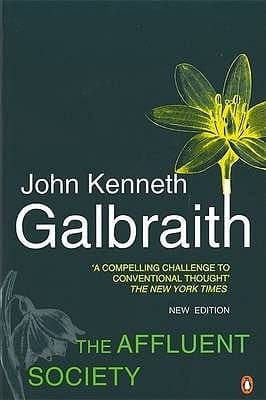
The Affluent Society cover
Archivist's Choice

The Affluent Society

John Kenneth Galbraith (1958)

Genre

Business / Politics / History / Economics / Philosophy

Reading Time

300 min

Key Themes

See below

Track Your Reading

Sign in to track this book

Galbraith criticizes classical economics, showing how an affluent society still focuses on scarcity, creating artificial desires while neglecting public good for private spending.

Core Idea

Galbraith argues that traditional economic ideas, based on goods being scarce, are outdated for rich societies. He believes modern industrial nations have largely solved the production problem, leading to too much focus on private spending at the expense of public services. This imbalance, made worse by advertising (the 'dependence effect') which creates artificial desires, results in 'private wealth and public neglect.' He questions the constant push for more production and calls for new economic goals that prioritize social balance, public investment, and valuing security and leisure over just material output.
Reading time
300 min
Difficulty
Medium
✓ Read this if...
You are interested in a foundational critique of post-war capitalism, the origins of modern economic thought on public goods, or the historical argument for greater public investment.
✗ Skip this if...
You are looking for a practical guide to personal finance, a defense of free-market fundamentalism, or a modern analysis of globalized economics.

Core idea

The central argument and framework that powers the entire book.

Galbraith argues that traditional economic ideas, based on goods being scarce, are outdated for rich societies. He believes modern industrial nations have largely solved the production problem, leading to too much focus on private spending at the expense of public services. This imbalance, made worse by advertising (the 'dependence effect') which creates artificial desires, results in 'private wealth and public neglect.' He questions the constant push for more production and calls for new economic goals that prioritize social balance, public investment, and valuing security and leisure over just material output.

At a glance

Reading time

300 min

Difficulty

Medium

Read this if...

You are interested in a foundational critique of post-war capitalism, the origins of modern economic thought on public goods, or the historical argument for greater public investment.

Skip this if...

You are looking for a practical guide to personal finance, a defense of free-market fundamentalism, or a modern analysis of globalized economics.

Key Takeaways

1

The Conventional Wisdom's Flaw

Outdated economic beliefs hinder progress in an age of affluence.

Quote

The enemy of the conventional wisdom is not ideas but the march of events.

Galbraith introduces 'conventional wisdom'—a set of widely accepted and comfortable ideas that form the basis of public discussion and policy. He argues that this wisdom, especially in economics, is mostly a leftover from an earlier, poorer time when scarcity was the main concern. In a rich society, these established truths become not just unhelpful but harmful. They stop us from seeing and solving new problems. The comfort of old ideas keeps us from pursuing effective solutions for today's challenges. This attachment to old ways mean...

Supporting evidence

Galbraith points to the persistent focus on increasing production and curbing inflation as primary economic goals, even when the society has achieved unprecedented levels of output and the threat of depression (born of underconsumption) has largely receded. The 'conventional wisdom' still frames these as paramount, ignoring new issues like public squalor amidst private wealth.

Apply this

Challenge deeply held assumptions in your field or industry. Regularly question the 'way things have always been done' to identify if those methods are still serving current realities or are merely relics of past conditions. Embrace new data and trends, even if they contradict comfortable narratives.
conventional-wisdomeconomic-paradigm-shiftintellectual-inertia
2

Private Affluence, Public Squalor

An imbalance in resource allocation prioritizes private goods over essential public services.

Quote

The line which divides our public from our private life has been a matter of increasing concern for the future of our society.

One of Galbraith's strongest criticisms is the sharp difference between the wealth of the private sector and the neglect of the public sector in rich societies. While individuals enjoy many consumer goods—cars with more chrome, many household items—public services like education, infrastructure, and city planning suffer from a lack of funds. This imbalance is not by chance; it results from common belief that private production is the only measure of economic health and that public spending is a burden. This leads to a society where pe...

Supporting evidence

Galbraith vividly contrasts the aggressive marketing and production of private automobiles with the deteriorating quality of public roads, parks, and schools. He notes the political ease of supporting tax cuts for private enterprise versus the political difficulty of securing funding for essential public services.

Apply this

Advocate for balanced investment across sectors. As a citizen, support policies that allocate sufficient resources to public goods like education, healthcare, and infrastructure. As a business leader, consider the societal impact of your industry's externalities and support public-private partnerships that address shared community needs.

public-goodsmarket-failuresocial-capitalinfrastructure-deficit
3

The Dependence Effect

Advertising creates artificial desires, making consumption less about need and more about manipulation.

Quote

As production becomes more complex, the needs to which it ministers are less directly the result of the individual's own desires and more of those which have been created for him.

Galbraith introduces the 'dependence effect,' arguing that in a rich society, making goods often creates the demand for them. Through clever advertising and sales, desires are made rather than being natural. This challenges the classical economic idea that wants are decided independently and production simply meets them. If wants are created by production itself, then the need to increase production to meet these 'needs' becomes a circular argument. This manipulation of desire means much of what we consume is not driven by real need, ...

Supporting evidence

Galbraith highlights the massive advertising industry, whose sole purpose is to persuade consumers that they 'need' products they previously didn't even know existed. He contrasts this with genuine, organic needs like food or shelter in less affluent societies.

Apply this

Cultivate critical consumer habits. Before purchasing, ask if the desire is intrinsic or if it has been externally influenced. Support businesses that focus on genuine utility and sustainability rather than engineered obsolescence and constant novelty. Question the messaging of advertising and its impact on your perception of needs.

consumerismartificial-demandadvertising-impactmanufactured-wants
4

The Myth of Production Urgency

The relentless pursuit of increased output loses its moral imperative in an age of abundance.

Quote

The notion that the production of goods and services is the only source of well-being is a dangerous illusion.

For classical economics, increasing production was a moral duty, directly linked to reducing poverty and improving human well-being. Galbraith argues that in a rich society, this urgency is mostly a myth. When basic needs are met and much production serves artificially created wants, the societal benefits of ever-increasing output drop significantly. The constant focus on production leads to using up resources too quickly, harming the environment, and making society focus on material goods instead of other forms of well-being. The 'pr...

Supporting evidence

Galbraith challenges the idea that a larger GDP automatically translates into greater societal well-being, especially when much of that GDP is driven by industries creating and satisfying non-essential, advertised wants. He suggests that beyond a certain point, more production yields diminishing returns in terms of genuine human flourishing.

Apply this

Re-evaluate personal and societal priorities beyond mere economic growth. Advocate for metrics of progress that include environmental health, social equity, and quality of life, not just GDP. Consider how your work contributes to genuine needs versus manufactured desires.

post-scarcity-economybeyond-gdpsustainable-developmentquality-of-life
5

The Problem of Social Imbalance

Wealth accumulation in the private sector does not automatically trickle down to public needs.

Quote

The more goods we have, the more we have to worry about disposing of them.

Galbraith points out a basic social imbalance: while the private sector is good at making and selling consumer goods, it cannot adequately provide for collective needs. The things that drive private production—profit, market competition—do not work well for public services like education, healthcare, infrastructure, or environmental protection. Traditional thinking, however, often assumes that a strong private sector will somehow create the resources or solutions for public problems, or that public spending is always wasteful. This le...

Supporting evidence

Galbraith points out that the affluence created by private industry often creates new public problems (e.g., pollution from factories, traffic congestion from cars) that the private sector is ill-equipped or unwilling to address, thus necessitating public intervention which is then criticized as 'wasteful'.

Apply this

Recognize the distinct roles of the private and public sectors. Support policies that empower government to effectively address collective needs where market mechanisms fail. As a citizen, be willing to contribute to public goods through taxation, understanding its vital role in societal well-being.

collective-action-problempublic-sector-roleeconomic-inequalityresource-allocation
6

Inflation as the Scapegoat

Inflation is often a convenient distraction from deeper structural economic issues.

Quote

Inflation has become an almost theological problem, a subject of deep and solemn incantation.

Galbraith criticizes the too strong focus on inflation as the main economic problem, arguing that it often serves as an easy excuse, distracting from deeper issues in a rich society. While inflation can be a problem, the obsession with stopping it, often by causing unemployment, ignores that a truly rich society should be able to manage stable prices without giving up other important social goals. He suggests that the fear of inflation is deeply rooted in common beliefs, comes from times of real economic instability, and is often used...

Supporting evidence

Galbraith discusses how economists and policymakers often react to even mild inflation with alarm, advocating for austerity measures that cut public spending or raise interest rates, potentially increasing unemployment, rather than addressing the root causes of imbalance.

Apply this

Approach economic debates with skepticism, especially when a single issue like inflation is presented as the paramount concern. Seek to understand the underlying structural issues and the potential trade-offs of proposed solutions, rather than accepting simplistic narratives. Advocate for balanced economic policies that consider multiple objectives, not just price stability.

economic-dogmamonetary-policyfull-employmentpolitical-economy
7

The Role of Education

Investment in human capital is crucial for societal progress, yet often neglected.

Quote

The ultimate source of economic growth is the human mind.

Galbraith strongly supports public investment in education, seeing it as a key part of societal progress and a solution to the problems of wealth. He argues that in a high-tech and complex economy, human capital—skilled, educated people—becomes the most valuable resource. Neglecting education, especially public education, is a self-defeating plan that increases inequality and slows innovation. While private industry may benefit from skilled workers, it cannot, and should not, be solely responsible for creating them. A well-educated po...

Supporting evidence

Galbraith highlights the paradox of a society rich in consumer goods but often stingy with its support for public schools, leading to underpaid teachers, outdated facilities, and a less competitive future workforce.

Apply this

Prioritize and advocate for strong public education systems at all levels. As an individual, continuously pursue learning and skill development. As a leader, invest in employee training and development, recognizing human capital as a core asset.

human-capitalpublic-educationinnovation-economysocial-mobility
8

Security and Leisure Over Production

An affluent society can afford to prioritize stability and quality of life.

Quote

The greatest source of social unrest is not poverty but inequality.

Galbraith suggests that once basic material needs are met, a rich society should change its priorities from maximizing production to increasing security and leisure. The constant pressure to produce and consume leads to anxious, overworked people, sacrificing quality of life for an endless stream of often unnecessary goods. Instead, resources should go towards providing more economic security (e.g., through social safety nets, unemployment insurance) and expanding chances for leisure, thinking, and personal growth. This change would s...

Supporting evidence

Galbraith observes that the fear of unemployment, even in a wealthy society, drives a relentless work ethic and consumption pattern, even when much of the work contributes to unnecessary production. He argues that this fear could be mitigated by robust social safety nets, allowing for greater personal freedom and less anxiety.

Apply this

Advocate for policies that prioritize social safety nets, healthcare, and work-life balance. As an individual, consciously prioritize leisure, personal growth, and community engagement over endless work and consumption. Re-evaluate your definition of 'success' beyond material accumulation.

leisure-economysocial-safety-network-life-balancepost-materialism
9

The Need for a New Economic Paradigm

Outdated economic theories are insufficient for addressing the challenges of abundance.

Quote

The ultimate problem is not how to make more things, but how to make the things we have better.

Galbraith's main message is the urgent need for a new economic system, one made for the realities of wealth rather than scarcity. The old economic theories, developed in a world of widespread poverty and limited production, are simply not equipped to analyze and solve the problems of a society where abundance is normal. Continuing to use these outdated frameworks leads to policy mistakes, wrong use of resources, and a failure to address important issues like social imbalance, environmental harm, and created wants. A new system must re...

Supporting evidence

Galbraith repeatedly shows how the conventional wisdom, rooted in classical economics, fails to explain or offer solutions for phenomena like the dependence effect or public squalor amidst private wealth. He argues these are not failures of the system, but failures of the analytical framework.

Apply this

Be open to challenging foundational theories in your field when they no longer align with current realities. Seek interdisciplinary approaches to complex problems. Support economic thinkers and policymakers who advocate for innovative solutions rather than simply reinforcing existing dogmas.

economic-rethinkingparadigm-shiftinstitutional-economicsholistic-economics

Critical analysis

Notable Quotes

To have failed to solve the problem of producing a sufficiency of goods would have been to have failed, in a material sense, to have made good the promise of American life.

Discussing the historical imperative of production.

The final consequence of the productive preoccupation is the great modern industry. It is a world in which the production of goods is not the end but the means.

Examining the shift in industrial purpose.

The greatest need in the affluent society is not for more and better products but for a more discriminating use of what we have.

Arguing for a change in societal priorities.

The problem of poverty is not so much a problem of insufficient production as it is a problem of maldistribution.

Addressing the root cause of poverty in an affluent society.

The accepted ideas of economics, like the accepted ideas of politics and much else, are the ideas which are convenient to the user.

Critiquing the self-serving nature of economic thought.

The more goods people have, the more they are persuaded that they need more.

Describing the cycle of consumption and advertising.

The case for social balance rests on the fact that when private production is increased, there is a strong tendency for public services to lag.

Introducing the concept of 'social balance'.

The central problem of the modern economy is no longer how to produce enough, but how to consume enough.

Highlighting the shift from scarcity to abundance.

Affluence has brought a new kind of poverty, which is the poverty of public services.

Elaborating on the imbalance between private wealth and public provision.

Inflation is a device for transferring wealth from the politically weak to the politically strong.

Analyzing the political implications of inflation.

The individual's wants are not original with himself. They are a product of the society in which he lives.

Challenging the notion of autonomous consumer demand.

The modern economy is a vast and intricate machine for converting the individual's wants into the state's needs.

Describing the relationship between individual desire and state policy.

In the affluent society, the production of goods is not the goal but the means to the goal of employment.

Reversing the traditional economic hierarchy of production and employment.

The line between what is private and what is public, what is individual and what is social, is one of the most difficult, and perhaps the most important, to draw in our time.

Reflecting on the blurred boundaries in modern society.

Quiz

Test Your Knowledge

Ready to see how well you understood this book? Take our interactive quiz with 10 questions.

10
Questions
~5
Minutes
?
Best Score

Key Questions (FAQ)

Galbraith argues that classical economic theories, developed during times of scarcity, are ill-suited for modern affluent societies. He critiques the obsession with production and private consumption while public services are neglected, highlighting the artificial creation of needs through advertising.

About the author