BookBrief
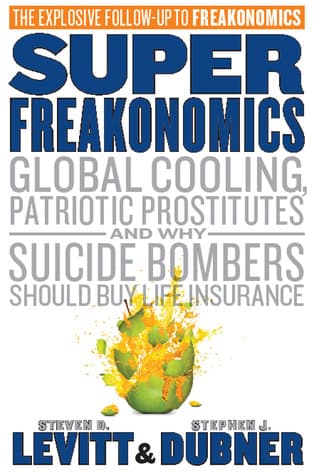
SuperFreakonomics: Global Cooling, Patriotic Prostitutes And Why Suicide Bombers Should Buy Life Insurance cover
Archivist's Choice

SuperFreakonomics: Global Cooling, Patriotic Prostitutes And Why Suicide Bombers Should Buy Life Insurance

Steven D. Levitt (2009)

Genre

Business / Politics / Economics / Finance / Science

Reading Time

12 Minutes

Key Themes

See below

Track Your Reading

Sign in to track this book

Levitt and Dubner explore the hidden incentives behind everything from prostitution and terrorism to global warming and chemotherapy, revealing the surprising logic that governs our world.

Core Idea

SuperFreakonomics continues the original's exploration of economics through unconventional lenses, applying economic principles and statistical analysis to a wide array of seemingly unrelated topics. The book argues that by looking beyond conventional wisdom and applying rigorous data analysis, one can uncover surprising incentives, hidden causes, and counterintuitive solutions to complex problems, ranging from the efficacy of different anti-terrorism tactics to the economics of prostitution and the challenges of global warming.
Difficulty
Easy

Core idea

The central argument and framework that powers the entire book.

SuperFreakonomics continues the original's exploration of economics through unconventional lenses, applying economic principles and statistical analysis to a wide array of seemingly unrelated topics. The book argues that by looking beyond conventional wisdom and applying rigorous data analysis, one can uncover surprising incentives, hidden causes, and counterintuitive solutions to complex problems, ranging from the efficacy of different anti-terrorism tactics to the economics of prostitution and the challenges of global warming.

At a glance

Difficulty

Easy

Key Takeaways

1

Incentives Drive Behavior, Even in Unexpected Places

Understanding the true incentives often reveals the underlying logic of seemingly irrational actions.

Quote

The world, we've learned, is not a particularly logical or fair place. But it is a fascinating one, and the more you look at it, the more you realize that human behavior is driven by a surprising array of incentives.

This book's main idea, expanded from the original Freakonomics, is that people—from prostitutes to terrorists—respond predictably to incentives. This holds true even when those incentives are not obvious or socially acceptable. The book urges readers to look past simple explanations and consider the economic and psychological forces at play. For example, it shows how the price of oral sex dropped due to increased supply and fewer barriers to entry, illustrating a basic economic principle in an unusual context. This view helps us under...

Supporting evidence

Analysis of the market for sex work, demonstrating supply and demand dynamics, and the impact of reduced transaction costs on pricing.

Apply this

When trying to understand or change behavior, always identify the true incentives—both monetary and non-monetary—that are influencing individuals, rather than assuming moral or altruistic motives.

2

The Counterintuitive Dangers of Everyday Life

Many perceived risks are exaggerated, while overlooked dangers pose a greater threat.

Quote

What's more dangerous, driving drunk or walking drunk? The answer might surprise you, and it reveals a lot about how we perceive risk versus actual danger.

The book enjoys challenging common ideas about risk. It asks whether walking drunk is more dangerous than driving drunk, suggesting that walking drunk can be more deadly because pedestrians are vulnerable and lack protection compared to a car's safety features (even with an impaired driver). This shows the limits of judging risk by instinct and the importance of using data. It also mentions how some safety efforts, like car seats for older children, are less effective than addressing other risks, making readers rethink how they spend ...

Supporting evidence

Statistical analysis comparing accident rates and fatalities for drunk drivers versus drunk pedestrians.

Apply this

Rely on empirical data and statistical evidence rather than gut feelings or media sensationalism when evaluating risks and making safety decisions.

3

Expert Bias and the Power of Information Asymmetry

Experts often act in their own self-interest, and information asymmetry empowers them.

Quote

Doctors, like all experts, have an incentive to maximize their own utility. This often means prescribing procedures that benefit them more than the patient.

This argument has limits, but it strongly shows how experts, like doctors and real estate agents, use their specialized knowledge. The book points out that doctors often do not wash their hands well, despite knowing the risks, and that chemotherapy is often prescribed even when it is not very effective. This suggests that financial incentives (like higher payments for procedures) can override the best patient care. Similarly, a real estate agent wants to sell quickly, not necessarily for the highest price, creating a conflict of inter...

Supporting evidence

Studies on doctor hand-washing compliance and the prevalence of chemotherapy prescriptions for certain cancers with low success rates. Comparison of sales prices for agent-owned versus client-owned homes.

Apply this

When dealing with experts, always be skeptical, ask probing questions, and seek second opinions. Understand their incentives and how they might diverge from your own.

4

Global Warming's Unexpected Solutions

Unconventional, high-leverage solutions to climate change often get overlooked.

Quote

What if the solution to global warming isn't to reduce carbon emissions, but to reflect more sunlight back into space? It sounds radical, but the numbers are compelling.

The book discusses geoengineering, specifically 'stratospheric aerosol injection'—pumping sulfur dioxide into the upper atmosphere to reflect sunlight, like volcanic eruptions. This idea is controversial, but the book presents it as a potentially much cheaper and more effective solution than current carbon reduction strategies, which face huge political and economic problems. While acknowledging the risks and ethical issues, the authors stress that the economic incentive for such a solution is powerful, costing billions rather than tr...

Supporting evidence

Economic analysis comparing the cost of geoengineering solutions (e.g., pumping sulfur dioxide into the atmosphere) with the projected costs of carbon emission reductions.

Apply this

When tackling complex problems like climate change, consider a broader range of solutions, including those that seem unconventional or even radical, and evaluate them based on cost-effectiveness and potential impact.

5

The Economics of Altruism and Selfishness

Human behavior is a complex interplay of self-interest and occasional altruism, influenced by context.

Quote

Are people hard-wired for altruism or selfishness? The answer is probably both, and the context often dictates which one emerges.

This chapter explores the tension between self-interest and helping others. It discusses experiments like the Ultimatum Game, where people often reject unfair offers even if it means getting nothing, suggesting they prefer fairness over simply getting the most for themselves. However, it also shows how easily helping behavior can be stopped or manipulated by incentives. The book argues that while people are not purely selfish, their desire to help is often limited and can be overcome by strong economic or social pressures. This balanc...

Supporting evidence

Discussion of behavioral economics experiments like the Ultimatum Game and Dictator Game, showing how fairness and social norms influence economic decisions.

Apply this

When designing systems or policies, acknowledge that human motivation is not purely selfish. Incorporate elements that appeal to fairness and social cooperation, but also understand the limits of altruism.

6

Terrorism Through an Economic Lens

Terrorist organizations, like any other entity, respond to economic principles and incentives.

Quote

A suicide bomber should buy life insurance. It sounds absurd, but from a purely economic standpoint, it makes perfect sense if their goal is to provide for their family.

This is one of the book's most striking arguments. Levitt and Dubner analyze terrorism not through political or religious views, but as an economic issue. They suggest that potential suicide bombers, if rational and motivated to provide for their families, would ideally buy life insurance. This thought experiment shows that even in extreme acts, underlying economic incentives can be present. The book also examines the surprisingly low economic value of a terrorist's life to the organization, suggesting that terrorists are often seen a...

Supporting evidence

Hypothetical scenario of a suicide bomber buying life insurance, used to illustrate the economic motivations of individuals within terrorist organizations and the organizational cost-benefit analysis of 'human capital.'

Apply this

When combating complex social problems like terrorism, consider the economic incentives and structures of the groups involved. Look for ways to disrupt their financial models or alter the economic calculus of their participants.

7

The Hidden Costs of 'Free' Actions

Even seemingly altruistic or cost-free actions often have hidden economic or social costs.

Quote

If a pimp and a Realtor both connect buyers and sellers, which one adds more value? The answer isn't as straightforward as you might think.

The comparison between a pimp and a Realtor is a classic example of the book's direct style. Both act as go-betweens, connecting 'buyers' and 'sellers' and taking a fee. The book argues that while one profession is accepted by society and the other is illegal, their economic function can be very similar. This idea challenges moral judgments and focuses attention on the basic economic role played by different people in various markets. It highlights that even in illegal markets, basic economic rules apply, and the 'value added' by inte...

Supporting evidence

Comparative analysis of the economic functions and value-added roles of pimps and Realtors, focusing on their intermediary services in different markets.

Apply this

Look beyond social stigma or moral judgments to understand the economic function and value proposition of different roles in society, even those considered unconventional or illicit.

8

Data-Driven Problem Solving Trumps Intuition

Complex problems yield better solutions when approached with rigorous data analysis, not just gut feelings.

Quote

The greatest enemy of knowledge is not ignorance, it is the illusion of knowledge.

This is the book's strongest idea, supporting the core method of Freakonomics. Throughout the book, the authors show how using statistical analysis and economic principles on difficult or emotional issues can reveal surprising truths and better solutions. Whether it is the effectiveness of chemotherapy, the causes of crime, or the best way to catch a terrorist, the book consistently supports a data-first approach. It encourages readers to question assumptions, gather evidence, and follow where the data leads, even if it goes against p...

Supporting evidence

Numerous examples throughout the book where statistical analysis challenges conventional wisdom, such as the effectiveness of car seats, the causes of crime, or the impact of TV.

Apply this

Adopt a skeptical, data-driven mindset when evaluating problems and solutions. Prioritize empirical evidence over anecdotal stories, expert opinions, or personal biases.

9

Unintended Consequences Are Everywhere

Interventions often produce unforeseen and sometimes detrimental ripple effects.

Quote

Every system, no matter how well-intentioned, has its loopholes and its unintended consequences.

The idea of unintended consequences appears throughout the book. It shows how policies, rules, or even individual actions can lead to results very different from what was planned. For example, efforts to reduce traffic deaths might lead to more pedestrian deaths if drivers feel safer and take more risks, or if the focus shifts too much from one type of accident to another. This serves as a warning for policymakers and anyone trying to change society: consider all possible results, both good and bad, before acting. It shows how complex...

Supporting evidence

Examples like the potential for increased pedestrian fatalities due to drivers feeling safer in improved vehicles, or the complex effects of various crime-fighting strategies.

Apply this

Before implementing any change or policy, conduct a thorough analysis of potential unintended consequences, considering how various stakeholders might adapt their behavior in response.

Critical analysis

Notable Quotes

Quiz

Test Your Knowledge

Ready to see how well you understood this book? Take our interactive quiz with 10 questions.

10
Questions
~5
Minutes
?
Best Score

Key Questions (FAQ)

SuperFreakonomics explores unexpected questions about economics, politics, and society, using data and incentives to reveal the hidden side of everyday life. It delves into topics ranging from global cooling and prostitution to terrorism and the effectiveness of medical treatments.

About the author