BookBrief
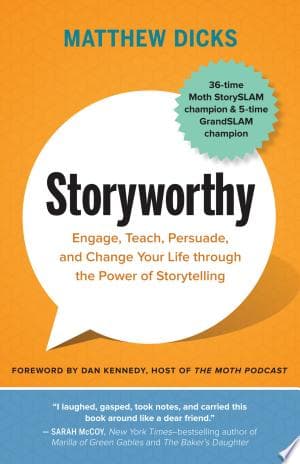
Storyworthy cover
Archivist's Choice

Storyworthy

Matthew Dicks (2018)

Genre

General

Reading Time

240 min

Key Themes

See below

Track Your Reading

Sign in to track this book

Learn to find the stories in your everyday life and turn them into compelling narratives with advice from five-time Moth GrandSLAM winner Matthew Dicks.

Core Idea

Matthew Dicks's "Storyworthy" explains that good personal stories come from everyday life, built through careful observation and specific techniques. Anyone can become a good storyteller by regularly finding 'five-second moments' of emotional impact, understanding the basic 'but and therefore' narrative flow, and using practical rules for building, sharing, and delivering stories. This process helps people connect with others and also better understand their own experiences.
Reading time
240 min
Difficulty
Medium
✓ Read this if...
You want to learn practical, actionable techniques to find, craft, and tell engaging personal stories, whether for public speaking, connecting with others, or simply reflecting on your life. Ideal for aspiring storytellers, writers, or anyone looking to improve their communication skills.
✗ Skip this if...
You are looking for a deep dive into literary theory, fiction writing techniques, or simply want to consume stories rather than learn to create them. If you prefer abstract concepts over concrete rules and exercises, this might feel too prescriptive.

Core idea

The central argument and framework that powers the entire book.

Matthew Dicks's "Storyworthy" explains that good personal stories come from everyday life, built through careful observation and specific techniques. Anyone can become a good storyteller by regularly finding 'five-second moments' of emotional impact, understanding the basic 'but and therefore' narrative flow, and using practical rules for building, sharing, and delivering stories. This process helps people connect with others and also better understand their own experiences.

At a glance

Reading time

240 min

Difficulty

Medium

Read this if...

You want to learn practical, actionable techniques to find, craft, and tell engaging personal stories, whether for public speaking, connecting with others, or simply reflecting on your life. Ideal for aspiring storytellers, writers, or anyone looking to improve their communication skills.

Skip this if...

You are looking for a deep dive into literary theory, fiction writing techniques, or simply want to consume stories rather than learn to create them. If you prefer abstract concepts over concrete rules and exercises, this might feel too prescriptive.

Key Takeaways

1

The 'Homework for Life' Habit

Daily reflection to uncover story-worthy moments

Quote

Every day something happens that is story-worthy. You just have to find it.

Dicks says the biggest obstacle to storytelling is not a lack of talent, but a lack of material. He introduces 'Homework for Life,' a daily habit of finding one story-worthy moment from your day. This is not about big adventures, but small, specific, emotionally impactful moments. By regularly looking for these 'five-second movies,' you train your mind to see story potential in everyday life, building a large supply of personal anecdotes. This habit turns ordinary experiences into useful storytelling material, countering the idea that...

Supporting evidence

Dicks shares his personal experience of consistently identifying a story-worthy moment each day, which allowed him to build a massive database of potential stories for his Moth performances and books.

Apply this

Each evening, take five minutes to identify the most story-worthy moment of your day. It could be a funny interaction, a moment of unexpected beauty, a small frustration, or a sudden realization. Briefly jot it down in a notebook or on your phone.

homework-for-lifestory-materialdaily-reflection
2

The Five-Second Moment

Stories are built around pivotal, brief shifts

Quote

A story is not about an event; a story is about a five-second moment in that event when you realize something has changed.

A good story is not just a timeline of events. Dicks states that a true story centers on a 'five-second moment' – a specific, brief instant where you experience a significant internal change, realization, or shift in perspective. This moment is the story's heart, the point of transformation. Everything before it builds tension and context, and everything after explains its effect. Without this key five-second shift, a narrative is just an anecdote or a report. This idea simplifies storytelling, helping you find the emotional core and ...

Supporting evidence

Dicks frequently uses examples from his own Moth stories, breaking them down to pinpoint the exact five-second moment where his perspective or understanding shifted, transforming a series of events into a meaningful narrative.

Apply this

When crafting a story, identify the core emotional change or realization you experienced. Build your narrative around this 'five-second moment,' leading up to it with setup and following it with a brief resolution or reflection.

story-coreturning-pointinternal-change
3

The 'But' and 'Therefore' Structure

Crafting narrative flow and meaning

Quote

The most powerful stories follow a 'but' and 'therefore' structure, where each event leads logically and emotionally to the next.

Dicks highlights the 'but' and 'therefore' idea as a core storytelling structure. Events in a story should not just happen; they should be connected by cause. 'This happened, BUT then something unexpected occurred,' or 'This happened, THEREFORE this was the consequence.' This structure makes sure your story moves forward logically and emotionally, keeping the audience engaged. It prevents rambling and makes the storyteller connect plot points in a meaningful way, showing the meaning and impact of each event. This method is important f...

Supporting evidence

Dicks illustrates this with examples of poorly structured stories that lack 'buts' and 'therefores,' contrasted with well-structured narratives where each sentence or event propels the story forward meaningfully.

Apply this

After outlining your story's main points, review them to ensure each event is connected by a 'but' (a twist or complication) or a 'therefore' (a direct consequence). If you find a point that doesn't fit, either remove it or reframe it to create a stronger causal link.

story-structurecausal-narrativeplot-progression
4

The Story's 'Theme' is for You, Not Them

Discovering personal meaning through storytelling

Quote

The theme of your story is the lesson you learned, the truth you discovered. It's for you to understand, not necessarily to preach to your audience.

Many storytellers feel they must clearly state a grand moral or theme. Dicks says the 'theme' is mainly for the storyteller. It is the deep personal realization or change that happened during the 'five-second moment.' By articulating this theme to yourself, you better understand the experience and its effect on your life. While the audience may guess a theme, your job is not to lecture, but to share an experience of personal change. This view frees storytellers from having to deliver a universal message, letting them focus on authenti...

Supporting evidence

Dicks recounts his struggle with trying to force a 'moral' into early stories and how letting go of that pressure allowed him to tell more genuine and impactful narratives.

Apply this

After identifying your 'five-second moment' and the change it brought, articulate to yourself the personal lesson or truth you gained. This internal clarity will subtly inform your telling, even if you never explicitly state it to your audience.

personal-truthstory-meaningself-discovery
5

The Importance of Specificity

Details bring stories to life and make them relatable

Quote

Specificity is the lifeblood of good storytelling. The more specific you are, the more universal your story becomes.

Vague language ruins a story. Dicks strongly advises extreme specificity in details, from the color of a shirt to the exact brand of a candy bar. These precise details ground the story in reality, letting the audience picture and immerse themselves in the narrative. Surprisingly, very specific details, even seemingly mundane ones, make a story more universally relatable because they bring up sensory experiences and emotions that go beyond individual situations. This focus on small details is not about overwhelming the audience, but ab...

Supporting evidence

Dicks often gives examples of how changing a generic 'car' to a 'beat-up, rust-spotted '78 Ford Pinto' immediately elevates the imagery and emotional resonance of a sentence.

Apply this

When writing or rehearsing, look for opportunities to replace general nouns and verbs with specific, descriptive ones. Instead of 'I was sad,' try 'A knot tightened in my stomach, and my eyes welled up.'

sensory-detailsvivid-languageaudience-immersion
6

Start in the Middle (of the Action)

Hooking the audience with immediate engagement

Quote

Don't start at the beginning; start in the middle of the action, close to the five-second moment, then fill in the necessary backstory.

A common mistake is to start a story with long explanations. Dicks suggests starting 'in the middle' of the action, near the story's most compelling or dramatic point. This immediately grabs the audience's attention, creating curiosity and a desire to know what led to this moment. Once hooked, you can then add necessary background and context. This technique avoids the slow start of traditional introductions, making sure your audience is invested from the first sentence. It is a dynamic approach that respects the listener’s time and d...

Supporting evidence

Dicks demonstrates this by showing how many of his successful Moth stories begin with a dramatic statement or action, rather than an introduction of characters or setting.

Apply this

Identify the most exciting or pivotal moment near the beginning of your story. Start there, then use concise flashbacks or brief explanations to provide background information as needed, rather than front-loading it.

in-media-resstory-hookaudience-engagement
7

The 'Crab Walk' for Emotional Vulnerability

Approaching sensitive topics indirectly to build connection

Quote

Sometimes the most vulnerable stories are best told by approaching them sideways, like a crab, rather than head-on.

Sharing very personal or painful stories can be hard. Dicks introduces the 'crab walk' technique: instead of directly addressing the sensitive topic, approach it indirectly, telling a seemingly unrelated story that eventually reveals the core emotional truth. This method allows the storyteller to build trust and connection with the audience before showing the full depth of their vulnerability. It is a strong way to manage emotional intensity, making the story easier to understand and more impactful for both the teller and the listener...

Supporting evidence

Dicks shares examples of how he has used the 'crab walk' to tell stories about trauma or profound sadness by initially focusing on a lighter, tangential event that eventually leads to the darker core.

Apply this

If you have a very sensitive story, consider telling an adjacent, less intense story that still hints at the emotional core. Build up to the direct revelation or let the audience infer the deeper meaning from your 'crab walk' narrative.

vulnerabilityemotional-pacingindirect-narrative
8

End with an Echo, Not a Sermon

Allowing the story's meaning to resonate naturally

Quote

The best endings don't tell the audience what to think; they simply echo the story's theme and leave them to draw their own conclusions.

Just as the theme is for the storyteller, the ending is for the audience to interpret. Dicks advises against clear moralizing or heavy-handed conclusions. Instead, aim for an ending that subtly reflects the story's theme or the 'five-second moment' of change. This allows the audience to think about what they have heard and draw their own meaningful conclusions, making the experience more personal and impactful. A strong ending often links back to the beginning, creating a sense of completeness without seeming too neat. It respects the...

Supporting evidence

Dicks contrasts effective, resonant story endings from his own work with less impactful ones that tried to force a specific message onto the listener.

Apply this

Review your story's ending. Does it state the obvious or preach? Try to revise it to subtly reference the core change or theme, allowing the audience to sit with the implications rather than being told what to think.

story-resolutionaudience-reflectionthematic-echo
9

Embrace the 'Sacred Cow' of Your Story

Knowing what cannot be cut, even if it feels mundane

Quote

Every story has a 'sacred cow' – a detail or moment that feels essential to you, even if it doesn't seem obviously critical to the plot.

When editing, storytellers often struggle with what to cut. Dicks introduces the idea of the 'sacred cow' – a detail, phrase, or brief moment that, for the storyteller, holds deep personal meaning, even if it does not directly move the plot forward. He argues that these 'sacred cows,' while seemingly extra, are often the very things that give the story authenticity and emotional depth, making it uniquely yours. While being brief is important, Dicks suggests that sometimes these small, personally vital details are worth keeping, as the...

Supporting evidence

Dicks shares examples of details he initially considered cutting but ultimately kept, realizing they were crucial for his own connection to the story, and often resonated with audiences more than he expected.

Apply this

When editing, identify any details you're hesitant to cut, even if they seem minor. Reflect on why they're important to *you*. If they contribute to the story's emotional truth or your personal connection to it, consider keeping them, even if slightly trimmed.

story-editingpersonal-authenticityemotional-truth
10

Storytelling as a Path to Self-Understanding

Narrating your life clarifies your experiences and identity

Quote

The act of telling your story is often the act of understanding your story.

Beyond entertaining an audience, Dicks stresses that storytelling is a strong tool for self-discovery and personal growth. By actively building a narrative from your experiences, you gain clarity, find patterns, and process emotions. The process of finding the 'five-second moment' and explaining its impact makes you reflect on key changes in your life. This thinking exercise helps make sense of your past, clarify your values, and even shape your future identity. It is a therapeutic and empowering practice that turns raw life experienc...

Supporting evidence

Dicks frequently references how the act of crafting and telling his own stories has helped him understand his past traumas, relationships, and personal evolution, often revealing insights he hadn't grasped before.

Apply this

Regularly practice the 'Homework for Life' and try to craft full stories from these moments, even if only for yourself. Pay attention to the insights and realizations that emerge during the narrative construction process.

self-discoverypersonal-growthnarrative-therapy

Critical analysis

Notable Quotes

A story is not just a sequence of events. A story is a sequence of events that you, the storyteller, have decided is interesting.

Defining what makes a story 'storyworthy' beyond just chronology.

Every human being has a thousand stories inside them. Every human being wants to tell them. Every human being wants to hear them.

Emphasizing the universal nature of storytelling and our innate desire for it.

My definition of a story: a true story about you, where something happens, and there are stakes.

A concise, practical definition for the kind of personal stories he advocates.

The secret to being a good storyteller is not telling a good story. It's remembering a good story.

Highlighting the importance of the 'Homework for Life' technique in finding material.

Homework for Life: At the end of every day, find one storyworthy moment from your day. Write it down. Just a sentence or two.

Introducing his core practice for daily story generation.

The greatest enemy of story is time. Not the lack of it, but the passage of it, which makes us forget.

Explaining why daily journaling (Homework for Life) is crucial to capture moments before they fade.

Begin your story as close to the moment of transformation as possible.

Advice on structuring stories to avoid unnecessary preamble and engage the audience quickly.

Don't tell us what you learned. Show us what you learned.

A classic storytelling principle applied to personal narrative, focusing on showing rather than telling.

The greatest stories are almost always about failure, embarrassment, or a moment of profound weakness.

Encouraging storytellers to embrace vulnerability and imperfect moments.

A story is not just what happened. It's about what happened to you, and how it changed you.

Emphasizing the internal transformation or realization as a key component of a good story.

The stakes in a story don't have to be life or death. They just have to matter to you.

Reassuring storytellers that everyday experiences can be storyworthy if they held personal significance.

Every successful story is a mystery. The audience wants to know what happens next.

Highlighting the element of suspense and curiosity that keeps an audience engaged.

You are the only person who can tell your story. And if you don't tell it, it may never be told.

A call to action for individuals to share their unique experiences and perspectives.

The goal of a story is not to deliver a message, but to create an experience.

Shifting the focus from didacticism to immersive engagement for the audience.

Quiz

Test Your Knowledge

Ready to see how well you understood this book? Take our interactive quiz with 10 questions.

10
Questions
~5
Minutes
?
Best Score

Key Questions (FAQ)

A 'storyworthy' moment is a five-second moment of change, realization, or minor epiphany in your life. It's not necessarily a dramatic event, but rather a small shift that holds meaning and can be expanded into a compelling narrative for an audience.

About the author