BookBrief
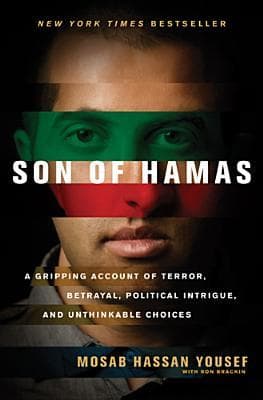
Son of Hamas cover
Archivist's Choice

Son of Hamas

Mosab Hassan Yousef (2010)

Genre

Politics / Biography / Memoir / History / Spirituality

Reading Time

6-8 hours

Key Themes

See below

Track Your Reading

Sign in to track this book

The eldest son of Hamas's founder tells his story, from radicalization to redemption, risking everything for peace and challenging the foundations of the Middle East conflict.

Core Idea

Mosab Hassan Yousef, son of Hamas founder Sheikh Hassan Yousef, describes his journey from the terrorist organization to becoming a top informant for the Israeli Shin Bet. The book details the psychological and moral difficulties of his dual life, his struggle with his father's legacy, the violent ideology he grew up with, and his conversion to Christianity. It argues that true peace requires moving past tribal loyalties and embracing love and forgiveness, even towards enemies, while exposing corruption and brutality within extremist groups.
Reading time
6-8 hours
Difficulty
Medium
✓ Read this if...
You are interested in a unique, first-person perspective on the Israeli-Palestinian conflict, the inner workings of Hamas, and the profound personal cost of choosing peace over ingrained hatred. This is for readers seeking stories of radical transformation and moral courage in the face of immense pressure.
✗ Skip this if...
You are looking for an academic analysis of Middle East politics or a balanced, objective history of the conflict. This is a deeply personal memoir with a clear spiritual and political viewpoint, not a neutral scholarly text.

Core idea

The central argument and framework that powers the entire book.

Mosab Hassan Yousef, son of Hamas founder Sheikh Hassan Yousef, describes his journey from the terrorist organization to becoming a top informant for the Israeli Shin Bet. The book details the psychological and moral difficulties of his dual life, his struggle with his father's legacy, the violent ideology he grew up with, and his conversion to Christianity. It argues that true peace requires moving past tribal loyalties and embracing love and forgiveness, even towards enemies, while exposing corruption and brutality within extremist groups.

At a glance

Reading time

6-8 hours

Difficulty

Medium

Read this if...

You are interested in a unique, first-person perspective on the Israeli-Palestinian conflict, the inner workings of Hamas, and the profound personal cost of choosing peace over ingrained hatred. This is for readers seeking stories of radical transformation and moral courage in the face of immense pressure.

Skip this if...

You are looking for an academic analysis of Middle East politics or a balanced, objective history of the conflict. This is a deeply personal memoir with a clear spiritual and political viewpoint, not a neutral scholarly text.

Key Takeaways

1

The Weight of Inheritance

Being the son of a Hamas founder meant a life dictated by an inescapable legacy.

Quote

Being the eldest son of Sheikh Hassan Yousef, I was expected to follow in his footsteps, to embrace the cause, and eventually, to lead.

Mosab's early life was not his own; his father, Sheikh Hassan Yousef, a respected co-founder of Hamas, planned it. From a young age, Mosab was involved in the organization's ideology, meetings, and political dealings, meant to inherit a dangerous leadership role. This upbringing gave him an unparalleled insider's view into Hamas's operations, internal workings, and influence over Palestinian society. The pressure to conform, to accept the narrative of resistance and martyrdom, was immense, shaping his identity before he could form his...

Supporting evidence

Mosab recounts attending Hamas meetings with his father from a young age, witnessing the inner workings and strategic discussions of the organization firsthand.

Apply this

Reflect on inherited beliefs and expectations within your own life. Are there paths you've followed out of obligation rather than genuine conviction? How can one respectfully navigate inherited legacies while forging an individual identity?


inherited-legacypolitical-indoctrinationfamilial-duty
2

The Brutality Within

Mosab witnessed Hamas's internal violence, shattering any idealized image of the resistance.

Quote

I saw firsthand the brutal reality of Hamas, not just against Israelis, but against its own people, its own members. This was not the freedom movement I was told to believe in.

Mosab's position within Hamas gave him a horrifying insight into its true nature, beyond its public image as a liberation movement. He saw not only the planning of attacks against Israel but also the systematic torture, imprisonment, and execution of Palestinians suspected of collaboration or dissent. This internal brutality, often more savage and random than the external conflict, eroded his belief in Hamas's stated goals. He realized that the organization, while claiming to fight for its people, often victimized them, using fear and...

Supporting evidence

Mosab details specific instances of Hamas torturing and executing alleged collaborators within Palestinian prisons, including methods he found abhorrent.

Apply this

Question narratives, especially those from groups claiming absolute moral authority. Seek out diverse perspectives and evidence, rather than accepting a single, dominant story, to understand the full complexity of any conflict or organization.

internal-conflictorganizational-hypocrisydisillusionment
3

From Prisoner to Informant

Imprisonment by Israel became an unlikely turning point, leading to a shocking alliance.

Quote

My time in Israeli prisons, rather than hardening my resolve against them, exposed me to a different kind of reality. It was there that the Shin Bet made an offer I couldn't refuse, an offer that felt like a path to saving lives.

Mosab's repeated arrests and imprisonments by Israeli security forces, specifically the Shin Bet, were ironic. Instead of strengthening his loyalty to Hamas, these experiences became a turning point. During interrogations, he learned of the intelligence agency's deep understanding of Hamas's operations, including its internal corruption and abuses. The Shin Bet's offer to work as an informant, initially a way to survive, became a moral necessity for Mosab. He saw it as a chance to prevent further bloodshed, both Israeli and Palestinia...

Supporting evidence

Mosab recounts detailed conversations and agreements with his Shin Bet handler, Captain Loai, outlining the terms and motivations behind his cooperation.

Apply this

Consider how adversity can sometimes open unexpected doors or force radical re-evaluations of one's loyalties and purpose. Is there a 'deal with the devil' in your life that could, paradoxically, lead to a greater good?

covert-operationsmoral-dilemmastrategic-defection
4

The 'Green Prince' Paradox

Mosab's code name reflected his unique and dangerous position as a high-value informant.

Quote

They called me the 'Green Prince' – 'Green' for Hamas, 'Prince' because of my father. It was a fitting, yet terrifying, description of my dual life.

Mosab's code name, 'The Green Prince,' perfectly described the paradox of his life. 'Green' represented his deep roots within Hamas, the color of the organization. 'Prince' signified his lineage as the son of Sheikh Hassan Yousef, a revered figure. This name highlighted his extraordinary access and credibility within Hamas while he worked as a top informant for Israel's Shin Bet. His effectiveness came from this dual identity, allowing him to gather critical intelligence from the highest levels of Hamas leadership. The constant tensio...

Supporting evidence

Mosab frequently refers to his code name and explains its meaning, emphasizing the constant danger and psychological burden of maintaining his cover.

Apply this

Reflect on how labels and identities, even those imposed by others, can shape perception and create complex personal realities. How might one navigate a 'double life' in a less extreme context, balancing competing roles or loyalties?

dual-identitycode-namecovert-intelligence
5

A New 'Father'

The teachings of Jesus offered a radical alternative to the cycle of violence and hatred.

Quote

I was looking for a God who loved, not one who demanded endless sacrifice and hatred. In the teachings of Jesus, I found that love, a radically different path to peace.

Beyond the political drama and espionage, a spiritual awakening is central to Mosab's change. Disillusioned with the violence and hypocrisy he saw in the name of Islam and Palestinian liberation, he began to search for a different spiritual truth. Encounters with a British missionary and secret studies of the Bible exposed him to Jesus's teachings, particularly the command to 'love your enemies.' This message contrasted sharply with the vengeful ideology he had been raised with, offering a path of forgiveness, reconciliation, and unco...

Supporting evidence

Mosab describes receiving a Bible from a British missionary, his secret reading of it, and the profound impact of passages like 'love your enemies' on his worldview.

Apply this

Explore spiritual or philosophical traditions that emphasize compassion and reconciliation, especially in contrast to those that promote division or violence. How might internalizing 'love your enemies' change your approach to conflict?

spiritual-conversionchristianitypeace-through-love
6

The Price of Truth

Embracing his new faith meant an agonizing separation from family and homeland.

Quote

Making my faith public meant losing everything I had ever known – my family, my land, my identity. But the truth was a greater prize than any of those.

Mosab's decision to publicly embrace Christianity was the ultimate act of defiance against his family, culture, and expectations. In Palestinian society, converting from Islam, especially for the son of a prominent religious leader, is an unforgivable sin, often punishable by death. This choice led to his complete rejection by his family, who disowned him, and forced him into exile, cutting all ties to his homeland. The emotional and psychological cost of this separation is immense, showing the personal sacrifices required to follow a...

Supporting evidence

Mosab details the public announcement of his conversion, the subsequent fatwas issued against him, and the complete breakdown of his relationship with his family, particularly his father.

Apply this

Consider the personal cost of standing by your deepest convictions, especially when they challenge societal or familial norms. What are you willing to lose for what you believe is true?

apostasyfamilial-disownmentexile
7

Love Your Enemies

The Christian mandate is presented as the only viable path to peace in the Middle East.

Quote

The cycle of violence will never end as long as we continue to hate our enemies. Only by loving them, by seeing their humanity, can true peace begin.

Mosab's conclusion, from his unique perspective as both a Hamas insider and an Israeli informant, is that political and military solutions to the Israeli-Palestinian conflict are flawed and lead to more bloodshed. He argues that the only true path to lasting peace is the spiritual transformation of individuals, guided by the principle of 'love your enemies,' as taught by Jesus. This is not a naive call for surrender, but a reorientation away from vengeance and towards empathy, forgiveness, and a recognition of shared humanity. He beli...

Supporting evidence

Mosab repeatedly emphasizes the futility of military solutions and political negotiations, arguing that a change of heart, inspired by spiritual love, is the only way forward.

Apply this

Challenge yourself to identify an 'enemy' or someone with whom you have profound disagreement. How might applying the principle of 'love your enemies'—not necessarily condoning actions, but recognizing shared humanity—alter your approach to that relationship or conflict?

reconciliationnon-violenceinterfaith-dialogue
8

The Burden of Secrecy

Maintaining his cover as an informant took an immense psychological toll.

Quote

Every handshake, every conversation, every moment was a performance. The fear of exposure was a constant companion, gnawing at my soul.

The psychological burden of Mosab's double life as 'The Green Prince' was almost unbearable. For years, he lived in constant paranoia, knowing that a single mistake, a careless word, or an act of betrayal could lead to his torture and death by Hamas. He had to carefully maintain his cover, pretending loyalty to an organization he secretly worked against, while risking his life for the Shin Bet. This long period of intense secrecy, deception, and the constant threat of discovery left deep scars. It highlights the often-unseen human cos...

Supporting evidence

Mosab describes detailed moments of extreme tension, such as being interrogated by Hamas, attending meetings where he had to feign allegiance, and the constant threat of his Shin Bet handlers being compromised.

Apply this

Consider the mental and emotional toll of prolonged deception or secrecy in your own life, even in less extreme circumstances. How can transparency and authenticity contribute to mental well-being and stronger relationships?

psychological-tollparanoiacovert-identity
9

A Plea for Understanding

His story is a call to see beyond stereotypes and recognize individual humanity.

Quote

My story is not just about me, or Hamas, or Israel. It's about the individual's struggle for truth, and the hope that understanding can bridge even the deepest divides.

Ultimately, 'Son of Hamas' is a powerful plea for empathy and understanding in a conflict often simplified. Mosab's journey challenges readers to look beyond labels like 'terrorist' or 'informant' and to recognize the complex humanity of individuals caught in difficult conflicts. His unique perspective allows him to critique both Hamas's brutality and aspects of Israeli policy, urging a more nuanced understanding of the suffering on all sides. By sharing his personal and dangerous story, Mosab aims to break down prejudice and demoniza...

Supporting evidence

Throughout the book, Mosab attempts to explain the motivations of those he worked with and against, often offering context for their actions, even while condemning their violence.

Apply this

Actively seek out narratives that challenge your preconceived notions about political conflicts or groups you disagree with. How can you cultivate empathy for those on 'the other side' without condoning harmful actions?

empathyconflict-resolutionhumanitarianism

Critical analysis

Notable Quotes

My father taught me that a true leader is a servant first. He washes the feet of his people, he doesn't rule over them.

Reflecting on his father's leadership style within Hamas, contrasting it with the perceived corruption and power-hungry nature of some within the movement.

The greatest weapon against the truth is not the lie, but the refusal to listen.

Discussing the closed-mindedness and dogmatism he encountered within extremist ideologies.

I was born into a war that wasn't mine, yet it defined my every breath.

Opening statement about his birth into the Israeli-Palestinian conflict and the pervasive nature of the struggle in his life.

Freedom is not the absence of chains, but the ability to choose your own chains.

Pondering the nature of freedom, particularly as he grappled with his allegiances and the expectations placed upon him.

To betray your family is to betray yourself. But what if your family is betraying its own people?

Internal conflict about his role as an informant for Shin Bet, weighing loyalty to his family against what he saw as the greater good.

In the darkness, I found a light I never expected. It wasn't the light of a bomb, but the light of a different kind of hope.

Describing his spiritual journey and conversion to Christianity, contrasting it with the violence he grew up with.

Hate is a cancer that eats away at the soul, leaving nothing but bitterness and despair.

Reflecting on the destructive nature of the hatred he witnessed and participated in during the conflict.

The hardest prison to escape is the one you build in your own mind.

Referring to the ideological and psychological constraints he felt growing up within Hamas and the societal expectations.

I was a pawn in a game I didn't understand, played by forces far greater than myself.

His feelings of being manipulated by both Hamas and Israeli intelligence during his time as an informant.

Peace is not the absence of war, but the presence of justice.

Discussing his evolving understanding of what true peace would entail for the region.

My father, for all his flaws, was a man of principle. He believed in what he was doing, even if I came to believe it was wrong.

Expressing his complex feelings towards his father, Sheikh Hassan Yousef, acknowledging his integrity despite their differing paths.

Sometimes, the greatest act of rebellion is to choose compassion over revenge.

Reflecting on his personal shift away from violence and toward a path of non-aggression and understanding.

The greatest danger is not the enemy you know, but the enemy within.

Referring to the internal struggles, doubts, and moral compromises he faced while working as a double agent.

Quiz

Test Your Knowledge

Ready to see how well you understood this book? Take our interactive quiz with 10 questions.

10
Questions
~5
Minutes
?
Best Score

Key Questions (FAQ)

'Son of Hamas' is the autobiography of Mosab Hassan Yousef, the eldest son of Sheikh Hassan Yousef, a prominent founder of Hamas. The book details his upbringing within the terrorist organization, his eventual disillusionment with violence, and his conversion to Christianity, leading to his defection and work with Israeli intelligence.

About the author