BookBrief
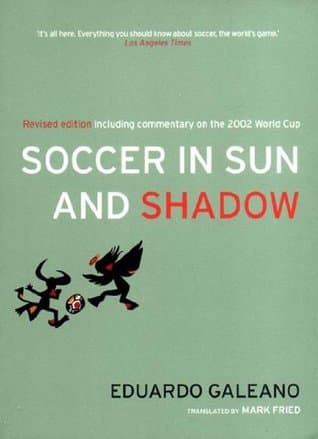
Soccer in Sun and Shadow cover
Archivist's Choice

Soccer in Sun and Shadow

Eduardo Galeano

Genre

Politics / History

Reading Time

240 min

Key Themes

See below

Track Your Reading

Sign in to track this book

Galeano's 'Soccer in Sun and Shadow' is a lyrical, politically charged book about football, combining history, global events, and personal thoughts to mourn the sport's commercialization while celebrating its lasting magic and human spirit.

Core Idea

Eduardo Galeano's "Soccer in Sun and Shadow" is a poetic and sharp look at modern football. It argues that the sport, once a natural expression of popular culture and joy, has been corrupted by commercialism, political manipulation, and the turning of players into products. Galeano says that while the game still shows glimpses of its original magic, it is increasingly overshadowed by global capitalism. This system turns players into merchandise, fans into consumers, and the field into a place for corporate brands and nationalistic feelings. He uses historical stories, myths, and personal thoughts to show how this change has taken the soul from soccer, regretting the loss of real artistry and the suppression of the game's democratic spirit, all while holding onto a sad hope for its recovery.
Reading time
240 min
Difficulty
Medium
✓ Read this if...
You are a football fan interested in the sport's cultural, political, and historical dimensions beyond mere match results, or if you appreciate lyrical, essayistic non-fiction that critiques modern society through the lens of a specific phenomenon.
✗ Skip this if...
You are looking for a straightforward history of football, a tactical analysis, or a purely celebratory account of the sport, as this book is deeply critical and often melancholic.

Core idea

The central argument and framework that powers the entire book.

Eduardo Galeano's "Soccer in Sun and Shadow" is a poetic and sharp look at modern football. It argues that the sport, once a natural expression of popular culture and joy, has been corrupted by commercialism, political manipulation, and the turning of players into products. Galeano says that while the game still shows glimpses of its original magic, it is increasingly overshadowed by global capitalism. This system turns players into merchandise, fans into consumers, and the field into a place for corporate brands and nationalistic feelings. He uses historical stories, myths, and personal thoughts to show how this change has taken the soul from soccer, regretting the loss of real artistry and the suppression of the game's democratic spirit, all while holding onto a sad hope for its recovery.

At a glance

Reading time

240 min

Difficulty

Medium

Read this if...

You are a football fan interested in the sport's cultural, political, and historical dimensions beyond mere match results, or if you appreciate lyrical, essayistic non-fiction that critiques modern society through the lens of a specific phenomenon.

Skip this if...

You are looking for a straightforward history of football, a tactical analysis, or a purely celebratory account of the sport, as this book is deeply critical and often melancholic.

Key Takeaways

1

The Beautiful Game's Ugly Truth

Soccer, like life, is a battle between joy and commercial exploitation.

Quote

History, on the other hand, is a prophet looking backward: from what was, and against what was, it announces what will be.

Galeano shows the tension in soccer: its ability to bring pure popular joy and spontaneous beauty, constantly threatened by commercialization, political manipulation, and corporate greed. He regrets the change of the 'beautiful game' from a popular festival into a global show, where the sport's purity is often lost for profit and control. This is not just about money; it is about a basic change in the game's soul, from a people's art to a product. This change reflects bigger worries about authenticity and commercialism in society. The...

Supporting evidence

Galeano contrasts the spontaneous, joyous street games of his youth with the highly organized, profit-driven professional leagues, and the rise of corporate sponsorships (Nike vs. Adidas) as a symbol of this shift.

Apply this

Support local, grassroots soccer initiatives over purely commercialized mega-events. Seek out and celebrate the moments of authentic, unscripted joy in sports, rather than succumbing to the manufactured hype.


commodification-of-sportgrassroots-soccerauthenticity-in-sport
2

The Player as Hero and Pawn

Players, once artists, become cogs in a machine, admired yet controlled.

Quote

The history of soccer is a sad voyage from beauty to duty.

Galeano describes the soccer player, at first a figure of popular admiration and spontaneous artistry, gradually becoming a highly trained, often used, professional athlete. The player is caught between the dreams of millions and the demands of club owners, sponsors, and national interests. Their bodies become tools, their creativity often limited by strict tactics and the pressure to perform for profit. While celebrated, they are also deeply controlled. Their careers are short and often end without much notice. This change reflects t...

Supporting evidence

He discusses the rigorous training regimes, the immense pressure on young players, and the often brief, intense careers of even the most legendary figures, contrasting their raw talent with the structured demands of modern play.

Apply this

Recognize the human cost behind elite athletic performance. Advocate for player welfare, fair compensation, and the protection of their artistic freedom within the sport.

athlete-exploitationprofessional-sports-ethicsplayer-agency
3

The Global Village's Unfair Game

Soccer mirrors global inequalities, where the wealthy dominate and the poor provide the talent.

Quote

The world's soccer map is a map of inequality.

Galeano argues that the global structure of soccer reflects and continues geopolitical inequalities. Developing nations, especially in Latin America and Africa, often act as 'talent factories' for rich European clubs. Young players are scouted, often at a young age, and moved to foreign lands. Sometimes they succeed greatly, but just as often they fail and are discarded. The financial power of European leagues controls the flow of talent, concentrating wealth and prestige while often leaving the originating countries with little more ...

Supporting evidence

The narrative of African and South American players being scouted by European clubs, often for meager compensation to their original teams, and the disparity in resources between continents.

Apply this

Support initiatives that invest in local soccer development in talent-producing regions, ensuring fair compensation and opportunities for players and their communities, rather than just exporting raw talent.

global-inequalitysports-colonialismtalent-drain
4

Memory, Myth, and the Magic of the Past

History isn't just facts; it's a living tapestry of stories, heroes, and forgotten dreams.

Quote

To be able to tell the story, to retrieve the memory, is to make the past present. It is to give life to those who were silenced.

Galeano's work is an act of historical recovery. He does not just list facts; he brings life to forgotten players, famous matches, and the social and political situations that shaped them. He understands that history is not a dry academic exercise but a living, often debated, story that shapes our present and future. By recalling the 'golden age' of soccer, the individual skill, and the community joy, he challenges the sterile, commercial present. His stories, often with sadness and humor, remind us that the true spirit of the game li...

Supporting evidence

His detailed, evocative recounting of specific historical matches, legendary players like Garrincha and Pelé, and the 'Christmas Truce' match of 1915, imbuing them with emotional and symbolic weight.

Apply this

Actively seek out and preserve the oral histories and personal narratives of sports figures and fans, ensuring that the human element of the game is not lost to statistics and corporate branding.

oral-historycollective-memorymyth-making-in-sport
5

The Spectator's Shifting Role

From active participant to passive consumer, the fan's experience is transformed.

Quote

The fan is the only one who truly believes in the magic.

Galeano regrets the change of the soccer fan from an active, often vocal, participant in the game's drama to a more passive consumer of a global show. In the past, fans were closely linked to their local teams, their identities tied to the club's success. Now, with satellite television, global merchandise, and more controlled stadiums, the fan experience is often filtered and made uniform. While access has increased, the raw, community passion and local identity can be weakened, replaced by a more detached, though still strong, way of...

Supporting evidence

He contrasts the vibrant, often chaotic atmosphere of old stadiums, where fans were an integral part of the game's energy, with the more controlled and commercialized environment of modern arenas.

Apply this

Prioritize attending local games and supporting community teams. Engage in fan culture that emphasizes collective experience and local identity, rather than solely consuming global brands.

fan-culturesports-consumerismcommunity-engagement-in-sport
6

The Politics of the Pitch

Soccer is never just a game; it's a reflection and arena of political struggle.

Quote

Soccer is a mirror of the society that plays it.

Galeano consistently shows how soccer is tied to politics, acting as both a distraction from and a stage for societal conflicts. From national pride during international matches to dictatorships using teams for propaganda, the game is never neutral. It can unite, divide, inspire, or oppress. He points out how successes and failures on the field often reflect broader national stories of victory or defeat, and how the sport's popularity makes it a strong tool for political messages. Even seemingly apolitical parts, like corporate sponso...

Supporting evidence

He references the use of soccer by dictatorships, the intense nationalistic rivalries in World Cups, and the symbolism attached to victories (e.g., Senegal's success as a symbol of African pride).

Apply this

Critically analyze the political messaging and implications surrounding major sporting events. Understand how sports can be used for both positive social change and manipulative propaganda.

sports-and-politicsnationalism-in-sportpropaganda-through-sport
7

The Lost Art of Spontaneity

Tactical rigidity and robotic precision stifle the game's inherent creativity.

Quote

The more the game becomes an industry, the less it resembles the game.

Galeano regrets the increasing standardization and strict tactics in modern soccer, which he sees as limiting the spontaneous creativity and individual skill that once defined the game. The focus on 'systems,' 'strategies,' and 'robot-like' precision, seen in discussions of Japanese robotic soccer, removes the human element of improvisation and the unexpected. He longs for the days when players were encouraged to express themselves, to dribble, to create moments of individual magic, rather than strictly following a coach's plan. This ...

Supporting evidence

His discussion of 'robotic soccer' in Japan as a metaphor for the direction of the game, and his nostalgia for the free-flowing, less constrained play of past eras, exemplified by players like Garrincha.

Apply this

Celebrate and encourage individual skill and creative expression in youth sports. Value unexpected moments of brilliance over perfectly executed but sterile tactics.

creativity-in-sporttactical-evolution-soccerhuman-vs-machine
8

Nike vs. Adidas: The Branding Battle

Corporate rivalries shape the game's landscape, often at the expense of its soul.

Quote

The battle for souls is fought on the fields of advertising.

Galeano details the corporate competition between sportswear companies like Nike and Adidas. He shows how these battles for market control greatly affect the sport itself. Their influence goes beyond just sponsorship to dictating equipment, influencing team choices, and shaping soccer's image. The story of Nike 'beating' Adidas is not just a business story; it is a tale of how branding and marketing became central to the sport's identity, often overshadowing the game's purity. This commercialization, while bringing financial resources...

Supporting evidence

The specific account of Nike's aggressive marketing strategies and how they challenged Adidas's long-standing dominance in the soccer world, particularly around major tournaments.

Apply this

Be critically aware of the influence of corporate branding in sports. Support brands that demonstrate ethical practices and genuinely invest in the grassroots development of the sport, not just its commercial exploitation.

sports-marketingcorporate-sponsorshipbrand-influence
9

The Enduring Power of the Dream

Despite its flaws, soccer retains its capacity to inspire hope and magic.

Quote

In spite of everything, I still believe that soccer is a miracle.

Despite his strong criticisms of soccer's commercialization and political use, Galeano confirms the game's lasting power to inspire. He acknowledges that even with the corruption and commercialism, the core magic of soccer—the unexpected goal, the individual moment of genius, the collective roar of the crowd—remains. It continues to be a dream factory, offering hope and moments of pure joy to millions globally. This resilience of the dream makes his lament powerful; it is a call to reclaim the game's soul, not to abandon it. The book ...

Supporting evidence

His concluding tone, which, despite the preceding critiques, expresses a deep, unwavering affection for the game, and his celebration of moments of unexpected triumph (like Senegal or Turkey's successes).

Apply this

Actively seek out and celebrate the moments of genuine artistry, sportsmanship, and unexpected joy in soccer. Hold onto the belief in the game's capacity to transcend its commercial trappings and unite people.

sports-inspirationresilience-of-sporthope-through-sport
10

The Storyteller's Legacy

Galeano's poetic prose elevates sports commentary to a profound cultural critique.

Quote

Every time the ball is kicked, a piece of history is written.

Beyond the specific insights into soccer, Galeano's work stands out for its literary quality. He goes beyond typical sports journalism, using poetic language, rich comparisons, and a deeply human perspective to turn commentary into a cultural and political critique. His ability to combine personal stories, historical facts, and philosophical thoughts elevates the subject, showing that sports are not trivial but fundamental reflections of society. His writing style itself is a key point, showing how passion and artistry can illuminate ...

Supporting evidence

The evocative language, the blend of personal reflection with historical analysis, and the inclusion of diverse cultural references throughout the book, which distinguish it from conventional sports writing.

Apply this

Approach all subjects, even seemingly mundane ones, with a critical, empathetic, and artistic lens. Recognize the power of storytelling to reveal deeper truths and connect disparate ideas.

literary-journalismcultural-critiqueart-of-storytelling

Critical analysis

Notable Quotes

Years have gone by and I've finally learned to accept myself for who I am: a beggar for good soccer. I go about the world, hand outstretched, and in the stadiums I plead: 'A pretty move, for the love of God.'

Opening lines of the book, setting the tone for Galeano's passionate, poetic approach to soccer.

The history of soccer is a sad voyage from beauty to duty. When the sport became an industry, the beauty that blossoms from the joy of play got torn out by its very roots.

Galeano laments the commercialization and professionalization of soccer.

In this world of ours, a world of powerful and powerless, soccer is the only religion without atheists.

Reflecting on soccer's universal appeal and its role as a global phenomenon.

The ball laughs, radiant, in the air. He brings it down, dresses it in colors, and puts it to sleep. He is the lord and master of the ball, his companion in solitude.

Describing the skill and artistry of a great player, often attributed to Diego Maradona.

Soccer is a metaphor for life, a game of fleeting moments and eternal passions.

A philosophical reflection on the deeper meanings of the sport.

The goal is soccer's orgasm. And like orgasms, goals have become an ever less frequent occurrence in modern life.

Critiquing defensive, tactical modern soccer compared to more free-flowing past eras.

In the cathedral of the stadium, the fans are the choir, singing the hymns of their tribe.

Describing the communal and ritualistic aspects of soccer fandom.

The military dictatorships of South America understood that soccer could be an opiate for the masses, but they also feared its power to unite and inspire rebellion.

Discussing soccer's political role under authoritarian regimes in Latin America.

He was born with a soccer ball at his feet, and he died with one. In between, he made the ball speak a language of joy.

A tribute to Garrincha, the Brazilian winger known for his dribbling and tragic life.

Soccer is the only place where a black man can be called 'monkey' and still be expected to dance.

Highlighting racism in soccer, particularly in European and South American contexts.

The ball does not choose its path; it is the player who chooses, and in that choice lies his art.

Reflecting on the creativity and decision-making involved in playing soccer.

When the match ended, the scoreboard was a lie. The true result was written in the tears of the vanquished and the silent awe of the victors.

Describing an emotionally charged match where the outcome transcended mere numbers.

In the global village, soccer is the common tongue, spoken with feet and understood by all.

Emphasizing soccer's role as a universal language in an interconnected world.

The history of soccer is written with the sweat of the oppressed and the dreams of the poor.

Connecting soccer's development to social and economic struggles, especially in Latin America.

Quiz

Test Your Knowledge

Ready to see how well you understood this book? Take our interactive quiz with 10 questions.

10
Questions
~5
Minutes
?
Best Score

Key Questions (FAQ)

'Soccer in Sun and Shadow' is a non-fiction book by Uruguayan journalist Eduardo Galeano that explores soccer's cultural, political, and historical dimensions. It blends personal reflections, historical anecdotes, and social commentary to examine how the sport reflects broader societal issues like globalization, war, and commercialization.

About the author