BookBrief
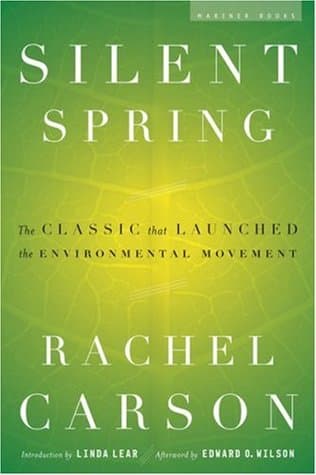
Silent Spring cover
Archivist's Choice

Silent Spring

Rachel Carson (1962)

Genre

Politics / History / Science

Reading Time

360 min

Key Themes

See below

Track Your Reading

Sign in to track this book

Rachel Carson's "Silent Spring" uncovers humanity's destructive use of pesticides, sparking a global awakening that created the modern environmental movement.

Core Idea

Silent Spring shows how the widespread use of synthetic chemical pesticides, especially DDT, after World War II was poisoning the environment, destroying ecosystems, and threatening human health. Carson argues that these chemicals, rather than being precise, are broad-spectrum poisons that build up in the food chain, disrupt natural controls, and cause lasting damage to nature. She describes a future where the natural world's essential sounds are gone. She critiques the short-sightedness and economic motives behind this chemical use, advocating for a fundamental shift towards ecological understanding and responsible care for the planet.
Reading time
360 min
Difficulty
Medium
✓ Read this if...
You are interested in the foundational text of the environmental movement, the history of pesticide use and its ecological consequences, or understanding the origins of the precautionary principle in public policy.
✗ Skip this if...
You prefer a purely scientific textbook on toxicology or a contemporary analysis of current environmental issues without historical context.

Core idea

The central argument and framework that powers the entire book.

Silent Spring shows how the widespread use of synthetic chemical pesticides, especially DDT, after World War II was poisoning the environment, destroying ecosystems, and threatening human health. Carson argues that these chemicals, rather than being precise, are broad-spectrum poisons that build up in the food chain, disrupt natural controls, and cause lasting damage to nature. She describes a future where the natural world's essential sounds are gone. She critiques the short-sightedness and economic motives behind this chemical use, advocating for a fundamental shift towards ecological understanding and responsible care for the planet.

At a glance

Reading time

360 min

Difficulty

Medium

Read this if...

You are interested in the foundational text of the environmental movement, the history of pesticide use and its ecological consequences, or understanding the origins of the precautionary principle in public policy.

Skip this if...

You prefer a purely scientific textbook on toxicology or a contemporary analysis of current environmental issues without historical context.

Key Takeaways

1

The Unseen Scourge

Pesticides are not selective; they are biocides with widespread, indiscriminate effects.

Quote

It is not until the public becomes aroused to the danger and demands action that the government will begin to act. This is the great challenge of our age.

Carson shows that 'selective' pesticides are a myth, revealing them as powerful poisons that harm entire ecosystems, not just target pests. She argues that chemical warfare against insects harms non-target species, including birds, fish, mammals, and humans, through direct exposure and accumulation in the food chain. This widespread contamination is often invisible at first, making its long-term effects subtle and hard to trace. The book highlights how these chemicals disrupt nature's balance, leading to unforeseen problems that often...

Supporting evidence

Carson details numerous instances, such as the widespread bird deaths observed after DDT spraying for Dutch elm disease, demonstrating the chemical's non-selectivity. She also cites studies showing DDT accumulation in food chains.

Apply this

Before adopting any chemical solution for pest control, research its broader ecological impact. Prioritize integrated pest management (IPM) strategies that minimize chemical use and support natural predators.

biocideecological-magnificationnon-target-species
2

The Web of Life Interrupted

Nature's intricate balance is easily disrupted by human intervention, leading to cascading ecological failures.

Quote

The 'control of nature' is a phrase conceived in arrogance, born of the Neanderthal age of biology and philosophy, when it was supposed that nature exists for the convenience of man.

Carson illustrates that all living things in an ecosystem are connected. She argues that putting synthetic chemicals into this delicate system always creates ripple effects, often far from the intended target. When predators are killed by pesticides, for instance, their prey can have population explosions, leading to new pest outbreaks. This shows a deep misunderstanding of ecological principles by those who supported widespread chemical use. Carson suggests that true 'control' of nature is an illusion, and that humanity's role should...

Supporting evidence

The book describes how the spraying of DDT to control mosquitos in Borneo led to a chain of events: DDT killed predatory wasps, leading to a caterpillar outbreak that ate thatched roofs; then DDT-poisoned cockroaches were eaten by geckos, which were eaten by cats, leading to a rat population explosion and a potential plague threat, necessitating the parachuting of cats.

Apply this

Before making significant changes to a natural environment, conduct thorough ecological impact assessments. Foster biodiversity in your garden or community to create resilient ecosystems that naturally resist pests.

ecosystem-balancetrophic-cascadebiodiversity
3

The 'Silent Spring' Foreshadowed

The widespread death of birds due to pesticide poisoning is a stark metaphor for broader environmental collapse.

Quote

Over increasingly large areas of the United States, spring now comes unheralded by the return of the birds, and the early mornings are strangely silent where once they were filled with the beauty of bird song.

The title itself captures one of Carson's most unsettling predictions: a future where the joyful sound of birds is silenced by human-made poisons. She documents mass bird deaths directly caused by pesticide use, particularly DDT. These bird deaths serve as an early warning system, signaling a larger, unseen threat to the entire natural world. The absence of birds is not just an aesthetic loss; it signifies a major disruption in the food chain and a loss of natural pest controls, further showing the interconnectedness she champions. Th...

Supporting evidence

Carson cites numerous reports from ornithologists and concerned citizens detailing sudden, widespread bird deaths following pesticide applications, particularly after large-scale spraying programs for fire ants or Dutch elm disease.

Apply this

Support bird conservation efforts and advocate for policies that protect bird habitats and reduce pesticide use. Create bird-friendly environments in your own backyard by avoiding chemicals and providing food and water.

avian-mortalityhabitat-lossindicator-species
4

The Human Cost

Pesticides are not just an environmental problem; they pose a direct, long-term threat to human health.

Quote

For the first time in the history of the world, every human being is now subjected to contact with dangerous chemicals, from the moment of conception until death.

Carson extends her analysis beyond wildlife to address the alarming effects of pesticide exposure on human health. She details how these chemicals build up in human tissues, appear in breast milk, and can lead to chronic illnesses, including cancer, neurological disorders, and reproductive problems. She connects specific chemicals to their known toxic effects on human bodies, challenging industry assurances of safety. This focus on human health was crucial in sparking public concern, as it brought the idea of 'environmental damage' in...

Supporting evidence

Carson discusses the chemical structure of DDT and its relatives, linking them to known carcinogens and neurotoxins. She cites studies on occupational exposure and the presence of pesticides in human fat tissues and mother's milk.

Apply this

Choose organic produce when possible, especially for foods with high pesticide residues. Filter your drinking water and advocate for stricter regulations on chemical use in agriculture and public spaces.

carcinogenneurotoxinendocrine-disruptorenvironmental-health
5

The Power of Industry & Government Collusion

The widespread adoption of dangerous chemicals was driven by powerful industrial interests and government inaction.

Quote

The public is fed a steady diet of misinformation and half-truths, designed to allay anxiety and promote the continued use of pesticides.

Carson exposes the systemic forces that allowed dangerous chemicals to spread unchecked. She critiques the close ties between the chemical industry and government regulators, showing how business interests often outweighed public health and environmental safety. She reveals how industry-funded research often downplayed risks, and how government agencies, often understaffed, failed to adequately test or regulate these compounds. This critique was not just about chemicals; it was about the integrity of science and the accountability of ...

Supporting evidence

Carson details how chemical companies actively promoted pesticides, often with misleading advertising, and how government agencies, like the USDA, were often complicit in advocating for widespread spraying without sufficient long-term studies.

Apply this

Be critical of information from industry-funded sources. Support independent scientific research and advocate for stronger, independent regulatory bodies free from corporate influence.

corporate-lobbyingregulatory-capturescientific-integrity
6

Alternatives Exist, Ignored

Effective, non-chemical pest control methods were known but often dismissed in favor of profitable chemical solutions.

Quote

The truly extraordinary thing is that these things have been allowed to happen, because there are other ways.

An important, often overlooked part of Carson's argument is her detailed explanation of existing, non-chemical ways to control pests. She highlights biological controls, such as introducing natural predators or parasites, as well as practices like crop rotation and resistant plant varieties. Her frustration is clear as she points out that these ecologically sound methods were largely ignored or suppressed in favor of more profitable chemical solutions. This shows that the problem was not a lack of options, but a failure of imagination...

Supporting evidence

Carson describes successful biological control programs, such as the use of parasitic wasps to control scale insects in citrus groves in California, and the sterile male technique for screw-worm flies, demonstrating viable alternatives to broad-spectrum pesticides.

Apply this

Research and implement integrated pest management (IPM) strategies in your garden or farm. Support companies and agricultural practices that prioritize biological and ecological pest control over chemical solutions.

biological-controlintegrated-pest-managementsustainable-agriculture
7

The Right to Know

Citizens have a fundamental right to be informed about the dangers to their environment and health.

Quote

The public must be informed, and it must be given the facts, for only in this way can it make its own decisions.

Carson's work shows the need for transparency and public education. She believed that informed citizens were the only safeguard against unchecked corporate and government power. By presenting scientific data in an accessible and compelling way, she empowered ordinary people to question authority and demand accountability. She argued that withholding information or misleading the public about environmental dangers was a deep violation of democratic principles. Her book was not just a scientific text; it was a call to civic action, asse...

Supporting evidence

Carson's entire book is an act of providing detailed, scientific information to the public that had previously been obscured or dismissed by industry and government agencies.

Apply this

Actively seek out unbiased information on environmental issues. Support whistleblowers and organizations that promote transparency. Engage in local and national policy debates concerning environmental protection.

public-awarenessenvironmental-justicecivic-engagement
8

Precautionary Principle in Practice

When potential harm is great, action should be taken even without full scientific certainty.

Quote

If we are to live so intimately with these chemicals, we had better know what they are and what they can do.

Although the term 'precautionary principle' was not widely used until later, Carson's entire argument embodies its idea. She argues that the potential for widespread, irreversible harm from synthetic chemicals requires a cautious approach, even if all long-term effects are not yet fully understood. The burden of proof, she suggests, should be on those introducing new chemicals to show their safety, rather than on the public to prove their harm after the fact. Her work is a historical example of how societal decisions about technology ...

Supporting evidence

Carson highlights the lack of comprehensive testing for many pesticides before their widespread release and the industry's focus on acute toxicity rather than chronic, long-term effects.

Apply this

Support policies that require rigorous independent testing of new chemicals before market release. Advocate for a shift in regulatory philosophy towards prevention rather than reaction.

precautionary-principlerisk-assessmentenvironmental-regulation
9

The Birth of a Movement

Silent Spring catalyzed the modern environmental movement and fundamentally altered humanity's relationship with nature.

Quote

The book was a turning point, awakening a sleeping public to the dangers of pollution and sparking a revolution in environmental consciousness.

Silent Spring was a major event that reshaped public awareness and policy. It launched the modern environmental movement, inspiring millions to question the unlimited use of technology and demand greater protection for nature. Its impact led to immediate legislative changes, most notably the ban of DDT, and set the stage for the creation of the Environmental Protection Agency (EPA) in the United States and similar bodies globally. Carson transformed the abstract idea of 'conservation' into a tangible, urgent concern for human health...

Supporting evidence

The historical context of the book's publication shows that it directly led to congressional hearings, a presidential science advisory committee report, and ultimately, the banning of DDT and the establishment of the EPA.

Apply this

Educate yourself and others about environmental issues. Participate in environmental advocacy groups and support policies aimed at protecting ecosystems and human health. Recognize the ongoing relevance of Carson's warnings.

environmental-movementDDT-banEPAenvironmental-consciousness

Critical analysis

Notable Quotes

The 'control of nature' is a phrase conceived in arrogance, born of the Neanderthal age of biology and philosophy, when it was supposed that nature exists for the purpose of man.

Carson critiques humanity's hubris in attempting to dominate natural systems.

For the first time in the history of the world, every human being is now subjected to contact with dangerous chemicals, from the moment of conception until death.

She highlights the pervasive and inescapable nature of chemical exposure in modern life.

Can anyone believe it is possible to lay down such a barrage of poisons on the surface of the earth without making it unfit for all life? They should not be called 'insecticides,' but 'biocides.'

Carson argues that pesticides are indiscriminate killers, affecting all life, not just insects.

We stand now at a crossroads. The road we have long been traveling is deceptively easy, a smooth superhighway on which we progress with great speed, but at its end lies oblivion. The other road, a less traveled one, offers our last, our only chance to arrive at a destination that assures the preservation of the earth.

Carson presents a stark choice between destructive convenience and sustainable preservation.

It is not until we are faced with the evidence, however, that we begin to realize the extent of the damage that has already been done.

She notes humanity's tendency to ignore environmental harm until it becomes undeniable.

The most alarming of all man's assaults upon the environment is the contamination of air, earth, rivers, and sea with dangerous and even lethal materials.

Carson identifies pollution as the primary threat posed by human activity.

Man, however much he may like to pretend the contrary, is part of nature.

Carson emphasizes humanity's intrinsic connection to and dependence on natural systems.

The public is fed a steady diet of misinformation and reassurance, when what they need is the truth.

Carson criticizes the deliberate downplaying of environmental risks by authorities and industry.

Future generations are unlikely to condone our lack of prudent concern for the integrity of the natural world that supports all life.

She warns of the judgment future generations will pass on current environmental negligence.

A Who's Who of pesticides is therefore also a Who's Who of poisons.

Carson highlights the inherent toxicity of the chemicals being widely used.

We are still in the Dark Ages where the science of ecology is concerned.

She points out the limited understanding of complex ecological interactions at the time.

The most important single fact about the presently used pesticides is that they are poisons.

Carson reiterates the fundamental danger of pesticides, a point often obscured.

The history of life on earth has been a history of interaction between living things and their surroundings.

She establishes the fundamental principle of ecology and interdependence.

The fact that the chemical industry is a child of the twentieth century is a disquieting thought.

Carson notes the relatively recent emergence and rapid proliferation of synthetic chemicals.

It is a sobering thought that the future of life on earth may depend on the success of man's efforts to control his own activities.

She places the responsibility for the planet's future squarely on human self-regulation.

Quiz

Test Your Knowledge

Ready to see how well you understood this book? Take our interactive quiz with 10 questions.

10
Questions
~5
Minutes
?
Best Score

Key Questions (FAQ)

'Silent Spring' by Rachel Carson details the devastating effects of indiscriminate pesticide use, particularly DDT, on the environment and human health. It exposes how these chemicals disrupt ecosystems, harm wildlife, and contaminate food chains, leading to a 'silent spring' devoid of bird song.

About the author