BookBrief
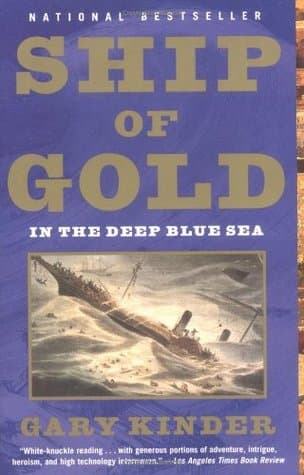
Ship of Gold in the Deep Blue Sea cover
Archivist's Choice

Ship of Gold in the Deep Blue Sea

Gary Kinder (1998)

Genre

Lifestyle / Biography / History / Science

Reading Time

15-20 hours (approx. 560 pages)

Key Themes

See below

Track Your Reading

Sign in to track this book

This book tells the true story of the high-stakes effort to recover the S.S. Central America, a legendary sidewheel steamer full of gold that sank in the Atlantic.

Core Idea

Gary Kinder's "Ship of Gold in the Deep Blue Sea" tells the story of finding and recovering the S.S. Central America, a ship that sank in 1857 with tons of California gold. The book describes Tommy Thompson's bold idea. He was an unusual inventor who, against common belief, created new robotic technology to find and salvage the treasure from 8,000 feet deep in the Atlantic. It covers the huge engineering problems, financial risks, and personal sacrifices involved in this deep-sea search. Beyond just getting the gold, the story connects the ship's sinking to the lives of its passengers and crew, and the scientific advances needed to work under the ocean's crushing pressure and darkness. It shows human cleverness, the appeal of treasure, and how one person's focused goal can impact exploration and technology.
Reading time
15-20 hours (approx. 560 pages)
Difficulty
Medium
✓ Read this if...
You are fascinated by true-life adventure, the history of gold rushes, marine archaeology, or the development of cutting-edge deep-sea technology. This book is for those who enjoy detailed narratives of human obsession, scientific ingenuity, and high-stakes exploration.
✗ Skip this if...
You prefer fictional narratives, are not interested in detailed accounts of engineering challenges, or find extensive historical and scientific explanations tedious. If you're looking for a quick read without in-depth technical descriptions, this might not be for you.

Core idea

The central argument and framework that powers the entire book.

Gary Kinder's "Ship of Gold in the Deep Blue Sea" tells the story of finding and recovering the S.S. Central America, a ship that sank in 1857 with tons of California gold. The book describes Tommy Thompson's bold idea. He was an unusual inventor who, against common belief, created new robotic technology to find and salvage the treasure from 8,000 feet deep in the Atlantic. It covers the huge engineering problems, financial risks, and personal sacrifices involved in this deep-sea search.

Beyond just getting the gold, the story connects the ship's sinking to the lives of its passengers and crew, and the scientific advances needed to work under the ocean's crushing pressure and darkness. It shows human cleverness, the appeal of treasure, and how one person's focused goal can impact exploration and technology.

At a glance

Reading time

15-20 hours (approx. 560 pages)

Difficulty

Medium

Read this if...

You are fascinated by true-life adventure, the history of gold rushes, marine archaeology, or the development of cutting-edge deep-sea technology. This book is for those who enjoy detailed narratives of human obsession, scientific ingenuity, and high-stakes exploration.

Skip this if...

You prefer fictional narratives, are not interested in detailed accounts of engineering challenges, or find extensive historical and scientific explanations tedious. If you're looking for a quick read without in-depth technical descriptions, this might not be for you.

Key Takeaways

1

The Lure of Sunken Treasure

The S.S. Central America was more than just gold; it was a time capsule and a national obsession.

Quote

The S.S. Central America was not just a ship; it was a floating bank, carrying a significant portion of America's wealth.

The S.S. Central America, known as the 'Ship of Gold,' represented a legendary lost treasure, valuable not only for its money but for its history. Sunk in 1857, it carried a large amount of California Gold Rush gold, becoming a symbol of a past era and a national tragedy. The huge amount of gold, over three tons, made it the largest single loss of treasure in American history. This was not just about finding riches; it was about recovering a piece of America's past, a direct link to the pioneers and the economy of a young nation. Its ...

Supporting evidence

The initial reports of the sinking detailed the immense cargo of gold, including ingots, assayers' bars, and minted coins, which immediately made it a target for future salvage operations. The economic impact of its loss on the nascent American economy was also significant, contributing to the Panic of 1857.

Apply this

Understand that true value often extends beyond monetary worth; historical context and cultural impact can elevate a pursuit from a mere treasure hunt to a significant historical recovery. When embarking on ambitious projects, consider their broader implications.


shipwreck-treasuregold-rush-historymaritime-archaeology
2

The Human Cost of Discovery

The pursuit of treasure is fraught with personal sacrifices, financial ruin, and moral dilemmas.

Quote

The gold was a magnet, drawing in dreamers and schemers, some of whom would sacrifice everything in its pursuit.

The search for the S.S. Central America was not a simple scientific project. It was a story full of people who risked, and often lost, money, reputations, and even their lives. From the first investors who put millions into unproven technology and risky ventures, to the scientists and engineers who spent years away from their families, the human cost was huge. The book describes the legal battles, conflicts among partners, and the mental and physical toll on those involved. Ethical lines often blurred, as the huge possible reward push...

Supporting evidence

The protracted legal battles surrounding the ownership of the recovered gold, involving numerous insurance companies and salvors, illustrate the intense financial and personal stakes. The personal struggles of Tommy Thompson, the lead scientist, who faced lawsuits and eventually became a fugitive, underscore the immense pressure and ethical challenges.

Apply this

Before committing to any high-stakes venture, conduct a thorough risk assessment that includes not only financial and technical risks but also the potential personal and ethical costs. Establish clear boundaries and exit strategies.

ethics-of-treasure-huntingpersonal-sacrificelegal-disputes
3

Technological Breakthroughs in Deep-Sea Exploration

The S.S. Central America's recovery pushed the boundaries of what was thought possible in oceanography.

Quote

They were essentially building a space program for the ocean, inventing technologies that didn't exist to reach a place no human had ever seen.

Finding and recovering the S.S. Central America was not just luck; it was the result of new technology. The ship lay almost 8,000 feet under the Atlantic, a depth previously thought impossible for detailed exploration and salvage. The team, led by Tommy Thompson, had to invent entirely new systems: advanced sonar to find targets, remotely operated vehicles (ROVs) that could work under great pressure, and advanced robotic arms for careful recovery. This was not just adapting old technology; it was creating a new field of deep-ocean rob...

Supporting evidence

The development and deployment of 'Nemo,' a custom-built ROV with specialized cameras, manipulators, and a unique recovery system, was central to the operation. Its ability to work precisely at extreme depths for extended periods was a significant leap forward in ocean engineering.

Apply this

When faced with seemingly insurmountable challenges, don't be limited by existing solutions. Invest in research and development, fostering an environment where innovation is encouraged, even if it means building from scratch.

deep-sea-roboticsocean-engineeringremote-operated-vehicles
4

The Power of Obsessive Vision

One man's unwavering belief transformed an impossible dream into a tangible reality.

Quote

Thompson's genius wasn't just in his scientific acumen; it was in his unyielding belief that the impossible was merely undiscovered.

Tommy Thompson, the main person in the search, shows the power of a focused goal. Despite doubts from scientists, constant financial problems, and many setbacks, his strong belief that finding and recovering the S.S. Central America was possible drove the entire project. He spent decades of his life, giving up personal comfort and getting into huge debt, all for this one goal. His aim was not just to find gold; it was to prove that advanced scientific methods could uncover the secrets of the deep ocean. This intense focus, while leadi...

Supporting evidence

Thompson's relentless pursuit of funding, his meticulous research into historical records and ocean currents, and his ability to assemble and motivate a team of engineers and scientists against long odds all point to his extraordinary, almost obsessive, vision.

Apply this

Cultivate a clear, compelling vision for your most ambitious goals. Understand that achieving 'impossible' feats often requires an unwavering commitment and a willingness to push past conventional wisdom and personal comfort zones.

visionary-leadershipperseverancescientific-dedication
5

The Unpredictable Nature of the Deep Sea

Even with advanced technology, the ocean remains a formidable and unpredictable adversary.

Quote

The deep sea doesn't care about your plans, your technology, or your dreams. It operates on its own terms.

Even with careful planning and advanced technology, the deep ocean presented many unpredictable problems. From strong storms that threatened the ship and its crew to unexpected currents that made ROV operations difficult thousands of feet below, the environment constantly reminded people of their limits. Equipment often failed, frequently needing clever on-the-spot repairs. The vastness and pressure of the deep sea meant that even small issues could become big problems. The book clearly shows the constant tension and the humbling expe...

Supporting evidence

Descriptions of the severe weather encountered during expeditions, the constant battle against deep-sea currents that could drag ROVs off course, and the numerous technical malfunctions that plagued the equipment illustrate the unpredictable nature of the operating environment.

Apply this

When undertaking complex projects in challenging environments, build in significant contingencies for unforeseen circumstances. Prioritize flexibility and adaptability in your plans and foster a team culture that can pivot and problem-solve under pressure.

maritime-challengesenvironmental-hazardsdeep-sea-conditions
6

The Intertwined Threads of History and Science

The S.S. Central America project demonstrated how historical research informs scientific discovery.

Quote

Without understanding the past, the present search would have been blind. History was the map, science was the compass.

The success of the S.S. Central America recovery was not only an engineering win; it was also due to thorough historical research. Thompson's team carefully searched historical records, newspaper articles, ship logs, and survivor stories to figure out the most likely sinking location. This deep look into historical data, including weather patterns, reported positions, and even the captain's mindset, gave important clues that narrowed down the huge ocean area. Combining historical detective work with advanced scientific methods was key...

Supporting evidence

Thompson's team utilized sophisticated mathematical modeling based on historical weather data, ocean currents, and survivor accounts to create a probabilistic map of the wreck site. This 'forensic oceanography' was critical in reducing the search area.

Apply this

When tackling complex problems, integrate insights from diverse fields. Don't silo knowledge; instead, actively seek out how historical context, social science, or other seemingly unrelated disciplines can inform your scientific or technical approach.

historical-researchscientific-methodinterdisciplinary-studies
7

The Psychological Impact of Wealth

The immense value of the gold distorted perceptions and fueled destructive conflicts.

Quote

The gold was a prism, bending light and distorting reality for all who gazed upon it.

The 'Ship of Gold' story also explores how immense wealth affects people. The sheer amount of gold recovered, and the promise of more, brought out many human emotions: greed, envy, suspicion, and paranoia. The initial friendship among the salvage team and investors eventually turned into bitter legal battles and accusations. The gold became a cause of division rather than unity, showing how easily the pursuit of riches can corrupt intentions and relationships. This part of the story is a strong reminder that while wealth can be a powe...

Supporting evidence

The numerous lawsuits filed against Thompson and his company by investors, insurance companies, and even former partners, all vying for a share of the recovered treasure, clearly illustrate the destructive power of the gold's value.

Apply this

When engaged in ventures with high financial stakes, establish clear agreements, boundaries, and conflict resolution mechanisms early on. Understand the psychological pressures that wealth can exert and build safeguards against greed-driven conflicts.

psychology-of-wealthgreedconflict-resolution
8

The Legacy of the Lost

The S.S. Central America serves as a poignant reminder of lives lost and the enduring power of human stories.

Quote

Beyond the gold, there were the stories of the people onboard, a silent testament to a forgotten tragedy.

While the gold is the most obvious part of the S.S. Central America's recovery, the book skillfully includes the human stories of those who died in the 1857 disaster. The ship carried not just wealth, but hopes, dreams, and lives. The detailed accounts of Captain Herndon and his crew's brave efforts to save passengers, the terrible experiences of survivors, and the tragic loss of over 400 lives add a deep human element to the scientific search. Finding personal items, such as photos, clothing, and everyday objects, connects the presen...

Supporting evidence

The detailed narrative of the sinking, including the actions of Captain Herndon, the rescue efforts by other ships, and the testimonies of the few survivors, humanizes the tragedy. The recovery of personal items like period clothing, spectacles, and even a daguerreotype of a young woman adds emotional depth to the archaeological findings.

Apply this

In any endeavor, remember the human element. Whether it's historical research or business, understanding and honoring the stories of individuals involved adds richness, meaning, and ethical weight to the pursuit.

maritime-disasterhuman-storieshistorical-memory
9

The Unfinished Quest

Despite its recovery, the 'Ship of Gold' saga continues to unfold with unresolved mysteries and legal battles.

Quote

The gold was found, but the story of the S.S. Central America was far from over. Some treasures, it seemed, could never truly be possessed.

Even after recovering a large amount of the S.S. Central America's gold, the story is still incomplete and has ongoing problems. The book ends with the shadow of unresolved legal disputes and the fate of Tommy Thompson, who, despite his great achievement, became a fugitive. The 'treasure' itself caused endless lawsuits, showing the complexities of ownership in international waters and the difficulties of managing huge wealth. This is a strong reminder that even the most celebrated wins can have long, complicated aftermaths, and that s...

Supporting evidence

The ongoing legal battles surrounding the remaining gold, the court orders for Thompson to reveal the location of the rest of the treasure, and his subsequent disappearance and fugitive status illustrate the unresolved nature of the saga.

Apply this

Be prepared for the long-term consequences of significant achievements. Plan for potential legal and ethical challenges that may arise even after initial success, and understand that some 'victories' may come with unforeseen and enduring complexities.

legal-challengesunresolved-mysteriespost-discovery-challenges

Critical analysis

Notable Quotes

The sea does not give up its dead easily, nor its treasures.

A recurring theme highlighting the difficulty and danger of underwater recovery.

The greatest treasure is not the gold itself, but the story it tells.

Reflecting on the historical significance of the artifacts beyond their monetary value.

They were not merely seeking gold; they were chasing ghosts, echoes of a forgotten world.

Describing the emotional and historical drive behind the quest for the Central America.

The ocean floor is the largest museum on Earth, its exhibits untouched for centuries.

Emphasizing the unique preservation qualities of the deep sea for historical artifacts.

Every salvaged artifact was a whisper from the past, a tangible link to lives long gone.

Discussing the personal connection and historical insight gained from the recovered items.

The pressure at that depth could crush a submarine, yet they worked with the delicacy of surgeons.

Illustrating the extreme conditions and specialized skills required for deep-sea recovery.

Luck, they say, favors the prepared mind, but in the deep sea, it also favors the obsessively persistent.

Highlighting the blend of scientific rigor and sheer determination needed for success.

The gold was a magnet, drawing men from all walks of life into its powerful orbit.

Explaining the universal allure of treasure and its impact on human ambition.

To touch something lost for over a century is to bridge the chasm of time.

Reflecting on the profound experience of interacting with artifacts from the past.

The ship didn't just sink; it carried with it the hopes, dreams, and fortunes of an era.

Emphasizing the broader societal impact of the SS Central America's loss.

Deep-sea exploration is less about finding what you expect and more about understanding what you discover.

A commentary on the unpredictable nature of scientific exploration and the importance of interpretation.

The sea, in its vast indifference, holds secrets that can redefine our understanding of the past.

Pondering the ocean's role as a repository of history and its potential for new revelations.

Their quest was a blend of meticulous science and audacious dreaming.

Summarizing the unique combination of skills and vision required for the project.

Every piece of coal, every shard of pottery, told a silent story of life aboard the ill-fated vessel.

Illustrating how even mundane artifacts contribute to the historical narrative.

Quiz

Test Your Knowledge

Ready to see how well you understood this book? Take our interactive quiz with 10 questions.

10
Questions
~5
Minutes
?
Best Score

Key Questions (FAQ)

The S.S. Central America was a side-wheel steamship that sank in a hurricane off the coast of the Carolinas in September 1857. It was carrying thousands of pounds of gold from the California Gold Rush, making its recovery one of the most significant treasure hunts in maritime history and a fascinating tale of American expansion.

About the author