“One is not born, but rather becomes, a woman.”
— A foundational statement of existentialist feminism, though more famously from 'The Second Sex,' its spirit permeates Beauvoir's earlier works like 'She Came to Stay.'

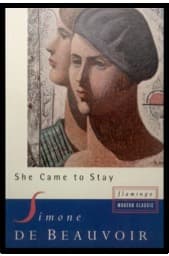
Simone de Beauvoir (1943)
Genre
Philosophy
Reading Time
10-12 hours (approx. 416 pages)
Key Themes
See below
Sign in to track this book
A celebrated intellectual couple's open relationship becomes a dangerous test when a young woman's arrival shatters their world, exposing jealousy and the fluid boundaries of self.
“One is not born, but rather becomes, a woman.”
— A foundational statement of existentialist feminism, though more famously from 'The Second Sex,' its spirit permeates Beauvoir's earlier works like 'She Came to Stay.'
“To be free is to be condemned to be free.”
— A central paradox of existentialism, highlighting the burden of absolute freedom and responsibility, a theme explored through Françoise's internal struggles.
“Hell is other people.”
— A famous line from Sartre, but one that perfectly encapsulates the relational anxieties and conflicts explored in 'She Came to Stay,' particularly the love triangle's dynamics.
“She was a woman of ideas, but also a woman of flesh and blood.”
— Describing Françoise, emphasizing the tension between intellectual life and embodied experience, a recurring theme in Beauvoir's work.
“The other's gaze alienates me from myself.”
— Exploring the concept of 'the look' and its power to objectify and define, as Françoise feels herself reduced by the perceptions of Xavière and Pierre.
“There are no ready-made values, one must invent them.”
— Reflecting the existentialist emphasis on radical freedom and the creation of meaning in a meaningless world, as the characters struggle with moral choices.
“Each man makes his own hell.”
— Underlining individual responsibility for one's psychological state and suffering, a consequence of the freedom to choose and define oneself.
“Love is not a tranquil haven, but a stormy sea.”
— Reflecting the tumultuous and often destructive nature of the relationships depicted, particularly the intense and complicated bond between Françoise, Pierre, and Xavière.
“She had wanted to live her life as an adventure, but it was turning into a tragedy.”
— A poignant reflection on Françoise's initial aspirations for freedom and self-determination versus the painful reality of her experiences.
“The present is opaque; the future is an open book.”
— Highlighting the uncertainty of the present moment and the potential, yet daunting, freedom to shape one's future through choices.
“One is always alone, even in the midst of others.”
— Expressing a fundamental existentialist solitude, the irreducible isolation of individual consciousness, even within intimate relationships.
“To exist is to choose oneself.”
— A concise summary of existentialist self-creation, where identity is not given but constantly forged through one's actions and decisions.
“She felt a terrible freedom, a freedom that crushed her.”
— Describing Françoise's overwhelming experience of existential freedom, which, rather than liberating, becomes a source of anxiety and burden.
“The other is necessary for my own consciousness.”
— While 'Hell is other people' points to conflict, this idea acknowledges the role of the 'other' in self-awareness and self-definition, albeit often through struggle.
“Every choice is a leap into the unknown.”
— Emphasizing the inherent risk and uncertainty of making decisions in an absurd world, a constant challenge for the characters.
Ready to see how well you understood this book? Take our interactive quiz with 10 questions.
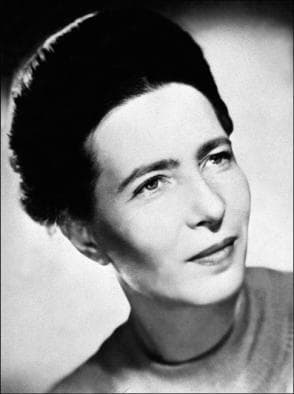
Simone Lucie Ernestine Marie Bertrand de Beauvoir was a French existentialist philosopher, writer, social theorist, and feminist activist. Though she did not consider herself a philosopher, nor was she considered one at the time of her death, she had a significant influence on both feminist existentialism and feminist theory.

Jeff Olson
4.4
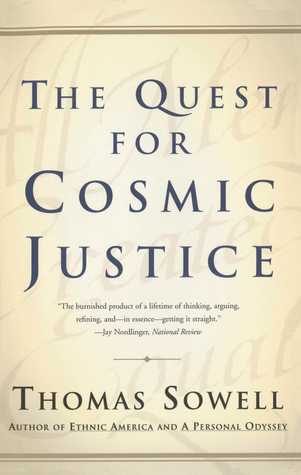
Thomas Sowell
4.4
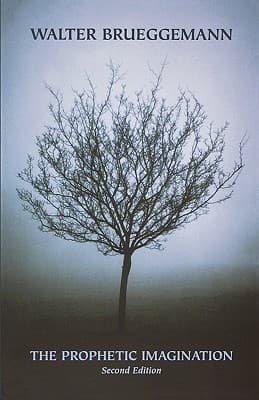
Walter Brueggemann
4.3
Rhonda Byrne
4.3

Robin Wall Kimmerer
4.3
George S. Clason
4.3
Elliot Aronson
4.3

Joseph Campbell
4.3