“There was no sound in the room now save the low hum of the air conditioner and the steady, rhythmic beat of the President's heart.”
— General Scott is alone with President Lyman in the Oval Office, contemplating his betrayal.

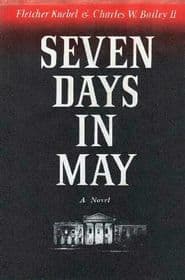
Fletcher Knebel (1961)
Genre
Politics / Thriller / Mystery
Reading Time
360 min
Key Themes
See below
Sign in to track this book
A Marine colonel uncovers a plot by a general to overthrow the U.S. government, leaving the President seven days to stop a military coup and save American democracy.
On a Sunday morning, Colonel Jiggs Casey, a Marine Corps intelligence officer, is on duty at the Pentagon's Joint Chiefs of Staff 'war room.' He notices an unusual order for ECOMCON, a nationwide military readiness exercise, to be held at a remote airbase in Texas called Site Y. The exercise is led by General James Mattoon Scott, the Chairman of the Joint Chiefs. Casey finds it strange that the exercise is scheduled for a Sunday and involves only specific units, raising his suspicions. He also learns of a heavily guarded, secret training facility in Texas, which further concerns him about the true purpose behind these activities.
Casey, troubled by the ECOMCON order and the secrecy around Site Y, discusses his concerns with his friend and colleague, Colonel Henderson. Henderson dismisses Casey's fears, attributing them to overwork. However, Casey's unease persists. He begins to track General Scott's movements and the details of ECOMCON, noting the unusual secrecy and the high-level personnel involved. His growing suspicion that something is wrong, possibly treasonous, begins to weigh on him, forcing him to consider the implications of what he might be uncovering.
Despite his apprehension, Casey decides he must inform President Jordan Lyman. He secures a private meeting and presents his fragmented evidence and suspicions about General Scott's activities and ECOMCON. President Lyman, weary from political battles and facing low approval ratings, is skeptical. He finds it almost impossible to believe that his own military, particularly the revered General Scott, would plot against the government. Lyman dismisses Casey's concerns, but Casey's earnestness plants a tiny seed of doubt.
Haunted by Casey's report, President Lyman cannot shake the feeling that something might be wrong. He decides to start a covert investigation. He enlists his most trusted advisors: Presidential Press Secretary Paul Girard, Senator Raymond Clark, and his old friend, Treasury Secretary Christopher Todd. They are tasked with discreetly gathering information on General Scott, Site Y, and the ECOMCON exercise. Lyman knows that any direct inquiry could alert the conspirators, so secrecy is important as they race against the clock to uncover the truth.
Paul Girard, disguised, manages to get near Site Y. He observes the intense security and the unusual activities at the base. He overhears a rehearsal of a broadcast that sounds like a proclamation of martial law, declaring an emergency and suspending civil liberties. The broadcast mentions the President's 'incapacity' and the military's 'temporary' takeover. This discovery provides the first concrete evidence that Casey's suspicions are not unfounded, confirming the existence of a plot to seize control of the government under the guise of a national emergency.
As the investigation progresses, President Lyman begins to understand General Scott's motivations. Scott, a decorated military leader, disapproves of Lyman's recent nuclear disarmament treaty with the Soviet Union, seeing it as a betrayal of national security. Scott has gained public support, using his popularity to undermine the President's authority. Lyman realizes that Scott sees himself as a patriot saving the country from a weak leader, believing that a military takeover is necessary to restore America's strength.
Fred Prentice, a former general and a critic of General Scott, is identified as a witness who could expose the plot. As Senator Clark tries to contact Prentice, conspirators try to kidnap him, but Prentice escapes, though injured. This incident provides further proof of the plot's existence and the ruthlessness of its participants. It also shows that the conspirators know they are being investigated and are willing to use extreme measures to silence anyone who might expose them, raising the stakes of Lyman's counter-operation.
With mounting evidence, President Lyman confronts General Scott in a tense, private meeting. Lyman presents the evidence he has gathered, but Scott denies everything, portraying himself as a loyal officer and the President as paranoid. Scott hints at dissatisfaction with Lyman's leadership within the military and among the populace. The confrontation reveals Scott's conviction in his cause and his belief that he is acting for the good of the nation, making it clear that he will not back down.
As the deadline for ECOMCON approaches, President Lyman's team uncovers the most terrifying aspect of the plot: General Scott intends to seize control of the nation's nuclear arsenal. This revelation elevates the crisis from a coup to a potential global catastrophe, as Scott's control of nuclear weapons could lead to an international incident or even war. Lyman realizes he must act decisively and quickly to prevent Scott from gaining control of these devastating weapons, understanding the danger posed by the general's ideology and power.
President Lyman, unable to directly arrest Scott without risking civil war, devises a plan. He leaks details of Scott's plot to a trusted journalist, ensuring the story will break just before ECOMCON is set to begin. This public exposure creates a political firestorm, forcing Scott's co-conspirators to choose between loyalty to Scott and their careers. The public outcry and the fracturing of support among the military leadership neutralize the coup, as the plot relies on secrecy and the perception of legitimacy.
With the plot exposed, General Scott's plan begins to crumble. Key military leaders, realizing the gravity of their involvement and facing public scrutiny, withdraw their support. The ECOMCON exercise is undermined as units fail to comply with orders, and the coordinated takeover falls apart. Scott's inner circle begins to desert him, leaving him isolated and his scheme in ruins. The military coup is averted, not through direct confrontation, but through the strategic exposure of its details.
In the aftermath, President Lyman reflects on the 'seven days in May.' While the coup is thwarted, the experience leaves him shaken by how fragile democratic institutions are and the constant vigilance required to protect them. General Scott and his primary co-conspirators are quietly arrested and dealt with, avoiding a public spectacle that could further destabilize the nation. Lyman understands that the threat of extremism, even from within, remains a constant danger, and he emerges from the ordeal with a renewed sense of purpose for the democratic process.
The Protagonist
Lyman transforms from a weary, underestimated leader into a decisive and resourceful protector of democracy, regaining his moral authority and strength.
The Antagonist
Scott's arc is one of unwavering conviction leading to ultimate downfall, as his ambition and misguided patriotism are exposed and defeated.
The Supporting
Casey evolves from a skeptical observer to a courageous whistleblower, risking his career and life to protect the democratic process.
The Supporting
Girard proves his loyalty and resourcefulness under extreme pressure, becoming a crucial operative in averting the coup.
The Supporting
Clark demonstrates unwavering loyalty and political acumen, becoming a key figure in the covert investigation to save the presidency.
The Supporting
Todd's role is primarily static, providing consistent, calm support and counsel to President Lyman throughout the crisis.
The Supporting
Rutkowski remains loyal to Scott's cause until the plot's collapse, illustrating the blind loyalty that enables such conspiracies.
The Mentioned
Prentice's role is to be a threatened witness, whose survival provides critical evidence for the President's team.
The novel explores how easily democratic institutions can be undermined, even from within, by those who believe they are acting for the greater good. The plot's existence, led by a popular military hero like General Scott, shows how vulnerable civilian rule is to perceived weakness or disagreement. President Lyman's struggle to counter the coup without open conflict underscores the delicate balance required to preserve democracy. Its strength is not just in laws but in the continued faith and vigilance of its citizens. The constant threat of a military takeover, even in a stable nation, is a warning.
“''Democracy is a very fragile thing, Jiggs. It can be broken, and it can be taken away. And it can be taken away by people who believe they are saving it.''”
A main theme is the conflict between loyalty to an individual or idea and loyalty to the Constitution and government. Colonel Casey shows this when he reports his suspicions about General Scott, despite Scott being a revered figure and Casey's superior. Similarly, the military officers involved in the coup believe their loyalty to General Scott and their vision of national strength is more important than their duty to the elected President. The novel makes characters, and readers, confront where true allegiance should lie when these values conflict.
“''My duty is to the Constitution, sir. Not to any man, not to any general, and not even to any President, if he violates it.''”
General Scott's charisma and popularity are key to his ability to plan the coup. The novel shows how a magnetic leader, especially one seen as strong, can gain widespread support and use public dissatisfaction to undermine democratic processes. Scott's authoritarian tendencies, masked by patriotism, reveal the power of a strongman figure in times of perceived national weakness. The book warns against blindly following charismatic leaders, even those with noble intentions, when they disregard established checks and balances.
“''He commands loyalty, Jiggs. Not just from his officers, but from the public. He's what they want – a strong man.''”
Information, its control, and its release are central to both the coup and its prevention. General Scott's plot relies on secrecy and manipulating information to create a narrative of presidential incompetence. Conversely, President Lyman's counter-operation depends on covert intelligence gathering and the strategic release of information to expose the plot. The novel highlights how critical intelligence is in a political thriller, showing that knowledge is power, and its use can either destroy or preserve a government. The race against time to uncover and publicize the truth drives the plot.
“''In this game, Jiggs, knowledge is everything. And if they know we know, it changes the game entirely.''”
The seven-day timeframe driving the narrative tension.
The entire narrative is framed by the 'seven days in May' countdown, creating immense suspense and urgency. The deadline for General Scott's ECOMCON exercise, which is the cover for the coup, provides a relentless pressure on President Lyman and his team. Each passing day brings the nation closer to the brink, forcing characters to make quick decisions and take significant risks. This device effectively heightens the stakes and maintains a high level of tension throughout the story, making the reader constantly aware of the impending crisis.
Colonel Casey, an ordinary officer, stumbles upon and exposes the extraordinary plot.
Colonel Jiggs Casey serves as the classic 'unlikely whistleblower' archetype. He is not a political operative or a high-ranking official with direct access to power, but a diligent Marine intelligence officer who simply notices inconsistencies. His initial skepticism and reluctance to believe in such a grand conspiracy make his eventual decision to report it all the more courageous and believable. This device grounds the extraordinary plot in the perspective of an ordinary, principled individual, making the threat feel more real and relatable.
A secret, remote military base as the epicenter of the conspiracy.
Site Y functions as a classic 'shadowy location' device, representing the hidden, illicit activities of the conspirators. Its remote location in Texas, the intense secrecy surrounding it, and the unusual exercises conducted there immediately signal that something sinister is afoot. The mystery of Site Y piques curiosity and provides a concrete, tangible target for President Lyman's investigation. It serves as the physical manifestation of the hidden threat, adding to the thriller's atmosphere and providing a focal point for the early stages of the investigation.
General Scott, a revered national hero, as the leader of the coup.
General James Mattoon Scott embodies the 'good guy' antagonist. He is not a cartoonishly evil villain but a highly respected, charismatic, and genuinely patriotic military leader. His belief that he is saving the country, rather than destroying it, makes him a complex and formidable opponent. This device increases the moral ambiguity and tension of the story, as President Lyman must confront someone who is widely admired, making the decision to expose him incredibly difficult and risky. It highlights that threats to democracy can come from unexpected, seemingly virtuous sources.
“There was no sound in the room now save the low hum of the air conditioner and the steady, rhythmic beat of the President's heart.”
— General Scott is alone with President Lyman in the Oval Office, contemplating his betrayal.
“The price of liberty is eternal vigilance, and sometimes, the price of vigilance is a heavy heart.”
— President Lyman reflects on the burdens of leadership and the constant threat to democracy.
“The military mind, once set on a course, is like a battleship: slow to turn, but irresistible once it gains momentum.”
— Paul Girard describes the unwavering determination of the military establishment.
“It's a strange thing, isn't it? To be afraid of your own army.”
— President Lyman confides in his aide, considering the coup plot.
“Patriotism is the last refuge of a scoundrel, but sometimes, it's also the first refuge of a patriot.”
— The characters debate the motivations behind General Scott's actions.
“Power corrupts, and absolute power corrupts absolutely. But what about absolute virtue?”
— A philosophical musing on the nature of power and human character.
“Democracy is not a spectator sport, gentlemen. It's a full-contact game.”
— President Lyman urges his staff to actively defend the government.
“The greatest weapon in a democracy is not a bomb, but a ballot.”
— A statement emphasizing the importance of democratic processes.
“Sometimes the greatest danger isn't from outside, but from within.”
— The realization that the threat to the presidency comes from trusted insiders.
“History would judge him, he knew. But first, he had to make history.”
— President Lyman considers the momentous decisions he must make.
“The silence in the room was heavier than any words.”
— A tense moment during a confrontation or revelation.
“The truth, like a persistent virus, always finds a way to surface.”
— The eventual uncovering of the coup plot.
“He felt like a man walking a tightrope, with the abyss of civil war on one side and the chasm of surrender on the other.”
— President Lyman's agonizing dilemma as he tries to avert disaster.
“A general's duty is to protect his country, not to run it.”
— A clear statement of the civilian-military divide and the proper role of the military.
Ready to see how well you understood this book? Take our interactive quiz with 10 questions.

Brett Casper
5.0

Dirk Uffelmann
4.7
Winston S. Churchill
4.5

Chimamanda Ngozi Adichie
4.5
Will Durant
4.4
Thomas Sowell
4.4
W.E.B. Du Bois
4.3
Alan Moore
4.3