BookBrief
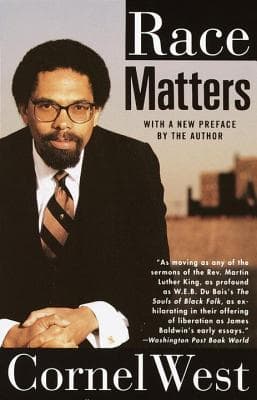
Race Matters cover
Archivist's Choice

Race Matters

Cornel West (1993)

Genre

Politics / History / Philosophy

Reading Time

150 min

Key Themes

See below

Track Your Reading

Sign in to track this book

Cornel West examines the lasting struggles of Black America, from the Rodney King riots to the Clarence Thomas hearings, calling for justice and cultural affirmation in a nation dealing with its racial identity.

Core Idea

Cornel West's "Race Matters" argues that the ongoing problems facing Black America in the late 20th century stem not just from economic or political issues, but from a spiritual and cultural "nihilism." This nihilism, a loss of hope and meaning, affects many parts of society and is made worse by both conservative indifference and liberal avoidance of racial topics. West believes that real progress needs a major change from usual racial thinking and identity politics to a "prophetic pragmatism" – a moral and political view based on an ethical commitment to justice, compassion, and self-reflection. This approach goes beyond narrow group interests to form wide-ranging alliances for democratic renewal.
Reading time
150 min
Difficulty
Medium
✓ Read this if...
You are seeking a profound, philosophical, and politically charged examination of race in America, particularly the spiritual and ethical dimensions of racial injustice and the challenges of Black leadership. This book is for those who want to move beyond superficial analyses to understand the deep-seated issues and the call for a transformative, prophetic response.
✗ Skip this if...
You prefer a purely historical narrative, a policy-focused analysis without philosophical depth, or an introduction to race theory that avoids complex moral and theological arguments. If you are looking for light reading or a simple, actionable political manifesto, this might not be for you.

Core idea

The central argument and framework that powers the entire book.

Cornel West's "Race Matters" argues that the ongoing problems facing Black America in the late 20th century stem not just from economic or political issues, but from a spiritual and cultural "nihilism." This nihilism, a loss of hope and meaning, affects many parts of society and is made worse by both conservative indifference and liberal avoidance of racial topics. West believes that real progress needs a major change from usual racial thinking and identity politics to a "prophetic pragmatism" – a moral and political view based on an ethical commitment to justice, compassion, and self-reflection. This approach goes beyond narrow group interests to form wide-ranging alliances for democratic renewal.

At a glance

Reading time

150 min

Difficulty

Medium

Read this if...

You are seeking a profound, philosophical, and politically charged examination of race in America, particularly the spiritual and ethical dimensions of racial injustice and the challenges of Black leadership. This book is for those who want to move beyond superficial analyses to understand the deep-seated issues and the call for a transformative, prophetic response.

Skip this if...

You prefer a purely historical narrative, a policy-focused analysis without philosophical depth, or an introduction to race theory that avoids complex moral and theological arguments. If you are looking for light reading or a simple, actionable political manifesto, this might not be for you.

Key Takeaways

1

The Pervasiveness of Nihilism

A spiritual and psychological crisis afflicting Black America, fueled by despair and meaninglessness.

Quote

Nihilism is not just a set of ideas, but a way of life, a lived experience of meaninglessness and despair that is deeply entrenched in the psychic structures of Black America.

West believes nihilism is the most significant threat to Black America, more damaging than white supremacy itself. It is a deep sense of hopelessness and meaninglessness, coming from a lack of love, care, and a future. This is not just a philosophical idea but a real experience, showing up as self-destructive behaviors, a lack of self-worth, and a constant feeling of being unwanted. It takes away the desire to live and succeed, making group action and self-improvement very hard. Dealing with this spiritual and psychological emptiness ...

Supporting evidence

West points to the high rates of violence, drug abuse, and incarceration within Black communities as symptoms of this underlying nihilistic despair, where individuals see no viable future or inherent value in their lives.

Apply this

Combat nihilism by fostering strong community bonds, emphasizing self-worth and mutual respect, and creating spaces for spiritual and emotional nourishment. Prioritize mentorship and intergenerational dialogue to instill hope and purpose in younger generations.


black-nihilismspiritual-crisismeaninglessness
2

The Pitfalls of Racial Reasoning

Over-reliance on racial identity as the sole lens for understanding and solving complex problems hinders progress.

Quote

To engage in racial reasoning is to believe that one's race is the primary lens through which all social, political, and economic issues should be understood and resolved.

West criticizes the tendency in both white and Black communities to reduce all societal problems to race, calling this 'racial reasoning.' This approach, while sometimes needed to acknowledge past injustices, becomes problematic when it stops a deeper look at class, gender, and other overlapping oppressions. For Black Americans, focusing only on race can lead to a narrow view of Black identity, stop internal criticism, and prevent the formation of wider alliances needed for systemic change. It also risks ignoring the varied experience...

Supporting evidence

West discusses how the Clarence Thomas/Anita Hill hearings were often framed solely through racial optics, obscuring crucial discussions about gender, power dynamics, and class, and leading to a polarized, unproductive debate.

Apply this

When analyzing social issues, always consider multiple axes of oppression—race, class, gender, sexuality—to gain a more nuanced understanding. Challenge simplistic racial explanations and advocate for intersectional solutions that address the root causes of injustice, not just their racial manifestations.

racial-essentialismintersectionalityidentity-politics
3

The Crisis of Black Leadership

Modern Black leadership often lacks a prophetic vision, prioritizing personal gain or narrow interests over community empowerment.

Quote

Too often, contemporary Black leadership is more concerned with being recognized by the powers that be than with fundamentally challenging those powers on behalf of the dispossessed.

West expresses concern about the decline of prophetic Black leadership, which historically articulated a broad vision of justice and freedom for all oppressed people. He argues that many current Black leaders have become too willing to compromise, seeking integration and personal advancement within existing power structures, or too focused on a narrow, often middle-class, agenda. This change has left the most vulnerable Black communities without effective support and a unifying vision. True leadership, for West, requires moral courage...

Supporting evidence

West contrasts the moral authority and broad vision of figures like Martin Luther King Jr. with what he perceives as the more self-serving or narrowly focused leadership that emerged in later decades, particularly after the Civil Rights Movement's peak.

Apply this

Support and cultivate leaders who demonstrate a commitment to social justice for all, not just a select few. Demand accountability from elected officials and community organizers to ensure their agendas genuinely serve the most marginalized, and prioritize grassroots organizing over top-down directives.

prophetic-leadershipblack-politicscommunity-empowerment
4

Beyond Affirmative Action

While necessary, affirmative action alone cannot dismantle systemic inequality; deeper structural changes are required.

Quote

Affirmative action is a necessary but not sufficient condition for achieving racial justice. It addresses symptoms, not root causes.

West acknowledges that affirmative action has been historically necessary and somewhat effective in addressing past and present discrimination. However, he also argues that it is only a reform that mainly helps the Black middle class and does not change the core conditions that cause poverty and disadvantage for most Black Americans. Real equality, he says, needs more fundamental actions: massive job creation, good public education from an early age, universal healthcare, and wealth redistribution. Focusing only on affirmative action ...

Supporting evidence

West suggests that while affirmative action has increased Black representation in certain institutions, it has done little to alleviate the deep-seated economic despair and lack of opportunity in inner-city communities, which require broader economic policies.

Apply this

Advocate for comprehensive structural reforms that address economic inequality, housing discrimination, and educational disparities, rather than relying solely on targeted programs like affirmative action. Support policies that create universal access to resources and opportunities for all citizens.

systemic-inequalityracial-justiceeconomic-justice
5

Demystifying the New Black Conservatism

Critically examining Black conservative voices as products of specific ideological and class interests, not universal Black thought.

Quote

The 'new Black conservatives' are not simply misguided; they represent a particular ideological response to the crisis of Black America, often aligning with a broader conservative agenda.

West critically looks at the rise of Black conservatism, especially figures like Clarence Thomas, seeing it not as a betrayal of Black identity, but as a specific ideological and class-based trend. He argues that these voices often express a self-reliance mindset, emphasizing individual responsibility and free-market solutions, which fit with mainstream conservative ideas. While acknowledging their right to these views, West warns against seeing them as representing the wider Black experience or offering workable solutions for the sys...

Supporting evidence

West scrutinizes the arguments made by Black conservatives during the Clarence Thomas hearings, highlighting how their narratives often downplayed systemic racism in favor of individualistic explanations for Black disadvantage.

Apply this

When encountering Black conservative viewpoints, analyze their underlying ideological frameworks and class interests. Engage in critical dialogue that challenges individualistic explanations for systemic problems and re-centers discussions on structural injustices and collective action.

black-conservatismideological-critiqueclass-politics
6

Black Sexuality: The Taboo Subject

The historical hypersexualization and repression of Black bodies have created a profound, unaddressed trauma.

Quote

Black sexuality remains a deeply repressed and distorted subject, a site of profound historical trauma and contemporary misunderstanding.

West directly addresses the sensitive and often avoided topic of Black sexuality, arguing that it remains a deeply repressed and twisted subject due to centuries of racist stereotypes and exploitation. From the hypersexualization of Black men to the stripping of sexuality and abuse of Black women, these historical harms continue to appear in current issues related to identity, relationships, and self-perception within the Black community. The inability to openly discuss and heal from these historical wounds adds to internal conflicts ...

Supporting evidence

West references the historical images of the 'Jezebel' and the 'brute' as examples of how racist ideologies have shaped perceptions of Black sexuality, leading to both external oppression and internal psychological damage.

Apply this

Create safe spaces within Black communities for open, honest, and non-judgmental dialogue about sexuality, desire, and intimacy. Challenge historical stereotypes and promote healthy, affirming representations of Black love and relationships in media and education.

black-sexualityhistorical-traumasexual-politics
7

Malcolm X and Black Rage

Malcolm X's enduring legacy lies in articulating the legitimate rage of oppressed Black people, demanding dignity and self-determination.

Quote

Malcolm X gave eloquent voice to the justified rage of a people systematically denied their humanity and dignity.

West explores the significance of Malcolm X, particularly his expression of Black rage. He argues that Malcolm X's strength was his ability to voice the deep anger and frustration of Black Americans, who had faced centuries of oppression and dehumanization. This was not a call for irrational violence, but a demand for self-respect, dignity, and self-determination in the face of systemic injustice. While Malcolm X's views changed, his early direct criticism of white supremacy and his insistence on Black self-love resonated deeply and s...

Supporting evidence

West highlights Malcolm X's powerful speeches and writings, which unapologetically exposed the hypocrisy of American democracy and called for Black people to define their own destiny, often contrasting with the more integrationist approach of other civil rights leaders.

Apply this

Recognize and validate the legitimate anger stemming from historical and ongoing injustices. Channel this rage into constructive forms of resistance, advocacy, and community building, inspired by Malcolm X's call for self-respect and collective empowerment.

malcolm-xblack-rageself-determination
8

The Necessity of a Prophetic Pragmatism

A call for an ethical, action-oriented philosophy that combines moral vision with practical engagement for justice.

Quote

What is needed is a prophetic pragmatism, a critical temper that is rooted in a moral vision of justice and freedom, yet always open to revision and democratic experimentation.

West supports 'prophetic pragmatism' as the philosophical and ethical framework needed to address the complex challenges facing Black America and the nation. This approach combines a strong moral commitment to justice, love, and community (the 'prophetic' part) with a flexible, experimental, and self-critical engagement with reality (the 'pragmatic' part). It rejects both rigid ideology and cynical resignation, instead calling for continuous struggle, dialogue, and adaptation. It asks us to not only dream of a better world but also ac...

Supporting evidence

West's own intellectual journey and engagement with various philosophical traditions (e.g., American pragmatism, Christian theology, Marxist thought) inform this concept, illustrating a synthesis of moral conviction with practical, evolving political action.

Apply this

Adopt a mindset of continuous learning and adaptation in your activism and advocacy. Ground your efforts in a clear moral vision of justice, but be willing to adjust strategies based on real-world outcomes and diverse perspectives. Engage in critical self-reflection and dialogue.

prophetic-pragmatismethical-philosophysocial-justice
9

Black-Jewish Relations: A Fragile Bridge

Historical alliances are strained by differing historical narratives and contemporary political realities, requiring empathetic dialogue.

Quote

The Black-Jewish alliance, once a beacon of hope, has become a fragile bridge, often fractured by competing historical narratives and political pressures.

West examines the complex and often difficult relationship between Black and Jewish communities in America, acknowledging their historical alliance during the Civil Rights Movement while also addressing current tensions. He argues that these strains often come from different historical narratives—the Holocaust for Jewish people versus slavery and Jim Crow for Black people—and from political disagreements, especially concerning the Israeli-Palestinian conflict and domestic issues. West stresses the need for empathy, honest dialogue, an...

Supporting evidence

West discusses specific instances of friction, such as controversies over Louis Farrakhan's rhetoric or differing views on affirmative action, to illustrate how historical bonds have been tested by contemporary political and social issues.

Apply this

Engage in open, empathetic dialogue with members of different communities, particularly those with whom there are historical tensions. Seek to understand differing historical narratives and political perspectives, and identify common ground for collaboration on shared goals of justice and equality.

black-jewish-relationsintergroup-dialoguehistorical-memory
10

The Enduring Relevance of Race

Despite attempts to declare it obsolete, race remains a fundamental organizing principle of American society.

Quote

To claim that race no longer matters in America is to willfully ignore the lived experiences of millions and the deeply embedded structures of power.

The basic idea of West's work is that race truly matters in America, despite claims of a post-racial society. He argues that race is not just a social construct but a powerful force that shapes life chances, access to resources, and personal identity. From economic differences and political representation to cultural perceptions and individual psychology, race continues to be a central organizing principle of American society. Ignoring or downplaying its importance is dishonest and harmful, preventing effective solutions to ongoing in...

Supporting evidence

The entire collection of essays serves as evidence, with each chapter dissecting how race impacts various facets of American life, from the Rodney King riots to the intricacies of Black leadership and sexuality.

Apply this

Actively challenge narratives that dismiss the ongoing impact of race. Educate yourself and others on the historical and contemporary ways race shapes society. Incorporate a racial justice lens into all analyses of social, economic, and political issues.

racial-inequalitysystemic-racismpost-racial-myth

Critical analysis

Notable Quotes

To engage in a serious discussion of race in America, we must begin not with the problems of black people but with the flaws of American society—flaws rooted in historical inequalities and longstanding cultural stereotypes.

Opening argument for the systemic nature of racial issues.

The liberal structuralist argument that emphasizes the role of economic forces and class divisions often underplays the power of race and racism as independent variables.

Critique of purely economic explanations for racial disparities.

Nihilism is not an argument but rather a condition, a disease of the soul.

Discussing the despair and lack of hope in marginalized communities.

Black leadership must accept the challenge of being a critical catalyst for a moral and spiritual awakening in America.

Call for a renewed vision and purpose in African American leadership.

The conservative behaviorist argument, which focuses on black cultural pathologies, often ignores the structural sources of these pathologies.

Critique of conservative explanations for racial problems.

The tragicomic plight of prophetic religion is that it must tell the truth in a world that does not want to hear it.

Reflecting on the role and difficulty of prophetic voices in society.

Race is the most explosive issue in American life precisely because it forces us to confront the tragic past and the problematic present of the country.

Highlighting the enduring significance and difficulty of discussing race.

We need to work for a society in which the humanity of all persons is affirmed, a society in which the dignity and respect of each person is acknowledged.

Expressing a vision for a more just and humane society.

To be a serious intellectual is to be a critical and self-critical thinker, one who is willing to challenge power and authority, even one's own.

Defining the role and responsibility of an intellectual.

The crisis in black America is not simply a matter of economics or politics; it is also a spiritual crisis, a crisis of meaning and hope.

Expanding the understanding of the multifaceted challenges facing Black communities.

Authentic black rage is a product of this history of humiliation and degradation, a history too often ignored or trivialized.

Explaining the origins and validity of black anger.

Justice is what love looks like in public.

A concise and powerful definition of justice.

If we are to be true to ourselves, we must be true to the best of our traditions, which means being critical of the worst.

Advocating for a critical engagement with historical traditions.

We must cultivate a politics of conversion, a politics that aims to change hearts and minds, not just laws and policies.

Arguing for a deeper, more transformative approach to political change.

Quiz

Test Your Knowledge

Ready to see how well you understood this book? Take our interactive quiz with 10 questions.

10
Questions
~5
Minutes
?
Best Score

Key Questions (FAQ)

'Race Matters' argues that race remains a pivotal issue in American society, deeply affecting political, economic, and social life for Black Americans. West contends that a combination of nihilism within Black communities and a lack of substantive engagement from mainstream society perpetuates racial inequality.

About the author

Cornel West

Cornel West is a prominent American philosopher, critic, and public intellectual. A prolific author, his influential works, including 'Race Matters,' explore themes of race, class, and democracy. West holds a PhD from Princeton University and has taught at prestigious institutions like Harvard and Princeton, making him a leading voice in social and political commentary.