BookBrief
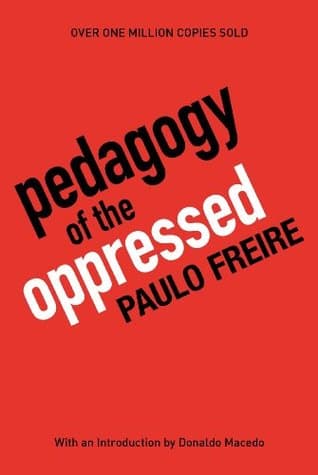
Pedagogy of the Oppressed cover
Archivist's Choice

Pedagogy of the Oppressed

Paulo Freire (1970)

Genre

Politics / History / Philosophy

Reading Time

12 Minutes

Key Themes

See below

Track Your Reading

Sign in to track this book

Core Idea

Paulo Freire's "Pedagogy of the Oppressed" critiques traditional, 'banking' models of education where teachers deposit knowledge into passive students, arguing this system perpetuates oppression. Instead, Freire proposes a 'problem-posing' education, a dialogical and collaborative process where teachers and students co-investigate reality. This method empowers the oppressed to critically analyze their circumstances, recognize their agency, and collectively work towards liberation through praxis—reflection and action. The book fundamentally argues that authentic education is a tool for humanization and social transformation, not domestication.
Difficulty
Hard

Core idea

The central argument and framework that powers the entire book.

Paulo Freire's "Pedagogy of the Oppressed" critiques traditional, 'banking' models of education where teachers deposit knowledge into passive students, arguing this system perpetuates oppression. Instead, Freire proposes a 'problem-posing' education, a dialogical and collaborative process where teachers and students co-investigate reality. This method empowers the oppressed to critically analyze their circumstances, recognize their agency, and collectively work towards liberation through praxis—reflection and action. The book fundamentally argues that authentic education is a tool for humanization and social transformation, not domestication.

At a glance

Difficulty

Hard

Key Takeaways

1

The Banking Concept of Education

Education as an act of depositing information, rather than a process of liberation.

Quote

The outstanding characteristic of this (banking) education is the sonority of words, not their transforming power.

Freire criticizes traditional education as a 'banking concept.' Teachers are 'depositors,' and students are 'receptacles.' This model treats students as passive objects to be filled with information, stifling critical thought and creativity. It reinforces oppressive structures, preparing individuals to accept the status quo rather than question or change it. This approach, common in many formal schooling systems, reduces knowledge to a static commodity. It denies learners' capacity for inquiry and problem-solving, serving the oppresso...

Supporting evidence

Freire elaborates on the 'banking concept' throughout Chapter 2, contrasting it with 'problem-posing education.' He uses examples of rote memorization and the teacher-as-narrator dynamic.

Apply this

Educators should shift from lecturing to facilitating dialogue, encouraging students to bring their own experiences and questions to the learning process, fostering active participation and critical thinking.

2

Problem-Posing Education

A liberatory educational approach centered on dialogue and critical inquiry.

Quote

Problem-posing education, by contrast, is revolutionary futurity.

Freire proposes 'problem-posing education' as the opposite of the banking concept. This method involves a dynamic, conversational relationship where teachers and students investigate reality together. Knowledge is not given but co-created through critical reflection on real-world problems. This process, called 'conscientização' (conscientization), helps individuals see social, political, and economic contradictions and act against oppressive elements. It changes education from a tool of control into a practice of freedom, allowing ind...

Supporting evidence

Chapter 2 fully develops the concept of problem-posing education, contrasting it with the banking model and emphasizing its dialogical nature and potential for conscientization.

Apply this

Implement Socratic seminars, project-based learning, and community-based research where students analyze and propose solutions to local or global issues, fostering a sense of agency.

3

Conscientization as Liberation

The process of developing critical consciousness to understand and transform one's social reality.

Quote

Conscientization is the deepening of the attitude of awareness characteristic of all emergence.

Conscientization is the central idea of Freire's teaching. It is the process by which individuals, especially the oppressed, deeply understand the social, political, and economic contradictions that affect their lives. It also helps them act against oppressive parts of reality. It is not just intellectual awareness but a deep shift in perspective that leads to change. This idea is arguably the book's strongest because it directly connects education to social change. It states that true freedom starts with critical self-awareness and c...

Supporting evidence

Freire introduces and elaborates on conscientization throughout Chapter 2 and Chapter 3, linking it directly to the practice of liberation and the overcoming of 'culture of silence.'

Apply this

Facilitate discussions and activities that encourage individuals to critically examine their own experiences of injustice or disempowerment, and collectively brainstorm strategies for addressing these issues in their communities.

4

The Oppressor-Oppressed Dialectic

A symbiotic, yet antagonistic, relationship that perpetuates dehumanization.

Quote

The oppressed, having internalized the image of the oppressor and adopted his guidelines, are fearful of freedom.

Freire argues that oppression harms both the oppressed and the oppressor. The oppressor, by denying others' humanity, also diminishes their own. The oppressed, having adopted the oppressor's view, often fear freedom and may even want to become oppressors themselves. This creates a cycle where true liberation requires both groups to overcome their dehumanized states. This argument is powerful in saying that liberation is a shared process, not just a role reversal. However, its practical application can be difficult given power imbalanc...

Supporting evidence

Chapter 1 extensively analyzes the oppressor-oppressed dialectic, discussing how the oppressed internalize the oppressor's consciousness and the fear of freedom.

Apply this

Create spaces where both marginalized and privileged individuals can engage in honest dialogue about power dynamics and systemic inequalities, fostering empathy and a shared commitment to dismantling oppressive structures.

5

Dialogue as the Essence of Liberation

Authentic communication as the foundation for humanization and transformative action.

Quote

Dialogue is the encounter between men, mediated by the world, in order to name the world.

Freire states that dialogue is essential for true humanization and liberation. Authentic dialogue, for Freire, is not just conversation but a deep meeting between individuals, marked by love, humility, faith, and critical hope. Through this dialogue, shared with the world they want to change, individuals 'name the world.' This means they critically reflect on and act upon their reality. Without dialogue, communication becomes a monologue, and education returns to the banking concept. This idea supports all of Freire's teaching methods...

Supporting evidence

Chapter 3 is dedicated to the theory of dialogical action, outlining its components (love, humility, faith, hope, critical thinking) and contrasting it with anti-dialogical action.

Apply this

In any group setting, establish ground rules that prioritize active listening, respectful disagreement, and shared inquiry, ensuring all voices are heard and valued in the process of collective problem-solving.

6

The Four Anti-Dialogical Actions

Tools of oppression: conquest, divide and rule, manipulation, and cultural invasion.

Quote

The oppressor must invent myths of the oppressors' superiority and the oppressed's inferiority.

Freire identifies four anti-dialogical actions oppressors use to keep power: conquest, divide and rule, manipulation, and cultural invasion. Conquest treats the oppressed as objects to be controlled; divide and rule prevents unity among the oppressed; manipulation subtly guides the oppressed to accept the oppressor's view; and cultural invasion imposes the oppressor's culture, alienating the oppressed from their own. Understanding these tactics helps the oppressed recognize and resist their subjugation. This framework helps analyze po...

Supporting evidence

Chapter 4 meticulously details each of the four anti-dialogical actions and their historical manifestations.

Apply this

Analyze current political or social events through the lens of these four actions, identifying how dominant groups might be employing them to maintain control or prevent collective action among marginalized communities.

7

The Four Dialogical Actions

Pathways to liberation: cooperation, unity, organization, and cultural synthesis.

Quote

The dialogical theory of action is not to be found in abstract words, but in concrete acts.

In contrast to anti-dialogical actions, Freire proposes four dialogical actions for liberation: cooperation, unity, organization, and cultural synthesis. Cooperation encourages collective action against oppression; unity builds solidarity among the oppressed; organization provides structure for sustained efforts to change things; and cultural synthesis respects and includes the culture of the oppressed, rather than replacing it. These actions are not just ideas but require concrete practice, forming the plan for a truly liberating edu...

Supporting evidence

Chapter 4 also details the four dialogical actions, presenting them as the necessary responses to the anti-dialogical actions for liberation.

Apply this

Support and participate in community organizing efforts that prioritize collective decision-making, celebrate diverse cultural perspectives, and build strong alliances among different groups working towards social justice.

8

The Role of Revolutionary Leadership

Leaders must engage in authentic dialogue, not manipulate, to achieve true liberation.

Quote

The revolutionary leadership must practice co-intentional education with the people.

Freire focuses on the role of revolutionary leadership. He stresses that true leaders must not become new oppressors. Their job is not to 'deposit' their ideas into the oppressed, but to engage in real dialogue, investigating reality with the people. They must encourage critical awareness and help the oppressed become agents of their own liberation, not passive receivers of revolutionary orders. This argument is important because it warns against authoritarian tendencies even within liberation movements. It ensures that the methods of...

Supporting evidence

Chapter 4 specifically addresses the theory of dialogical action and its application to revolutionary leadership, contrasting it with the anti-dialogical actions of oppressors.

Apply this

When participating in activist groups or community initiatives, ensure that leadership structures are horizontal and democratic, prioritizing collective input and shared decision-making over hierarchical authority, fostering a sense of shared ownership.

9

Nietzschean Overtones and Limitations

While powerful, some arguments bear a resemblance to Nietzschean will-to-power, potentially overlooking systemic constraints.

Quote

The oppressed are not to be saved from their condition, but to save themselves.

Freire's focus on the oppressed becoming agents of their own liberation is deeply empowering. However, some interpretations might see a subtle, perhaps unintended, hint of Nietzschean 'will to power.' The intense focus on overcoming oppression through conscious action, while inspiring, could be misinterpreted to downplay the deep-seated, systemic, and often invisible structures that limit agency. This is not a criticism of Freire's intent, but an acknowledgment that the book, especially in its more philosophical parts, might benefit f...

Supporting evidence

Freire's repeated assertion that the oppressed must 'name the world' and 'transform it' through their own actions, and his critique of any 'savior' mentality, implicitly places a heavy emphasis on the agency of the oppressed (e.g., Chapter 1 and 2).

Apply this

While promoting individual and collective agency, also advocate for policy changes and structural reforms that address systemic inequalities, recognizing that individual conscientization alone may not dismantle deeply entrenched oppressive systems.

10

Hope and Praxis

Liberation is an ongoing process of reflection and action, fueled by critical hope.

Quote

Human existence cannot be silent, nor can it be nourished by false words, but only by true words, with which men transform the world.

Freire concludes by saying that liberation is not a fixed state but an ongoing process of 'praxis' – the dynamic interaction of reflection and action. This process is sustained by 'critical hope,' which is not naive optimism but a deep belief in the possibility of transformation, even when facing difficulties. This critical hope, combined with continuous dialogue and action, prevents the revolutionary struggle from becoming static or authoritarian. This final point summarizes the book's lasting message: true freedom is a constant, col...

Supporting evidence

The concept of praxis is woven throughout the entire book, particularly highlighted in the introduction and concluding chapters as the essential component of liberation. Critical hope is also discussed in Chapter 3 as a fundamental requirement for dialogue.

Apply this

Cultivate a mindset of continuous learning and adaptation in social justice work, regularly reflecting on the outcomes of actions and adjusting strategies based on new insights, maintaining persistent effort without succumbing to cynicism.

Critical analysis

Notable Quotes

Quiz

Test Your Knowledge

Ready to see how well you understood this book? Take our interactive quiz with 10 questions.

10
Questions
~5
Minutes
?
Best Score

Key Questions (FAQ)

Pedagogy of the Oppressed is a seminal work of critical pedagogy that explores the relationship between the oppressor and the oppressed. It critiques traditional educational methods, advocating for a "problem-posing" approach that empowers learners to critically analyze their reality and engage in transformative action.

About the author