BookBrief
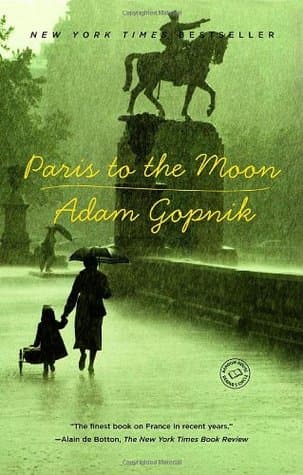
Paris to the Moon cover
Archivist's Choice

Paris to the Moon

Adam Gopnik (2000)

Genre

Lifestyle / Biography / Memoir

Reading Time

9-12 hours

Key Themes

See below

Track Your Reading

Sign in to track this book

An American writer raises his family in late 20th-century Paris, finding the city's magic in its everyday quirks as much as its romantic image.

Core Idea

Adam Gopnik's "Paris to the Moon" explores the expatriate experience in Paris. It challenges romanticized views of the city while celebrating its daily charm. Gopnik uses his experience raising a young son, Luke, to examine cultural differences, historical context, and personal changes that come with living abroad. The book suggests that truly understanding a place, and oneself, comes from small, often funny, daily observations and the common challenges of family life, all set in an iconic city. It argues that the 'myth' of Paris is less about perfection and more about its ability to inspire thoughts on identity, belonging, and time.
Reading time
9-12 hours
Difficulty
Medium
✓ Read this if...
You are fascinated by Parisian culture, enjoy thoughtful memoirs blending personal narrative with cultural observation, or appreciate a writer who can find profound meaning and humor in the mundane.
✗ Skip this if...
You prefer fast-paced narratives with strong plot progression, are looking for a practical guide to Paris, or dislike books that meander through philosophical reflections and everyday anecdotes.

Core idea

The central argument and framework that powers the entire book.

Adam Gopnik's "Paris to the Moon" explores the expatriate experience in Paris. It challenges romanticized views of the city while celebrating its daily charm. Gopnik uses his experience raising a young son, Luke, to examine cultural differences, historical context, and personal changes that come with living abroad. The book suggests that truly understanding a place, and oneself, comes from small, often funny, daily observations and the common challenges of family life, all set in an iconic city. It argues that the 'myth' of Paris is less about perfection and more about its ability to inspire thoughts on identity, belonging, and time.

At a glance

Reading time

9-12 hours

Difficulty

Medium

Read this if...

You are fascinated by Parisian culture, enjoy thoughtful memoirs blending personal narrative with cultural observation, or appreciate a writer who can find profound meaning and humor in the mundane.

Skip this if...

You prefer fast-paced narratives with strong plot progression, are looking for a practical guide to Paris, or dislike books that meander through philosophical reflections and everyday anecdotes.

Key Takeaways

1

The Myth of Parisian Perfection

Paris, like parenthood, is a beautiful illusion that dissolves into charming, complex reality.

Quote

We went to Paris for a sentimental reeducation - I did anyway - even though the sentiments we were instructed in were not the ones we were expecting to learn, which I believe is why they call it an education.

Gopnik shows a Paris that is both beautiful and frustrating, breaking down the romanticized American view. He finds that the 'Paris' most Americans imagine is an idealized fantasy. The reality involves dealing with bureaucracy, indifferent shopkeepers, and the common challenges of raising a child, all set against a charming background. This demystification is not a letdown but an improvement, allowing for a deeper, more real appreciation of the city's true nature. His 'sentimental reeducation' is about learning to love the real Paris,...

Supporting evidence

Gopnik recounts his initial struggles with the French language and bureaucracy, the shocking discovery of a relatively small Parisian apartment, and the universal challenges of finding childcare and managing a household, all of which contrast sharply with his pre-conceived notions of effortless Parisian elegance.

Apply this

Approach new experiences, especially those with strong cultural or personal expectations (like moving abroad or starting a family), with an open mind. Be prepared for the gap between expectation and reality, and find joy in the authentic, often imperfect, truth. Embrace the mundane alongside the magical.

cultural-expectationsromanticism-vs-realityparenting-challenges
2

The Universal Language of Parenthood

Beneath cultural differences, the anxieties and joys of raising children are profoundly similar.

Quote

The dual processes of navigating a foreign city and becoming a parent are not completely dissimilar journeys—both hold new routines, new languages, a new set of rules by which everyday life is lived.

One of Gopnik's most important ideas is that parenthood is a unifying experience. Despite the clear cultural differences between New York and Paris—different ways of discipline, education, even playground rules—a parent's basic emotions stay the same. Worry for a child's health, the joy of a new milestone, the exhaustion of sleepless nights, fierce protective love—these cross borders and languages. Gopnik finds himself discussing baby food and playground politics with French parents, realizing that the 'new language' of parenthood is ...

Supporting evidence

Gopnik's humorous observations on Parisian playgrounds, where French mothers are seemingly more relaxed about their children's independence, or his detailed accounts of navigating French pediatricians and school systems, always circle back to the core parental anxieties and triumphs he shares with his French counterparts.

Apply this

Seek common ground in human experiences, especially in unfamiliar environments. Parenthood, shared hobbies, or professional challenges can be powerful connectors that bridge cultural divides and foster understanding.

cross-cultural-parentinghuman-connectionuniversal-experiences
3

The Everyday Sublime

True beauty and profound meaning are found not just in grand monuments, but in daily life.

Quote

Evenings with French intellectuals preceded middle-of-the-night baby feedings; afternoons were filled with trips to the Musée d'Orsay and pinball games; weekday leftovers were eaten while three-star chefs debated a 'culinary crisis.'

Gopnik's memoir shows how to find the extraordinary in the ordinary. While he engages with Parisian high culture—museums, intellectual gatherings, fine dining—he also celebrates the magic of daily routines: a walk in the Luxembourg Gardens, a simple meal at a local bistro, watching his son play. He demonstrates that 'Parisian style' is not just about fashion or art, but about appreciating life itself, even in its most common moments. The mix of intellectual debates with baby feedings highlights that true richness comes from combining ...

Supporting evidence

His detailed descriptions of grocery shopping at local markets, the particularities of Parisian cafés, the simple pleasure of a croque monsieur, and his son's delight in everyday activities like playing pinball, are all given as much weight and evocative description as visits to the Louvre.

Apply this

Actively seek out and appreciate the beauty and meaning in your daily life and routines. Cultivate mindfulness towards the 'small' moments, as they often contribute most to overall well-being and a sense of richness.

mindfulnessaesthetic-appreciationfinding-joy-in-ordinary
4

The American Abroad: A Mirror

Experiencing a foreign culture reveals as much about one's own identity as it does about the new place.

Quote

Gopnik's was above all a personal pilgrimage to the place that had for so long been the undisputed capital of everything cultural and beautiful.

Gopnik's journey to Paris is about understanding France, but also about understanding himself and, by extension, America. His observations of Parisian life are often seen through an American lens, showing differences in values, priorities, and social norms. The French approach to food, education, public space, and even intellectualism makes Gopnik think about American equivalents. Sometimes he admires them, sometimes he is amused, and sometimes he finds a new appreciation for parts of his own culture he had taken for granted. The 'Ame...

Supporting evidence

His comparisons of American and French parenting styles, the contrasting attitudes towards consumerism, and the different approaches to public discourse and intellectual life all serve to illuminate both cultures, with America often serving as the implicit counterpoint.

Apply this

Engage with different cultures, whether through travel, literature, or conversation, not just to learn about them, but to gain new perspectives on your own culture and personal identity. Question your assumptions.

cultural-identityself-reflectionexpat-experience
5

The Language of Food and Belonging

Food in Paris is more than sustenance; it's a profound expression of culture, history, and social connection.

Quote

Weekday leftovers were eaten while three-star chefs debated a 'culinary crisis.'

Food, for Gopnik, becomes a central way to understand Parisian life. It is not just about gourmet dining, though he explores that, but about the deeply ingrained cultural rituals around eating: the daily market trip, the appreciation for fresh, seasonal ingredients, the communal aspect of meals, and even intellectual discussions about culinary philosophy. He observes how the French approach food with a seriousness and respect that often surprises an American. Through food, he slowly begins to grasp the French emphasis on pleasure, tra...

Supporting evidence

Gopnik details his family's adventures in a French supermarket, the significance of bread (especially the baguette), the cultural weight of cheese, and the fervent discussions among chefs and critics about the future of French cuisine, illustrating how food permeates every aspect of society.

Apply this

Pay attention to the role of food in different cultures (including your own). Understand that culinary practices often reflect deeper values, histories, and social structures. Use food as a gateway to cultural understanding and connection.

food-cultureculinary-traditionscultural-anthropology
6

Embracing the Flâneur

To truly know a city, one must wander aimlessly, observing and absorbing its rhythms.

Quote

Gopnik walked the paths of the Tuileries, enjoyed philosophical discussions at his local bistro, wrote as violet twilight fell on the arrondissements.

Gopnik acts as a 'flâneur,' a relaxed urban explorer. His best ideas often come not from planned appointments, but from simply walking the streets, observing daily details, and being open to chance encounters and reflections. This unhurried pace, different from the typical American rush, allows him to truly absorb Paris's atmosphere, to notice subtle interactions, architectural details, and changing light. Walking becomes a form of meditation and discovery, revealing the city's hidden layers and allowing for a deeper, more sensory eng...

Supporting evidence

Throughout the book, Gopnik describes his extensive walks through various arrondissements, his observations of street performers, dog walkers, and café patrons, and the way these seemingly casual observations lead to profound insights about Parisian character and culture.

Apply this

In new environments (or even familiar ones), make time for unstructured exploration. Put away your phone, walk without a specific destination, and simply observe. Allow your senses to take in the details and rhythms of your surroundings.

urban-explorationmindful-walkingobservational-learning
7

The Enduring Power of Stories

Our understanding of places and people is shaped by the narratives we inherit and create.

Quote

Paris. The name alone conjures images of chestnut-lined boulevards, sidewalk cafés, breathtaking façades around every corner--in short, an exquisite romanticism that has captured the American imagination for as long as there have been Americans.

Gopnik is very aware of the strong stories that came before and shaped his Parisian experience. He arrives with many literary and cinematic clichés about the city, and much of his journey involves facing, confirming, or changing these stories. He explores how myths are built around places, and how these myths, though often inaccurate, serve an important cultural purpose. His own writing adds to this ongoing narrative, but with a nuanced, personal touch that acknowledges both the magic and the mundane. The book itself shows the lasting...

Supporting evidence

Gopnik frequently references famous literary figures who lived in Paris (Hemingway, Fitzgerald) and discusses the city's portrayal in film and art, showing how these pre-existing narratives influence his own expectations and discoveries.

Apply this

Be aware of the stories and narratives that shape your perceptions of places, people, and events. Critically evaluate these narratives, and actively seek out diverse perspectives to form a more complete understanding.

narrative-theorycultural-mythologyliterary-influence
8

Humor as a Survival Mechanism

Laughter and wit are essential tools for navigating the absurdities of life, especially abroad.

Quote

With singular wit and insight, Gopnik weaves the magical with the mundane in a wholly delightful, often hilarious look at what it was to be an American family man in Paris at the end of the twentieth century.

Gopnik's distinct wit is not just for fun; it is a key way to cope with the frustrations and cultural misunderstandings that come with living abroad. From exasperating bureaucracy to confusing social customs, humor helps him keep perspective, ease tension, and ultimately find joy in situations that might otherwise be overwhelming. His self-deprecating humor and sharp observations turn potential annoyances into delightful stories, making the reader feel both his struggles and his successes. Laughter becomes a way to bridge the gap betw...

Supporting evidence

His hilarious accounts of trying to master the French language, his misadventures in French stores, or the cultural clashes regarding child-rearing are all imbued with a gentle, self-aware humor that makes the challenges relatable and endearing.

Apply this

Cultivate a sense of humor, especially when facing new or challenging situations. Laughter can reduce stress, improve adaptability, and help you connect with others, even across cultural barriers.

cultural-adaptationcoping-mechanismsobservational-humor
9

The Evolution of a Relationship with a City

Love for a place, like love for a person, matures from initial infatuation to a deeper, more complex bond.

Quote

It was also the opportunity to raise a child who would know what it was to romp in the Luxembourg Gardens, to enjoy a croque monsieur in a Left Bank café—a child (and perhaps a father, too) who would have a grasp of that Parisian sense of style we Americans find so elusive.

Gopnik's relationship with Paris changes significantly over his five years there. It starts with an almost childlike wonder and a desire to experience its legendary glamour, a 'personal pilgrimage.' As he deals with the realities of daily life—the joys of raising a child, the frustrations of bureaucracy, the nuances of cultural difference—his love for the city deepens and becomes more complex. It moves beyond superficial admiration to a strong, lived-in affection that acknowledges both its flaws and its lasting magic. This path mirror...

Supporting evidence

His initial awe of Parisian art and architecture is slowly complemented by a deep appreciation for its neighborhoods, its people, and the rhythm of everyday life, culminating in a bittersweet farewell that reflects a profound connection.

Apply this

Allow your relationships with places, people, and even ideas to evolve. Resist the urge to hold onto initial idealizations; instead, embrace the complexities and imperfections that lead to deeper, more resilient connections.

place-attachmentpersonal-growthlong-term-relationships

Critical analysis

Notable Quotes

The true purpose of a pilgrimage is not to arrive at a destination, but to discover a new way of looking at the journey itself.

Reflecting on the expatriate experience in Paris.

Paris is a city of a thousand villages, each with its own rhythm, its own smell, its own particular way of being itself.

Describing the distinct neighborhoods of Paris.

The greatest pleasure in Paris is not in seeing what's new, but in rediscovering what's old and finding it fresh again.

Discussing the enduring charm of Parisian traditions.

Children, as it turns out, are the ultimate travel companions, because they force you to slow down and notice everything.

Reflecting on experiencing Paris with his young son, Luke.

There are two kinds of people in the world: those who love Paris, and those who haven't been there yet.

A playful declaration of his affection for the city.

The expatriate life is a constant negotiation between the comfort of the familiar and the thrill of the new.

Exploring the challenges and rewards of living abroad.

A good meal in Paris is not just food; it's a performance, a ritual, a profound act of civilization.

Describing the importance of gastronomy in French culture.

The French have a genius for making the ordinary extraordinary.

Observing the elegance and attention to detail in everyday French life.

To live in Paris is to live with history breathing down your neck, but in the best possible way.

Contemplating the historical depth of the city.

The real magic of Paris is not in its monuments, but in the way it makes you feel alive.

Emphasizing the emotional impact of the city.

There is a certain kind of light in Paris that makes everything look like a painting.

Describing the unique atmospheric quality of the city.

The art of living well, the French seem to understand, is not about having more, but about appreciating what you have more deeply.

Reflecting on French attitudes towards life and pleasure.

Parenting, like expatriation, is a constant act of improvisation, a dance between control and letting go.

Drawing parallels between raising a child and living in a foreign country.

Paris is a city that rewards curiosity, that unfolds its secrets slowly, if you're willing to look.

Encouraging exploration and attentiveness in the city.

Quiz

Test Your Knowledge

Ready to see how well you understood this book? Take our interactive quiz with 10 questions.

10
Questions
~5
Minutes
?
Best Score

Key Questions (FAQ)

'Paris to the Moon' is a memoir by Adam Gopnik, chronicling his family's move from New York City to Paris in 1995. It blends personal anecdotes of raising a child in a foreign city with cultural observations of Parisian life at the end of the 20th century.

About the author

Adam Gopnik

Adam Gopnik is a Canadian essayist, novelist, and short-story writer, widely recognized for his insightful observations on culture, art, and politics. A long-time staff writer for The New Yorker, his notable works include "Paris to the Moon" and "Winter: Five Windows on the Season." Gopnik's writing is celebrated for its intellectual depth and elegant prose.