BookBrief
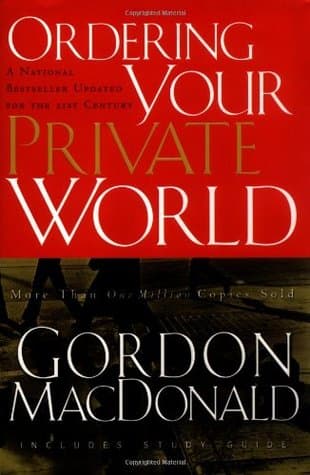
Ordering Your Private World cover
Archivist's Choice

Ordering Your Private World

Gordon MacDonald (1984)

Genre

Leadership / Spirituality / Self-Help

Reading Time

240 min

Key Themes

See below

Track Your Reading

Sign in to track this book

Cultivating a disciplined inner spiritual life is key to lasting public effectiveness and preventing burnout in a world that overvalues external activity.

Core Idea

Gordon MacDonald argues that true public effectiveness and lasting impact come directly from a well-ordered 'private world.' He believes people often prioritize external activity and public image over internal spiritual, intellectual, and emotional health, which leads to burnout, moral failure, and superficial results. The book offers a way to build inner order through managing time, thoughts, relationships, and rest, stating that this internal discipline is necessary for lasting and real external success.
Reading time
240 min
Difficulty
Medium
✓ Read this if...
You are a leader, professional, or individual feeling overwhelmed, fragmented, or in danger of burnout, and believe your external busyness is compromising your internal well-being and long-term effectiveness. You want practical, spiritually-grounded advice on personal discipline and prioritizing what truly matters.
✗ Skip this if...
You are looking for a quick-fix productivity hack book, prefer secular self-help, or are not open to spiritual principles guiding personal development and leadership.

Core idea

The central argument and framework that powers the entire book.

Gordon MacDonald argues that true public effectiveness and lasting impact come directly from a well-ordered 'private world.' He believes people often prioritize external activity and public image over internal spiritual, intellectual, and emotional health, which leads to burnout, moral failure, and superficial results. The book offers a way to build inner order through managing time, thoughts, relationships, and rest, stating that this internal discipline is necessary for lasting and real external success.

At a glance

Reading time

240 min

Difficulty

Medium

Read this if...

You are a leader, professional, or individual feeling overwhelmed, fragmented, or in danger of burnout, and believe your external busyness is compromising your internal well-being and long-term effectiveness. You want practical, spiritually-grounded advice on personal discipline and prioritizing what truly matters.

Skip this if...

You are looking for a quick-fix productivity hack book, prefer secular self-help, or are not open to spiritual principles guiding personal development and leadership.

Key Takeaways

1

The Private World Precedes Public Effectiveness

True leadership and spiritual vitality stem from a well-ordered inner life, not just outward activity.

Quote

One of the great battlegrounds of the new century is within the private world of the individual.

MacDonald argues that modern Western culture, especially in religious and leadership circles, wrongly sees busyness and public visibility as signs of spirituality and effectiveness. This leads to too much focus on external programs, meetings, and duties, often at the cost of one's inner, private world. He states that real and lasting impact in public life comes directly from a disciplined, thoughtful, and spiritually nourished inner life. Without this basic order in the private world, people, even with good intentions, risk burnout, h...

Supporting evidence

MacDonald frequently references the societal pressure on leaders to appear constantly active and engaged, contrasting it with the biblical examples of leaders like Jesus who regularly withdrew for solitude and prayer to replenish their inner resources.

Apply this

Regularly schedule 'white space' in your calendar for solitude, reflection, and spiritual disciplines. This isn't just downtime; it's proactive investment in your core being. Start with 15-30 minutes daily, building up to longer periods weekly or monthly.

inner-lifespiritual-disciplineleadership-sustainability
2

Mastering the Calendar and the Clock

Intentional time management is crucial for protecting the private world from the demands of the public.

Quote

We have schedule planners, computerized calendars, and self-stick notes to help us organize our business and social lives everyday. But what about organizing the other side of our lives—the spiritual side?

MacDonald points out that while we are good at organizing our public and professional lives with various tools, we often fail to apply the same care to our private, spiritual lives. He stresses that time is limited and cannot be replaced, and how we use it shows our true priorities. Good management of the calendar and the clock is not about fitting more into a busy schedule, but about setting clear limits and making time for personal growth, spiritual practices, and relationships. This active approach stops the constant demands of the...

Supporting evidence

MacDonald's own experience as a busy pastor and leader, where he learned through trial and error the necessity of rigid calendar blocking and saying 'no' to good opportunities to protect essential private time.

Apply this

Block out non-negotiable time in your calendar for spiritual practices (prayer, meditation, scripture reading) and personal reflection. Treat these appointments with the same seriousness as professional meetings, refusing to let other demands infringe upon them.

time-managementboundariesprioritization
3

The Tyranny of the Urgent

Distinguish between urgent tasks and truly important priorities to avoid constant reactivity.

Quote

The values of our Western culture incline us to believe that the busy, publicly active person in ministry is also the most spiritual.

MacDonald criticizes the cultural habit of equating busyness with importance, which makes people constantly respond to urgent, but often unimportant, demands. This 'tyranny of the urgent' stops people from investing in activities that are truly important for long-term growth and well-being, especially those related to their private world. He suggests a shift from reacting to planning ahead, emphasizing that important tasks (like spiritual practices, deep work, and meaningful relationships) rarely feel urgent but are essential for last...

Supporting evidence

MacDonald uses the example of leaders who are constantly putting out fires and responding to emails, leaving no time for strategic planning, personal development, or deep spiritual engagement, leading to burnout.

Apply this

Before starting your day, identify your top 1-3 'important but not urgent' tasks for your private world. Dedicate your freshest energy to these first, before diving into the reactive demands of the day. Use a priority matrix to help categorize tasks.

priority-managementurgent-vs-importantproactive-living
4

Cultivating a World of Thought

Disciplined thinking and intentional input are essential for shaping the inner landscape.

Quote

The quality of our private world is determined by the quality of our thought life.

MacDonald argues that the private world is not just about quiet time, but about the quality and direction of one's thoughts. He stresses that just as we protect our physical space, we must actively manage our mental space. This includes what we take in (what we read, listen to, and see) and how we process it (reflection, meditation, prayer). If left unchecked, our thoughts can cause anxiety, negativity, and distraction, hindering spiritual growth. In contrast, a disciplined thought life, focused on truth and purpose, becomes a source ...

Supporting evidence

MacDonald often refers to the influence of media and pervasive cultural narratives on our thinking, advocating for intentional engagement with scripture and enriching literature to counteract these influences.

Apply this

Implement a 'thought audit' for a week: pay attention to recurring negative or unproductive thoughts. Then, intentionally replace them with scripture, positive affirmations, or focused problem-solving. Dedicate time daily to reading edifying books or listening to insightful podcasts.

mindfulnesscognitive-disciplinespiritual-formation
5

The Power of Rest and Recreation

True rest is not idleness but a restorative practice that renews the soul and body.

Quote

Our massive responsibilities at home, work, and church have resulted in a lot of good people on the verge of collapse.

MacDonald strongly challenges the modern praise of constant activity by stating the necessary role of rest and recreation in keeping a healthy private world. He distinguishes between simply stopping work and true, refreshing rest—activities that truly renew the mind, body, and spirit. This includes the biblical idea of Sabbath, which is not just a day off, but a deliberate practice of stopping work and enjoying God. Neglecting rest leads to burnout, less creativity, and a reduced ability to serve well. Prioritizing rest is not a luxur...

Supporting evidence

MacDonald frequently cites the epidemic of burnout among highly dedicated individuals in leadership and ministry, attributing it to the failure to embrace consistent, intentional rest and Sabbath practices.

Apply this

Establish a weekly Sabbath practice: designate one 24-hour period to cease from regular work, refrain from digital distractions, and engage in activities that genuinely refresh you—reading for pleasure, spending time in nature, connecting with loved ones, or spiritual reflection.

sabbathburnout-preventionself-care
6

Confronting the Inner Imposter

Authenticity in the private world is crucial for integrity in the public sphere.

Quote

Tempted to give imbalanced attention to the public world at the expense of the private, we become involved in more programs, more meetings.

MacDonald addresses the common problem of living a double life—an impressive public image hiding an unexamined or messy private world. This gap, driven by a desire for approval or fear of exposure, creates an 'inner imposter' that erodes integrity and causes anxiety. He argues that true spiritual health and leadership effectiveness require a consistent connection between one's inner beliefs and outer actions. Facing this inner imposter involves honest self-assessment, confession, and a commitment to aligning private values with public...

Supporting evidence

MacDonald often refers to the tragic downfalls of public figures and leaders whose private lives were inconsistent with their public image, underscoring the destructive power of hypocrisy.

Apply this

Regularly engage in self-reflection through journaling or with a trusted mentor/spiritual director. Ask yourself: 'Are my private thoughts and actions consistent with my public declarations and values?' Identify one area where there's a disconnect and take a small, actionable step towards alignment.

authenticityintegrityself-reflection
7

The Importance of Key Relationships

Nurturing deep, trust-based relationships is fundamental to a healthy private world.

Quote

No person is an island, especially in the spiritual journey.

While focusing on the 'private' world, MacDonald does not suggest isolation. Instead, he highlights the vital role of a few deeply trusted relationships in supporting one's inner life. These are not casual acquaintances but confidantes who offer accountability, encouragement, and honest feedback without judgment. In a culture that often values many connections over deep ones, MacDonald reminds us that real spiritual and emotional health requires openness within a safe, committed group. These relationships act as a crucial support syst...

Supporting evidence

MacDonald often shares anecdotes about his own mentors and trusted friends who provided crucial support and challenged him to grow, illustrating the practical benefits of such relationships.

Apply this

Identify 1-2 individuals with whom you can be completely transparent about your inner struggles and triumphs. Proactively schedule regular, intentional time to connect with them for mutual encouragement and accountability. If you don't have such a person, actively seek one out.

accountabilitymentorshipcommunity
8

Learning to Say 'No'

Protecting the private world often requires setting firm boundaries and declining good opportunities.

Quote

Tempted to give imbalanced attention to the public world at the expense of the private, we become involved in more programs, more meetings.

MacDonald argues that one of the hardest, yet most important, skills for ordering one's private world is the ability to say 'no.' In a world full of good causes and endless demands, the temptation to take on too much is huge, especially for those driven to serve or achieve. However, every 'yes' to an external demand is potentially a 'no' to an internal priority. Learning to decline opportunities, even good ones, is not selfish but a wise way to manage oneself. It is about recognizing one's limits and protecting the time and energy nee...

Supporting evidence

MacDonald recounts instances where he himself had to make difficult decisions to step back from certain commitments or decline invitations, even when they seemed beneficial, to preserve his personal and spiritual well-being.

Apply this

Practice the 'hell yes or no' rule: if an opportunity doesn't immediately elicit an enthusiastic 'hell yes', then it's a 'no'. Before committing to anything new, check your calendar and your energy levels, and consider its impact on your private world priorities.

boundariesself-stewardshipdecluttering
9

The Habit of Reflection

Regular introspection and journaling are vital tools for understanding and shaping the inner self.

Quote

The unexamined life is not worth living.

MacDonald supports the practice of reflection as a foundation of an ordered private world. This is not just passive thinking, but active, intentional looking inward—examining motives, evaluating decisions, processing emotions, and finding spiritual insights. Tools like journaling are very useful for this process, providing a written record of one's inner journey and allowing for deeper self-awareness. Without regular reflection, people risk living reactively, repeating patterns, and failing to learn from experiences. Through this deli...

Supporting evidence

MacDonald's emphasis on understanding one's own motivations and the impact of one's actions suggests a strong underlying belief in the power of consistent self-assessment and reflection.

Apply this

Commit to a daily journaling practice for 10-15 minutes. Use prompts like: 'What was my greatest challenge today and how did I respond?', 'What brought me joy?', 'Where did I see God working?', or 'What do I need to let go of?'

journalingintrospectionself-awareness
10

Living from the Inside Out

Cultivating inner victory is the prerequisite for all meaningful public effectiveness.

Quote

Gordon MacDonald equips a new generation to live life from the inside out, cultivating the inner victory necessary for public effectiveness.

The main message of MacDonald's work is a change in perspective: true, lasting impact and spiritual effectiveness do not come from external effort or public praise, but from a deeply nurtured and successful inner life. He challenges the common cultural idea that prioritizes outer activity, arguing that lasting public influence is simply a result of a well-ordered private world. This 'inside out' approach means that spiritual practices, personal reflection, healthy boundaries, and real relationships are not extras but essential foundat...

Supporting evidence

The entire premise of the book, contrasting the 'public world' and 'private world' and advocating for the latter as the source of strength, serves as evidence for this core takeaway.

Apply this

Regularly review your priorities to ensure they align with an 'inside-out' philosophy. Before taking on new commitments, ask: 'How will this impact my private world, and is my private world robust enough to sustain this?' Prioritize your spiritual and mental well-being as the primary fuel for all other endeavors.

holistic-livingspiritual-maturitypurpose-driven

Critical analysis

Notable Quotes

The private world of the man or woman of God is that which is not open to the public; it is the inner sanctuary of personal thought, feeling, and decision.

Defining the 'private world' concept at the book's outset.

We are all in danger of living a life that is too public, too much on the surface, too little aware of the deep currents that shape us.

Warning against an externally focused life.

When we fail to order our private world, we eventually find that we have little to give to our public world.

Explaining the consequence of neglecting inner life.

The greatest enemy of the ordered private world is hurry.

Identifying a primary obstacle to inner peace and order.

Discipline is not an enemy of spontaneity. It is the framework within which spontaneity can flourish.

Reframing the relationship between discipline and freedom.

A person who is not able to retreat to a private place and be alone with God for significant periods of time will eventually be drained and ineffective.

Emphasizing the importance of solitude and spiritual retreat.

The ordering of our private world begins with the ordering of our thought-life.

Highlighting the foundational role of managing one's thoughts.

We cannot give away what we do not possess. If we want to give love, joy, peace, and patience, we must first possess them in our private world.

Explaining the principle of inner abundance for outer impact.

Many of us are living in a constant state of reaction, rather than living from a place of intentionality.

Contrasting reactive living with purposeful living.

The wise person is one who understands the value of silence and uses it to replenish the soul.

Advocating for the practice of silence.

Leadership that is authentic and sustainable flows from a well-ordered private world.

Connecting inner order to effective leadership.

The quality of our spiritual life is determined by the quality of our time alone with God.

Stressing the criticality of personal devotion.

Don't let the urgent crowd out the important.

A classic time management principle applied to inner life.

The person who is constantly giving without regularly receiving will eventually run dry.

Warning against burnout and the need for replenishment.

Quiz

Test Your Knowledge

Ready to see how well you understood this book? Take our interactive quiz with 10 questions.

10
Questions
~5
Minutes
?
Best Score

Key Questions (FAQ)

The book argues that true public effectiveness and spiritual health stem from cultivating a well-ordered private, inner world. It challenges the modern tendency to prioritize external busyness over internal spiritual development, which can lead to burnout and an imbalanced life.

About the author