BookBrief
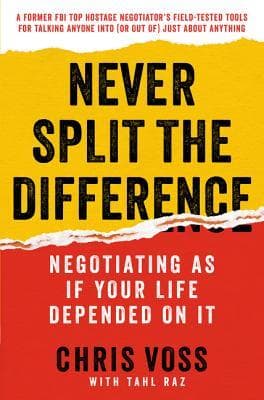
Never Split the Difference cover
Archivist's Choice

Never Split the Difference

Chris Voss (2016)

Genre

Business / Psychology / Leadership / Self-Help

Reading Time

270 min

Key Themes

See below

Track Your Reading

Sign in to track this book

An FBI hostage negotiator shares communication methods to gain an advantage in any negotiation, from diffusing terrorists to debating your spouse.

Core Idea

Negotiation is not about compromise. It is about understanding the other party's true motivations and using empathy to influence their decisions. By using techniques like mirroring, labeling emotions, asking open-ended questions, and strategically using 'No,' negotiators can get important information, reduce hostility, and guide others toward good outcomes they feel are their own ideas. The goal is to achieve 'That's Right,' a moment of real understanding, not a superficial 'Yes.'
Reading time
270 min
Difficulty
Medium
✓ Read this if...
You want to improve your negotiation skills in business, personal life, or high-stakes situations by learning practical, psychologically-grounded techniques from a former FBI hostage negotiator.
✗ Skip this if...
You prefer a purely academic or theoretical approach to negotiation, or are looking for a book that focuses solely on economic models rather than interpersonal dynamics and emotional intelligence.

Core idea

The central argument and framework that powers the entire book.

Negotiation is not about compromise. It is about understanding the other party's true motivations and using empathy to influence their decisions. By using techniques like mirroring, labeling emotions, asking open-ended questions, and strategically using 'No,' negotiators can get important information, reduce hostility, and guide others toward good outcomes they feel are their own ideas. The goal is to achieve 'That's Right,' a moment of real understanding, not a superficial 'Yes.'

At a glance

Reading time

270 min

Difficulty

Medium

Read this if...

You want to improve your negotiation skills in business, personal life, or high-stakes situations by learning practical, psychologically-grounded techniques from a former FBI hostage negotiator.

Skip this if...

You prefer a purely academic or theoretical approach to negotiation, or are looking for a book that focuses solely on economic models rather than interpersonal dynamics and emotional intelligence.

Key Takeaways

1

Tactical Empathy: The Core Skill

Understand, don't just sympathize, to gain leverage.

Quote

Negotiation is not an act of battle; it's an act of discovery. The objective is to uncover as much information as possible.

Voss argues that real empathy in negotiation is not about agreeing with the other side. It is about understanding their perspective, emotions, and motivations so well that you can predict their moves and influence their decisions. This 'tactical empathy' is a deliberate process of seeing the world through their eyes. It is not to validate their feelings, but to gather useful information. It involves recognizing and naming their emotions, which disarms them and builds trust, making them more open to your proposals. This shift from an a...

Supporting evidence

Voss's experience negotiating with bank robbers and kidnappers, where understanding the perpetrator's worldview, fears, and desires (e.g., to be seen as powerful, to avoid jail) was crucial to de-escalation and safe resolution. He recounts a negotiation with a bank robber named Monty, where empathizing with Monty's desire not to be disrespected led to a breakthrough.

Apply this

Before any negotiation, list the other side's likely emotions, motivations, and worldview. During the negotiation, actively listen and use mirroring and labeling to demonstrate understanding. For example, 'It seems like you're concerned about…' or 'It sounds like you feel frustrated by…'


tactical-empathyactive-listeningperspective-taking
2

Mirroring: The Echo Chamber

Repeat the last few words to encourage elaboration.

Quote

Repeat the last one to three words of what someone has just said. We call that mirroring. It's an art, not a science.

Mirroring is a simple yet powerful technique for building rapport and encouraging the other party to share more information. By repeating the last one to three words someone has said, you show you are paying attention. You invite them to elaborate without asking a direct question. This creates a comfortable, non-threatening environment where they feel heard and understood. It prompts them to open up and volunteer important details they might otherwise keep to themselves. It is a subtle form of active listening that uses our natural te...

Supporting evidence

Voss recounts using mirroring effectively in hostage negotiations, where a simple 'He's got my brother…' repeated by the negotiator led the distraught individual to provide critical details about the hostage-taker and their demands.

Apply this

In your next conversation, try mirroring the last few words of what your colleague or partner says. Observe how they instinctively elaborate, providing more context or detail. Use it to clarify vague statements or encourage deeper explanations.

mirroringrapport-buildinginformation-gathering
3

Labeling: Naming the Emotion

Acknowledge feelings to defuse tension and build trust.

Quote

Labeling is a way of validating someone's emotion by acknowledging it. Give someone's emotion a name and you show you understand how they feel.

Labeling is identifying the other party's emotions verbally. By saying things like, 'It sounds like you're feeling frustrated,' or 'It seems like you're concerned about X,' you show you are paying attention to their words and their underlying emotional state. Naming their emotion, even if you are wrong, is powerful. If you are right, they feel understood. If you are wrong, they will correct you and give more information, deepening your understanding. Labeling reduces negative emotions and opens a path for rational discussion by making...

Supporting evidence

Voss describes using labeling to de-escalate a tense situation with a heavily armed bank robber, stating, 'It sounds like you're worried about going back to jail.' This simple acknowledgment of the robber's underlying fear opened the door for further conversation.

Apply this

Practice labeling in everyday conversations. When someone expresses strong feelings, try to identify and articulate them: 'It looks like you're really excited about that project' or 'It sounds like you're a bit annoyed by the delay.' Observe how they respond and the shift in their demeanor.

labelingemotional-intelligencede-escalation
4

Calibrated Questions: The 'How' and 'What'

Open-ended questions that empower the other side to solve your problems.

Quote

The secret to gaining the upper hand in a negotiation is to use calibrated questions to give your counterpart the illusion of control.

Calibrated questions are open-ended questions, usually starting with 'How' or 'What' (never 'Why,' as it can sound accusatory). They are designed to guide the other party toward your desired outcome while making them feel they came up with the solution themselves. These questions make the other side think and explain their position. This reveals their limits and priorities, often leading them to suggest solutions favorable to you. Instead of dictating terms, you invite them to help solve the problem, creating a sense of autonomy and r...

Supporting evidence

Voss recounts using 'How can I do that?' or 'What do you want me to do?' in hostage situations to prompt the hostage-taker to articulate their demands and constraints, which often revealed vulnerabilities or pathways to resolution.

Apply this

Instead of saying, 'I can't lower the price,' ask, 'How am I supposed to do that?' or 'What would you have me do?' When facing resistance at work, ask, 'How can we make this work for both of us?' This shifts the burden of problem-solving onto them, often leading to more creative and agreeable solutions.

calibrated-questionsillusion-of-controlproblem-solving
5

The Power of 'No'

Getting 'no' is the start of real negotiation, not the end.

Quote

The word 'no' is not a failure. It is, in fact, often the beginning of the negotiation.

Conventional wisdom tells us to aim for 'yes,' but Voss argues that 'no' is often more productive early in a negotiation. When someone says 'no,' they feel in control and safe, which makes them open to listening. A 'yes' can often be superficial or just to please you, while a 'no' brings clarity and reveals the other party's real boundaries and needs. Voss encourages negotiators to actively seek 'no' by framing questions so 'no' is a comfortable answer, such as 'Is it a ridiculous idea to…?' or 'Are you against…?' This reduces defensi...

Supporting evidence

Voss describes using 'Is now a bad time to talk?' to get a 'no' from a busy counterpart, which paradoxically often led them to say, 'No, it's not a bad time, what do you need?' This approach grants autonomy and reduces resistance.

Apply this

Instead of pushing for a 'yes,' try to elicit a 'no' early on. Ask questions like, 'Is it out of the question to consider X?' or 'Are you opposed to Y?' This can disarm the other person and make them more willing to engage in a genuine discussion.

power-of-noautonomydefensiveness
6

Accusation Audit: Disarming the Negatives

State all your counterpart's potential negative thoughts upfront.

Quote

What are all the terrible things they could say about me? What are all the negative things they could possibly think about me? Write them all down and say them all out.

The 'accusation audit' is a technique where you list all the negative things the other party might be thinking or feeling about you, your offer, or the situation, and voice them yourself upfront. By acknowledging these potential criticisms, you disarm them. It shows you are self-aware, transparent, and empathetic to their perspective, instantly building trust and reducing their defensiveness. This pre-emptive move neutralizes their internal objections before they can even voice them, making them more open to hearing your actual propos...

Supporting evidence

Voss used this when approaching a potential client, starting with, 'I know you probably think I'm pushy, that I'm just trying to sell you something, and that I don't really understand your business.' This immediately put the client at ease and opened a productive dialogue.

Apply this

Before a difficult conversation, list all the negative assumptions the other person might have about you or your position. Start the conversation by acknowledging these: 'You probably think I'm unreasonable for asking this,' or 'I know this might sound like a crazy idea, but…' This often elicits a reassuring response and builds rapport.

accusation-audittransparencytrust-building
7

The Black Swan: Uncovering Hidden Information

Seek the unknown unknowns that can transform the negotiation.

Quote

The Black Swan is a small piece of information that completely changes the dynamic of the negotiation.

Voss stresses that every negotiation contains 'Black Swans' — pieces of information, often hidden or seemingly small, that can change the entire dynamic if found. These are the unknown unknowns that, once revealed, give you great leverage. The goal is to carefully probe, listen, and use all techniques (mirroring, labeling, calibrated questions) to uncover these hidden motivations, constraints, or desires of the other party. These 'Black Swans' might be a hidden deadline, an unspoken fear, a personal goal, or an external pressure. When...

Supporting evidence

Voss recounts a negotiation where a seemingly minor detail—the hostage-taker's desire to call his mother before surrendering—revealed a crucial 'Black Swan': his underlying need for connection and validation, which was leveraged for a peaceful resolution.

Apply this

In every negotiation, actively search for information that doesn't fit the obvious narrative. Ask open-ended questions about their history, motivations, and what success looks like for them. Pay attention to subtle cues or inconsistencies. What's the one thing they're not telling you?

black-swansinformation-asymmetryleverage
8

Beware of 'Yes' and Aim for 'That's Right'

The true sign of understanding is 'That's right,' not superficial agreement.

Quote

The two words that you want to hear more than any other are 'That's right.'

While 'yes' can be a superficial agreement to move things along, Voss argues that 'That's right' means genuine understanding and buy-in. When someone says 'That's right,' it means you have accurately explained their perspective, feelings, and motivations. This is a moment of connection and validation. It shows they feel truly heard and understood. It is the critical turning point where rapport is strong, and they become more open to your influence. Conversely, 'You're right' is often dismissive, a polite way of saying 'I don't want to...

Supporting evidence

Voss illustrates this by recounting how in hostage situations, getting the subject to say 'That's right' after a summary of their situation often marked the moment they began to cooperate and trust the negotiator.

Apply this

After mirroring or labeling, summarize the other person's position or feelings. For example, 'So, it sounds like you're feeling undervalued because of X, and you're looking for Y. Is that right?' Aim for 'That's right' as your true indicator of progress.

thats-rightrapportvalidation
9

Fairness as a Weapon

Neutralize the 'fairness' claim by inviting them to define it.

Quote

When someone hits you with 'It's not fair!', your first response should be, 'Okay, tell me what is fair.'

The word 'fair' is often used to manipulate or make the other party feel guilty. Voss advises against getting defensive or trying to justify your position when someone claims 'It's not fair!' Instead, immediately ask them to define what 'fair' means to them. By asking 'Okay, tell me what is fair?' or 'How do you propose we make this fair?', you make them explain their assumptions and demands. This often reveals their true, often self-serving, agenda and gives you concrete information to work with, rather than being caught in a vague e...

Supporting evidence

Voss details how he used this in negotiations where a counterpart would claim unfairness, and by asking them to define 'fair,' he exposed their often unreasonable expectations, allowing him to address specifics.

Apply this

The next time someone says, 'That's not fair!' to you, calmly respond with, 'Okay, I understand. What would a fair outcome look like to you?' or 'How do you think we can make this fair?' Be prepared to listen and then address the specifics they present.

fairness-tacticemotional-hijackreframe-negotiation
10

Anchoring and Extreme Offers

Use extreme anchors to shift the other side's perception of value.

Quote

The first offer, however ridiculous, anchors the negotiation.

Voss advocates for strategic anchoring, often by making an extreme, seemingly irrational offer or demand as your first move. This is not about getting that extreme offer accepted. It is about changing the other party's perception of value. By setting a very high or very low anchor, you make subsequent, more reasonable offers seem much more acceptable and attractive by comparison. This uses cognitive biases, specifically the anchoring effect, to your advantage. While it feels counter-intuitive to start with something that might offend,...

Supporting evidence

Voss details a negotiation for a consulting fee where he started with an absurdly high anchor, which, after a period of calibrated questioning and empathy, led to a final agreement significantly higher than what he would have initially proposed.

Apply this

When buying or selling, consider making an initial offer that is intentionally extreme (either very high or very low) but justifiable with some logic, even if tenuous. Be prepared to immediately follow up with empathy and calibrated questions to manage the reaction and guide the conversation toward your real target.

anchoring-effectextreme-offerscognitive-bias

Critical analysis

Notable Quotes

The one thing all great negotiators have in common is their ability to effectively understand and manipulate the emotional dynamics of a negotiation.

Introducing the core concept of emotional intelligence in negotiation.

Negotiation is not an act of battle; it's an act of discovery.

Challenging the common adversarial view of negotiation.

He who has learned to disagree without being disagreeable has discovered the most precious of secrets.

Emphasizing the importance of maintaining rapport while asserting one's position.

No is not the end of the negotiation, it is the beginning.

Explaining how 'No' offers an opportunity to understand underlying concerns.

Don't be a taker, be a giver.

Encouraging a collaborative, value-creating approach rather than a zero-sum game.

The beauty of the Accusation Audit is that it takes the power out of your opponent's accusations.

Describing a technique to preempt negative accusations by voicing them yourself.

When you are trying to make a deal, you are not trying to be right; you are trying to get to a solution.

Highlighting the difference between intellectual debate and practical problem-solving in negotiation.

Emotions are never the enemy. Suppressing them is. Ignoring them is. Running from them is.

Advocating for acknowledging and understanding emotions in oneself and others.

The most powerful word in negotiation is 'Fair'.

Explaining how the word 'Fair' can be used as both a weapon and a shield.

Listen to their side, and make them feel heard.

Emphasizing the foundational importance of active listening and empathy.

Your most powerful tool in any negotiation is your ability to get the other side to say, 'That's right.'

Introducing the concept of 'That's Right' as a sign of genuine understanding and agreement.

Calibrated questions are never simple yes/no questions. They are open-ended questions designed to extract information.

Explaining the strategic use of open-ended questions to guide the conversation.

The beauty of a truly open-ended question is that it forces the other side to reveal their true motivations and concerns.

Further elaborating on the power of calibrated questions.

The greatest value of negotiation is not in getting what you want, but in understanding what the other person wants.

Shifting the focus from self-interest to understanding the counterpart's needs.

Quiz

Test Your Knowledge

Ready to see how well you understood this book? Take our interactive quiz with 10 questions.

10
Questions
~5
Minutes
?
Best Score

Key Questions (FAQ)

Tactical Empathy is the deliberate use of empathy to understand the mindset of your counterpart, not to agree with them, but to gain leverage and influence. It involves actively listening and identifying their emotions and perspectives to better navigate the negotiation.

About the author

Chris Voss

Chris Voss is a renowned former FBI negotiator and the author of the bestselling book 'Never Split the Difference.' His work focuses on applying high-stakes negotiation tactics to everyday business and personal interactions. Voss's expertise lies in communication strategies, making his insights highly valuable for professionals seeking to improve their influence and deal-making skills.