“Nothing matters. I'm going to prove it to you.”
— Pierre Anthon's initial declaration from the plum tree.

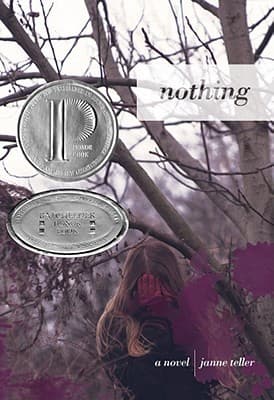
Janne Teller (2010)
Genre
Philosophy / Young Adult
Reading Time
180 min
Key Themes
See below
Sign in to track this book
To prove life's meaning to a classmate perched in a tree, a group of students descend into a chilling spiral of increasingly extreme sacrifices, forcing them to confront the true value of everything they hold dear.
On the first day of seventh grade, Pierre-Anthon, a student at Tæring School, abruptly stands up in class and declares that nothing matters, that life has no meaning. He then walks out of the classroom, climbs into a plum tree outside the school, and refuses to come down. His classmates, including the narrator Agnes, initially try to coax him down, mocking him and throwing things. Pierre-Anthon remains steadfast, shouting down his nihilistic pronouncements. His parents and teachers are unable to persuade him, and eventually, the school gives up, allowing him to stay in the tree, much to the increasing frustration and bewilderment of his former classmates.
Driven by a desire to prove Pierre-Anthon wrong and to refute his claim that nothing matters, a group of his classmates, led by the pragmatic Sofie, decides to create a 'Pile of Meaning.' Their plan is to gather objects that are personally significant to each of them and present this collection as evidence that life does indeed hold value. They start by meeting in an abandoned sawmill, where Sofie brings her green sandals, a gift from her mother. The initial items are relatively innocuous, but the act of contributing is meant to challenge Pierre-Anthon's philosophy and reaffirm their own sense of purpose.
The early stages of the Pile of Meaning involve relatively minor sacrifices. Sofie contributes her green sandals. Hans, a talented footballer, gives up his new football. Henrik, a devout Muslim, contributes his prayer mat. Each item holds a personal connection, representing a hobby, a belief, or a cherished possession. The students believe that by collectively surrendering these items, they are demonstrating the inherent value these objects hold, and by extension, the meaning in their lives. They hope this growing pile will eventually convince Pierre-Anthon to descend from his tree.
As the pile grows, a darker dynamic begins to emerge. The children start to demand increasingly significant and personal sacrifices from one another. Sofie, having contributed her sandals, then demands that Hans give up his football. Hans, in turn, demands something from another student, pushing the boundaries of what is considered 'meaningful.' This escalation isn't just about the objects themselves; it's about proving their commitment to the 'meaning' project and, by extension, forcing Pierre-Anthon to acknowledge it. The group becomes a tribunal, judging the 'meaningfulness' of each proposed sacrifice.
The nature of the sacrifices becomes much more severe. Rosa, known for her beautiful long hair, is forced to cut it off and contribute her braid to the pile. Later, the beloved pet hamster of Else is demanded and sacrificed, leading to significant distress among the group. These acts mark a clear turning point, as the children move from giving up mere possessions to sacrificing parts of their identity, cherished memories, or even living beings. The initial lightheartedness is replaced by a grim determination and an underlying fear of not complying with the group's increasingly arbitrary demands.
The pressure to contribute to the Pile of Meaning begins to erode the children's friendships and sense of community. Everyone is wary of being next to be targeted for a sacrifice. When Sofie demands that Little Kai give up his prosthetic leg, a symbol of his identity and mobility, the group is shocked, but ultimately, they compel him to do so. This act, driven by a twisted sense of proving meaning, highlights the breakdown of empathy and the growing cruelty within the group. The children are no longer simply proving Pierre-Anthon wrong; they are asserting their dominance over each other.
The most harrowing demand comes when Jan-Johan, a boy with a crush on Sofie, demands her virginity as her contribution to the pile. The group, now thoroughly desensitized and operating under a mob mentality, allows and even encourages this act. Sofie is coerced into sleeping with Jan-Johan in the sawmill, a traumatic event that shatters her innocence and leaves her deeply scarred. This act signifies the complete moral collapse of the group, demonstrating how far they are willing to go in their desperate, misguided quest to prove meaning and defeat Pierre-Anthon's nihilism.
Having amassed a pile of truly grotesque and tragic sacrifices, including a coffin containing a dead baby (contributed by the parents of a deceased classmate, to the horror of the children), the students decide it's time to confront Pierre-Anthon. They drag the entire, horrifying pile to the base of his plum tree. They present it to him, expecting him to be shocked into acknowledging the 'meaning' they have created through their suffering. However, Pierre-Anthon remains unmoved, simply stating that their actions only confirm his belief that nothing matters, dismissively calling their pile 'worthless.' His rejection drives the children to a new level of fury.
Pierre-Anthon's complete indifference and his dismissive judgment of their sacrifices as 'nothing' pushes the children over the edge. Enraged by his unyielding nihilism and the immense suffering they have endured, they drag him down from the tree. In a fit of collective madness and vengeance, they beat him to death with the very objects from their Pile of Meaning. This brutal act is the culmination of their descent into savagery, a desperate and ultimately futile attempt to force meaning into existence through violence and eliminate the source of their existential torment.
After Pierre-Anthon's murder, the children scatter, leaving his body and the horrifying Pile of Meaning at the base of the plum tree. The authorities soon discover the scene. The police launch an investigation, and the gruesome details of the pile and Pierre-Anthon's death quickly become a national scandal. The children are questioned, but due to their collective silence and the chaotic nature of the event, no single individual is ever held directly accountable for the murder. The community grapples with the unspeakable tragedy and the implications of what the children have done.
To the astonishment of the children and the public, the Pile of Meaning, with all its grotesque contents, is declared a work of art by a renowned art curator. It is meticulously preserved and exhibited in a prestigious museum, gaining international fame as 'The Pile of Meaning.' People from all over the world come to view it, interpreting its meaning in various ways. This transformation of their traumatic acts into celebrated art further complicates the children's understanding of their actions and the nature of meaning itself, leaving them with a profound sense of alienation and bewilderment.
Years later, the surviving children, now adults, carry the unspoken burden of their past. They are forever bound by the shared trauma of the Pile of Meaning and Pierre-Anthon's death. They visit the exhibition of the pile, observing how strangers interpret their suffering, yet unable to articulate the true, horrifying story behind it. The experience has irrevocably shaped their lives, leaving them with a profound sense of loss, guilt, and a lingering question about the true nature of meaning and the cost of trying to define it. The book ends with the children forever marked by their collective descent into barbarism.
The Protagonist/Narrator
Agnes transforms from a participant in the 'meaning' project to a horrified witness, grappling with the moral decay of her peers and her own complicity.
The Antagonist/Catalyst
Pierre-Anthon remains static in his conviction, serving as an unyielding philosophical challenge to the other children.
The Supporting/Antagonist
Sofie transforms from a determined leader into a ruthless enforcer, losing her moral compass in the pursuit of proving meaning.
The Supporting/Antagonist
Jan-Johan descends from a participant to an exploiter, revealing a cruel and self-serving nature.
The Supporting
Rosa goes from a proud girl to a traumatized victim, losing a part of her identity.
The Supporting
Kai is stripped of his mobility and dignity, becoming a symbol of the group's brutality.
The Supporting
Hans moves from an eager participant to a complicit member of the group, witnessing the escalating horror.
The Supporting
Else endures the traumatic loss of her pet, a victim of the group's escalating demands.
At its core, the novel explores humanity's desperate need to find meaning in existence. Pierre-Anthon's nihilistic declaration acts as a profound challenge, forcing his classmates to confront their own beliefs about purpose. Their 'Pile of Meaning' is a physical manifestation of this search, a misguided attempt to create tangible evidence of value. However, the irony is that in their extreme pursuit of proving meaning, they commit increasingly meaningless and cruel acts, ultimately destroying the very values they claim to uphold. The book suggests that meaning cannot be forced or proven through external accumulation, but rather is an internal, subjective experience.
“From the moment Pierre-Anthon climbed the tree, he had forced us to ask ourselves the question: Does life mean something or nothing?”
The novel vividly portrays the rapid and brutal corruption of a group of innocent children. What begins as a seemingly harmless project to prove a classmate wrong quickly devolves into mob mentality, cruelty, and ultimately, murder. The children, initially driven by a desire to affirm life's value, become desensitized to suffering and commit increasingly horrific acts, culminating in sexual assault and homicide. Their descent into barbarism highlights how easily moral boundaries can erode under collective pressure and a distorted sense of purpose, leaving them scarred and forever changed.
“We were not children anymore. We were something else. Something that had been created by the pile.”
A central theme is the dangerous power of mob mentality and groupthink. The children, individually, might not have committed such atrocities, but as a collective, they egg each other on, fear ostracization, and lose their individual moral compasses. Sofie's leadership, initially driven by a desire to prove meaning, becomes increasingly authoritarian, and dissent is quickly suppressed. The pressure to contribute to the 'Pile of Meaning' overrides individual conscience, leading to a shared responsibility for escalating cruelty. The story serves as a chilling allegory for how easily a group can be led astray, even with seemingly noble intentions, when critical thinking and individual empathy are abandoned.
“No one wanted to be the one who wasn't willing to sacrifice. No one wanted to be the one who didn't understand what meaning was.”
The book explores the complex nature of sacrifice and what truly constitutes 'value.' The children's sacrifices begin with tangible, cherished objects but quickly escalate to abstract and deeply personal things: hair, a pet, a prosthetic leg, virginity, and even a dead baby. The irony is that the more extreme their sacrifices become, the less 'meaningful' they appear, instead becoming acts of desperation and cruelty. The novel forces the reader to question whether true value can be assigned or proven through such acts, or if these actions instead strip life of its inherent worth. The ultimate sacrifice, Pierre-Anthon's life, proves to be the most meaningless act of all.
“What was the most important thing? What was the most meaningful thing?”
Towards the end of the novel, the 'Pile of Meaning' is transformed into an internationally renowned art exhibit. This development introduces the theme of art and interpretation, highlighting how meaning can be imposed, recontextualized, and even exploited. The children's traumatic experiences are sanitized and celebrated by the art world, with critics and viewers attaching their own interpretations to the gruesome collection. This external validation and re-framing of their suffering further alienates the original creators, demonstrating how the 'meaning' of an event can be distorted and appropriated, often far removed from its original, painful truth.
“The pile was no longer ours. It belonged to the world, and the world had given it a new meaning.”
Pierre-Anthon's physical and symbolic refuge.
The plum tree serves as a crucial physical and symbolic plot device. Physically, it is Pierre-Anthon's sanctuary, a place of detachment from the world and a constant, visible challenge to his classmates. Symbolically, it represents his unyielding nihilism and his elevated, almost god-like, position as an observer and judge. Its presence throughout the narrative reinforces his unchanging philosophy and acts as the focal point towards which all the children's desperate actions are directed. It is the immovable object against which their frantic search for meaning collides.
A physical manifestation of the children's desperate search for meaning.
The 'Pile of Meaning' is the central plot device. It is a tangible collection of objects and sacrifices that progressively grows in size and horror. Initially intended as proof against Pierre-Anthon's nihilism, it quickly becomes a symbol of the children's escalating cruelty, their loss of innocence, and the corrupting power of groupthink. Each item added to the pile marks a new stage in their moral descent, pushing the narrative forward and intensifying the conflict. Its eventual transformation into a celebrated art exhibit further highlights the novel's themes of interpretation and the commodification of suffering.
The story is told from the collective 'we' perspective of the children, primarily Agnes.
While Agnes is the primary narrator, the story often uses a collective 'we' or 'us' when referring to the children's actions and thoughts. This narrative choice is crucial for establishing the theme of mob mentality and shared responsibility. It blurs the lines of individual blame and highlights how the group acts as a single, often terrifying, entity. It immerses the reader in the collective experience of the children, making their descent feel both personal and universally applicable to the dangers of groupthink. It emphasizes that this is not just Agnes's story, but the story of a generation.
The increasing severity of demands drives the plot's dark progression.
The gradual and horrifying escalation of the sacrifices is a key plot device. It begins with relatively innocuous items like sandals and a football, but systematically progresses to deeply personal and traumatic offerings: hair, a pet, a prosthetic leg, virginity, and eventually a dead baby. This escalating pattern creates relentless tension and drives the plot towards its tragic climax. Each new, more extreme demand pushes the children further down a path of moral decay, illustrating the slippery slope of unchecked ambition and the loss of ethical boundaries within the group.
“Nothing matters. I'm going to prove it to you.”
— Pierre Anthon's initial declaration from the plum tree.
“There was no point in learning anything because everything was just a big, meaningless glob.”
— Reflecting the initial impact of Pierre Anthon's philosophy on the narrator.
“What does it mean to be alive if we're all just going to die anyway?”
— A common question posed by the children as they grapple with Pierre Anthon's ideas.
“The only thing that really matters is that you matter to someone.”
— A counter-argument or a yearning for connection amidst the nihilistic crisis.
“We had to find something that mattered, something that proved us wrong.”
— The children's motivation for starting the 'heap of meaning'.
“The heap grew. And with it, the demands.”
— Describing the escalation of the children's sacrifices for the heap.
“It was as if we were trying to fill a hole that could never be filled.”
— Reflecting on the futility and growing emptiness despite the heap's growth.
“Nothing is something only if it means something to someone.”
— A pivotal realization about the subjective nature of meaning.
“We were doing it for him, to prove him wrong, but also for ourselves.”
— Highlighting the complex motivations behind the children's actions.
“The more we took, the more we had to take.”
— Describing the increasing and darker demands of the 'heap of meaning'.
“He didn't want to be right. He just wanted to be seen.”
— A poignant interpretation of Pierre Anthon's underlying desire.
“We had created a monster out of our fear of nothing.”
— A realization of the destructive consequences of their quest for meaning.
“Maybe nothing is the only thing that's real.”
— A lingering, unsettling thought that challenges conventional understanding.
“It was a beautiful nothing, a nothing that meant everything to us.”
— Reflecting on the final state of the 'heap' and its significance to the children.
Ready to see how well you understood this book? Take our interactive quiz with 10 questions.

Biography coming soon.

Jeff Olson
4.4
Thomas Sowell
4.4
Walter Brueggemann
4.3

Rhonda Byrne
4.3

Robin Wall Kimmerer
4.3

George S. Clason
4.3
Elliot Aronson
4.3
Joseph Campbell
4.3