BookBrief
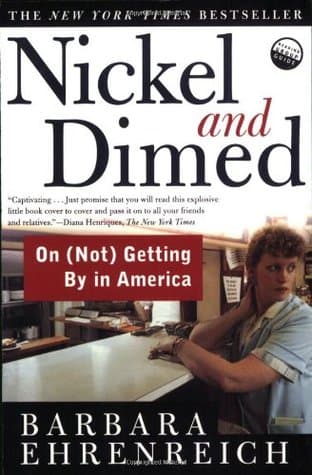
Nickel and Dimed: On (Not) Getting by in America cover
Archivist's Choice

Nickel and Dimed: On (Not) Getting by in America

Barbara Ehrenreich (2001)

Genre

Politics / Memoir / Economics

Reading Time

4-5 hours

Key Themes

See below

Track Your Reading

Sign in to track this book

Barbara Ehrenreich's undercover expose on minimum-wage work reveals that even two jobs are not enough to escape poverty.

Core Idea

Barbara Ehrenreich's "Nickel and Dimed" challenges the idea that hard work alone can lift people out of poverty in America. Through her immersive journalism, working minimum-wage jobs across several states, she shows that even full-time service sector work does not cover basic living expenses like rent, food, and healthcare. The book argues that the structure of low-wage work, with its hidden costs and lack of benefits, traps people in poverty. It exposes the myth of the 'unskilled' worker and the immense effort needed just to survive.
Reading time
4-5 hours
Difficulty
Easy
✓ Read this if...
You want a powerful, first-hand account of the realities of minimum-wage work in America and a critical examination of economic inequality, social welfare, and the dignity of labor. This book is for those interested in understanding the systemic barriers faced by low-income individuals.
✗ Skip this if...
You are looking for a prescriptive guide to personal finance or a purely academic economic analysis. While it touches on economics, its strength is in its immersive, qualitative journalism and personal narrative.

Core idea

The central argument and framework that powers the entire book.

Barbara Ehrenreich's "Nickel and Dimed" challenges the idea that hard work alone can lift people out of poverty in America. Through her immersive journalism, working minimum-wage jobs across several states, she shows that even full-time service sector work does not cover basic living expenses like rent, food, and healthcare. The book argues that the structure of low-wage work, with its hidden costs and lack of benefits, traps people in poverty. It exposes the myth of the 'unskilled' worker and the immense effort needed just to survive.

At a glance

Reading time

4-5 hours

Difficulty

Easy

Read this if...

You want a powerful, first-hand account of the realities of minimum-wage work in America and a critical examination of economic inequality, social welfare, and the dignity of labor. This book is for those interested in understanding the systemic barriers faced by low-income individuals.

Skip this if...

You are looking for a prescriptive guide to personal finance or a purely academic economic analysis. While it touches on economics, its strength is in its immersive, qualitative journalism and personal narrative.

Key Takeaways

1

The Myth of the 'Unskilled' Worker

Low-wage jobs are physically and mentally demanding, requiring significant skill and effort.

Quote

No job, no matter how lowly, is truly 'unskilled.'

Ehrenreich's experience shatters the idea that low-wage work is 'unskilled' or easy. She details the physical demands of jobs like waitressing, cleaning, and stocking, which include constant standing, heavy lifting, repetitive motions, and a fast pace. Beyond the physical, these jobs demand mental strength: memorizing complex menus, managing multiple tasks under pressure, dealing with difficult customers, and appearing cheerful despite exhaustion. The author shows that these jobs require resilience, problem-solving, and interpersonal ...

Supporting evidence

Ehrenreich's personal experiences as a waitress (e.g., memorizing extensive menus, carrying heavy trays, managing multiple tables simultaneously) and a hotel maid (e.g., cleaning numerous rooms to strict deadlines, lifting heavy mattresses, enduring chemical fumes).

Apply this

Challenge personal biases by observing the complexity and effort involved in service jobs. Advocate for fair wages and better working conditions by recognizing the inherent skill and value of all labor, regardless of pay scale. Support policies that acknowledge the physical and mental toll of these jobs.


unskilled-labor-mythinvisible-labordignity-of-work
2

The Impossibility of 'Pulling Yourself Up'

Even with full-time work, low wages make self-sufficiency an unachievable dream.

Quote

The idea that anyone can pull themselves up by their bootstraps is a cruel joke when your boots are worn out and you can't afford new ones.

The main revelation of 'Nickel and Dimed' is how impossible it is to survive, let alone thrive, on minimum or near-minimum wage. Ehrenreich consistently finds that even working full-time, often 60-70 hours across multiple jobs, her income is not enough for basic needs like rent, food, and transportation. She is always financially insecure, constantly figuring out how to stretch every dollar, often sacrificing nutrition or health. This debunks the American idea of upward mobility through hard work, showing a system where the working po...

Supporting evidence

Ehrenreich's detailed financial logs across her different experiments (Florida, Maine, Minnesota), consistently showing a deficit or razor-thin surplus after rent, food, and gas, even when working two jobs. Her inability to afford a security deposit or a car in some locations exemplifies this.

Apply this

Recognize that poverty is often systemic, not a personal failing. Support policies like a living wage, affordable housing, and accessible public transportation that address the structural barriers to self-sufficiency. Advocate for a social safety net that truly supports those working full-time.

living-wagepoverty-trapupward-mobility-mythwage-stagnation
3

The Hidden Costs of Being Poor

Poverty creates additional expenses, making it more expensive to be poor.

Quote

The poor pay more for everything.

Ehrenreich illustrates how poverty is not just a lack of money; it actively creates higher costs. Without a stable income or credit, she must choose more expensive options: weekly motels instead of monthly apartments, fast food over healthier home-cooked meals (due to lacking a kitchen or time), and unreliable public transport or older, less fuel-efficient cars. Not being able to afford a security deposit means higher weekly rents; not having health insurance means avoiding necessary medical care, leading to worse health and higher co...

Supporting evidence

Her experiences with weekly motel rates being disproportionately higher than monthly apartment rents, her reliance on convenience store food due to lack of cooking facilities, and the constant stress over vehicle maintenance or public transport costs.

Apply this

Support initiatives that reduce the 'poverty penalty,' such as affordable housing programs, access to healthy and affordable food, and financial literacy resources that help break cycles of predatory lending. Understand that systemic barriers, not poor choices, often drive these higher costs.

poverty-penaltycost-of-povertyfinancial-exclusion
4

The Dehumanizing Impact of Low-Wage Work

Beyond financial strain, these jobs erode dignity and foster constant anxiety.

Quote

There are no 'free' people in a low-wage economy; there are only people whose poverty is managed by others.

The psychological toll of low-wage work is as significant as the financial and physical toll. Ehrenreich often describes the constant worry of making ends meet, the humiliation of being treated as disposable by employers and customers, and the loss of personal dignity. Workers often face arbitrary rules, surveillance, and a lack of respect; their bodies and time are treated as commodities. The absence of privacy (e.g., drug testing, background checks) and the infantilization by management further take away autonomy. This environment c...

Supporting evidence

Her experiences with mandatory drug testing, arbitrary rules at Wal-Mart, the constant surveillance by managers, and the condescending attitudes from some customers. The pervasive feeling of being 'watched' and judged.

Apply this

Advocate for workplace dignity, fair treatment, and respect for all employees, regardless of their position. Support labor unions and policies that protect workers' rights and privacy. Challenge narratives that blame individuals for their economic circumstances.

workplace-dignitydehumanizationworker-rightsemotional-labor
5

The Collective Generosity of the Poor

Despite their struggles, low-wage workers often exhibit profound mutual support.

Quote

The working poor, far from being isolated, form intricate webs of mutual support.

One of Ehrenreich's discoveries is the generosity and solidarity among the working poor. Despite their own difficult situations, her co-workers often offer small acts of kindness: sharing food, rides, tips on navigating the system, or simply emotional support. This mutual aid is a crucial, informal safety net, showing resilience and community in the face of systemic neglect. It highlights a human capacity for empathy and collective action, contrasting with the often-harsh, individualistic talk about poverty and self-reliance. This cam...

Supporting evidence

Instances where co-workers shared food from their meager lunches, offered rides to work when Ehrenreich couldn't afford gas, or provided emotional support and advice on navigating difficult managers or financial struggles.

Apply this

Recognize and support grassroots community efforts and mutual aid networks. Foster a culture of empathy and solidarity, understanding that collective support is vital for those facing economic hardship. Challenge stereotypes of the poor as isolated or selfish.

mutual-aidcommunity-supportsolidarityhuman-resilience
6

Invisible Labor and the Service Economy

The service economy relies on a massive, often invisible, workforce performing essential tasks.

Quote

We are the people who make your lives possible, yet we remain largely invisible.

Ehrenreich's journey shows the large, often unseen, labor force that supports the modern service economy. From cleaning hotel rooms and serving food to stocking shelves and caring for the elderly, these workers perform essential tasks that allow others to live comfortable lives. Yet, society consistently undervalues, underpays, and often ignores their contributions. The book makes readers confront the reality that the convenience and affordability many take for granted are built on the backs of workers who struggle to survive. This in...

Supporting evidence

Her detailed accounts of cleaning dozens of hotel rooms daily, the sheer volume of dishes washed in a restaurant kitchen, or the constant restocking and customer service required in a Wal-Mart.

Apply this

Consciously acknowledge and appreciate the labor of service workers in daily life. Advocate for policies that ensure fair wages, benefits, and respectful working conditions for all workers in the service sector. Challenge the societal tendency to devalue service work.

service-economyinvisible-workforcelabor-valueessential-workers
7

The Illusion of Welfare Reform

Welfare reform's promise that 'any job is better than no job' is demonstrably false.

Quote

The idea that getting a job, any job, automatically lifts you out of poverty is a dangerous fantasy.

Ehrenreich's project was partly inspired by talk about welfare reform, which claimed that simply getting a job, no matter how low-paying, would lead to self-sufficiency. Her findings clearly dismantle this idea. She shows that even with full-time employment, and often multiple jobs, people can remain deeply in poverty. The 'workfare' model, which pushes people into low-wage jobs without addressing the systemic issues of inadequate pay, lack of benefits, and affordable housing, merely shifts the burden without solving the problem. It r...

Supporting evidence

Ehrenreich's consistent inability to make ends meet despite working diligently, often more than 40 hours a week, across all her experimental locations. Her struggle to find affordable housing or reliable transportation, even with a steady paycheck.

Apply this

Critically evaluate policies that prioritize 'work requirements' without simultaneously ensuring a living wage, affordable housing, healthcare, and childcare. Advocate for comprehensive social policies that genuinely support economic mobility, not just employment for its own sake.

welfare-reformworkfarepoverty-policysocial-safety-net
8

The Erosion of Hope and Health

The constant struggle of low-wage work severely impacts physical and mental well-being.

Quote

The constant stress and physical toll of poverty leave little room for hope, let alone health.

Beyond the immediate financial struggles, Ehrenreich documents the erosion of health and hope among the working poor. The physical demands of the jobs lead to chronic pain and exhaustion, often made worse by a lack of affordable healthcare and the inability to take sick days without losing crucial income. The constant stress of financial insecurity, combined with the dehumanizing work environment, harms mental health, causing anxiety, depression, and hopelessness. This systemic neglect of workers' well-being creates a cycle where heal...

Supporting evidence

Ehrenreich's own physical ailments (sore feet, back pain, exhaustion) during her experiments, and her observations of co-workers struggling with illness, injury, or chronic conditions without adequate medical care or time off.

Apply this

Advocate for universal healthcare, paid sick leave, and workplace safety regulations that protect all workers. Support policies that address the mental health crisis exacerbated by economic insecurity. Recognize the direct link between economic injustice and public health outcomes.

health-disparitiesmental-healthworkplace-stresseconomic-insecurity
9

The Power Dynamics of Employer-Employee Relations

Employers often wield unchecked power, exploiting workers' desperation.

Quote

In the low-wage economy, the employer is often a benevolent dictator, or simply a dictator.

Ehrenreich's encounters with various employers show the power imbalance in low-wage work. Managers often have arbitrary control, imposing strict rules, demanding unpaid labor (e.g., staying late, working off the clock), and threatening termination for minor infractions. The constant fear of losing a job—the only lifeline for these workers—makes them vulnerable to exploitation and unable to advocate for themselves. This unchecked power dynamic creates an environment where workers' rights are often ignored, and their desperation is used...

Supporting evidence

Instances of managers changing schedules last minute, demanding overtime without adequate pay, or threatening to fire employees for minor offenses. The absence of a clear grievance process or union representation in her workplaces.

Apply this

Support labor unions and their right to organize. Advocate for stronger labor laws and enforcement mechanisms that protect workers from exploitation. Demand corporate accountability and ethical labor practices from employers.

labor-exploitationworker-rightspower-imbalanceunionization
10

A Call to Re-evaluate Economic Justice

The book serves as a powerful indictment of systemic economic inequality and a call for change.

Quote

Our society is built on the backs of people we refuse to see, and whose struggles we refuse to acknowledge.

'Nickel and Dimed' is not just a personal memoir; it is a researched and empathetic expose that calls for a re-evaluation of economic justice in America. Ehrenreich's experience forces readers to confront the truth that a significant portion of the workforce is essential yet systematically undervalued and exploited. Her work indicts policies that perpetuate poverty, the societal idea that blames individuals for their economic struggles, and the collective blindness to the suffering of the working poor. It is a call to action, urging r...

Supporting evidence

The cumulative impact of all her findings across different states and jobs, consistently demonstrating the systemic rather than individual nature of poverty for the working poor.

Apply this

Engage in informed advocacy for policies like a living wage, universal healthcare, affordable housing, and stronger labor protections. Challenge individualistic narratives of poverty and promote a deeper understanding of systemic economic inequality. Support organizations working for economic justice.

economic-justicesystemic-inequalitysocial-justicepolicy-advocacy

Critical analysis

Notable Quotes

I am looking for a job, preferably one that pays a living wage, but I am prepared to accept something that pays less.

Ehrenreich's initial premise as she begins her experiment, seeking employment.

No one ever said that a job has to be pleasant. What I want to know is, does it have to be this unpleasant?

Reflecting on the grueling nature of her low-wage work, particularly as a waitress.

The food may be bad, the customers rude, the hours long, and the pay miserly, but at least you're not out on the street.

Highlighting the pervasive gratitude expected of low-wage workers, despite poor conditions.

When you enter the low-wage workplace, you check your civil liberties at the door.

Observing the lack of privacy and control workers experience in many low-paying jobs.

The working poor are not a race, but they are treated as if they were.

Discussing the systemic dehumanization and discrimination faced by low-wage workers.

It is not enough to be able to 'afford' housing; you have to be able to find it.

Struggling to find affordable and safe housing while working low-wage jobs.

The 'working poor' are in fact the very people who make this country work.

Emphasizing the essential, yet often invisible, contributions of low-wage laborers.

You can be smart, you can be resourceful, you can be hardworking, but if you're poor, you're still poor.

Challenging the myth that hard work alone is enough to escape poverty.

The greatest mystery, for me, is how people can work this hard and still be poor.

A central question Ehrenreich grapples with throughout her experiment.

The working poor are not lazy. They are working harder than most of us can imagine, for less pay than most of us would accept.

Dispelling stereotypes about low-wage workers and highlighting their immense effort.

Poverty is not a character failing. It is a shortage of money.

A concise and powerful statement refuting common moralistic views of poverty.

The hidden costs of being poor are enormous.

Referring to the extra expenses, like higher interest rates, less reliable transport, and lack of bulk buying, that disproportionately affect the poor.

The 'service sector' is where we are increasingly expected to perform our most intimate and personal functions.

Reflecting on the nature of service work and the emotional labor involved.

If you're a single mother, then you're poor by definition.

Observing the particular economic vulnerability of single mothers in the low-wage economy.

Quiz

Test Your Knowledge

Ready to see how well you understood this book? Take our interactive quiz with 10 questions.

10
Questions
~5
Minutes
?
Best Score

Key Questions (FAQ)

'Nickel and Dimed' is a non-fiction book by Barbara Ehrenreich where she goes undercover to investigate the reality of living on minimum wage in America. She takes various low-paying jobs across different states to expose the struggles and strategies required for survival.

About the author

Barbara Ehrenreich

Barbara Ehrenreich was a renowned investigative journalist and author known for her critical examination of class and poverty in America. Her seminal work, "Nickel and Dimed: On (Not) Getting by in America," exposed the struggles of low-wage workers through her immersive reporting. Ehrenreich's unflinching social commentary and dedication to shedding light on the lives of the marginalized solidified her reputation as a vital voice in non-fiction.