“We are not numbers. We are human beings, and we will never surrender our humanity.”
— A character asserts their dignity and resistance against dehumanization during the Palestinian struggle.

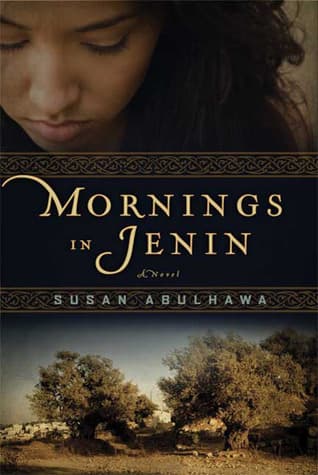
Susan Abulhawa (2008)
Genre
Politics / Historical Fiction
Reading Time
9 hours
Key Themes
See below
Sign in to track this book
Through the eyes of Amal and four generations of her family, "Mornings in Jenin" is a sweeping, moving story of displacement, love, and strength amidst the Palestinian-Israeli conflict.
In 1948, Zionist forces invade the Palestinian village of Ein Hod. The Abulheja family, led by Yehya and his wife, Basima, are forced to leave their homes. Their ancient olive groves, a symbol of their connection to the land, are taken. They are marched to the Jenin refugee camp, a desolate and crowded place. Yehya, heartbroken by the loss of his land and way of life, dies shortly after their arrival. His eldest son, Hasan, cares for his family, including his pregnant wife, Dalia, and their young son, Ismael. The family struggles to adapt to camp life, which has scarcity and uncertainty.
During an Israeli raid on the Jenin camp, a young Israeli soldier, wanting to replace her lost child, snatches Ismael, Hasan and Dalia's infant son, from his mother's arms. Dalia is devastated, but the soldier escapes with the baby. The Abulheja family does not know that Ismael is renamed David and raised as a Jewish Israeli. After this event, Dalia gives birth to twins: Yousef and Amal. Hasan, despite the grief over Ismael's abduction, finds comfort and purpose in his new children, especially his bright daughter, Amal. He dedicates himself to their upbringing, reading to Amal every morning, encouraging her love for stories and knowledge in the grim reality of the camp.
Amal grows up in the Jenin camp, a bright child who finds joy despite the hardship. She forms a close bond with her father, Hasan, who encourages her intellect and dreams. He reads to her daily, sharing stories and wisdom, which is a cherished ritual. However, this period of stability ends when Hasan is killed by an Israeli bullet during an argument at a checkpoint. His death is a blow to the family, especially to Amal, who is young. The loss of her father leaves a void in her life, ending her innocent childhood and forcing her to confront the conflict more directly.
As Amal deals with her grief and adolescence, her twin brother, Yousef, takes a different path. Fueled by the injustices he sees and the loss of his father, Yousef becomes drawn to the Palestinian resistance movement. He believes that armed struggle is the only way to reclaim their land and dignity. He participates in protests, joins groups, and dedicates his life to the cause, often putting himself in danger. His commitment worries Amal and their mother, Dalia, who fear for his life, but Yousef sees no other option. His actions show the desperation and anger in the refugee camp.
Amal, driven by her father's legacy and her intelligence, does well in her studies, despite the limited resources of the camp. Her academic achievements are recognized, and she receives a scholarship to attend university in Beirut, Lebanon. This opportunity is a turning point in her life, allowing her to escape the confines and hardships of Jenin. Leaving her family, particularly her mother and Yousef, is difficult, but Amal sees it as a chance for a better future and to honor her father's wishes for her education. In Beirut, she experiences a different world, but the memories and struggles of Jenin stay with her.
In Beirut, Amal focuses on her studies, finding purpose and intellectual stimulation. She also meets and falls in love with a fellow Palestinian student, a thoughtful young man named Huda. Their shared experiences as refugees and their hopes for a free Palestine create a deep connection between them. Huda offers Amal a sense of belonging and love that she had wanted since her father's death. Their relationship grows amidst the political problems in Lebanon, as the Palestinian diaspora deals with its own challenges. Amal experiences happiness and normalcy, a sharp contrast to her early life in Jenin.
Amal and Huda marry, building a life together in Beirut. They soon have a daughter, Sara, who becomes the center of Amal's world. However, their happiness is shattered by the Israeli invasion of Lebanon in 1982. The war brings violence and destruction to Beirut, forcing Amal to relive the trauma of her childhood. She experiences the terror of bombings and the constant fear for her family's safety. During the chaos, Huda is killed, leaving Amal a widow and single mother. This loss is another blow, reinforcing the cycle of violence and displacement that has affected her family for generations. Amal raises Sara alone, burdened by grief and the weight of their history.
After Huda's death and the instability in Lebanon, Amal decides to seek refuge in the United States, hoping to provide a safer future for Sara. They settle in Boston, where Amal tries to build a new life, working and raising her daughter. However, moving to America brings its own challenges. Amal deals with feelings of displacement and a sense of loss for her homeland and the family she left behind. She struggles with her identity as a Palestinian refugee in a foreign land, often feeling like an outsider. The pursuit of peace and a normal life for Sara is intertwined with her grief and the longing for her roots.
While Amal is in America, the First Intifada begins in the Palestinian territories. Yousef, still in Jenin, becomes a dedicated figure in the uprising. He is involved in organizing protests, confronting Israeli soldiers, and advocating for Palestinian rights, often using non-violent methods but also engaging in more confrontational acts. His commitment to the cause takes over his life, and he becomes a symbol of resistance for many. Yousef is eventually killed by Israeli forces, a martyr for the Palestinian cause. His death is another loss for Amal and Dalia, further solidifying the family's sacrifices in the struggle for freedom.
Years later, through a series of events, Amal uncovers the truth about her abducted brother, Ismael. She learns that he was renamed David and raised as a Jewish Israeli. The revelation is shocking and painful. Amal eventually finds David, who is now an adult with his own family, unaware of his Palestinian origins. The encounter is full of tension, emotion, and the complexities of their shared, yet separate, histories. This discovery forces Amal to confront the deepest wounds of her family's past and the personal cost of the Israeli-Palestinian conflict.
Amal tries to build a relationship with David, driven by a need to reclaim a piece of her lost family. However, David, having been raised with a different identity and story, struggles to accept the truth of his past. He is torn between his life as David and the revelation of his birth family. The cultural, religious, and political gap between them is immense. Despite Amal's efforts to share their history and the pain of their family, David remains unable or unwilling to fully embrace his Palestinian heritage, a reflection of the deep divisions created by the conflict. The reunion, while significant, does not bring the reconciliation Amal hoped for.
Later in her life, Amal returns to Jenin with her daughter, Sara. She feels a need to reconnect with her roots, to walk the land of her ancestors, and to ensure that Sara understands their family's history and the struggle of the Palestinian people. Returning to the refugee camp is a bittersweet experience, filled with memories of loss and strength. Amal dedicates herself to preserving their story, sharing her personal story and the collective memory of her family with Sara, hoping to give her a sense of identity and a commitment to justice. Her journey ends with the act of storytelling, ensuring that the Abulheja family's experiences will not be forgotten.
The Protagonist
From a bright child enduring loss in Jenin, Amal evolves into a resilient woman who seeks to understand and share her family's traumatic history, ultimately becoming the keeper of their story.
The Supporting
From a son supporting his displaced family, Hasan becomes a devoted father and a symbol of quiet resilience before his life is tragically cut short.
The Supporting
Dalia's arc is one of enduring profound grief and loss, yet she remains a steadfast matriarch, a symbol of her family's unbroken spirit.
The Supporting
From a child of the camp, Yousef grows into a committed resistance fighter, sacrificing his life for the Palestinian cause.
The Supporting
From an abducted infant stripped of his identity, David lives a life unaware of his origins, eventually grappling with a truth that shatters his perceived reality.
The Supporting
From a rooted patriarch, Yehya's arc is one of profound loss and heartbreak, symbolizing the initial trauma of displacement for his family.
The Supporting
Basima's arc is one of silent endurance, witnessing the generational suffering of her family while holding onto their shared past.
The Supporting
Huda offers Amal love and stability, but his arc is tragically cut short, symbolizing the impact of the conflict on personal happiness.
The Supporting
Sara's arc begins as a child of displacement, culminating in her becoming the inheritor of her family's history, tasked with preserving their memory.
The central theme is the loss of the Palestinian homeland, Ein Hod, and the struggle for identity among generations of refugees. The Abulheja family's forced displacement in 1948 breaks their connection to their land, culture, and way of life. Characters like Yehya die from heartbreak over this loss, while Amal deals with feelings of displacement and a fragmented identity throughout her life, even in America. The abduction of Ismael and his renaming as David shows the ultimate loss of identity, where an individual is entirely cut off from their heritage, showing how the conflict takes land and erases personal and collective histories.
“A homeland is not a place, I realized. It is a feeling. A feeling of belonging, of being connected, of being safe. It is the smell of your mother's cooking, the sound of your father's voice, the touch of a lover's hand. It is the olive tree that stood in your yard, the stones of your house, the earth beneath your feet. It is the stories of your ancestors, the songs of your childhood, the dreams of your future. It is who you are, and without it, you are nothing.”
The novel traces how the trauma of displacement and conflict passes down through four generations of the Abulheja family. From Yehya's initial heartbreak to Amal's lifelong grief and the violence Yousef experiences, each generation carries the scars of the past. The constant cycle of loss—homes, loved ones, peace—creates deep psychological wounds. However, with this trauma, the family shows strength. Dalia endures loss, Amal finds strength in education and motherhood, and Yousef fights for justice. Their ability to survive, adapt, and strive for a better future, often by sharing their story, shows their spirit despite adversity.
“We were not broken, not yet. We were bent, bruised, and bleeding, but we were not broken. We were still standing, and we would keep standing, until the last breath left our bodies.”
Storytelling is a theme; it is a way to resist, remember, and preserve identity against erasure. Hasan's daily reading to young Amal gives her a love for stories and is a foundational memory. As the main character, Amal becomes the primary storyteller, telling her family's history to her daughter, Sara, and to the reader. This act of sharing their experiences—the beauty of Ein Hod, the horrors of Jenin, the personal losses—ensures that the Palestinian story is not forgotten or silenced. Through these stories, the Abulheja family's connection to their land and their humanity is kept, offering a counter-narrative to official histories.
“I had to write it down, to tell our story, before it vanished, before the world forgot that we ever existed. Because if we forgot, then they would have truly won.”
Despite the constant violence, displacement, and loss, the novel highlights the strength and importance of love and family bonds. The affection between Hasan and Amal, Dalia's love for her children, and Amal's love for Huda and Sara provide moments of warmth, comfort, and purpose. These relationships are often the only source of comfort and stability in a chaotic world. The family's support for one another, even when separated by distance or differing paths, shows how love is a powerful force for survival and a reason to keep fighting for a future, even when facing overwhelming odds.
“Love was the only thing that could survive in the midst of all this hatred. It was the only shield we had.”
The novel shows the cycle of violence that defines the Israeli-Palestinian conflict, affecting every generation of the Abulheja family. From the initial expulsion and the abduction of Ismael to the deaths of Hasan and Yousef, violence is always present. This cycle creates different responses: Yousef's path of resistance, and Amal's search for understanding and peace through storytelling. The inability of Amal and David to fully reconcile their identities shows the difficulty of breaking this cycle personally. The book questions if true peace can be achieved when historical wounds and injustices remain unaddressed, while also wishing for it.
“The war never ended for us. It just changed its clothes and found new ways to tear us apart.”
The story is told primarily through Amal's subjective and reflective voice.
The entire narrative is framed as Amal Abulheja's personal account, often addressing her daughter, Sara. This first-person perspective allows for deep emotional access to Amal's experiences, grief, and reflections. It provides an intimate and subjective lens through which the reader experiences the historical events, emphasizing the personal toll of the conflict rather than a detached historical overview. Amal's voice, spanning decades and continents, ensures that the story is imbued with her unique blend of pain, resilience, and longing, making the political deeply personal.
The narrative frequently shifts between past and present, revealing events out of strict chronological order.
While primarily following Amal's life sequentially, the novel often employs flashbacks and reflective passages that jump back in time to earlier events, such as the initial expulsion from Ein Hod or specific moments with her father. This non-linear structure mirrors the way memory functions, where past traumas and cherished moments constantly intrude upon the present. It allows the author to build suspense around certain revelations, like the truth about Ismael, and to constantly remind the reader of the historical roots and lasting impact of the ongoing conflict on the characters' lives.
The olive tree and the land of Ein Hod symbolize connection, heritage, and identity.
The olive tree is a powerful and recurring symbol throughout the novel. For the Abulheja family, particularly Yehya, the olive groves of Ein Hod represent their deep roots, heritage, sustenance, and identity. Their forced separation from these trees in 1948 is not merely a loss of property but a severing of their spiritual and historical connection to the land. The olive tree embodies the enduring Palestinian connection to their homeland and their resilience, even when uprooted. The land itself, Ein Hod, becomes a lost paradise, a powerful symbol of what was taken and what is perpetually longed for.
The character of Ismael/David serves as a living embodiment of the fractured identities caused by the conflict.
The abduction of Ismael and his subsequent renaming and upbringing as David is a potent plot device. It is not just a tragic personal story but a metaphor for the broader Palestinian experience of displacement, loss of identity, and the imposition of a new reality. David represents the ultimate separation from one's roots and the profound difficulty, if not impossibility, of true reconciliation when identities have been so drastically altered and opposing narratives deeply ingrained. His existence forces Amal and the reader to confront the deepest, most personal consequences of the political conflict.
The camp functions as a character in itself, embodying the enduring state of Palestinian exile and resistance.
The Jenin Refugee Camp is more than just a setting; it acts as a character in the narrative, a crucible where generations of Palestinians are forged. It symbolizes the ongoing state of exile, the harsh realities of displacement, and the resilience and resistance of its inhabitants. Life within the camp shapes the characters, particularly Yousef's radicalization and Amal's early experiences. The camp represents a living testament to the conflict's unresolved nature, a place of both immense suffering and unwavering hope, a constant reminder of the lost homeland and the fight for return.
“We are not numbers. We are human beings, and we will never surrender our humanity.”
— A character asserts their dignity and resistance against dehumanization during the Palestinian struggle.
“The land is not just soil and stones; it is memory, it is history, it is us.”
— Reflection on the deep connection between Palestinians and their homeland, emphasizing cultural and personal ties.
“In war, the first casualty is truth, but the last is hope.”
— A poignant observation on the effects of conflict, highlighting the enduring nature of hope despite deception.
“We carry our homes in our hearts, because we cannot carry them on our backs.”
— Expresses the displacement and resilience of refugees who maintain their sense of home internally.
“The olive tree does not die. It waits.”
— Metaphor for Palestinian endurance and steadfastness, symbolizing survival through hardship.
“To forget is to betray the ones who came before us.”
— A reminder of the importance of remembering history and ancestors in the face of oppression.
“Love is the only war worth fighting.”
— A character's personal belief in the power of love as a form of resistance and survival.
“They took our land, but they cannot take our stories.”
— Assertion of cultural preservation and the power of narrative in the face of loss.
“In the silence of exile, we learn to scream with our eyes.”
— Describes the unspoken pain and expression of those living in displacement and silence.
“A mother's grief is a country without borders.”
— Highlights the universal and boundless nature of maternal sorrow in times of conflict.
“We are the children of many exiles, but we are not orphans.”
— Affirms identity and community among Palestinians despite generations of displacement.
“The sky does not ask for passports.”
— A critique of borders and divisions, emphasizing shared humanity and freedom.
“Every tear is a map of a lost homeland.”
— Poetic expression of how grief and memory are intertwined with the sense of lost place.
“To be Palestinian is to be born into a story of resistance.”
— Defines Palestinian identity as inherently linked to ongoing struggle and resilience.
Ready to see how well you understood this book? Take our interactive quiz with 10 questions.

Biography coming soon.

Brett Casper
5.0
Dirk Uffelmann
4.7

Winston S. Churchill
4.5
Chimamanda Ngozi Adichie
4.5
Will Durant
4.4
Thomas Sowell
4.4
W.E.B. Du Bois
4.3

Alan Moore
4.3