“The world was not a something one could measure, it was a something one could only wonder at.”
— Reflecting on the limitations of scientific measurement in capturing the full essence of the world.

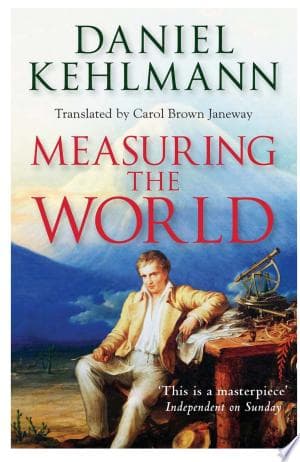
Daniel Kehlmann (2010)
Genre
Lifestyle / Historical Fiction
Reading Time
360 min
Key Themes
See below
Sign in to track this book
On the brink of scientific revolution, an explorer braves the Amazon while a mathematician deciphers the universe from his study, both driven to measure the unmeasurable.
The novel introduces a young Alexander von Humboldt, driven to explore and measure the natural world. Despite his aristocratic background and his mother's attempts to guide him toward a more traditional career, Humboldt focuses on scientific studies, especially botany, geology, and ethnography. He carefully plans his expeditions, learning various scientific techniques and languages. His early life shows a strong desire to travel and a rejection of the settled life expected of a Prussian nobleman, setting the stage for his adventures in South America. He gains a companion, Aimé Bonpland, a botanist, who joins him on his journeys.
At the same time, Carl Friedrich Gauss is shown as a child prodigy from a poor family in Braunschweig. His incredible mathematical skills are clear from a very young age, surprising his teachers and even the Duke of Brunswick, who becomes his supporter. Gauss, however, is socially awkward and very introverted, preferring the world of numbers to human interaction. He develops new ideas in mathematics, such as the method of least squares and non-Euclidean geometry, often working late into the night. His genius is recognized early, but his personal life stays mostly within his study, a sharp contrast to Humboldt's global travels.
Humboldt, with Bonpland, finally gets passage to the New World. Their expedition takes them through the dense jungles and vast rivers of Venezuela, including the Orinoco and Amazon basins. Humboldt carefully records every detail, from plant species and animal behavior to geological formations and astronomical observations. He endures harsh conditions, tropical diseases, and encounters with indigenous tribes, often pushing himself to exhaustion. His goal is not just to collect data but to understand how all natural phenomena connect, aiming for a complete view of the world.
Back in Germany, Gauss deals with the more ordinary parts of life. He marries Johanna Osthoff, and later Minna Waldeck after Johanna's death, and starts a family. Despite his unmatched genius, he faces financial problems and the pressures of academic life, including needing a stable job. His radical mathematical theories are not always immediately understood or accepted by his peers, leading to frustration. He often withdraws into his own mind, finding comfort and clarity only in the abstract world of mathematics, sometimes neglecting his family for his work, as seen on his wedding night when he jots down a formula.
A key moment in Humboldt's journey is his attempt to climb Mount Chimborazo in Ecuador, then thought to be the world's highest peak. With Bonpland and local guides, he climbs to an unprecedented height, experiencing extreme cold, thin air, and altitude sickness. Though he fails to reach the absolute summit due to an impassable crevice, Humboldt makes important observations about plant distribution at different altitudes, the effects of atmospheric pressure, and the geological structure of volcanoes. This daring feat secures his reputation as a pioneering explorer and natural scientist.
Gauss, despite disliking travel, gets involved in practical uses of his mathematics, especially in geodesy and surveying. He is hired to conduct a triangulation survey of the Kingdom of Hanover, a task that requires him to apply his advanced understanding of geometry and statistics to real-world measurements of the Earth's surface. This work, though physically demanding and involving tedious outdoor labor, further confirms his theories about the curvature of space and the imperfections of Euclidean geometry when applied to large scales, connecting his abstract thought and empirical observation.
After five years of constant exploration, Humboldt returns to Europe, first to France and then to Germany, bringing an immense collection of specimens, maps, and scientific data. He is celebrated as a hero, his discoveries changing many fields of science. His travelogues and scientific publications become bestsellers, making him one of the most famous men of his time. However, despite the praise, Humboldt remains restless, already planning new expeditions and feeling a disconnect between his grand experiences and the often-minor concerns of European society.
In his later years, Gauss becomes more withdrawn, his life almost entirely focused on his work. He accepts a professorship and directorship of the observatory in Göttingen, positions that give him the resources and quiet he needs for his research. He makes further important contributions to electromagnetism, optics, and number theory. His social interactions lessen, and he prefers the company of his calculations to that of people, further cementing his image as the 'Prince of Mathematicians' who rarely left his study, a sharp contrast to Humboldt's outward-facing life.
The novel's turning point happens when the two protagonists, now elderly and famous, finally meet in Berlin at a scientific conference hosted by Humboldt. Gauss, reluctantly persuaded by his son, travels to the Prussian capital. The meeting shows their clear differences in personality and approach to knowledge. Humboldt, still talkative and socially skilled, tries to engage Gauss, who remains awkward, blunt, and largely unimpressed by social courtesies. Their brief interactions show a mutual respect for each other's genius, despite their different methods and temperaments.
The final parts of the novel reflect on the lasting impact of Humboldt and Gauss. Humboldt, the explorer, measured the world through direct experience, observation, and thorough cataloging of its physical and biological phenomena. Gauss, the mathematician, measured it through abstract thought, equations, and a theoretical understanding of its basic structures. Both, in their own ways, expanded humanity's understanding of the cosmos, showing that measurement can take many forms, from the empirical to the purely intellectual. Their lives, though parallel, represent two fundamental approaches to scientific inquiry and the pursuit of knowledge.
The Protagonist
From a privileged but restless youth, he transforms into the world's most famous explorer, eventually finding a new form of restless intellectual engagement in old age.
The Protagonist
He evolves from a misunderstood child genius to the 'Prince of Mathematicians', increasingly retreating into his intellectual world while grappling with personal and professional challenges.
The Supporting
He begins as Humboldt's dedicated assistant, later establishing his own botanical career in South America, settling into a life more rooted than Humboldt's.
The Supporting
She provides a fleeting period of domestic bliss for Gauss before her untimely death, leaving a void that contributes to his later isolation.
The Supporting
She takes on the difficult role of Gauss's second wife, her struggles with his genius mirroring his own difficulties with domesticity.
The Supporting
He grows up overshadowed by his father's genius, eventually seeking independence and a new life away from his demanding father.
The Supporting
He acts as a crucial benefactor, enabling Gauss's early education and research, thus shaping his future.
The Mentioned
Not applicable as a fully developed character.
The novel explores two different forms of genius and how they 'measure the world.' Humboldt's genius is empirical, requiring physical exploration, careful observation, and collecting vast amounts of data to understand how the world connects (e.g., his climb of Chimborazo, cataloging species). Gauss's genius is theoretical, abstract, and internal, measuring the world through mathematical principles and the curvature of space from his study (e.g., his discoveries in non-Euclidean geometry, the method of least squares). This theme shows that understanding and 'measuring' the world are not single pursuits but multifaceted efforts, each valid.
“One could not measure the world, one could only approach it. And the closer one got, the more it changed.”
Both characters, despite their great achievements, experience deep loneliness and isolation. Humboldt's isolation comes from his constant travels, often separated from normal society and enduring harsh conditions with only a few companions. His intellectual pursuits are so far ahead of his time that he often feels misunderstood. Gauss's isolation is more internal, a result of his introverted nature and the rarity of minds that can grasp his mathematical insights. His genius separates him from his family and most social interactions, leaving him deeply alone in his intellectual world. This theme is clear in Gauss's difficulties with his wives and children, and Humboldt's constant desire for new expeditions.
“He didn't need people, he needed numbers. Numbers never disappointed him.”
The novel clearly shows the conflict between the characters' grand goals and the demands of personal and family life. Humboldt largely gives up domesticity for exploration, his restless spirit unable to settle down. Gauss, while trying to build a family, often neglects his wives and children for his all-consuming mathematical work. His wedding night, where he jumps out of bed to write down a formula, is a good example. This theme questions whether true genius can exist with normal family life, suggesting that pursuing extraordinary knowledge often requires significant personal sacrifice and an inability to fully engage with home responsibilities.
“A man who wanted to measure the world had no time for wives.”
Set during the German Enlightenment, the novel reflects the era's strong belief in reason, science, and a systematic understanding of the world. Both Humboldt and Gauss embody this spirit, trying to bring order and knowledge to the unknown. However, the novel also looks at the human cost of such pursuits, highlighting their quirks, weaknesses, and the absurdity of their greatness. It shows that even the most brilliant minds have human flaws, desires, and social awkwardness. The narrative uses subtle humor to show the contrast between their huge achievements and their very human struggles, offering a nuanced view of the Enlightenment ideal.
“He knew that the world was round, but he could not understand why people behaved the way they did.”
The novel touches on the ethical questions and personal costs tied to scientific progress and observation, especially through Humboldt's expeditions. While driven by a noble pursuit of knowledge, his interactions with indigenous populations, his collection of specimens, and his relentless drive sometimes seem exploitative or insensitive, reflecting colonial attitudes of the time. The physical toll on both himself and his companions, enduring disease and danger, also represents a significant price. For Gauss, the price is paid in his personal relationships and mental well-being, as his single-minded focus isolates him from emotional connection. The narrative implicitly asks what is lost in the constant quest for knowledge.
“To measure the world, one had to stand outside it, or at least pretend to.”
Alternating chapters follow the distinct lives of Humboldt and Gauss.
The novel employs a parallel narrative structure, frequently alternating between the lives of Alexander von Humboldt and Carl Friedrich Gauss. This device allows Kehlmann to highlight the contrasts and unexpected similarities between the two geniuses. It emphasizes their different approaches to 'measuring the world' – one through empirical exploration, the other through abstract mathematics – and builds anticipation for their eventual meeting. The juxtaposition enriches the thematic exploration of genius, ambition, and the human condition, showing two simultaneous but divergent paths to greatness.
A detached, often humorous, narrative voice comments on the protagonists' lives.
Kehlmann uses a distinct ironic and witty narrative voice that often provides dry commentary on the protagonists' eccentricities, social awkwardness, and the absurdities of their situations. This humor humanizes the otherwise larger-than-life figures, preventing them from becoming mere caricatures. The narration often undercuts their grand achievements with observations about their personal failings or the mundane realities of their lives, creating a balance between awe and amusement. This device significantly contributes to the novel's 'charm and readability' mentioned in the description.
Authentic historical settings blended with modern sensibilities and occasional anachronisms.
The novel is meticulously researched, providing an authentic historical backdrop of the late 18th and early 19th centuries, particularly regarding scientific practices, social norms, and geographical knowledge. However, Kehlmann occasionally injects modern sensibilities and anachronistic humor (e.g., characters thinking in ways that feel contemporary) into the narrative. This blend allows the historical figures to feel more relatable and accessible to a modern audience, while also subtly commenting on the timeless nature of genius and human foibles. It creates a playful distance from strict historical realism, enhancing the novel's literary quality.
Supporting characters who highlight the protagonists' traits through contrast.
Various supporting characters serve as foils to the two main protagonists. Aimé Bonpland, Humboldt's more grounded and less philosophically driven companion, highlights Humboldt's boundless ambition and sometimes reckless pursuit of knowledge. Johanna and Minna, Gauss's wives, and his son Eugene, underscore Gauss's profound social awkwardness and his inability to connect on an emotional level, emphasizing his isolation and single-minded dedication to mathematics. These characters provide human context and amplify the unique qualities and challenges faced by Humboldt and Gauss.
“The world was not a something one could measure, it was a something one could only wonder at.”
— Reflecting on the limitations of scientific measurement in capturing the full essence of the world.
“He knew that the world was immense, and that he was small, but he also knew that he contained within himself the ability to grasp and understand its immensity.”
— Alexander von Humboldt's ambition and self-awareness in his quest for knowledge.
“Order was a human invention, and the world itself was chaos, beautiful and terrifying.”
— Gauss's internal conflict between mathematical order and the perceived chaos of existence.
“To measure was to understand, and to understand was to possess.”
— A driving motivation for many scientists and explorers in their pursuit of knowledge.
“He understood that the most profound insights often came from the most unexpected places.”
— Humboldt's open-minded approach to learning and observation.
“Genius was not a gift, but a burden, a constant pressure to see more, to know more, to do more.”
— Gauss's perspective on the demands and isolation of his intellectual capabilities.
“The world was not a flat surface, but a curved one, and he felt the curvature in his own spirit.”
— Gauss grappling with non-Euclidean geometry and its implications.
“He didn't just want to see the world, he wanted to feel it, taste it, smell it, become a part of it.”
— Humboldt's immersive and experiential approach to exploration.
“Every measurement was an approximation, every certainty a temporary illusion.”
— A reflection on the inherent limitations and uncertainties in scientific measurement.
“The greatest journeys were not across continents, but within the mind.”
— A contrast between physical exploration and intellectual discovery.
“He was a man who wanted to know everything, and in knowing everything, to control it.”
— A characterization of the ambition and drive behind scientific inquiry.
“Silence was not empty, but full of possibilities, full of the unsaid and the yet-to-be-discovered.”
— A reflection on the contemplative nature of scientific thought and observation.
“The past was a foreign country, and he was its most diligent cartographer.”
— A metaphor for the historical and reconstructive efforts of understanding the world.
“To be truly alone was to be truly free, free from the expectations of others, free to pursue one's own truths.”
— Gauss's preference for solitude in his intellectual pursuits.
Ready to see how well you understood this book? Take our interactive quiz with 10 questions.

Daniel Kehlmann is a German-language novelist and playwright of both Austrian and German nationality.