BookBrief
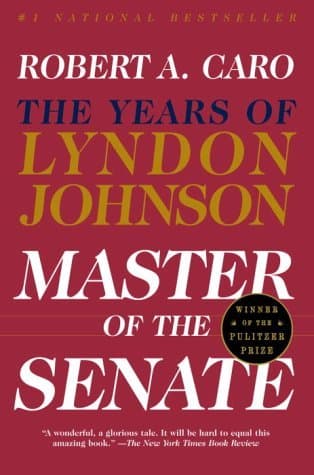
Master of the Senate cover
Archivist's Choice

Master of the Senate

Robert A. Caro (2002)

Genre

Politics / Biography / History

Reading Time

Approximately 30-40 hours (at 30 pages/hour)

Key Themes

See below

Track Your Reading

Sign in to track this book

Lyndon B. Johnson's rise in the United States Senate, where his charm and legislative skill broke gridlock to pass Civil Rights legislation, changed American politics forever.

Core Idea

Robert Caro's "Master of the Senate" details Lyndon B. Johnson's rise to power in the U.S. Senate. Caro argues that Johnson, through ambition, legislative mastery, and a persuasive style (the 'Johnson Treatment'), made the Senate Majority Leader position almost dictatorial. The book shows how Johnson's use of information, rule manipulation, and understanding of senators allowed him to pass significant laws, like the 1957 Civil Rights Act, despite strong opposition. This changed the balance of power in the American political system and prepared the way for his presidency. It explores the workings of legislative power and the moral compromises involved. Caro suggests that Johnson's focus on power was for personal gain and to achieve legislative goals he believed were right. The book looks at the all-consuming nature of political life and how one person's will and skill can influence a nation's history, while also examining the ethical issues and human cost of such political dominance.
Reading time
Approximately 30-40 hours (at 30 pages/hour)
Difficulty
Hard
✓ Read this if...
You are fascinated by the intricate workings of American political power, the psychology of ambition, and the legislative process, and are prepared for a deep, detailed, and lengthy exploration of a pivotal period in U.S. history through the lens of one of its most dominant figures. This is essential reading for anyone interested in Lyndon B. Johnson's pre-presidential career.
✗ Skip this if...
You prefer concise narratives, are easily overwhelmed by extensive biographical detail and political minutiae, or lack patience for a very long book focused on legislative tactics rather than broad historical sweeps. If you're not deeply interested in the U.S. Senate's mechanics or LBJ's early career, this might feel like a slog.

Core idea

The central argument and framework that powers the entire book.

Robert Caro's "Master of the Senate" details Lyndon B. Johnson's rise to power in the U.S. Senate. Caro argues that Johnson, through ambition, legislative mastery, and a persuasive style (the 'Johnson Treatment'), made the Senate Majority Leader position almost dictatorial. The book shows how Johnson's use of information, rule manipulation, and understanding of senators allowed him to pass significant laws, like the 1957 Civil Rights Act, despite strong opposition. This changed the balance of power in the American political system and prepared the way for his presidency. It explores the workings of legislative power and the moral compromises involved.

Caro suggests that Johnson's focus on power was for personal gain and to achieve legislative goals he believed were right. The book looks at the all-consuming nature of political life and how one person's will and skill can influence a nation's history, while also examining the ethical issues and human cost of such political dominance.

At a glance

Reading time

Approximately 30-40 hours (at 30 pages/hour)

Difficulty

Hard

Read this if...

You are fascinated by the intricate workings of American political power, the psychology of ambition, and the legislative process, and are prepared for a deep, detailed, and lengthy exploration of a pivotal period in U.S. history through the lens of one of its most dominant figures. This is essential reading for anyone interested in Lyndon B. Johnson's pre-presidential career.

Skip this if...

You prefer concise narratives, are easily overwhelmed by extensive biographical detail and political minutiae, or lack patience for a very long book focused on legislative tactics rather than broad historical sweeps. If you're not deeply interested in the U.S. Senate's mechanics or LBJ's early career, this might feel like a slog.

Key Takeaways

1

The Senate's Decline and LBJ's Ascent

How Lyndon Johnson resurrected a moribund Senate through sheer force of will and legislative genius.

Quote

By the time Johnson arrived, the Senate had become a parody of itself and an obstacle that for decades had blocked desperately needed liberal legislation.

Caro details the U.S. Senate in the mid-20th century: a body stuck in tradition, seniority, and a Southern filibuster that stopped progressive laws, especially on civil rights. It was a place where bills died and individual senators held much power. Johnson, entering this, saw not just the problems but the chance for one person to take control. His goal was to dominate the institution, changing it from a slow body into a dynamic engine for his will. His rise to Majority Leader, ignoring established rules, showed his drive and skill, s...

Supporting evidence

Caro's extensive description of the Senate's pre-Johnson state, detailing the power of committee chairs, the unwritten rules, and the consistent blocking of legislation, particularly by Southern Democrats.

Apply this

Understand that even deeply entrenched, seemingly immovable systems can be transformed by a leader with a clear vision, relentless work ethic, and a willingness to defy conventional wisdom.

legislative-dysfunctionsenate-powerpolitical-transformation
2

The 'Johnson Treatment': Master of Persuasion

LBJ's legendary blend of charm, intimidation, and relentless personal lobbying to bend senators to his will.

Quote

He knew how to seduce, how to charm, how to threaten, how to cajole, how to flatter, how to dominate.

The 'Johnson Treatment' was more than a negotiation tactic; it was an intense effort to sway a senator. Caro describes Johnson's close presence, his voice changing from loud to a whisper, his hand on an arm, his constant pursuit in hallways and offices. He used every piece of information he had—weaknesses, ambitions, family lives, political needs—to find the right way to apply pressure. This was personal, making it hard for people to refuse him. He understood that politics was about human relationships and using them to achieve legisl...

Supporting evidence

Numerous anecdotes throughout the book detailing specific instances of Johnson cornering senators, such as his relentless pursuit of Senator Richard Russell or his 'treatment' of younger, wavering senators on key votes.

Apply this

When seeking to influence, understand the individual motivations and pressures of the other party. Personal connection and tailored arguments, even if intense, can be far more effective than generic appeals.

political-persuasionlobbying-tacticsinterpersonal-power
3

The Art of the Legislative Process

LBJ's unparalleled mastery of Senate rules and procedures as a tool for power and progress.

Quote

He knew the rules of the Senate better than anyone else, and he used them like a master craftsman uses his tools.

Johnson's legislative skill came from knowing Senate rules, procedures, and customs. He understood them and used them as tools. He could predict every parliamentary move, use every loophole, and create legislative strategies that seemed impossible. This knowledge let him control the legislative agenda, bring bills to the floor, and manage votes precisely, often outsmarting more experienced senators. His ability to navigate the Senate's complex rules was key to his power, helping him pass laws that had been stuck for decades. It showed...

Supporting evidence

Caro's detailed accounts of Johnson's procedural maneuvers, such as his handling of the 1957 Civil Rights Act, where he expertly guided the bill through various committees and amendments, often at breakneck speed, to prevent its complete emasculation.

Apply this

Deeply understanding the 'rules of the game' in any complex system (corporate, political, social) provides a significant advantage in achieving objectives and navigating obstacles.

legislative-strategyparliamentary-procedureinstitutional-knowledge
4

The Price of Power: Moral Compromises

Johnson's ruthless ambition often led to ethically questionable actions and personal betrayals.

Quote

His ambition was boundless, and he was willing to do almost anything to achieve his ends.

Caro shows the darker side of Johnson's ambition. While he achieved legislative successes, his methods were often unethical, involving manipulation, deception, and exploiting others' weaknesses. He built his power through favors, threats, and a large intelligence network, often using information to his benefit. This pragmatism, while effective, had a moral cost. Johnson's drive for power often overshadowed fairness or loyalty, creating a complex picture of a leader who was both visionary and flawed, embodying the idea that results oft...

Supporting evidence

Caro's detailed accounts of Johnson's political maneuvering in his early career, his willingness to undermine rivals, and the stories of his treatment of staff and colleagues, often bordering on abusive.

Apply this

Recognize that significant achievements, especially in power-driven environments, often involve difficult ethical trade-offs. Leaders must weigh the moral implications of their methods against the desired outcomes.

political-ethicsmachiavellianismambition-costs
5

The Civil Rights Breakthrough: A Calculated Gambit

Johnson leveraged his unique position to pass the first significant Civil Rights legislation in nearly a century.

Quote

He, the Southerner, the man who had always opposed civil rights legislation, was the only one who could get it passed.

One of the most notable achievements in 'Master of the Senate' is Johnson's work on the 1957 Civil Rights Act. As a Southerner, he understood the strong opposition and tactics used to block such laws. His position as Majority Leader, with his legislative skill, allowed him to navigate the difficult political situation. He played a complex game, calming Southern conservatives while passing a bill that, though changed, was an important first step. This was a calculated political success, showing his ability to overcome his regional back...

Supporting evidence

Caro's extensive breakdown of the 1957 Civil Rights Act's passage, detailing the compromises, the behind-the-scenes negotiations, and Johnson's strategic use of parliamentary rules to outmaneuver Southern opponents.

Apply this

Significant social change often requires leaders who can bridge divides and find common ground, even if it means initially accepting incremental progress rather than demanding perfection.

civil-rights-movementsouthern-politicslegislative-breakthrough
6

The Power of Information and Intelligence

LBJ's insatiable hunger for information was a cornerstone of his political dominance.

Quote

He knew everything about everyone, and he used that knowledge relentlessly.

Johnson built an extensive intelligence network, both formal and informal, that gave him constant information about every senator, staffer, lobbyist, and political event. He knew their voting records, personal habits, finances, family lives, ambitions, and fears. This detailed understanding of the political system allowed him to predict moves, exploit weaknesses, and tailor his 'treatment' for maximum effect. He understood that knowledge was power, and he put great effort into getting and using it, making him hard to challenge in his ...

Supporting evidence

Caro's descriptions of Johnson's extensive phone calls, his network of aides who reported every detail, and his legendary memory for facts and figures related to individual senators and their districts.

Apply this

In any leadership role, invest heavily in gathering comprehensive intelligence about stakeholders, competitors, and the environment. This data-driven approach enhances decision-making and strategic advantage.

information-gatheringpolitical-intelligencedata-driven-leadership
7

The All-Consuming Nature of Political Life

Johnson's dedication to politics was absolute, leaving little room for personal life or even rest.

Quote

He worked harder, longer, and more relentlessly than any other man in the Senate.

Caro shows a man completely focused on his political ambition. Johnson's workdays were long, often stretching late into the night and starting before dawn. He expected the same intensity from his staff, creating a high-pressure environment. His personal life, especially his relationship with Lady Bird, was secondary to his political career. This dedication, while helping his success, also highlights the personal sacrifices needed to reach and stay at the top of power. It suggests that for some, politics is an all-encompassing identity...

Supporting evidence

Detailed accounts of Johnson's grueling schedule, his minimal sleep, his constant phone calls, and the demands he placed on his family and staff, often to their detriment.

Apply this

Aspiring leaders should recognize the profound personal sacrifices often required for top-tier political or professional success, and honestly assess if they are willing to pay that price.

work-ethicpolitical-sacrificeambition-drive
8

The Power of the Majority Leader's Office

LBJ redefined the role of Majority Leader, transforming it into the most powerful position in the Senate.

Quote

He didn't just occupy the office; he reinvented it, making it the central nervous system of the Senate.

Before Johnson, the Senate Majority Leader was mainly a coordinating role, secondary to powerful committee chairs and seniority. Johnson, however, made it a position of great authority. He centralized power, controlled the legislative calendar, managed committee assignments, and decided what came to a vote. He became the leader of the Senate, guiding its flow and direction. This change redefined the role, allowing him to have great influence and making the Majority Leader's office the true center of legislative power. His time set a n...

Supporting evidence

Caro's analysis of how Johnson systematically consolidated power, from controlling committee assignments to dictating floor schedules and personally lobbying for every key vote, effectively bypassing traditional power centers.

Apply this

In any organizational structure, a determined leader can redefine and expand the scope of their role, centralizing power and influence to achieve strategic objectives, often against established norms.

majority-leader-powerinstitutional-reformpolitical-leadership
9

The Empathy and Brutality Paradox

Johnson possessed a profound understanding of human nature, which he used for both good and ill.

Quote

He had an almost supernatural ability to read men, to understand their deepest desires and fears.

One of the compelling aspects of Caro's portrayal is Johnson's contrasting nature: his ability for genuine empathy and his equal capacity for harshness. He could understand the hopes and fears of individual senators, connecting with them personally, only to then use those vulnerabilities for political gain. This is not simple manipulation; it shows a complex psychological profile where insight into human nature was a primary tool, used without moral hesitation. This dual nature made him effective, allowing him to form alliances and ov...

Supporting evidence

Stories of Johnson comforting grieving senators, remembering details about their families, only to then press them mercilessly on a vote they were reluctant to cast. His ability to connect with both Northern liberals and Southern conservatives on different terms.

Apply this

Effective leadership often requires a deep understanding of human psychology, but the ethical use of that understanding is paramount. Leaders must decide whether to use empathy for collaboration or for manipulation.

human-psychologyleadership-paradoxethical-dilemmas
10

The Shadow of the Future Presidency

Johnson's Senate years were a crucible, forging the legislative titan who would later become President.

Quote

Everything he learned, every tactic he perfected in the Senate, would be brought to bear on the grander stage of the Presidency.

'Master of the Senate' is not just about Johnson's time in the Senate; it helps explain his presidency. The legislative skills, ambition, mastery of process, and ability to form coalitions were all developed during these twelve years. Caro subtly shows how Johnson's Senate experience provided the foundation and confidence for his later, broader legislative agenda. The book reveals that the President who would pass important Civil Rights and social programs was not a sudden creation but the result of decades of intense political learni...

Supporting evidence

Caro's recurring thematic threads connecting Johnson's Senate tactics (e.g., building consensus, using information) to his future presidential ambitions and eventual legislative successes.

Apply this

Recognize that foundational experiences and skill development in one role often serve as the essential groundwork for greater achievements in subsequent, more prominent positions.

presidential-preludepolitical-developmentlegacy-building

Critical analysis

Notable Quotes

Power doesn't corrupt. It reveals.

Caro's recurring theme about the nature of power as observed in Lyndon Johnson.

He knew how to use power, and he never hesitated to use it.

Describing Lyndon Johnson's masterful and ruthless application of his political will.

The greatest weapon in a politician's arsenal is information.

Highlighting Johnson's meticulous gathering and use of intelligence on his colleagues.

He could be charming, he could be brutal, and he was always, always calculating.

A concise summary of Lyndon Johnson's complex and often contradictory personality and methods.

The Senate was a place of endless talk, but sometimes, just sometimes, talk could change the world.

Reflecting on the power of debate and persuasion within the legislative body, especially concerning civil rights.

He didn't just want to win; he wanted to annihilate.

Describing Johnson's intense competitive drive and his desire for absolute victory over opponents.

The price of leadership is loneliness.

A general observation about the burdens and isolation often faced by powerful leaders.

He understood the human heart, its weaknesses and its desires, and he played upon them like a master musician.

Illustrating Johnson's profound psychological insight into individuals and his ability to manipulate them.

The measure of a man's greatness is not in his victories, but in what he overcomes to achieve them.

A broader philosophical point about resilience and the challenges faced on the path to success.

He built his power brick by brick, vote by vote, favor by favor.

Detailing the meticulous and incremental way Johnson constructed his political empire.

The Senate was his stage, and he was its greatest actor.

Metaphorically portraying Johnson's command of the Senate floor and his theatrical political performances.

To get things done, you have to be willing to break some rules, and make some enemies.

Reflecting on the pragmatic and often confrontational nature of effective political action.

He saw the future, and he was determined to drag the present into it, kicking and screaming if necessary.

Emphasizing Johnson's visionary drive and his forceful approach to enacting his agenda, particularly on civil rights.

The truth was not always what mattered; what mattered was what people believed.

Highlighting Johnson's understanding of perception and narrative in politics, sometimes over objective fact.

Quiz

Test Your Knowledge

Ready to see how well you understood this book? Take our interactive quiz with 10 questions.

10
Questions
~5
Minutes
?
Best Score

Key Questions (FAQ)

"Master of the Senate" focuses on Lyndon B. Johnson's twelve years in the United States Senate, specifically from 1949 through 1960. It details his rise to power and his transformative impact on the legislative body during this crucial decade.

About the author