“There are no new plots, only new writers, new ways of telling the same old stories.”
— Miles Green reflecting on the nature of storytelling and literary originality.


John Fowles (1982)
Genre
Literary Fiction / Philosophy
Reading Time
240 min
Key Themes
See below
Sign in to track this book
A novelist with amnesia struggles against his seductive muse, who may be his doctor, in a playful look at art, identity, and storytelling.
Miles Green wakes in a stark white, windowless room, disoriented and with complete amnesia. He remembers nothing of who he is or how he got there until a nurse, Dr. Delfie, gives him his name. Dr. Delfie, a stunning woman, tries to examine him, but Miles is more interested in her striking looks and the unsettling perfection of his surroundings. He quickly becomes suspicious of her methods and his strange confinement. His mind, though blank about his past, is very active, creating theories and questions about his situation and Dr. Delfie's true identity. He feels an unexplained connection to her, a sense of familiarity despite his amnesia.
Miles's suspicion grows, fueled by Dr. Delfie's evasiveness and the room's surreal feel. He starts to think he is not in a hospital but some symbolic space, and that Dr. Delfie is not a doctor. Through logic and intuition, he concludes she is his muse, a symbol of creative inspiration. When faced with his insistent and detailed theories, Dr. Delfie, after some resistance, admits he is a novelist, John Fowles, and she is his muse, Urania. This news confirms his artistic identity but does little to explain their strange meeting.
With their true identities known, the relationship between Miles (now accepting himself as John Fowles, the novelist) and Urania becomes a battle of wills. Miles, eager to regain his creative power and leave the white room, tries to control his next novel. Urania, however, asserts her own role, arguing she is not just a passive vessel but an active part of the creative process. She criticizes his past works, questions his artistic choices, and demands a more important, less objectified role in his future stories. Their dialogue becomes a discussion on authorship, inspiration, and the link between creator and creation.
Miles, seeing Urania as someone to control, tries to seduce her, believing physical intimacy will restore his creative flow and show his dominance. Urania, however, is an elusive and powerful opponent. Each time Miles makes a move, she changes, shifting her appearance and personality. She becomes various female figures: a modest Victorian lady, a fierce Amazonian warrior, a playful nymph, and even a cold feminist academic. These changes are not just physical; they show the muse's many powers and her refusal to be limited by Miles's expectations or desires. She constantly thwarts his attempts to control her.
The surreal atmosphere deepens with the sudden arrival of a second muse, Erato, the muse of erotic poetry. Erato is younger, more openly sensual, and less intellectual than Urania. Her arrival further complicates Miles's situation and the power dynamics in the white room. Erato's presence adds a new layer to the debate about inspiration, focusing on physical desire and raw emotion as creative forces. She often disagrees with Urania, undermines her arguments, and even tries to seduce Miles herself, creating a love triangle that is both absurd and symbolic of the competing demands on an artist's imagination.
The setting suddenly changes, turning the white room into a surreal courtroom. Miles is put on trial, accused of various literary sins, especially his treatment of female characters and his perceived patriarchal biases in his stories. Erato, with her sharp wit and aggressive manner, acts as prosecutor, dissecting Miles's past works and exposing his perceived flaws. Urania, though appearing as a witness, also adds to the indictment, offering subtle critiques of his artistic shortcomings. Miles, now the defendant, must defend his entire writing career and his understanding of the creative process, facing a relentless intellectual attack from his own inspirations.
After a harsh prosecution and a mostly weak defense, Miles is found guilty by the muses. Their verdict is not literal imprisonment, but a symbolic one: he is sentenced to a purgatory where he will forever struggle with writer's block and creative weakness. This sentence is a direct result of his inability to truly understand and respect the independent role of his muses and, by extension, the female characters he creates. The judgment emphasizes the book's main idea: true creativity needs a collaborative and respectful relationship between the author and their sources of inspiration, not one of dominance and objectification.
Desperate to escape his creative prison and the muses' constant critiques, Miles tries to flee the white room. This leads to a farcical and increasingly absurd chase. The room itself transforms, becoming a series of fantastical and symbolic landscapes — a forest, a desert, a stormy sea — each showing different challenges and aspects of the creative struggle. The muses, especially Urania, pursue him relentlessly, often appearing in different forms and using their powers to stop his escape. This chase is a metaphor for the artist's endless struggle to escape the demands of inspiration and the difficulties of the creative process, only to find that inspiration is unavoidable.
After his exhausting and ultimately useless escape attempt, Miles finds himself back in the pristine white room, facing Urania and Erato again. However, his journey has had some impact. Though still frustrated, he starts to show a glimmer of understanding, a new acceptance of the muses' independent power and the collaborative nature of creation. The futility of his escape reinforces the idea that an artist cannot truly leave their muse; inspiration is an intrinsic part of their being. This return suggests a possible turning point, implying that true artistic growth can only come from recognizing and respecting the forces that drive it.
In a moment of exhaustion and new humility, Miles makes a final plea to Urania and Erato. He acknowledges their power, their wisdom, and his own faults. He expresses a desire to create a new kind of novel, one that truly respects and explores the complexities of female characters, moving past his previous patriarchal tendencies. While the muses do not offer immediate or easy forgiveness, there is a sense that this new understanding might lead to a more fruitful and balanced creative relationship. The ending is open, suggesting the struggle between artist and muse is ongoing, but with a hint of potential growth and reconciliation.
The Protagonist
Miles begins as an amnesiac, then asserts patriarchal control over his muses, but eventually begins to understand and respect their independent agency, hinting at future creative growth.
The Antagonist/Supporting
Uranias maintains her independent power throughout, challenging Miles's patriarchal views and ultimately guiding him toward a more respectful understanding of the muse's role.
The Supporting
Erato consistently challenges established norms and injects a vital, sensual energy into the narrative, forcing Miles to confront different facets of inspiration.
The novel explores the source and control of creative inspiration. Is the muse a passive vessel or an active, independent force? Fowles uses the muses' literal presence to question the author's ultimate authority over their creations. Miles's initial amnesia symbolizes the blank slate before inspiration, and his struggle with Urania and Erato represents the artist's constant battle to use, understand, and respect the forces that drive their work. The courtroom scene directly addresses the author's responsibility and ethics in shaping stories, especially regarding gender.
““You novelists! Always trying to possess us. But we are not yours to possess. We are ours.””
A main theme is the criticism of patriarchal attitudes in literature and the objectification of female characters. Urania and Erato constantly challenge Miles (and by extension John Fowles) on his past portrayal of women in his novels, accusing him of reducing them to archetypes or plot devices. Urania's transformations into various female figures—from modest to aggressive—symbolize the complex nature of womanhood that Miles, as an author, has failed to truly capture or respect. The novel advocates for a more nuanced, empathetic, and fair representation of female characters, reflecting a feminist critique of traditional literary practices.
““You think you invent us. We invent you.””
Mantissa is highly metafictional, constantly drawing attention to its own artificiality and creation process. The main character being a novelist (John Fowles himself) who talks directly with his muses blurs the lines between author, character, and inspiration. The 'white room' setting, the changing identities, and the open discussions about plot, character, and genre all remind the reader they are engaging with a constructed reality. This self-awareness allows Fowles to comment on storytelling rules, the link between fiction and reality, and the act of writing a novel.
““This is a book about writing a book about writing a book.””
The novel shows the anxieties and frustrations in the creative process. Miles's amnesia can be seen as a metaphor for creative block, a state where the artist feels without ideas or purpose. His subsequent struggle to write and his battles with the muses represent the difficult, often contentious relationship between an author and their inspiration. The muses' 'sentence' of creative purgatory further highlights the severe results of failing to nurture and respect the creative urge. The story shows the psychological toll writing can take, and the constant need for artists to grow and adapt their approach.
““The greatest enemy of art is the good idea badly pursued.””
Miles Green's initial state of memory loss.
Miles's amnesia serves as a powerful starting point, symbolizing a tabula rasa for the exploration of identity, authorship, and creative beginnings. It allows the narrative to strip away Miles's preconceived notions and societal roles, forcing him to confront his essence as a writer and his relationship with his muses from a fundamental level. The recovery of his identity as John Fowles is not a simple retrieval of memory but a revelation of his artistic self, intertwined with the very nature of his inspiration. It also creates initial suspense and allows for the gradual, meta-fictional unveiling of his profession.
The sterile, featureless setting where most of the action takes place.
The white room functions as a symbolic space, an archetypal 'blank page' or a 'writer's block' where all external distractions are removed, forcing the protagonist to confront his inner world and the source of his creativity. Its sterile, unchanging nature emphasizes the intellectual and conceptual battles taking place. The room's ability to transform into various landscapes during Miles's escape attempts further underscores its symbolic nature, representing the fluid and imaginative space of the mind. It serves as a stage where the abstract concepts of inspiration and authorship can be personified and debated.
The muses' ability to change their appearance and persona at will.
The muses' frequent transformations are a key plot device, serving multiple functions. They visually represent the multifaceted and elusive nature of inspiration, which cannot be pinned down or controlled. For Uranias, her changes highlight the diverse archetypes and roles women play, challenging Miles's reductive views and showing her refusal to be objectified. For Erato, her transformations emphasize the shifting nature of desire and passion. This device also adds a layer of surrealism and theatricality to the narrative, preventing the reader (and Miles) from settling into any single interpretation of the muses or their power.
The novel's self-conscious awareness of its own fictionality.
Metafiction is arguably the overarching plot device, as the novel constantly refers to itself as a construct, discusses the process of writing, and blurs the lines between author and character. The muses directly critique Miles's (John Fowles's) past novels, and the characters often comment on the narrative's direction and style. This device allows Fowles to engage in a profound philosophical discourse about the act of creation, the relationship between writer and reader, and the constructed nature of reality within fiction. It invites the reader to actively participate in deconstructing the text and considering the power dynamics inherent in storytelling.
“There are no new plots, only new writers, new ways of telling the same old stories.”
— Miles Green reflecting on the nature of storytelling and literary originality.
“The greatest pleasure of love is in its beginning, and its greatest pain is in its ending.”
— Miles musing on the cyclical nature of relationships and the emotional arc of love.
“Reality is a construct, a story we tell ourselves to make sense of the chaos.”
— A philosophical discussion between Miles and Urfe about the subjective nature of reality.
“Every writer is a failed god, trying to create worlds that are always less perfect than the one they inhabit.”
— Miles contemplating the ambition and inherent limitations of the authorial role.
“The only true freedom is in the imagination, where all things are possible and nothing is forbidden.”
— Urfe challenging Miles's more grounded perspective on freedom and constraints.
“We are all prisoners of our own narratives, bound by the stories we believe about ourselves.”
— A reflection on self-identity and the power of personal narrative.
“To write is to be a voyeur, to watch life unfold from a safe distance, and then to reconstruct it in your own image.”
— Miles describing the detached yet intimate process of writing.
“The past is a foreign country; they do things differently there. But the future is an even stranger one.”
— A play on a famous literary quote, highlighting the unpredictability of the future.
“Meaning is not found, it is made. And often, unmade.”
— A discussion about the subjective and fluid nature of meaning in life and literature.
“The greatest deception is the one we perpetrate upon ourselves.”
— Urfe accusing Miles of self-deception regarding his creative block.
“Art is a lie that tells the truth.”
— A classic paradox explored in the context of fiction's ability to reveal deeper realities.
“Every story is a seduction, a carefully constructed illusion designed to capture and hold the reader's attention.”
— Miles reflecting on the manipulative aspect of storytelling.
“The blank page is both a promise and a threat.”
— Miles's internal struggle with writer's block and the daunting nature of creation.
“Life is a series of drafts, and we are constantly revising ourselves.”
— A metaphor for personal growth and the ongoing process of self-definition.
Ready to see how well you understood this book? Take our interactive quiz with 10 questions.
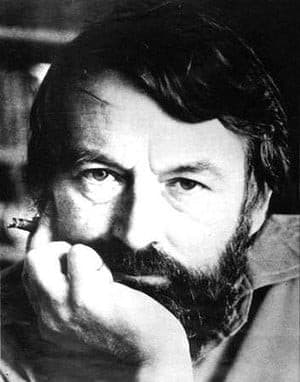
John Robert Fowles was an English novelist of international renown, critically positioned between modernism and postmodernism. His work was influenced by Jean-Paul Sartre and Albert Camus, among others.