BookBrief
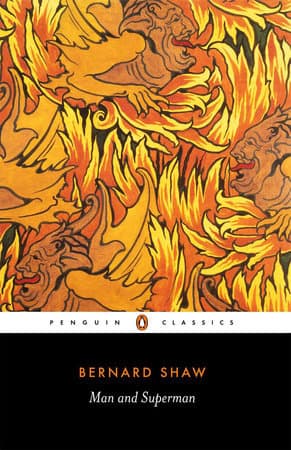
Man and Superman cover
Archivist's Choice

Man and Superman

George Bernard Shaw (1903)

Genre

Philosophy

Reading Time

240 min

Key Themes

See below

Track Your Reading

Sign in to track this book

Don Juan and Ann Whitefield battle for the future of humanity, debating societal roles and evolution through witty conversation and the eternal conflict between the sexes.

Synopsis

Shaw's 'Man and Superman' argues that humanity is driven by an impersonal 'Life Force' whose goal is to reproduce and evolve towards a 'Superman' – a higher stage of human development marked by greater intellect and will. Women, often without realizing it, are the main agents of this Life Force, instinctively trying to get men, especially those with good genes, to marry them for procreation. In contrast, brilliant men, like Jack Tanner, often resist this biological drive, valuing intellectual freedom and progress over traditional romance and family life. The play examines the hypocrisy of conventional morality, the illusion of free will against biological urges, and societal structures that hinder real human advancement. It suggests that true progress comes from consciously accepting the evolutionary impulse, moving beyond basic desires and social norms to develop the intellect and will needed to create the Superman.
Reading time
240 min
Difficulty
Medium
✓ Read this if...
You are fascinated by philosophical debates on evolution, gender roles, free will, and societal critique, presented through the witty and often provocative lens of George Bernard Shaw. You enjoy plays that blend comedy with deep intellectual inquiry.
✗ Skip this if...
You prefer light, character-driven narratives without extensive philosophical discourse, or if you are put off by Shaw's often didactic and polemical style, especially regarding gender dynamics and evolutionary theory.

Plot Summary

Principal Figures

Themes & Insights

Plot Devices & Literary Techniques

Critical analysis

Notable Quotes

The reasonable man adapts himself to the world: the unreasonable one persists in trying to adapt the world to himself. Therefore all progress depends on the unreasonable man.

From the 'Maxims for Revolutionists' section, a core philosophical statement.

He who can, does. He who cannot, teaches.

From the 'Maxims for Revolutionists,' a provocative jab at the academic world.

You see things; and you say 'Why?' But I dream things that never were; and I say 'Why not?'

Often attributed to Shaw, this embodies the spirit of the Life Force and revolutionary thought.

There are two tragedies in life. One is not getting what you want. The other is getting it.

From the 'Maxims for Revolutionists,' highlighting the bittersweet nature of desire and fulfillment.

To be in hell is to drift; to be in heaven is to steer.

Don Juan's speech in Act 3, contrasting passive existence with purposeful living.

Marriage is popular because it combines the maximum of temptation with the maximum of opportunity for being respectable.

From the 'Maxims for Revolutionists,' a cynical view of societal institutions.

The only way to avoid being miserable is not to have enough leisure to wonder whether you are happy or not.

Don Juan's observation on the human condition in Act 3.

Do not do unto others as you would that they should do unto you. Their tastes may not be the same.

From the 'Maxims for Revolutionists,' a humorous twist on the Golden Rule.

A man's got to be a man. A woman's got to be a woman. And then they've got to be something better.

Ann Whitefield's reflection on gender roles and evolution.

Life is a force which you can only conquer by letting it conquer you.

Don Juan's philosophical insight into the nature of the Life Force.

The greatest of evils is to be conscious of an evil and not to dare to remedy it.

Don Juan's condemnation of inaction and moral cowardice.

Hell is the home of honor, duty, justice, and all the unholy virtues.

Don Juan's provocative re-evaluation of conventional virtues in Hell.

Every man over forty is a scoundrel.

From the 'Maxims for Revolutionists,' a sweeping, cynical generalization.

The true artist will let his wife starve, his children go barefoot, his mother drudge for his living at seventy, sooner than work at anything but his art.

From the 'Maxims for Revolutionists,' a stark portrayal of artistic dedication.

Quiz

Test Your Knowledge

Ready to see how well you understood this book? Take our interactive quiz with 10 questions.

10
Questions
~5
Minutes
?
Best Score

Key Questions (FAQ)

'Man and Superman' primarily explores George Bernard Shaw's theory of Creative Evolution, the roles of men and women in society, and the artist's function. It's a powerful drama of ideas that delves into the eternal struggle between the sexes through a philosophical lens.

About the author

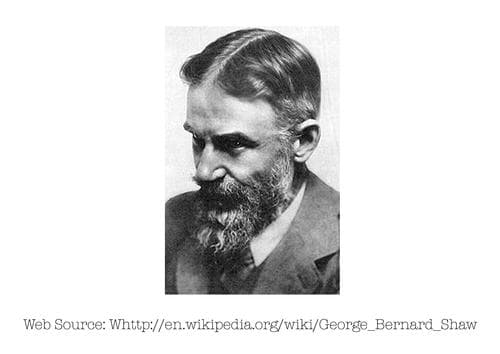
George Bernard Shaw

George Bernard Shaw, known at his insistence as Bernard Shaw, was an Irish playwright, critic, polemicist and political activist. His influence on Western theatre, culture and politics extended from the 1880s to his death and beyond. He wrote more than sixty plays, including major works such as Man and Superman (1902), Pygmalion (1913) and Saint Joan (1923). With a range incorporating both contemporary satire and historical allegory, Shaw became the leading dramatist of his generation, and in 1925 was awarded the Nobel Prize in Literature.