“I celebrate myself, and sing myself, / And what I assume you shall assume, / For every atom belonging to me as good belongs to you.”
— Opening lines of 'Song of Myself,' establishing themes of selfhood and universality.

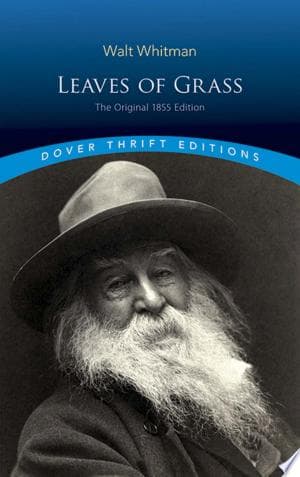
Walt Whitman (2007)
Genre
Philosophy
Reading Time
130 min
Key Themes
See below
Sign in to track this book
Whitman's 'Leaves of Grass' uses free verse to celebrate the divine in nature and the human body, showing how the self, nature, and the cosmos are connected.
“I celebrate myself, and sing myself, / And what I assume you shall assume, / For every atom belonging to me as good belongs to you.”
— Opening lines of 'Song of Myself,' establishing themes of selfhood and universality.
“Do I contradict myself? / Very well then I contradict myself, / (I am large, I contain multitudes.)”
— From 'Song of Myself,' addressing potential inconsistencies in his views and embracing complexity.
“A child said What is the grass? fetching it to me with full hands; / How could I answer the child? I do not know what it is any more than he.”
— From 'Song of Myself,' pondering the simple yet profound nature of grass and the limits of knowledge.
“The United States themselves are essentially the greatest poem.”
— From the 1855 Preface to 'Leaves of Grass,' asserting the poetic grandeur of the American nation.
“Not till the sun excludes you do I exclude you.”
— From 'Song of Myself,' expressing radical inclusion and acceptance of all.
“This is the city and I am one of the citizens, / Whatever interests the rest interests me, politics, wars, markets, newspapers, schools, / The mayor and councils, and the families directly involved, / The like of the rest I am of these.”
— From 'Song of Myself,' emphasizing his connection and engagement with urban life and society.
“O Captain! my Captain! our fearful trip is done, / The ship has weather’d every rack, the prize we sought is won, / The port is near, the bells I hear, the people all exulting, / While follow eyes the steady keel, the vessel grim and daring; / But O heart! heart! heart! / O the bleeding drops of red, / Where on the deck my Captain lies, / Fallen cold and dead.”
— From 'O Captain! My Captain!', an elegy for Abraham Lincoln, reflecting on loss after victory.
“All goes onward and outward, nothing collapses, / And to die is different from what any one supposed, and luckier.”
— From 'Song of Myself,' offering a philosophical perspective on death as a transformation, not an end.
“I too am not a bit tamed, I too am untranslatable, / I sound my barbaric yawp over the roofs of the world.”
— From 'Song of Myself,' declaring his wild, unconstrained poetic voice.
“The press of my foot to the earth springs a hundred affections, / They scorn the best I can do to relate them.”
— From 'Song of Myself,' describing the profound connection and love he feels for the physical world.
“No array of words can ever tell how much I love you.”
— From 'A Glimpse,' a simple, direct expression of deep affection.
“I believe in you my soul, the other I am must not abase itself to you, / And you must not abase yourself to the other.”
— From 'Song of Myself,' emphasizing the equality and mutual respect between body and soul.
“Have you felt so proud to get at the meaning of poems?”
— From 'Song of Myself,' challenging readers to find meaning not just in words but in experience.
“And I will show that there is no imperfection in the present, and can be none in the future, / And I will show that whatever happens to anybody it may be turn’d to good account, and fail not, but pass onward the same.”
— From 'Song of Myself,' expressing profound optimism and belief in the inherent goodness of existence and events.
Ready to see how well you understood this book? Take our interactive quiz with 10 questions.
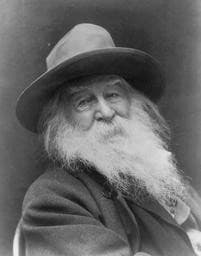
Walter Whitman Jr. was an American poet, essayist, and journalist. He is considered one of the most influential poets in American history. Whitman incorporated both transcendentalism and realism in his writings and is often called the father of free verse. His work was controversial in his time, particularly his 1855 poetry collection Leaves of Grass, which was described by some as obscene for its overt sensuality.
Jeff Olson
4.4
Thomas Sowell
4.4
Walter Brueggemann
4.3

Rhonda Byrne
4.3

Robin Wall Kimmerer
4.3
George S. Clason
4.3

Elliot Aronson
4.3

Joseph Campbell
4.3