“The world is a beautiful place and worth fighting for.”
— Maia reflects on the wonders of the Amazon and her determination to protect it.

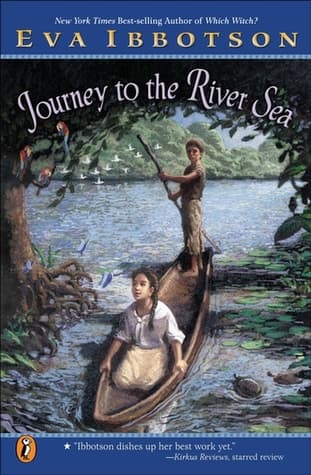
Eva Ibbotson (2001)
Genre
Lifestyle / Fantasy / Children's / Historical Fiction / Young Adult
Reading Time
300 min
Key Themes
See below
Sign in to track this book
In 1910, a spirited English orphan journeys to the Amazon, only to find her dreams of exotic adventure thwarted by her repellent relatives, forcing her to forge her own path among enigmatic actors, hidden heirs, and the wild beauty of the river.
Maia Fielding, a ten-year-old orphan, lives at the Mayfair Academy for Young Ladies in London, dreaming of adventure. When she learns she is to live with distant relatives, the Carters, in Manaus, Brazil, she is overjoyed. Her guardians, Miss Minton and Professor Embry, prepare her for the journey. Despite warnings from her classmates about dangers like alligators and wild Indians, Maia is full of romantic ideas about the Amazon, imagining lush places and exotic animals. She goes on the long voyage by ship, with the governess Miss Minton, who will oversee her education and care in the new land.
When they arrive in Manaus, Maia's romantic expectations are immediately broken. The Carters, Mrs. Carter, who is obsessed with cleanliness and English ways, and Mr. Carter, a timid man, are not the adventurous people Maia imagined. Their twin daughters, Beatrice and Gwendolyn, are spoiled, selfish, and dislike Maia's presence. The Carter house is a suffocating place, filled with bug spray, strict rules, and a fear of anything 'native.' Maia is kept inside and forbidden from exploring the world outside, leaving her disappointed and lonely.
Despite the Carters' rules, Maia's adventurous spirit leads her to explore. She soon meets two boys who become her secret friends. One is Clovis King, a young English actor who came to Manaus with a traveling theater group, the Bernardo Players. Clovis desperately wants to return to England, suffering from homesickness and the fear of getting too old for his child roles. The other is Finn Taverner, a mysterious boy living in the jungle who is rumored to be a 'wild Indian.' Finn is actually the son of English parents who disappeared, and he is trying to avoid the authorities who want to send him back to England to claim his inheritance.
Finn tells Maia and Miss Minton that he is looking for the legendary giant sloth, thought to be extinct, hoping to prove his parents were not frauds and to secure his claim to their estate. Miss Minton, interested in Finn's story and understanding his situation, agrees to help him. Meanwhile, Clovis's acting career is in trouble as he quickly outgrows his child roles. He faces being left behind by the Bernardo Players. Maia, sympathetic to both boys, tries to help them with their challenges, often relying on Miss Minton's wisdom and resourcefulness.
A fire starts at the Manaus opera house during a performance by the Bernardo Players. In the confusion, Clovis, who was performing, is shaken and believes his career is over. Seeing an opportunity, Maia creates a plan. She suggests that Clovis, who is about the same age and size as Finn, could pretend to be Finn and return to England to claim the Taverner inheritance. This would allow Finn to stay in the Amazon, his only home, and give Clovis a way to escape his unhappy acting life and return to England with money. Miss Minton, after thinking carefully, supports the plan.
With Maia and Miss Minton's help, Clovis changes, adopting Finn's ways and background. He successfully convinces the authorities, including the stern Mr. Murray, that he is Finn Taverner. Clovis sails back to England, where he eventually inherits the Taverner estate and starts a new life, free from the pressures of acting. The real Finn, now free from the threat of being sent to England, finds a new home and purpose with the local indigenous people, fully connecting with the Amazonian wilderness and continuing his search for the giant sloth, guided by his knowledge of the jungle.
As the Carters continue their self-absorbed lives, Maia grows more independent and resourceful. She finds comfort and friendship in unexpected places, especially with Professor Neville, an eccentric but kind ethnologist who values her intelligence and curiosity. She also forms a strong bond with Miss Minton, who, despite her stern look, is a loyal and protective guardian. Maia's experiences in the Amazon, from meeting local communities to helping with the boys' plans, broaden her views and strengthen her decision to live a life of adventure and purpose, rather than give in to the Carters' dull existence.
During their time together, Maia slowly finds out about Miss Minton's past. She learns that Miss Minton had a personal connection to the Amazon long before arriving with Maia. It is revealed that Miss Minton had a romantic relationship with a man named Bernard Taverner, Finn's father, many years ago. This explains Miss Minton's understanding of the jungle and her desire to help Finn. This shared history deepens the bond between Maia and Miss Minton, as Maia sees a more vulnerable and passionate side to her governess.
The Carters' financial situation worsens significantly because of Mr. Carter's incompetence and bad investments. They face losing everything and returning to England in shame. Despite their unkindness, Maia, with her generous spirit, feels a sense of duty. She uses her own small inheritance, with Miss Minton's advice, to help the Carters stabilize their finances. This act of kindness, while not fully appreciated by the Carters, shows Maia's growth in compassion and her ability to handle complex situations with maturity beyond her years.
As the time comes for Maia to consider her future, she makes a decision. Having experienced the life of the Amazon and formed deep connections, she chooses not to return to the restrictive life in England or stay permanently with the Carters. Instead, she decides to stay in Manaus with Miss Minton and Professor Neville, continuing her education and exploring the Amazon. She goes on a new adventure, sailing upriver with Professor Neville, eager to learn more about the natural world and the indigenous cultures, fully embracing her destiny as an independent and adventurous young woman.
The Protagonist
Maia transforms from a hopeful but sheltered orphan into a confident, independent young woman who embraces her own path in the Amazon.
The Supporting
Miss Minton sheds some of her rigid exterior, revealing her compassionate nature and personal history, ultimately finding a new purpose in the Amazon.
The Supporting
Finn successfully evades being sent to England, securing his freedom to live in his beloved Amazon.
The Supporting
Clovis transitions from a struggling, homesick actor to a secure young man with a new identity and inheritance in England.
The Antagonist
Mrs. Carter remains largely unchanged, defined by her anxieties and prejudices, but her financial situation declines.
The Antagonist
The twins remain static, defined by their jealousy and pettiness throughout the story.
The Supporting
Professor Neville provides a consistent source of support and intellectual stimulation for Maia, ultimately offering her a new path.
The Supporting
Mr. Murray remains steadfast in his professional duties, inadvertently facilitating Clovis's new life and Finn's freedom.
The novel explores self-discovery through Maia's experiences in a new, challenging environment. Maia, as an orphan, seeks to define herself beyond her circumstances, finding her true calling in the Amazon. Finn also deals with his identity, torn between his English heritage and his connection to his native roots. Clovis, too, searches for an identity beyond his child-actor role. The Amazon is a place where characters shed forced identities and embrace who they truly are. Maia's decision to stay in the Amazon at the end shows her full embrace of her adventurous and independent spirit.
“"The Amazon had given her more than just a home; it had given her a self."”
The book shows the contrast between English Victorian ways and the untamed world of the Amazon. The Carters show the worst parts of colonialism: xenophobia, a desperate clinging to 'civilized' ways, and a fear of anything different. Their obsession with cleanliness and their dislike for local culture show the destructive impact of forcing foreign values. In contrast, characters like Maia, Miss Minton, and Professor Neville represent a more open-minded approach, appreciating the Amazon's natural beauty and respecting its indigenous cultures, suggesting a more harmonious existence.
“"The Carters had brought England with them like a terrible, invisible disease, infecting everything they touched."”
A main theme is the desire for adventure and freedom, set against different forms of confinement. Maia is initially confined by being an orphan and then by the Carters' restrictive household. Finn is confined by the legal system that seeks to remove him from his home. Clovis is confined by his acting career and homesickness. The Amazon itself, with its vastness and wildness, symbolizes freedom. The characters' journeys are driven by their desire to break free from these limits and pursue lives of excitement and self-determination, ending with Maia's choice to remain in the Amazon.
“"Some lives are not meant to be neat and tidy. Some lives are meant to be wild and free."”
The novel explores different forms of family and the human need for belonging. Maia, an orphan, searches for a true home and a loving family. She finds it not in her blood relatives, the Carters, but in the bond she forms with Miss Minton, Finn, and Professor Neville. Finn, too, seeks to honor his lost parents' legacy and find his place among the indigenous communities. The story suggests that family is not only defined by blood, but by love, loyalty, and shared experiences, and that belonging can be found in unexpected places, even far from one's origins.
“"A family wasn't just blood. It was people who cared about you, who looked out for you, who made you feel like you belonged."”
A living, breathing character and symbolic setting for adventure and freedom.
The Amazon River and its surrounding jungle are more than just a setting; they act as a character in themselves. They represent wildness, danger, beauty, and freedom, contrasting sharply with the restrictive English propriety of the Carters. The river facilitates travel and discovery, while the jungle conceals secrets and offers refuge. For Maia, it's a place of wonder and self-discovery. For Finn, it's home and a source of identity. The Amazon's pervasive presence constantly challenges the characters and pushes them toward growth or reveals their inherent prejudices.
A symbol of wonder, mystery, and Finn's parents' legacy.
The giant sloth, a mythical creature believed to be extinct, serves as a powerful symbol. For Finn, it represents his parents' scientific legacy and his hope of proving their work was legitimate, thus securing his inheritance and freedom. Its elusive nature mirrors Finn's own desire to remain hidden. More broadly, the exotic animals and lush flora of the Amazon (macaws, butterflies, orchids) represent the wonder and beauty that Maia initially dreams of and later finds, contrasting with the Carters' fear and attempts to sanitize their environment. They highlight the richness of the natural world that Maia embraces.
A key plot mechanism for resolving character conflicts and advancing the narrative.
The plot device of impersonation, specifically Clovis pretending to be Finn, is central to resolving the main conflicts for both boys. It allows Finn to remain in the Amazon, his true home, free from the English authorities, and provides Clovis with a means to escape his unhappy acting career and return to England with financial security. This device relies on the characters' resourcefulness and the dramatic irony of the situation. It highlights themes of identity and the idea that one's true self might not be what is legally or socially expected.
A means of conveying backstory, motivations, and plot developments.
Letters play a significant role in revealing crucial information and driving the plot. Maia's initial invitation to the Carters comes via letter. The letters from Mr. Murray regarding Finn's inheritance create urgency and conflict. More importantly, the discovery of old letters and documents related to Finn's parents and Miss Minton's past reveals their interconnected histories and deeper motivations. These written communications serve to gradually unravel mysteries, provide exposition, and connect characters across time and distance, adding depth to the narrative and explaining character actions.
“The world is a beautiful place and worth fighting for.”
— Maia reflects on the wonders of the Amazon and her determination to protect it.
“Adventure is worthwhile in itself.”
— Maia embraces the unknown as she travels to Brazil.
“It is not what you are born, but what you choose to be.”
— Clovis, the actor, discusses identity and self-determination.
“The river is a road that goes both ways.”
— Describing the Amazon River's role in connecting people and places.
“Sometimes the most ordinary things are the most extraordinary.”
— Maia finds magic in everyday life in the Amazon.
“A true friend is the greatest of all blessings.”
— Maia values her friendships with Finn and Clovis.
“Home is not a place, but a feeling.”
— Maia realizes home is where she feels accepted and loved.
“The jungle teaches patience and respect.”
— Finn shares wisdom about living in harmony with nature.
“Books are like ships that carry you to far-off lands.”
— Maia's love for reading fuels her imagination and dreams.
“Courage is not the absence of fear, but the triumph over it.”
— Maia faces challenges in the Amazon with bravery.
“Every creature has its place in the great tapestry of life.”
— Highlighting the interconnectedness of the Amazon ecosystem.
“To be free is to be true to oneself.”
— Finn's perspective on living authentically in the wild.
“The stars are the same everywhere, but they look different here.”
— Maia observes the night sky in Brazil, feeling both familiar and new.
“Kindness is a language that everyone understands.”
— Small acts of kindness bridge cultural gaps in the story.
Ready to see how well you understood this book? Take our interactive quiz with 10 questions.
Biography coming soon.