“The government is not your father. The government is you.”
— A central tenet of the world's political system, where citizens are the government.

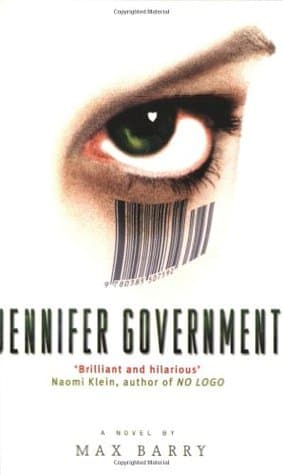
Max Barry (2003)
Genre
Politics / Thriller / Science Fiction / Young Adult
Reading Time
350 min
Key Themes
See below
Sign in to track this book
In a future where corporate identity is literal and assassination is a marketing strategy, a low-level employee's accidental hitman contract ignites a global chase with a government agent to expose the absurdity of unchecked capitalism.
Hack Nike, a low-level merchandising officer for Nike, struggles financially. Two senior executives, both named John Nike, from the Marketing department, offer him a new contract. Desperate for advancement, Hack signs without reading the fine print. He soon learns his new role requires him to participate in a scheme to generate hype for Nike's new shoes by shooting teenagers. Horrified, Hack tries to report this to the police. In this corporate-dominated world, the police misinterpret his complaint as a request to subcontract the assassination, leading them to involve the NRA.
Jennifer Government, a dedicated agent for the government (an entity that mainly regulates corporate activity), learns about the murders targeting teenagers, linked to Nike's marketing strategy. She has a personal vendetta against John Nike (the ultimate CEO of Nike, distinct from the two executives Hack met). Recognizing the severity and corporate involvement, Jennifer starts her investigation, determined to uncover the truth and bring those responsible to justice, even if it means clashing with powerful corporate interests and the often-complicit police force.
Violet, the sister of one of the teenagers murdered in the Nike marketing scheme, is consumed by grief and a desire for revenge. Refusing to accept the corporate violence, she decides to act. Violet begins to track and target individuals and entities she holds responsible for her brother's death, aiming to disrupt the corporate system that allowed such acts. Her actions, driven by personal loss, eventually intersect with Jennifer Government's official investigation and Hack Nike's desperate attempts to escape his predicament, adding another layer to the chaos.
After realizing his contract's true nature, Hack Nike tries to escape the country, hoping to leave his obligations behind. However, his efforts fail as he quickly discovers that corporations have a global and inescapable reach. His passport is invalidated, and he becomes a target. While fleeing, Hack accidentally uncovers deeper layers of the corporate conspiracy, realizing that the Nike murder scheme is a small part of a larger, more sinister plot by powerful individuals and rival corporations, drawing him further into danger.
The mastermind behind the corporate violence, John Nike, reveals his plan. He seeks to destabilize the global economy through calculated corporate conflicts and market manipulations, aiming to consolidate power and create a new world order where his company, Nike, holds absolute control. His motivations are not purely financial but come from a belief in his vision for a completely deregulated, hyper-capitalist society. This plan involves pitting corporations against each other, exploiting loopholes, and using violence as a tool for market dominance.
Jennifer Government initially views Hack Nike with suspicion due to his connection to the murders, but eventually realizes he is a victim and a potential asset. Hack, desperate for protection and a way out, reluctantly agrees to cooperate with Jennifer. They form an alliance, combining Jennifer's investigative skills and government resources with Hack's insider knowledge of Nike's operations. Together, they begin to piece together the full scope of John Nike's plan, facing constant danger from corporate enforcers and the corrupt system they fight against.
The National Rifle Association (NRA), in this world, is a powerful, privatized military contractor that takes on assassination contracts for corporations. They become central to the escalating corporate warfare, carrying out hits and enforcing corporate will. Their involvement highlights the extreme deregulation and privatization of violence. As the conflict between corporations intensifies, the NRA's actions become more widespread and brutal, further destabilizing society and making it harder for Jennifer Government and Hack Nike to navigate the dangerous situation and uncover the truth without becoming casualties.
Driven by her desire for vengeance, Violet continues her campaign against the corporations she holds responsible for her brother's death. She targets various corporate symbols and personnel, trying to dismantle the system from within, even with extreme methods. Her actions directly challenge the corporate power structure and force the public to confront the consequences of unchecked capitalism. Violet's story ends in a significant confrontation, where she must decide how far she will go for justice and whether her personal revenge can truly make a difference against such a formidable, systemic enemy.
The story builds to a climax where Jennifer Government and Hack Nike, along with unexpected allies, converge on John Nike's hidden headquarters. They must confront John Nike and his corporate enforcers to stop the final stages of his global destabilization plan. The confrontation is violent and chaotic, involving shootouts, corporate sabotage, and a desperate race against time. Both Jennifer and Hack must push their limits, relying on their wits and determination to overcome the overwhelming corporate power against them and prevent a complete collapse of society.
Following the climax, John Nike's immediate plans are thwarted, but the underlying corporate power structure remains largely intact. The world is left reeling from the corporate warfare and the exposure of the extreme lengths companies will go to for profit and power. Jennifer Government reflects on the victory, but also on the systemic issues that persist. Hack Nike, changed by his ordeal, must come to terms with his past and decide his future in a world still dominated by corporations. The ending leaves questions about the cost of unchecked capitalism and the ongoing struggle for freedom.
The Protagonist
Jennifer evolves from a lone wolf driven by personal vendetta to a leader who inspires others, realizing that systemic change requires more than individual acts of heroism.
The Protagonist
Hack transforms from a passive, naive employee into a more aware and proactive individual, learning to navigate and fight against the system that once exploited him.
The Antagonist
John Nike remains steadfast in his extremist ideology, his character serving as a static representation of unchecked corporate greed and power.
The Supporting
Violet's arc shifts from raw, personal vengeance to a more nuanced understanding of systemic injustice, influencing others to question the status quo.
The Supporting
They remain static representations of corporate complicity and ruthlessness, serving as instruments of the main antagonist's will.
The Supporting
The NRA remains a consistently destructive force, embodying the extreme consequences of privatized violence without significant internal character development.
The Mentioned
As a victim, Billy's character arc is cut short, but his death serves as a catalyst for other characters' development.
The novel shows a dystopian future where corporations are the dominant power, above governments and ethical limits. This theme is central, illustrated by companies like Nike openly commissioning murders for marketing (Hack's contract, the teen assassinations), and the police offering to subcontract these crimes. It highlights how profit motives, when unregulated, can lead to violence, human rights abuses, and the erosion of societal values, turning citizens into mere consumers or expendable assets. Corporate names becoming surnames emphasizes this complete absorption of identity by the market.
“What had happened was that companies had gotten bigger and bigger and then bigger still, and then the governments had collapsed, and now the companies were the governments.”
The theme of identity loss is clear through the practice of individuals taking their employer's last name. Hack Nike, for instance, is not just an employee but literally 'owned' by Nike in his name. This extends to a broader loss of agency, where personal choices are dictated by corporate contracts and market forces. Hack's inability to escape his murderous contract, despite his moral objections, shows how individuals are trapped within the corporate system. Even the government, represented by Jennifer Government, struggles to assert its authority over these powerful entities, showing a world where personal freedom is an illusion.
“He was Hack Nike, and his last name was Nike, and that was that. He worked for Nike. He had always worked for Nike. He would always work for Nike.”
The novel explores a disturbing future where violence and even law enforcement are privatized. The NRA, for example, is a powerful mercenary organization that takes assassination contracts, making murder a legitimate business transaction. The police, instead of upholding justice, act as brokers for these contracts, highlighting the complete breakdown of public institutions. Jennifer Government's struggle against this system shows the difficulty of achieving true justice when the mechanisms of law and order have been corrupted and commodified by corporations. This theme questions the role of the state and the dangers of allowing private entities to control instruments of force.
“The police, they were just another company. They had a job to do. They did it for money, like everyone else.”
This theme is embodied by Violet, who seeks revenge for her brother's murder. While her actions are driven by grief and a desire for justice, they contrast with Jennifer Government's more systemic approach to fighting corporate corruption. The novel questions whether individual acts of vengeance, however righteous, can truly dismantle a deeply entrenched system of power. It explores the effectiveness and morality of direct action against institutionalized injustice, suggesting that while personal retribution can be cathartic, lasting change requires a broader attack on the system itself, rather than just its individual perpetrators.
“She wanted to hurt them. All of them. The people who had killed her brother, and the people who had let it happen, and the people who had made it possible.”
Individuals take the last names of their employers.
This device immediately establishes the novel's dystopian setting and the pervasive influence of corporations. By forcing characters like Hack Nike and Jennifer Government to bear corporate names, it visually and symbolically represents the complete subsumption of individual identity and loyalty to their employers. It's a constant reminder of who holds power and how deeply integrated corporate control is into every aspect of life, making it a powerful tool for world-building and characterization.
Essential services and functions are privatized and market-driven.
The privatization of services like law enforcement (the police brokering murder contracts, the NRA as a mercenary force) and even government itself (Jennifer Government's agency operating within a corporate framework) is a crucial plot device. It creates the absurd and dangerous conditions that drive the narrative, making it difficult for protagonists to find traditional avenues of justice. This device underscores the novel's satirical critique of unchecked capitalism by showing the logical (and horrific) conclusion of a fully market-driven society.
Multiple characters share the name 'John Nike,' creating confusion and signifying corporate uniformity.
The use of multiple 'John Nikes' (the two executives who hire Hack, and the ultimate CEO) serves both as a source of dark humor and a chilling symbol. It highlights the dehumanizing nature of the corporate world, where individuals become interchangeable cogs. It also creates initial confusion for Hack and the reader, emphasizing the pervasive and anonymous nature of corporate power, making it harder to pinpoint responsibility and adding to the sense of an omnipresent, faceless antagonist.
Jennifer Government's identifying barcode tattoo.
Jennifer Government's barcode tattoo under her eye is a subtle but potent symbol. It marks her as an agent of the 'government' (itself a corporate-like entity in this world) and signifies her role as an enforcer of a specific kind of order. It's a visual metaphor for the commodification of identity and the integration of surveillance into everyday life, even for those supposedly fighting the system. The tattoo serves as a constant reminder of the societal context she operates within and her own complex relationship with authority.
“The government is not your father. The government is you.”
— A central tenet of the world's political system, where citizens are the government.
“You can't just kill people. There are rules.”
— A character reminds another about the corporate legal framework governing violence.
“It's not about what's right. It's about what sells.”
— A cynical observation on corporate motivation and consumerism.
“Freedom isn't free. But it is cheaper than the alternative.”
— A dark humorous take on the cost of liberty in a privatized world.
“Every decision you make is a vote.”
— Emphasizing the power of individual choices in a market-driven society.
“The problem with having everything privatized is that you have to buy everything.”
— A character reflects on the practical downsides of extreme privatization.
“You don't get rich by playing fair. You get rich by playing smart.”
— A character's philosophy on wealth accumulation.
“Your name is your brand. Protect it.”
— A common corporate-influenced mantra in the novel's society.
“When you want something, you just take it. That's how the world works.”
— A character expressing a ruthless perspective on ambition and power.
“There's always someone watching. Always someone selling.”
— A comment on constant surveillance and commercialization.
“The only thing worse than a government that does too much is a government that does nothing.”
— An implicit critique of extreme laissez-faire principles.
“Nobody cares if you're good. They care if you're effective.”
— A pragmatic view of success in a results-oriented world.
“Violence is a product like any other. Supply and demand.”
— A chillingly rational view of violence in a market-driven society.
“You don't change the system by complaining. You change it by buying something else.”
— The novel's philosophy on consumer power as a form of political action.
“The truth is just another commodity, to be bought and sold.”
— A character reflecting on the manipulation of information.
Ready to see how well you understood this book? Take our interactive quiz with 10 questions.

Biography coming soon.

Brett Casper
5.0

Dirk Uffelmann
4.7

Winston S. Churchill
4.5
Chimamanda Ngozi Adichie
4.5
Will Durant
4.4
Thomas Sowell
4.4
W.E.B. Du Bois
4.3
Alan Moore
4.3