BookBrief
Jacques the Fatalist cover
Archivist's Choice

Jacques the Fatalist

Denis Diderot (2006)

Genre

Philosophy

Reading Time

270 min

Key Themes

See below

Track Your Reading

Sign in to track this book

In a chaotic journey through 18th-century France, the servant Jacques struggles with his belief in fate while living a life of freedom, questioning storytelling and free will.

Synopsis

Diderot's "Jacques the Fatalist" questions the Enlightenment's belief in rational free will. Instead, it suggests a universe run by cause and effect, or 'fate.' Through a winding, self-aware story, the book explores how people, despite feeling independent, are often shaped by their circumstances and natural tendencies. It argues that our ideas of right and wrong, who we are, and even the stories we tell ourselves come from this fixed reality, often in ways we do not see. Beyond its philosophy, the book comments on storytelling and literary rules. Diderot intentionally breaks story expectations, often speaking directly to the reader and going off-topic. This shows the author's power and how reality is built in fiction. This playful defiance suggests that even our stories, like our lives, unfold in a set way, whether by fate or the author's choice.
Reading time
270 min
Difficulty
Hard
✓ Read this if...
You are interested in the philosophical implications of free will versus determinism, enjoy experimental and self-referential narratives, or want to understand the intellectual ferment of the Enlightenment through a highly unconventional lens.
✗ Skip this if...
You prefer straightforward plots, linear storytelling, or find extensive philosophical digressions and authorial intrusions disruptive to your reading experience.


Plot Summary

Principal Figures

Themes & Insights

Plot Devices & Literary Techniques

Critical analysis

Notable Quotes

Do you imagine that the number of things that happen to us is greater than the number of things that don't? Just consider the infinite number of possibilities that don't happen, and you will see that what does happen is nothing.

Jacques discussing the nature of fate and coincidence with his master.

How had they met? By chance, like everyone else in the world. What were their names? What does that matter? Where were they going? To the nearest village, or to the next, it makes no difference.

The narrator's opening lines, setting a tone of indifference to conventional narrative details.

My captain always said that everything that happens to us down here, good or bad, has been written up above.

Jacques frequently references his captain's fatalistic philosophy.

One does not write for the sake of writing, but for the sake of being read.

The narrator interjecting commentary on the act of storytelling and reader engagement.

The great error of man is to believe that he is the master of his fate.

A philosophical observation made by Jacques or the narrator regarding human hubris.

What is the good of telling a story if one cannot deviate from the truth, if one cannot add a few embellishments, if one cannot make the listener wait, if one cannot lead him astray?

The narrator debating the conventions of storytelling and the reader's expectations.

We are all puppets, my friend, and a great hand guides our strings.

Jacques expressing his fatalistic view of human agency.

Is it not true that the very effort we make to escape our destiny is precisely what leads us to it?

A paradoxical thought offered by Jacques on the inescapable nature of fate.

There are no events, only the interpretation of events.

A profound philosophical statement on perception and reality.

My master thought I was a philosopher; I was merely recounting what my captain had said.

Jacques downplaying his own philosophical insights, attributing them to his captain.

Life is a perpetual motion, a perpetual change, a perpetual contradiction.

A general reflection on the dynamic and inconsistent nature of existence.

Every man has his own devil, and mine is called 'It was written up above.'

Jacques personifying his fatalistic belief as a personal torment or guiding principle.

The longer the story, the more opportunities for digressions, for interruptions, for reflections.

The narrator justifying the episodic and meandering structure of the novel.

One day, my master said to me, 'Jacques, you speak of fate as if it were a person.' 'And why not, master,' I replied, 'since it acts like one?'

A dialogue between Jacques and his master, highlighting their differing perspectives on fate.

Quiz

Test Your Knowledge

Ready to see how well you understood this book? Take our interactive quiz with 10 questions.

10
Questions
~5
Minutes
?
Best Score

Key Questions (FAQ)

Jacques the Fatalist follows the travels of a servant, Jacques, and his Master through 18th-century France. As they journey, they encounter various characters and stories, all while Jacques maintains his belief that every event and decision is predetermined, despite his apparent free will.

About the author

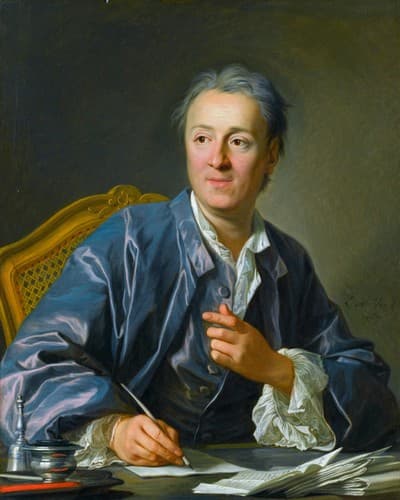
Denis Diderot

Denis Diderot was a French philosopher, art critic, and writer, best known for serving as co-founder, chief editor, and contributor to the Encyclopédie along with Jean le Rond d'Alembert. He was a prominent figure during the Age of Enlightenment.