“The past is a foreign country; they do things differently there.”
— A general observation on history and the passage of time, though often attributed to L.P. Hartley, Delaney's novel reflects this sentiment deeply.

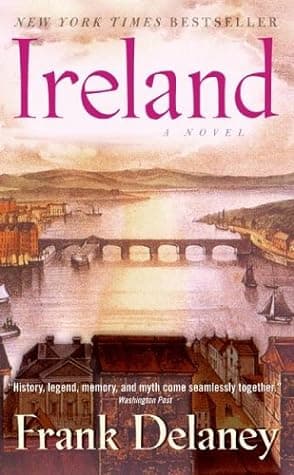
Frank Delaney (2004)
Genre
Lifestyle / Historical Fiction
Reading Time
15-20 hours
Key Themes
See below
Sign in to track this book
In 1950s Ireland, a young boy's life is changed by a storyteller, sending him on a lifelong search to find lost tales and his homeland's spirit.
In the winter of 1951, a Seanchai (storyteller) comes to the farmhouse of nine-year-old Ronan O'Mara in County Wicklow, Ireland. The Seanchai, a man with an ancient craft, tells Ronan and his family stories of Ireland's mythical past for three nights. He tells tales of Fionn Mac Cumhaill, ancient kings like Niall of the Nine Hostages, and the start of Christianity. Ronan, an imaginative boy, is captivated by the storyteller's voice and the scope of his tales. This meeting sparks a deep interest in Ronan, connecting him to his country's history and making him want to understand the Seanchai's craft and the stories.
On the third night, the Seanchai's storytelling becomes controversial. He tells a critical interpretation of historical events and religious figures, especially St. Patrick and the early Christianization of Ireland. Ronan's Catholic parents, particularly his mother, are offended by what they see as disrespect. Despite Ronan's pleas, the Seanchai is banished from their home and leaves in the night. His sudden departure leaves Ronan sad and curious. The boy promises to find the Seanchai again, driven by a desire for the untold stories and to understand the man who brought them to life. This moment starts Ronan's lifelong search.
As Ronan becomes a teenager, his interest in the Seanchai and Ireland's stories grows. He starts traveling to nearby towns and villages, asking about the storyteller. His first attempts are mostly unsuccessful. He meets skepticism, indifference, or vague memories. During these travels, Ronan sees different parts of Irish life and the lasting effects of its history – poverty, the Church's influence, and people's quiet strength. He learns to listen, observe, and put together information. He slowly develops skills like an amateur historian and detective, driven by the elusive Seanchai.
Ronan's intelligence and passion lead him to university, where he studies history, English literature, and folklore. He hopes academic research will answer his questions about the Seanchai and Ireland's history. However, he quickly dislikes the dry, analytical approach of academia. He gains knowledge, but he finds it lacks the spirit of the Seanchai's stories. His professors often dismiss oral traditions and legends, preferring documented facts. This time confirms Ronan's belief that the Seanchai holds a unique, more real way to understand Ireland's soul. It strengthens his commitment to his personal search beyond formal education.
After university, Ronan works in broadcasting, first in radio and later in television. This job helps his search. His work takes him across Ireland, letting him interview people, visit remote places, and explore local histories and legends. He uses every chance to ask about the Seanchai, following faint clues and collecting stories. His broadcasting skills, especially listening and connecting with people, are valuable tools. He learns to tell truth from exaggeration and to piece together the Seanchai's fragmented history, slowly forming a picture of the man and his purpose, even as the Seanchai remains hard to find.
During his travels, Ronan meets a woman in County Clare who says she is the Seanchai's wife, Maeve. She is an elderly, wise woman who tells Ronan about the Seanchai's character, his dedication to his art, and his sacrifices for it. Maeve reveals the Seanchai's love for Ireland and its stories, his struggles with poverty, and the misunderstanding he often faced. She explains his way of blending fact with legend to show deeper truths. This meeting is a turning point for Ronan. It makes the legendary figure more human and gives him a better understanding of the Seanchai's mission and the difficulties of keeping an ancient tradition alive in modern Ireland.
Through Maeve and others, Ronan finds letters and journals written by the Seanchai. These writings are valuable. They show the storyteller's research, his thoughts on Irish history, and his ideas. The Seanchai's letters detail his belief that Ireland's true history is not just in facts, but in collective memory, myths, and oral traditions. He explains his controversial interpretations, saying they are needed to challenge simple stories and show the complex realities. These documents give Ronan a deeper understanding of the Seanchai's work, confirming his own thoughts about storytelling's power.
Ronan's journey spans decades, including 'The Troubles' in Northern Ireland. He sees how history, myth, and conflicting stories are used in political conflict. This experience strengthens his understanding of the Seanchai's importance: the need for a full understanding of Ireland's past to handle its present. He sees how stories can divide, but also unite and heal. His ongoing search for the Seanchai connects with his desire to understand his country's divisions and the power of narrative in shaping identity.
As Ronan ages, his search for the Seanchai becomes less about finding the man and more about understanding his legacy. He learns that the Seanchai, after a long life, passed away, having influenced many people like Ronan. Ronan discovers that while the Seanchai is physically gone, his spirit and stories live on through those he touched. He meets people who, inspired by the Seanchai, have taken up parts of his tradition in different ways. Ronan realizes that the Seanchai's goal was not just to tell stories, but to awaken in others a love for Ireland's history and a commitment to its preservation.
By the end of his life, Ronan O'Mara, now a broadcaster and informal historian, realizes he has become a Seanchai. He has spent his life collecting, understanding, and sharing Ireland's stories, both factual and legendary. His journey, which began with a nine-year-old boy's interest, ends with him becoming a conduit for Ireland's narrative. He understands that the Seanchai's gift was not just telling tales, but connecting people to their past, their land, and each other. Ronan's search ends not with a reunion with the Seanchai, but with his own embodiment of the storytelling tradition, ensuring that the saga of his tenacious, troubled, and extraordinary isle continues to be told.
The Protagonist
From a spellbound boy, Ronan evolves into a relentless seeker of truth, ultimately becoming a modern-day Seanchai himself.
The Catalyst/Mentor
Though his physical journey is largely off-page, his enduring legacy and philosophy are revealed through Ronan's discoveries.
The Supporting
She helps bridge the gap between the mythical Seanchai and his human reality for Ronan.
The Supporting
Her initial, pivotal action sets Ronan's journey in motion, though her direct influence wanes as he grows.
The Supporting
His quiet support of the banishment contributes to Ronan's departure from his childhood home and quest.
The Mentioned
Represents the ancient, enduring myths that Ronan seeks to understand and preserve.
The Mentioned
His traditional story is a key point of contention that drives Ronan's deeper inquiry into Irish history.
The Mentioned
Symbolizes the ancient, foundational history of Ireland that Ronan strives to comprehend.
The novel shows storytelling as a way to preserve history, shape identity, and pass on culture. The Seanchai shows how oral narratives capture a nation's essence more than facts. Ronan's search is fueled by these stories, and his broadcasting career lets him continue this tradition. The book argues that stories, even those mixing myth and history, are important for understanding a people's soul and for handling their present and future. They are a nation's living memory.
“''Ireland is not a country, but a story.'”
The search for identity, personal and national, is central to the novel. Ronan's search to understand the Seanchai connects to his desire to understand what it means to be Irish. The book explores how Ireland's history, its myths, heroes, and struggles have created a national character. Through the Seanchai's tales and Ronan's observations, the novel explores the strength, wit, spirituality, and occasional brutality that define the Irish people. It suggests that understanding national identity means facing the complexities of its past.
“''The stories are in the land, not just in the books. And in the people, if you listen.'”
A main theme is the interplay between history and myth and legend. The Seanchai blurs these lines, saying legends often show deeper truths about a culture than historical records. Ronan's early academic disillusionment shows this conflict. He finds formal history lacks the soul of the Seanchai's narratives. The book suggests that both are needed for a full understanding of a nation's past. The 'true' history of Ireland is in combining fact and folklore, allowing a deeper connection to its heritage.
“''History is what happened. Legend is what we make of it. And sometimes, legend tells a truer tale.'”
The novel explores the challenge of keeping old traditions alive in a changing world. The Seanchai is shown as the 'last practitioner' of an old art, trying to stay relevant in 20th-century Ireland. His banishment from Ronan's home shows the conflict between oral culture and modern religious and social norms. Ronan's journey, though modern in its methods, comes from respect for this fading tradition. He wants to understand it, and he finds a way to bridge the gap and continue the Seanchai's spirit in a modern context.
“''The old ways die hard, but they die. Unless someone remembers to keep them alive.'”
Ronan's life is a search for truth and meaning, about Ireland's history and his place in it. His search is about reconciling the magical stories of his childhood with Irish life's realities, including poverty, political strife (The Troubles), and religious conservatism. The Seanchai's narratives offer interpretations that challenge simple views, making Ronan think critically and seek deeper understanding. The novel suggests that truth is multifaceted and often found in different perspectives.
“''There are many Irelands, boy, and each one has its own truth. The trick is to see them all.'”
A symbolic figure representing Ireland's collective memory and oral tradition.
The Seanchai functions less as a conventional character and more as an archetypal figure, embodying the ancient spirit of Irish storytelling. He is a living repository of history, myth, and folklore, representing the collective memory of the nation. His elusive nature and profound impact on Ronan highlight his symbolic role as a catalyst for cultural awakening. His stories are not merely entertainment but a sacred trust, passed down through generations, making him a powerful symbol of Ireland's enduring heritage and the wisdom contained within its oral traditions.
Ronan's lifelong journey to find the Seanchai and understand Ireland's true story.
The novel employs a classic quest narrative structure. Ronan's initial encounter with the Seanchai sets him on a lifelong journey (the 'quest') to find the storyteller and, more importantly, to understand the deeper truths of Ireland's history and identity that the Seanchai represents. This quest involves physical travel across Ireland, intellectual exploration through academia and research, and personal growth. The elusive nature of the Seanchai makes the journey itself more significant than the final reunion, symbolizing the continuous search for knowledge and meaning rather than a definitive endpoint.
Ronan's adult narration looking back at the formative childhood encounter.
The novel uses Ronan's childhood memory of the Seanchai's visit as a powerful framing device. The enchantment of those three nights in 1951 serves as the genesis for Ronan's entire life's work. By beginning with this vivid, almost magical, recollection, the author establishes the profound impact of storytelling on a young, impressionable mind. This frame allows the subsequent narrative to unfold as Ronan's retrospective journey, giving weight to his lifelong pursuit and emphasizing the enduring power of that initial, formative experience.
A thematic conflict and narrative technique, contrasting spoken tales with academic texts.
This device is both a theme and a narrative technique. The novel constantly contrasts the vibrant, living oral tradition embodied by the Seanchai with the more rigid, often dry, nature of written academic history. Ronan's journey involves navigating both, ultimately synthesizing them. The Seanchai's stories are presented as dynamic, evolving truths, while Ronan's research involves sifting through documented facts. This interplay highlights the different ways history can be understood and preserved, arguing for the validity and richness of both, but particularly emphasizing the soulful connection offered by oral narratives.
Exploring the subjective nature of historical accounts and national myths.
While Ronan himself is a reliable narrator of his own quest, the novel implicitly uses the concept of the 'unreliable narrator' when it comes to historical accounts. The Seanchai's controversial interpretations of figures like St. Patrick challenge the commonly accepted, often simplified, narratives. This device highlights that history is often written by the victors or shaped by dominant ideologies (like the Church). By presenting alternative, more complex versions of historical events and figures, the novel forces the reader, alongside Ronan, to question established 'truths' and recognize the subjective nature of national myths and historical records.
“The past is a foreign country; they do things differently there.”
— A general observation on history and the passage of time, though often attributed to L.P. Hartley, Delaney's novel reflects this sentiment deeply.
“Every stone has a story, and every story a stone.”
— Reflecting the deep historical embeddedness of Ireland, where the landscape is full of ancient markers and tales.
“The rain fell, as it always did, not as a curse but as a blessing, washing clean the slate of time.”
— Describing the ubiquitous Irish rain, framed not as a negative but as an integral, even purifying, part of the country's character.
“He understood then that a man's life was not measured in years, but in the echoes he left behind.”
— A reflection on legacy and the lasting impact of individuals, particularly in a community with a strong oral tradition.
“The true history of a place is not in its kings and battles, but in the murmur of its people.”
— Emphasizing the importance of everyday lives and oral histories over grand narratives of power.
“There's a thin veil between this world and the next, and in Ireland, it's often tattered.”
— Alluding to the mystical and spiritual aspects of Irish culture, where folklore and the supernatural are close to everyday life.
“A good story, like a good whiskey, improves with age and a bit of embellishment.”
— A playful nod to the Irish love of storytelling and the way narratives evolve and become richer over time.
“Sorrow, like joy, was a communal thing here; shared, absorbed, and then, eventually, endured.”
— Highlighting the strong sense of community and collective experience, both in hardship and celebration.
“The land itself felt ancient, sagged with the weight of forgotten centuries.”
— Describing the pervasive sense of history and antiquity embedded in the Irish landscape.
“He carried the stories of his ancestors like stones in his pocket, heavy and comforting.”
— Illustrating the profound connection to ancestral heritage and the weight and comfort of inherited narratives.
“To be Irish was to carry a certain melancholy, a beautiful, rain-swept sadness.”
— A common trope about the Irish character, often linked to the country's history and climate.
“The silence in the ancient places was not empty, but full of whispers.”
— Referring to the spiritual and historical resonance of ancient sites, suggesting they are alive with past voices.
“Life here was a tapestry woven with threads of myth and fact, often indistinguishable.”
— Reflecting the intertwining of history, folklore, and everyday life in the Irish cultural fabric.
“The past wasn't dead; it was merely sleeping, and a good storyteller could wake it.”
— Emphasizing the power of storytelling to bring history and memory to life.
Ready to see how well you understood this book? Take our interactive quiz with 10 questions.

Biography coming soon.