BookBrief
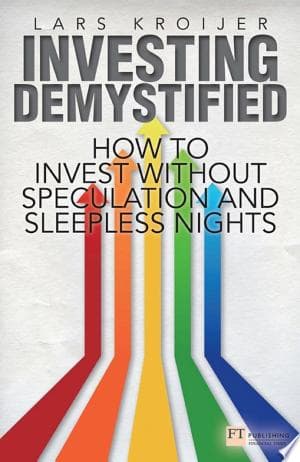
Investing Demystified cover
Archivist's Choice

Investing Demystified

Lars Kroijer (2013)

Genre

General

Reading Time

12 Minutes

Key Themes

See below

Track Your Reading

Sign in to track this book

Cut through financial jargon and build a simple, low-cost portfolio tailored to your needs to achieve superior investment returns without the stress of market beating.

Core Idea

Lars Kroijer argues that for the vast majority of individual investors, the optimal investment strategy is to invest in a globally diversified portfolio of low-cost index funds or ETFs. He debunks the myth that active investing, stock picking, or market timing can consistently outperform the market after fees and taxes, emphasizing that these activities are a zero-sum game before costs and a negative-sum game after costs for the average participant. The book provides a clear, actionable framework for building and maintaining a passive investment portfolio, focusing on simplicity, cost efficiency, and long-term discipline.
Difficulty
Easy

Core idea

The central argument and framework that powers the entire book.

Lars Kroijer argues that for the vast majority of individual investors, the optimal investment strategy is to invest in a globally diversified portfolio of low-cost index funds or ETFs. He debunks the myth that active investing, stock picking, or market timing can consistently outperform the market after fees and taxes, emphasizing that these activities are a zero-sum game before costs and a negative-sum game after costs for the average participant. The book provides a clear, actionable framework for building and maintaining a passive investment portfolio, focusing on simplicity, cost efficiency, and long-term discipline.

At a glance

Difficulty

Easy

Key Takeaways

1

The Futility of Active Investing

Most individual investors, and even many professionals, cannot consistently beat the market after fees.

Quote

The vast majority of active investors fail to beat the market over the long term, making the pursuit of alpha a losing game for most.

Kroijer's main idea is his clear rejection of active investing for most people. He says the financial industry is a zero-sum game before costs. After management fees, trading costs, and taxes, the average active investor will underperform the market. He points out that even professionals, with all their resources, struggle to consistently make more than the market, making it even harder for individual investors. This basic idea frees investors from the time-consuming and often harmful search for specific stocks or market timing. It in...

Supporting evidence

Numerous studies on active fund performance, such as those by S&P Dow Jones Indices (SPIVA reports), consistently show that a significant majority of actively managed funds underperform their respective benchmarks over various time horizons.

Apply this

Accept that beating the market is highly unlikely and focus on strategies that capture market returns efficiently. This means avoiding individual stock picking, sector bets, and actively managed funds with high fees.


2

Embrace Broad Diversification

A globally diversified portfolio of low-cost index funds is the simplest and most effective investment strategy.

Quote

The most broadly diversified and simplest portfolio makes the most sense.

Kroijer's practical advice focuses on broad diversification. He suggests investing in low-cost, globally diversified index funds or ETFs that track major market indices, like a global stock market index and a global bond market index. This approach exposes investors to thousands of companies and governments across various regions and sectors, reducing the effect of any single company or country's poor performance. Diversification is about reducing risk and capturing the overall growth of the global economy without needing to predict w...

Supporting evidence

The efficient market hypothesis, which suggests that asset prices reflect all available information, implies that consistently outperforming the market is difficult. Broad market index funds, like those tracking the MSCI World Index or FTSE Global All Cap Index, offer immediate diversification.

Apply this

Construct a portfolio primarily using two or three broadly diversified, low-cost index funds (e.g., a global equity fund and a global bond fund). Resist the urge to add niche funds or individual stocks.

3

Minimize Costs Ruthlessly

Investment fees are a guaranteed drag on returns and should be minimized at all costs.

Quote

A low cost approach will yield benefits whilst leaving you with a higher quality portfolio.

Kroijer stresses the importance of keeping investment costs low. He argues that fees are one of the few things an investor can directly control that definitely affects returns. Unlike market performance, which is unpredictable, fees constantly reduce your money. Even small differences in expense ratios (e.g., 0.1% versus 1%) add up significantly over decades, eating away a large part of potential wealth. He notes that high fees often come with active management, which, as he shows, rarely earns its cost. This focus on cost efficiency ...

Supporting evidence

The power of compounding works against you with fees. A 1% annual fee on a $100,000 portfolio growing at 7% annually reduces the final value by over $100,000 after 30 years compared to a 0.1% fee.

Apply this

Choose index funds or ETFs with the lowest possible expense ratios. Be wary of hidden fees, trading costs, and advisory fees that are not transparent or value-added.

4

Asset Allocation Dictates Risk

Your portfolio's mix of stocks and bonds is the primary determinant of its risk and return profile.

Quote

Understand the right level of risk for you and how this affects your investments.

Kroijer explains that the most important risk decision an investor makes is asset allocation. This is how much of their portfolio is in stocks versus bonds. Stocks offer higher long-term returns but are more volatile, while bonds provide stability and income but usually lower returns. He doesn't recommend one allocation for everyone but helps readers find their 'right' risk level based on their time frame, financial goals, and emotional comfort with market swings. Understanding this is key, as an unsuitable asset allocation can lead t...

Supporting evidence

Historical data consistently shows that equity-heavy portfolios have higher volatility but also higher long-term returns than bond-heavy portfolios. For example, a 60/40 stock/bond portfolio has a different risk-return profile than an 80/20 portfolio.

Apply this

Determine your personal risk tolerance and time horizon. Allocate a higher percentage to equities if you have a long time horizon and can tolerate volatility; opt for a higher bond allocation if your time horizon is shorter or your risk aversion is high. Rebalance periodically.

5

The 'Do Nothing' Advantage

Once an appropriate portfolio is set, the best action for most investors is often inaction.

Quote

Everything that you don’t need to worry about – in order to make the most from your investments.

This idea offers a powerful, unexpected insight. After setting up a well-diversified, low-cost portfolio that matches one's risk tolerance, Kroijer argues that constant adjustments, market watching, and reacting to news are harmful. Human biases, like fear and greed, often cause investors to buy high and sell low. The 'do nothing' approach, or more accurately, the 'do very little' approach (just rebalancing sometimes), prevents these self-defeating behaviors. This patience allows compounding to work and the market's long-term upward t...

Supporting evidence

Behavioral finance studies, such as those by Daniel Kahneman and Amos Tversky, illustrate how cognitive biases lead to suboptimal investment decisions. Historical market data shows that investors who stay invested through downturns generally recover and achieve better long-term returns than those who try to time the market.

Apply this

Resist the urge to check your portfolio frequently or react to daily market fluctuations. Set up automated contributions and only rebalance your portfolio back to its target asset allocation once or twice a year, or when it drifts significantly.

6

Understand the Tax Implications

Taxes are a significant drag on returns and should be considered in portfolio construction.

Quote

Understand the implications of tax and liquidity.

Kroijer reminds investors that returns are not just about market performance; they are also about what's left after taxes. He emphasizes using tax-advantaged accounts (like 401(k)s, IRAs, ISAs, etc.) whenever possible, as these allow investments to grow tax-deferred or tax-free. For taxable accounts, he suggests strategies like tax-loss harvesting and holding investments for the long term to benefit from lower long-term capital gains rates. This often-overlooked part of investing can greatly affect an investor's final wealth, making i...

Supporting evidence

The difference between short-term and long-term capital gains tax rates, and the tax-free growth within retirement accounts, can lead to tens or hundreds of thousands of dollars in difference over a lifetime of investing.

Apply this

Prioritize maxing out contributions to tax-advantaged retirement accounts. For taxable accounts, choose tax-efficient investments like broad market index funds and hold them for the long term to minimize short-term capital gains taxes.

7

Liquidity and Emergency Funds

Maintain sufficient accessible cash for emergencies before investing in long-term assets.

Quote

Understand the implications of tax and liquidity.

Before discussing market investments, Kroijer stresses the need for an adequate emergency fund in highly liquid, safe assets like cash or money market accounts. This fund should cover several months of living expenses. The reasons are two-fold: first, it keeps investors from being forced to sell long-term investments at a bad time (e.g., during a market downturn) to cover unexpected costs. Second, it reduces the psychological stress of market volatility, knowing that essential needs are met. This practical advice ensures that an inves...

Supporting evidence

Personal finance studies show that individuals without emergency funds are more likely to incur high-interest debt or liquidate investments prematurely during financial shocks.

Apply this

Build an emergency fund covering 3-6 months of essential living expenses in a high-yield savings account before investing in stocks or bonds. Do not consider this cash as part of your investment portfolio.

8

Investment is Not Speculation

True investing is a long-term strategy of owning productive assets, not short-term gambling.

Quote

Don’t spend your time worrying whether you can beat the markets: you don’t need to beat them to be a successful investor.

Kroijer shows the difference between investing and speculating. Investing, for him, is the patient process of buying and holding small ownership stakes in productive global businesses and lending to stable governments, expecting long-term growth. Speculation, however, involves trying to predict short-term market movements or picking individual 'hot' stocks, which he says is mostly pointless for the average person. This difference is important for keeping a disciplined, rational approach, stopping investors from falling for get-rich-qu...

Supporting evidence

Historical market returns over decades show consistent positive growth for broad market indices, while individual stock performance is highly variable and difficult to predict.

Apply this

Adopt a long-term mindset (10+ years) for all investments. Avoid chasing hot stocks, cryptocurrencies (unless for a tiny, speculative portion of your portfolio), or attempting to time market entries and exits.

9

Simplicity is Key

Complex investment strategies rarely outperform simple, well-understood approaches.

Quote

Lars Kroijer simplifies the often complex world of finance and tells you everything you need to know – and everything that you don’t need to worry about.

One of the book's main messages is the power of simplicity. Kroijer removes financial jargon and complex strategies, saying they often confuse investors and justify high fees rather than improve returns. His suggested approach—a few low-cost, broadly diversified index funds, held for the long term, with occasional rebalancing—is very simple. This simplicity makes the strategy accessible to everyone, reduces the chance of expensive mistakes, and minimizes the time and effort needed from the investor. While it doesn't address the comple...

Supporting evidence

Many academic studies and investment professionals (e.g., John Bogle, Warren Buffett) advocate for simple, low-cost index investing as the most effective strategy for most people.

Apply this

Resist the allure of complex financial products or strategies. Stick to a straightforward portfolio of global equity and bond index funds. Understand every component of your portfolio.

Critical analysis

Notable Quotes

Quiz

Test Your Knowledge

Ready to see how well you understood this book? Take our interactive quiz with 10 questions.

10
Questions
~5
Minutes
?
Best Score

Key Questions (FAQ)

No, you don't need to be an expert or try to beat the market to be a successful investor. This book shows you how to build a simple, rational portfolio tailored to your needs for superior returns.

About the author