BookBrief
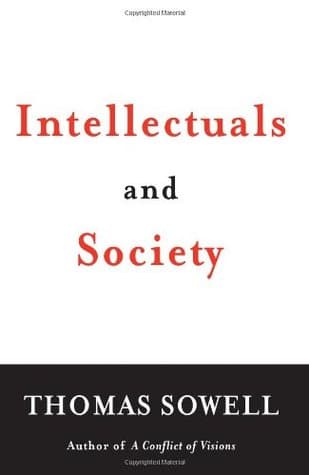
Intellectuals and Society cover
Archivist's Choice

Intellectuals and Society

Thomas Sowell (2009)

Genre

Politics / Psychology / History / Economics / Philosophy

Reading Time

10-12 hours

Key Themes

See below

Track Your Reading

Sign in to track this book

Thomas Sowell explains how modern intellectuals, despite often being wrong, subtly influence democratic societies by shaping public opinion rather than directly advising rulers, making them a powerful but unaccountable force.

Core Idea

Thomas Sowell's "Intellectuals and Society" examines the role of intellectuals in society. He argues that many in this group, often self-appointed and operating within their own circles, hold immense indirect power. They shape public opinion, policy, and cultural norms without being held accountable for the real-world results of their ideas. Sowell contrasts the abstract 'vision' of these intellectuals, often based on their perceived moral or intellectual superiority, with the practical realities and scattered knowledge found in markets and traditional institutions. He believes this separation from practical outcomes, combined with a preference for new, grand solutions over small changes, often leads to bad societal results, even if the intellectuals have good intentions. The book also looks at what motivates intellectuals. These motivations are often not about money, but about status, influence, and approval from their peers, rather than direct results. Sowell highlights the 'knowledge problem'—the idea that no central group can ever have enough specific knowledge to effectively plan or direct complex societies. He criticizes how intellectuals often prefer abstract, logical designs over the messy, natural order that comes from decentralized interactions. Ultimately, Sowell is deeply skeptical of unelected, unaccountable intellectuals telling society what to do. He instead supports systems that respect widely distributed knowledge and allow for feedback from real-world consequences.
Reading time
10-12 hours
Difficulty
Medium
✓ Read this if...
You are interested in a critical examination of the role and influence of intellectuals in shaping public policy and societal norms, appreciate empirical analysis over abstract theorizing, and are open to challenging conventional wisdom about intellectual authority. It is particularly relevant for those studying political science, economics, sociology, or the history of ideas from a conservative or classical liberal perspective.
✗ Skip this if...
You are uncomfortable with strong critiques of intellectual elites, prefer abstract philosophical arguments to empirical and historical analysis, or are looking for a book that celebrates the transformative power of intellectual thought without significant caveats. Readers seeking a gentle introduction to socio-political thought or those firmly entrenched in progressive intellectual frameworks might find Sowell's arguments confrontational.

Core idea

The central argument and framework that powers the entire book.

Thomas Sowell's "Intellectuals and Society" examines the role of intellectuals in society. He argues that many in this group, often self-appointed and operating within their own circles, hold immense indirect power. They shape public opinion, policy, and cultural norms without being held accountable for the real-world results of their ideas. Sowell contrasts the abstract 'vision' of these intellectuals, often based on their perceived moral or intellectual superiority, with the practical realities and scattered knowledge found in markets and traditional institutions. He believes this separation from practical outcomes, combined with a preference for new, grand solutions over small changes, often leads to bad societal results, even if the intellectuals have good intentions.

The book also looks at what motivates intellectuals. These motivations are often not about money, but about status, influence, and approval from their peers, rather than direct results. Sowell highlights the 'knowledge problem'—the idea that no central group can ever have enough specific knowledge to effectively plan or direct complex societies. He criticizes how intellectuals often prefer abstract, logical designs over the messy, natural order that comes from decentralized interactions. Ultimately, Sowell is deeply skeptical of unelected, unaccountable intellectuals telling society what to do. He instead supports systems that respect widely distributed knowledge and allow for feedback from real-world consequences.

At a glance

Reading time

10-12 hours

Difficulty

Medium

Read this if...

You are interested in a critical examination of the role and influence of intellectuals in shaping public policy and societal norms, appreciate empirical analysis over abstract theorizing, and are open to challenging conventional wisdom about intellectual authority. It is particularly relevant for those studying political science, economics, sociology, or the history of ideas from a conservative or classical liberal perspective.

Skip this if...

You are uncomfortable with strong critiques of intellectual elites, prefer abstract philosophical arguments to empirical and historical analysis, or are looking for a book that celebrates the transformative power of intellectual thought without significant caveats. Readers seeking a gentle introduction to socio-political thought or those firmly entrenched in progressive intellectual frameworks might find Sowell's arguments confrontational.

Key Takeaways

1

The Indirect Power of Ideas

Intellectuals shape society not through direct counsel to rulers, but by molding public opinion.

Quote

It has not been by shaping the opinions or directing the actions of the holders of power that modern intellectuals have most influenced the course of events, but by shaping public opinion in ways that affect the actions of power holders in democratic societies...

Sowell argues that the influence of modern intellectuals has changed greatly from earlier times. Rather than directly advising rulers, their power now comes from shaping public opinion. In democratic societies, even leaders who dislike intellectuals must eventually respond to the general consensus or narratives that intellectuals have helped create. This indirect influence is far-reaching, as it sets the boundaries of acceptable discussion and policy options. Intellectuals, through media, academia, and cultural institutions, build the...

Supporting evidence

Sowell contrasts this modern phenomenon with historical figures like Machiavelli, who sought direct influence on rulers. He points to how government leaders, despite personal views, are compelled to bend to public opinion largely shaped by intellectuals.

Apply this

To critically evaluate policy and societal direction, one must look beyond political rhetoric and identify the underlying intellectual currents and assumptions that have shaped public discourse. Understand that policy debates often occur within a pre-defined intellectual playing field set by these shapers of opinion.

public-opinionindirect-influencedemocratic-power
2

The 'Anointed' vs. The 'Unseen Hand'

Intellectuals often believe they possess superior wisdom to guide society, contrasting with spontaneous order.

Quote

The vision of the 'anointed' is that they possess superior wisdom and virtue, enabling them to guide society more effectively than the 'unseen hand' of market processes or traditional institutions.

Sowell introduces the strong contrast between the 'anointed' and the 'unseen hand.' The 'anointed' are intellectuals who believe their specialized knowledge and moral superiority give them the right to guide society through rational planning and intervention. They often see complex societal results as problems their superior intellect can solve, rather than as natural outcomes of decentralized interactions. This contrasts sharply with the 'unseen hand' view, which suggests that many good societal outcomes come from the uncoordinated d...

Supporting evidence

Sowell frequently cites examples where intellectuals propose top-down solutions to complex problems, often dismissing the efficacy of market mechanisms or evolved social customs. He highlights the inherent hubris in believing one can comprehensively plan for society.

Apply this

When evaluating social or economic policies, discern whether they originate from a belief in centralized, expert-driven planning ('anointed') or from an appreciation for decentralized, emergent processes ('unseen hand'). Question the underlying assumptions about who knows best and how knowledge is dispersed in society.

central-planningspontaneous-orderepistemologyhubris
3

The Disconnect from Consequences

Intellectuals rarely bear the direct costs of their failed prescriptions, fostering an insulation from reality.

Quote

One of the most surprising aspects of this study is how often intellectuals have been proved not only wrong, but grossly and disastrously wrong in their prescriptions for the ills of society—and how little their views have changed in response to empirical evidence of the disasters entailed by those views.

A key problem in the intellectual's role, according to Sowell, is their separation from the direct results of their ideas. Unlike entrepreneurs who risk bankruptcy or engineers whose bridges might fail, intellectuals rarely face personal or professional ruin when their grand societal plans lead to disaster. Their 'product' is ideas, and the 'market' for these ideas often rewards novelty, moral stances, or ideological consistency more than practical success. This lack of accountability means that failed policies are rarely traced back ...

Supporting evidence

Sowell points to numerous historical instances where intellectual prescriptions (e.g., certain economic planning models, social engineering projects) led to widespread suffering or economic collapse, yet the proponents of these ideas rarely faced professional repercussions or fundamentally altered their worldview.

Apply this

When encountering proposals for societal change, ask: Who benefits if this works? Who pays if it fails? What are the mechanisms of accountability for those advocating these changes? Be skeptical of those who advocate for radical change from a position of zero personal risk.

accountabilitymoral-hazardfeedback-loopsintellectual-insulation
4

Vision vs. Empiricism

Intellectuals prioritize grand, internally consistent visions over messy, contradictory empirical evidence.

Quote

The validity of a vision is in its coherence and internal consistency, not necessarily in its correspondence to reality.

Sowell argues that intellectuals are often driven by a desire for a grand, consistent, and morally satisfying idea of how society should work, rather than a neutral analysis of how it does work. The elegance and internal consistency of a theory often matter more than its real-world accuracy. When faced with evidence that contradicts their view, intellectuals are more likely to dismiss the evidence, reinterpret it, or criticize those who present it, rather than giving up their deeply held theoretical framework. This preference for ...

Supporting evidence

Sowell critiques various intellectual movements that persisted despite overwhelming evidence of their failures (e.g., certain Marxist economic theories). He highlights how intellectual debates often revolve around the logical purity of an idea rather than its real-world effectiveness.

Apply this

When evaluating arguments, distinguish between those based on an appealing theoretical framework and those grounded in empirical data and observed outcomes. Prioritize evidence-based reasoning over ideologically pure but unproven visions. Always ask, 'What's the evidence?' and 'What are the counter-examples?'

ideologyconfirmation-biasempirical-evidencetheoretical-purity
5

The 'Knowledge Problem'

Intellectuals overestimate their ability to gather and process the vast, dispersed knowledge required for societal planning.

Quote

The fatal conceit is to believe that any single mind or group of minds can possess the dispersed knowledge necessary to plan and control a complex society.

Building on Hayek's ideas, Sowell stresses the 'knowledge problem' inherent in intellectual attempts at central planning. He argues that the vast, complex, and often unspoken knowledge needed to run a society is not held by a few experts but is spread among millions of individuals. This includes local knowledge, specialized skills, and constantly changing preferences. Intellectuals, often working with abstract concepts, tend to underestimate this distributed nature of knowledge and overestimate their ability to gather, process, and ac...

Supporting evidence

Sowell frequently refers to the failures of centrally planned economies and social engineering projects, attributing them to the planners' inability to account for the immense, decentralized knowledge of the populace. He implicitly draws on Hayek's 'The Use of Knowledge in Society.'

Apply this

Be wary of policies that rely on central authorities to collect and process vast amounts of information to make decisions for others. Favor solutions that leverage decentralized decision-making, market signals, and local knowledge. Recognize the limits of any single authority's knowledge.

knowledge-problemcentral-planningdecentralizationtacit-knowledge
6

The Lure of Novelty and Moral Superiority

The intellectual marketplace rewards originality and perceived moral high ground over practical efficacy.

Quote

In the intellectual marketplace, novelty and the assertion of moral superiority often take precedence over empirical validation or practical success.

Sowell observes that the motivations within the intellectual sphere differ significantly from those in other fields. For an intellectual, being original, controversial, or holding the perceived moral high ground can be more professionally rewarding than being empirically correct or practically effective. This encourages the constant creation of new, untested theories and a tendency to frame issues in strong moral terms, even when more nuanced, evidence-based approaches might be more useful. The desire to be seen as insightful, compass...

Supporting evidence

Sowell highlights how intellectuals often gain acclaim for proposing radical solutions or critiquing existing systems, regardless of the feasibility or track record of their ideas. He points to the academic rewards for publishing novel theories, even if they are later disproven.

Apply this

When evaluating intellectual arguments, consider the incentives of the speaker. Is the goal to discover truth and improve conditions, or to gain prestige, moral authority, or academic advancement? Be skeptical of arguments that rely heavily on moral condemnation without offering practical, evidence-based solutions.

incentivesmoral-posturingacademic-rewardsnovelty-bias
7

The 'Non-Pecuniary' Incentives

Intellectuals are driven by non-monetary rewards like prestige, influence, and the satisfaction of their 'vision'.

Quote

The rewards of intellectuals are often non-pecuniary – the satisfaction of their vision, the acclaim of peers, and the sense of moral purpose.

While often critical of financial incentives in others, intellectuals themselves operate under a distinct set of rewards. Sowell argues these are mainly 'non-monetary': the deep satisfaction of seeing one's idea implemented, admiration and prestige from peers, a sense of moral rightness, and the pure intellectual thrill of creating an elegant theory. These strong motivations can lead to a detachment from practical considerations and an increased focus on the internal consistency and moral appeal of their ideas, rather than their real-...

Supporting evidence

Sowell contrasts the intellectual's motivations with those of business people or politicians, who face more direct financial or electoral consequences. He implies that the 'high-minded' nature of intellectual pursuits can mask self-serving biases.

Apply this

Understand that all individuals, including intellectuals, respond to incentives. Identify the non-monetary rewards that might be driving an intellectual's arguments or policy recommendations. This helps to deconstruct seemingly altruistic claims and reveal underlying motivations.

incentive-structureprestige-economymoral-righteousnessself-interest
8

The Asymmetry of Information and Expertise

Intellectuals often generalize their specialized knowledge beyond its domain, creating flawed universal prescriptions.

Quote

A specialist in one field, when venturing into another, often carries the intellectual baggage and biases of their original discipline, leading to flawed universal prescriptions.

Sowell highlights a key flaw: intellectuals, especially those in respected fields, often extend their specialized knowledge too far. A brilliant physicist might believe their analytical rigor applies equally well to social policy, or a philosopher might assume their ethical framework can dictate economic outcomes. This leads to universal solutions based on knowledge that is deep but narrow, ignoring the complexities and specifics of other areas. The result is often a 'one-size-fits-all' solution that fails to account for the unique dy...

Supporting evidence

Sowell frequently critiques intellectuals who make sweeping pronouncements about economics, history, or social policy despite their primary expertise being in unrelated fields. He might point to a literary critic attempting to design an economic system.

Apply this

Always question the scope of an expert's claimed authority. Just because someone is brilliant in one area doesn't mean their opinions are equally valid in all others. Seek out genuine interdisciplinary approaches, not just cross-disciplinary pronouncements. Be wary of 'universal solutions' proposed by narrow specialists.

expert-fallacyspecialization-biasinterdisciplinarityhubris-of-knowledge
9

The 'Intellectual Milieu' as a Filter

Intellectuals operate within self-reinforcing echo chambers that filter out dissenting views and empirical failures.

Quote

The intellectual milieu often acts as a self-reinforcing echo chamber, where certain ideas gain traction and legitimacy, while dissenting views or empirical failures are systematically ignored or dismissed.

Sowell implies that intellectuals do not work in isolation but within an 'environment'—a social and professional setting that shapes their thinking. This environment often becomes an echo chamber, where certain ideas, usually those aligned with the prevailing 'vision,' are amplified and celebrated, while contradictory evidence or differing opinions are marginalized, ridiculed, or simply ignored. This self-reinforcing dynamic makes it very hard for intellectuals to correct themselves, even when faced with strong evidence that their ide...

Supporting evidence

Sowell observes the persistence of certain intellectual fads or ideologies long after their practical failures have become apparent. He might discuss how certain academic departments or media outlets consistently promote a particular viewpoint.

Apply this

Actively seek out diverse perspectives and sources of information, especially those that challenge your existing beliefs or the prevailing intellectual consensus. Be aware of the 'groupthink' phenomenon within intellectual circles and question its validity. Understand that intellectual isolation can lead to flawed conclusions.

echo-chambergroupthinkconfirmation-biasintellectual-isolation
10

The Intellectual as a 'Prophet'

Many intellectuals aspire to be moral and social prophets, guiding humanity, rather than dispassionate analysts.

Quote

Many intellectuals see themselves not merely as analysts, but as moral and social prophets, whose duty is to point the way for humanity.

Beyond just analysis, Sowell suggests that many intellectuals have a deep desire to act as 'prophets' or moral guides for society. This role gives their pronouncements a moral authority that goes beyond simple factual argument. They aim not just to understand the world, but to change it according to their 'vision' of what is right and just. This prophetic drive can lead to mixing factual analysis with moral urging, making it hard to separate objective truth from ideological conviction. It also explains why intellectuals resist evidenc...

Supporting evidence

Sowell often highlights the moralistic tone in intellectual critiques of society and their grand proposals for reform, which often emphasize abstract justice over practical considerations. He contrasts this with the more modest role of a scientist or engineer.

Apply this

Differentiate between an intellectual's factual claims and their moral pronouncements. While moral guidance can be valuable, it should not be conflated with empirical truth. Scrutinize arguments that rely heavily on moral authority without sufficient factual backing. Recognize the human desire to 'save the world' and its potential pitfalls.

moral-authoritysocial-prophetideological-convictionvisionary-thinking

Critical analysis

Notable Quotes

The anointment of some individuals as 'intellectuals' implies that others are not. And it is not necessarily the case that those designated as 'intellectuals' are in fact more intelligent than those who are not.

Sowell critiques the self-designation and public perception of 'intellectuals' and their presumed superiority.

There are no solutions, only trade-offs.

A foundational economic principle Sowell often emphasizes, highlighting the inherent compromises in policy decisions.

It is hard to imagine a more stupid or more dangerous way of making decisions than by putting those decisions in the hands of people who pay no price for being wrong.

Sowell criticizes the lack of accountability among many intellectuals and policymakers.

What is called 'social justice' is often the opposite of justice, because it involves treating people unequally in order to produce equal outcomes.

Sowell's critique of the concept of 'social justice' and its practical implications.

Intellectuals are people who deal in ideas. But not all people who deal in ideas are intellectuals.

A nuanced distinction Sowell makes about the specific role and characteristics of those he labels 'intellectuals'.

Facts do not speak for themselves. They are spoken for by people. And people can speak in very different ways, even when looking at the same facts.

Sowell discusses the interpretation of data and the influence of pre-existing frameworks.

The word 'crisis' is a great excuse for expanding the power of government, even when no real crisis exists.

Sowell's skepticism regarding the use of 'crisis' rhetoric to justify governmental overreach.

Much of the social history of the Western world over the past three decades has involved replacing what worked with what sounded good.

Sowell's general critique of modern social policy trends.

The first lesson of economics is scarcity: There is never enough of anything to satisfy all those who want it. The first lesson of politics is to disregard the first lesson of economics.

A concise summary of the conflict between economic reality and political promises.

People who believe that they are 'fighting for justice' often see no reason to moderate their tactics or to question their assumptions.

Sowell highlights the potential for ideological blindness in those driven by a sense of moral righteousness.

The great danger is not that we will make mistakes, but that we will cling to our mistakes because we have invested so much in them.

Sowell warns against the human tendency to rationalize and defend past errors.

The media's role in a free society is to be a check on power, not a conduit for propaganda.

Sowell's view on the ideal function of the press versus its actual performance.

One of the painful ironies of history is that when a country surrenders its freedom in order to gain security, it usually ends up with neither.

A historical observation about the trade-off between liberty and perceived security.

No one will ever know how many good ideas have been stillborn because they could not be expressed in the fashionable jargon of the moment.

Sowell laments the intellectual insularity and trend-driven nature of academic and intellectual discourse.

Quiz

Test Your Knowledge

Ready to see how well you understood this book? Take our interactive quiz with 10 questions.

10
Questions
~5
Minutes
?
Best Score

Key Questions (FAQ)

Thomas Sowell argues that modern intellectuals primarily influence society not by directly advising rulers, but by shaping public opinion. This societal climate of opinion then indirectly compels even resistant power-holders in democratic societies to adopt policies aligned with intellectual trends.

About the author