BookBrief
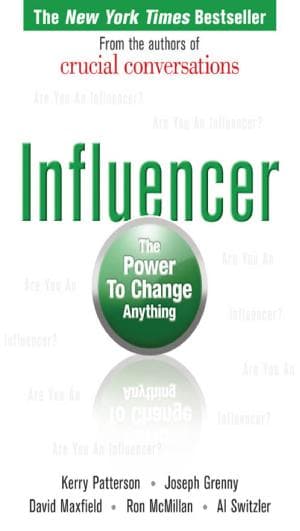
Influencer: The Power to Change Anything, First Edition cover
Archivist's Choice

Influencer: The Power to Change Anything, First Edition

Kerry Patterson (2007)

Genre

General

Reading Time

12 Minutes

Key Themes

See below

Track Your Reading

Sign in to track this book

Core Idea

The book "Influencer" argues that anyone can become an influencer and bring about significant, lasting change in individuals, groups, or organizations by mastering six key sources of influence. It debunks the myth that only those in positions of authority can drive change, instead asserting that ordinary people can achieve extraordinary results by strategically applying these influence tactics. The core premise is that by understanding and leveraging a combination of personal, social, and structural motivations and abilities, one can successfully tackle even the most intractable human problems, from personal habits to global challenges.
Difficulty
Medium

Core idea

The central argument and framework that powers the entire book.

The book "Influencer" argues that anyone can become an influencer and bring about significant, lasting change in individuals, groups, or organizations by mastering six key sources of influence. It debunks the myth that only those in positions of authority can drive change, instead asserting that ordinary people can achieve extraordinary results by strategically applying these influence tactics. The core premise is that by understanding and leveraging a combination of personal, social, and structural motivations and abilities, one can successfully tackle even the most intractable human problems, from personal habits to global challenges.

At a glance

Difficulty

Medium

Key Takeaways

1

The Six Sources of Influence

Change is inevitable when all six sources of influence are strategically aligned.

Quote

When all six sources of influence are brought to bear, change becomes inevitable.

The book's best idea is the 'Six Sources of Influence' model. It states that lasting change isn't just about willpower or one effort, but about aligning six different influences: personal drive and skill, social drive and skill, and environmental drive and skill. Most attempts at change fail because they focus on only one or two sources, like individual motivation or punishment. Effective influencers figure out which sources are weak and then apply specific plans to strengthen them all. This creates a strong effect that makes new beha...

Supporting evidence

The book illustrates this with numerous case studies, such as the doctors in Thailand who dramatically reduced infant mortality by aligning all six sources: teaching new skills (personal ability), creating peer support groups (social motivation), providing necessary tools (structural ability), and offering incentives (structural motivation).

Apply this

When facing a change challenge, map out the current state against all six sources. Identify which sources are currently supporting the old behavior or hindering the new one, and then brainstorm interventions for each. For example, if a team isn't adopting new software, address not just training (personal ability) but also peer encouragement (social motivation) and making the old software inaccessible (structural ability).


2

Focus on High-Leverage Behaviors

Identify and target a few vital behaviors that create a ripple effect for broader change.

Quote

Influencers don’t try to change everything; they identify and focus on a few high-leverage behaviors.

A common mistake in trying to make changes is trying to do too many things at once, which leads to feeling overwhelmed and giving up. The book highlights the need to find 'vital behaviors' – a few actions that, if taken, will lead to many other good changes. These aren't always the most obvious actions, but they are the ones that open the door to other desired behaviors. By focusing efforts on these key points, influencers can get big results with less effort and fewer resources, making the change process more efficient and sustainabl...

Supporting evidence

The example of reducing hospital infections by focusing on just five vital behaviors for handwashing, rather than a broad campaign, demonstrates this. These specific actions, when consistently performed, had a disproportionately large impact on overall hygiene and patient safety.

Apply this

Before initiating any change, conduct an analysis to pinpoint 2-3 vital behaviors. Ask: 'What are the few things that, if done consistently, would produce the greatest positive impact?' Prioritize interventions around these specific actions, rather than attempting a diffuse, unfocused approach.

3

Make the Undesirable Desirable

Shift perceptions and experiences to make difficult or unpleasant behaviors appealing.

Quote

Influencers don’t just tell people to change; they find ways to make the new behavior inherently more rewarding and appealing.

Just telling people to change rarely works, especially if the desired behavior seems hard, boring, or unpleasant. This book shows the important need to make unwanted behaviors appealing. This means more than just external rewards; it's about seeing the behavior differently, connecting it to deeper values, making the experience enjoyable, or making the alternative truly less appealing. By using inner drive and good feelings, influencers can turn resistance into eagerness. This leads to real adoption instead of unwilling compliance. Thi...

Supporting evidence

The book recounts a story where employees were reluctant to adopt a new, more efficient but initially complex software. Instead of just mandating it, leaders reframed it as a 'game' with leaderboards and small, immediate wins, making the learning process engaging and desirable.

Apply this

When a desired behavior is met with resistance, analyze why it's undesirable. Can it be gamified? Connected to a higher purpose? Made more social? Or can the negative consequences of *not* changing be made more salient and immediate? Focus on making the new path more attractive than the old.

4

Harness Social Influence

Leverage peer pressure and social norms to encourage widespread adoption of new behaviors.

Quote

The fastest way to change what people do is to change what they believe others around them do.

People are social and are greatly affected by what their peers do and expect. This book points out how powerful social influence is for change. Instead of fighting against social norms, good influencers learn to use them, making desired behaviors popular. This involves finding leaders, creating supportive groups, publicly praising those who adopt early, and showing the group's commitment to change. When people see their peers accepting a new behavior, they are much more likely to follow, even if they had doubts at first. This uses our...

Supporting evidence

The success story of HIV prevention in Africa, where local leaders and respected community members publicly advocated for safe practices, demonstrating that 'everyone is doing it,' significantly shifted norms and behaviors.

Apply this

Identify key opinion leaders or respected individuals within the target group. Empower them to model the desired behavior and advocate for it. Create opportunities for peer support and public commitment. Make sure the new behavior is visibly practiced and celebrated by the group.

5

Design the Environment for Success

Structure the physical and digital environment to make desired behaviors easier and undesired behaviors harder.

Quote

The environment you create can either make your desired behavior effortless or impossible.

While motivation is important, our physical and digital surroundings often guide our choices more than we realize. This book emphasizes that good influencers don't just try to change minds; they change the world around people to make the desired behavior the default. This involves 'environmental skill' and 'environmental drive' – removing obstacles, providing tools, setting reminders, and even making unwanted behaviors harder or less convenient. This approach recognizes that human willpower is limited and that a well-designed environm...

Supporting evidence

The example of a company reducing workplace accidents by redesigning workstations to make safety procedures the only comfortable way to operate, or making healthy food options the most visible and accessible choice in a cafeteria.

Apply this

Audit the environment: what cues, tools, or obstacles currently exist? How can the environment be reconfigured to prompt the desired behavior (e.g., placing gym clothes by the door) and deter the undesired (e.g., hiding unhealthy snacks)? Think beyond just physical spaces to digital tools and processes.

6

Master Personal Ability: Skills and Knowledge

Equip individuals with the necessary skills and knowledge to perform new behaviors successfully.

Quote

People often fail not because they lack motivation, but because they lack the ability.

A key, often overlooked, part of influence is making sure people have the actual skills and knowledge needed for the new behavior. It's easy to assume people know how to do something, but many change efforts fail because this basic 'personal skill' is missing. The book argues that good training, coaching, and chances to practice are essential. This is not just about giving information, but about hands-on learning, feedback, and reinforcement that builds confidence and competence. Without this foundation, even the most driven person wi...

Supporting evidence

The book highlights a situation where managers were expected to give feedback but lacked the specific communication skills to do so effectively. Providing targeted training and role-playing exercises significantly improved their ability and, consequently, their compliance with the new expectation.

Apply this

Before expecting a new behavior, assess the required skills. Design practical, experiential training programs, offer coaching, and create safe spaces for practice and feedback. Don't just tell people what to do; show them how and let them try it out.

7

The Power of Stories and Vicarious Experience

Use compelling narratives and observation to inspire and teach new behaviors.

Quote

Stories don't just entertain; they transport us into new possibilities and demonstrate what's achievable.

Beyond facts and instructions, people are deeply moved and convinced by stories. This book highlights the power of 'learning by seeing others' – watching others successfully do the desired behavior – and strong stories to inspire change. When people see or hear about someone like them getting a good result by adopting a new behavior, it makes the change seem more possible and less scary. Stories create emotional links, reduce perceived risk, and give clear examples of how to act. This is a strong tool for building both personal drive ...

Supporting evidence

The book mentions how simply sharing stories of successful employees who adopted new safety protocols, and the benefits they experienced, was more effective than lengthy rulebooks in changing behavior.

Apply this

Collect and share success stories related to the desired change. Use videos, testimonials, or live demonstrations where people can observe others successfully performing the new behavior. Frame new initiatives with a compelling narrative that connects to broader values and aspirations.

8

Beyond Willpower: Systemic Change

Recognize that individual willpower is insufficient; change requires systemic interventions.

Quote

Relying on willpower alone is a recipe for failure; true change comes from altering the system, not just the individual.

One of the most important ideas is rejecting the 'willpower myth.' The book argues that expecting people to simply 'try harder' or use more self-control is an unrealistic and ineffective plan for lasting change. Instead, it supports a system-wide approach, recognizing that behavior comes from many interacting forces (the six sources of influence). When people fail to change, it's often not a personal fault, but a fault of the system around them. This view helps influencers look past individual blame and focus on creating environments ...

Supporting evidence

The book critiques traditional management approaches that blame employees for poor performance, instead advocating for analyzing the systemic factors (lack of training, poor tools, misaligned incentives) that contribute to the problem.

Apply this

When a change initiative stalls, resist the urge to blame individuals. Instead, conduct a thorough analysis of all six sources of influence. Where are the systemic breakdowns? How can the environment, social norms, or structural incentives be altered to support the desired behavior, rather than simply demanding more effort from individuals?

9

Measure and Iterate

Continuously monitor progress, gather feedback, and adjust strategies for optimal results.

Quote

Influence is not a one-time event; it's an ongoing process of diagnosis, intervention, measurement, and adjustment.

The process of influence is rarely smooth or perfect from the start. This book shows the importance of constantly improving. Influencers don't just put a plan in place and hope for the best; they actively measure the impact of what they do, get feedback from those affected, and are ready to adjust their plans. This flexible approach allows for corrections, refining methods, and adapting to unexpected problems. It acknowledges that human behavior is complex and needs ongoing attention and flexibility, rather than a rigid approach. This...

Supporting evidence

While not a single explicit study, the book's numerous examples of successful change efforts often involve initial attempts that were refined based on observation and feedback, demonstrating an iterative process.

Apply this

Establish clear metrics for success before launching an initiative. Regularly collect data on these metrics and solicit qualitative feedback from participants. Be willing to pivot, adjust, or even abandon strategies that aren't working, and continuously experiment with new approaches based on what you learn.

10

The Ethical Imperative of Influence

Influence is a powerful tool that carries a responsibility to be used for positive, ethical change.

Quote

With great power comes great responsibility, and the power to influence is no exception.

While the book focuses on 'how to' influence, its examples show an ethical side. The power to change things means the power to change things for better or worse. The examples consistently show positive, life-improving changes – better health, safety, productivity, and community well-being. This suggests that true influence, as presented, is not manipulative but empowering and aims for mutual benefit. The book's framework provides tools that, when used responsibly, can truly improve lives and organizations. This reinforces that effecti...

Supporting evidence

All case studies, from reducing infant mortality in Thailand to improving workplace safety, inherently demonstrate influence being used for a greater good, implicitly setting an ethical standard.

Apply this

Before embarking on an influence initiative, critically evaluate the intended outcome. Is it genuinely beneficial for all stakeholders? Is it respectful of individual autonomy? Ensure transparency and focus on empowering others, rather than simply controlling them, to build trust and ensure ethical application of influence principles.

Critical analysis

Notable Quotes

Quiz

Test Your Knowledge

Ready to see how well you understood this book? Take our interactive quiz with 10 questions.

10
Questions
~5
Minutes
?
Best Score

Key Questions (FAQ)

The book's central theme is that influence is a learnable skill that empowers individuals to motivate others to change behaviors and adopt new skills. It provides practical strategies to make change inevitable in personal, professional, and societal contexts.

About the author