“All that a man has is his hope. That's what keeps him alive. And if he hasn't got anything else, he's got that. And if you take that away from him, what's left?”
— Mac discussing the desperation of the striking workers.

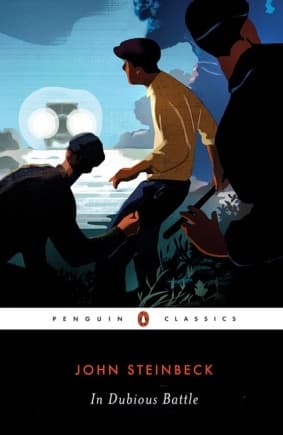
John Steinbeck (1936)
Genre
Politics / Historical Fiction
Reading Time
600 min
Key Themes
See below
Sign in to track this book
In California's apple country, a young man's search for purpose leads him into a violent migrant worker strike, transforming him into a leader consumed by the cause.
Jim Nolan, a young, lost man, goes to the Communist Party office in San Francisco, looking for purpose. He tells Harry, an organizer, about his past: his father was a Party member killed in a labor dispute, and Jim has been jailed for vagrancy. Harry, impressed by Jim's sincerity, quickly recruits him. Jim is immediately paired with Mac McLeod, an experienced and cynical Party agent, and sent to the Torgas Valley. Their goal is to organize a strike among migrant apple pickers who suffer from exploitation and low wages, before the crop is harvested.
Mac and Jim arrive in the Torgas Valley, pretending to be apple pickers. They find the migrant camp's conditions terrible: unsanitary, crowded, and workers earning very little. Mac, using his experience, quickly finds potential leaders and problems. He befriends London, a respected but cautious older worker, and subtly begins to create unrest. Jim, at first more idealistic and less skilled at manipulation, watches Mac's methods, learning how to use existing tensions and fears among the desperate workers. Their immediate goal is to stop the harvest from being completed at the current low wages.
The workers hesitate to strike, fearing eviction and hunger. Mac, always opportunistic, uses an incident where a ladder breaks and a worker, Old Dan, falls and breaks his collarbone. Mac exaggerates the injury and the company's carelessness, using it as a rallying point. He organizes a collection for Old Dan, which unites the workers and shows their collective power. This incident, skillfully manipulated by Mac, turns simmering resentment into open defiance. The workers, led by London, vote to strike, demanding higher wages and better conditions, stopping the apple harvest.
After the strike vote, the workers are evicted from company housing. Mac and Jim lead them to an abandoned field, where they set up a new, makeshift camp. This camp becomes the center of the strike, a self-governing community where workers share resources and responsibilities. London emerges as a natural leader, keeping order and morale. Doc Burton, a sympathetic intellectual and Party associate, arrives to provide medical care and observe the group dynamics. Mac and Jim work hard to keep unity, address complaints, and counter landowners' attempts to break the strike, including threats and offers of scabs.
The landowners, represented by the Growers' Association, respond to the strike with increasing aggression. They send men to intimidate strikers, destroy property, and spread rumors. A local store owner refuses credit, and sheriff's deputies patrol the area, often harassing workers. Mac and Jim, with London's help, organize patrols to protect the camp and keep spirits up. Despite growing hardship and fear, the strikers remain largely united, strengthened by their shared experience and Mac's persuasive words, who constantly reminds them of their shared exploitation and the justice of their cause.
Doc Burton, the Party-affiliated doctor, grows increasingly doubtful about the tactical manipulations Mac and Jim use. While he sympathizes with the workers, he is bothered by how individual suffering is used for the collective cause. He observes the dehumanizing effects of the struggle, noting how the focus on the 'cause' often overrides individual compassion and truth. Doc Burton discusses philosophy with Jim, questioning the Party's strict ideology and the potential for fanaticism, suggesting that the methods might corrupt the goals. His presence offers an intellectual contrast to the Party's practical approach.
The conflict grows dramatically. Landowners organize a 'vigilante' group, leading to a direct confrontation with the strikers. During a tense standoff, shots are fired, several strikers are wounded, and one young boy, Dick, is killed. This tragedy energizes the workers but also deepens their despair and anger. Mac and Jim skillfully use Dick's death as a martyr story, reinforcing the injustice of their situation and strengthening their resolve. The violence, however, takes a heavy toll on the camp, increasing the feeling of being under siege and the physical and emotional strain on everyone.
Amid escalating violence and growing desperation, Doc Burton mysteriously disappears from the camp. His absence creates more tension and fear among the strikers. Mac suspects he might have been abducted or killed by the landowners' men, or perhaps he simply left, unable to reconcile his intellectual doubts with the brutal realities of the strike. Jim is particularly troubled by Doc's disappearance, as he had come to respect the doctor's view and humanity. The incident highlights the dangers faced by anyone associated with the strike and their precarious situation.
The Growers' Association, desperate to save the apple crop, brings in a large group of Mexican scabs to break the strike. This poses a serious threat to the strikers' efforts. Mac and Jim, along with London, organize a desperate attempt to prevent the scabs from working. They try to appeal to the scabs' solidarity, but the scabs, equally desperate for work, are often unwilling to join the strike. This adds a new layer of complexity and despair, as the strikers must confront fellow laborers, driven by similar economic hardship, who are being used against them.
As the strike reaches its brutal end, Jim's transformation is complete. He loses his initial idealism for a hardened, practical commitment to the Party's cause, mirroring Mac's earlier cynicism. He is willing to sacrifice anything, including himself, for the group. During a confrontation with the landowners' men, Jim is shot and killed. Mac finds his body, and in a chilling act, props Jim's lifeless form up, using his brutalized face as a symbol to further incite the remaining strikers, turning Jim's individual tragedy into a powerful rallying cry for the ongoing 'dubious battle.'
The Protagonist
Jim transforms from a searching idealist into a hardened, self-sacrificing Party operative, ultimately becoming a martyr for the cause he embraced.
The Supporting (Mentor/Antagonist)
Mac remains consistently cynical and dedicated to the Party's methods, serving as a static force that shapes Jim's development.
The Supporting
London evolves from a cautious worker to a steadfast and respected leader of the strike, embodying the collective will of the laborers.
The Supporting
Doc Burton remains an intellectual outsider, his arc marked by increasing disillusionment with the Party's methods before his mysterious disappearance.
The Supporting
Al's character remains largely consistent as a loyal and passionate, albeit hot-headed, supporter of the strike.
The Supporting
Lisa's arc is primarily symbolic, representing the vulnerable and suffering within the strike, a constant reminder of the human cost.
The Supporting
Dakin remains a static antagonist, consistently resisting the strike and representing the oppressive forces.
The Supporting
Burke moves from hesitant observer to committed participant in the strike, illustrating the power of collective action.
The novel explores how strict adherence to an ideology, in this case, Communism, can lead to dehumanizing individuals and justifying questionable tactics. Mac consistently puts the 'cause' before individual suffering, viewing people as tools for revolution. Jim's change from an idealist to a hardened operative shows this, as he learns to suppress personal empathy for strategic gain. Doc Burton serves as the moral contrast, questioning whether the ends truly justify such means, especially when individual lives and truths are sacrificed. This theme is clear in Mac's final act with Jim's body.
““I guess I'm too much of a doctor. I can't quite see a group of men as a group. It's always a man or a woman to me.””
A main theme is the struggle between individual identity and becoming part of a collective movement. Jim Nolan starts as a searching individual, but through the strike, he gradually loses his personal desires and doubts, becoming an extension of the Party's will. The workers also find strength and purpose in their collective identity as strikers, overcoming individual fears through shared action. However, the novel also examines the cost of this, as individual voices and needs can be silenced or manipulated for the 'greater good.' The contrast between Jim's early questions and his later unwavering commitment shows this theme.
““You can't think for yourself. You're a part of the group. You've got to be a part of the group.””
Steinbeck looks at the complexities of leadership, especially in a revolutionary setting. Mac McLeod is a master manipulator, able to inspire, persuade, and deceive workers, always with the Party's goals in mind. He understands human psychology, using existing grievances and fears. London, in contrast, shows a more natural, empathetic leadership, earning respect through his wisdom and integrity. The novel compares these styles, showing how both are necessary for a movement, but also highlighting the ethical problems in leading desperate people toward a potentially violent outcome. Mac's use of Old Dan's injury or Dick's death are key examples.
““A man alone has no power. He's just a man.””
At its heart, the novel criticizes the brutal poverty and exploitation faced by migrant agricultural workers during the Great Depression. The terrible living conditions, low wages, and lack of basic rights drive the strike. The landowners' greed and indifference to human suffering are clearly shown, creating a distinct antagonist for the workers. This theme provides the social and economic background for the ideological battles, showing the desperate circumstances that push ordinary people to extraordinary acts of resistance and sacrifice.
““They're like ants, London said. You can kill them, but they just keep coming. They don't know any better.””
The story shows how social unrest can quickly turn into a cycle of violence. The workers' peaceful demands are met with intimidation and aggression from landowners, which in turn fuels the strikers' anger and leads to retaliation. The deaths of Dick and Jim are tragic examples of this escalating conflict. The novel suggests that once violence begins, it becomes an almost unavoidable force, consuming both sides and leading to a 'dubious battle' where the lines between right and wrong blur, and the human cost steadily rises.
““When you're dealing with hungry men, you're dealing with fire.””
A specific event that triggers the main conflict or a significant turning point.
In 'In Dubious Battle,' the breaking of Old Dan's ladder and his subsequent injury serve as the catalyst incident that ignites the strike. While grievances were simmering, Mac skillfully manipulates this seemingly accidental event, exaggerating its severity and blaming the company, to rally the hesitant workers. This single incident transforms diffuse discontent into unified action, providing a concrete cause for the workers to rally around and justifying their decision to strike. It demonstrates Mac's opportunistic leadership and the volatile nature of social unrest.
A character who provides an intellectual and ethical counterpoint to the pragmatic actions of others.
Doc Burton embodies the moral dilemma of the intellectual within a revolutionary movement. He is sympathetic to the workers' plight and associated with the Party, yet he constantly questions the dehumanizing tactics and rigid ideology employed by Mac and, eventually, Jim. His philosophical discussions with Jim provide an important ethical perspective, challenging the notion that the 'ends justify the means.' Doc Burton's character highlights the tension between abstract ideals and the brutal realities of political action, often making him an outsider looking in, before his mysterious disappearance removes this critical voice.
A character whose death is used to galvanize the remaining participants in a cause.
Both the death of Dick, a young worker, and ultimately Jim Nolan's death serve as instances of the martyr figure. Mac immediately seizes upon Dick's death during a confrontation to inflame the workers' anger and solidify their resolve, framing it as an act of capitalist brutality. Similarly, when Jim is killed, Mac's chilling final act of propping up Jim's body is a calculated use of a fallen comrade to inspire continued struggle. These deaths are not just tragedies but become powerful symbols, instrumentalized by the Party to fuel the 'dubious battle' and reinforce the justice of their cause.
A small, self-contained community that reflects larger societal issues.
The makeshift strike camp established by the workers in the abandoned field functions as a microcosm of society and the broader class struggle. Within this small community, the workers attempt to create their own rules, share resources, and maintain order, mirroring the ideals of a communist society. However, it also reflects the external pressures of violence, scarcity, and internal conflicts. This isolated setting allows Steinbeck to intensely focus on the social dynamics, leadership struggles, and individual transformations that mirror the larger political and economic battles of the era, making the camp a crucible for the themes of the novel.
“All that a man has is his hope. That's what keeps him alive. And if he hasn't got anything else, he's got that. And if you take that away from him, what's left?”
— Mac discussing the desperation of the striking workers.
“A man who wants to get along has to be a little bit of a politician.”
— Jim speaking about the need for strategy in organizing.
“The people are hungry. They have nothing. They are being pushed down. And when you push them down long enough, they come up.”
— Mac explaining the inevitability of the workers' revolt.
“It's a strange thing, but the people who have nothing are the most generous.”
— Jim observing the generosity among the impoverished striking workers.
“You can't make an omelet without breaking eggs.”
— Mac justifying the sacrifices and potential violence in the struggle.
“The trouble is that a man gets used to things. He gets used to being hungry, and he gets used to being afraid.”
— Jim reflecting on the desensitization of the poor.
“It isn't what you say that's important, it's what they hear.”
— Mac advising Jim on how to communicate with the workers effectively.
“There's a time when a man has to stand up for what he believes in, even if it means he's going to get hurt.”
— Jim's internal monologue about commitment to the cause.
“Fear is a great weapon. It can make men do things they wouldn't ordinarily do.”
— Mac discussing the tactics of both sides in the conflict.
“A leader has to be a little bit cold. He can't let his feelings get in the way.”
— Mac instructing Jim on the necessary detachment of a leader.
“The only way to win is to make them afraid of you.”
— Mac outlining a harsh strategy for the striking workers.
“When a man's hungry, he's got no time for anything but food. And when he's got no food, he's got no time for anything but getting it.”
— Doc Burton explaining the fundamental drive of the impoverished.
“It's the little guys that get hurt in every war.”
— Doc Burton reflecting on the casualties of social struggle.
“The end justifies the means.”
— A recurring theme and justification for the actions taken by the organizers.
Ready to see how well you understood this book? Take our interactive quiz with 10 questions.
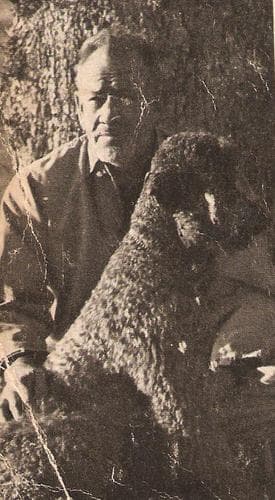
John Ernst Steinbeck was an American writer. He won the 1962 Nobel Prize in Literature "for his realistic and imaginative writings, combining as they do sympathetic humor and keen social perception". He has been called "a giant of American letters."

Brett Casper
5.0
Dirk Uffelmann
4.7
Winston S. Churchill
4.5
Chimamanda Ngozi Adichie
4.5
Will Durant
4.4
Thomas Sowell
4.4
W.E.B. Du Bois
4.3
Alan Moore
4.3