BookBrief
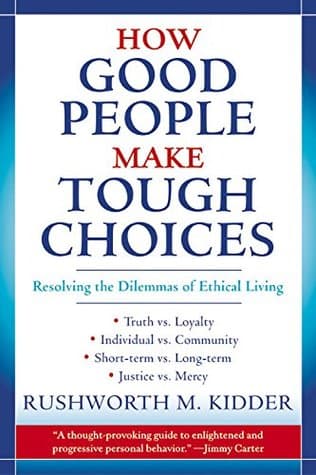
How Good People Make Tough Choices cover
Archivist's Choice

How Good People Make Tough Choices

Rushworth Kidder (2009)

Genre

Business / Psychology / Leadership / Philosophy

Reading Time

240 min

Key Themes

See below

Track Your Reading

Sign in to track this book

Learn to navigate ethical dilemmas, turning difficult choices into chances for self-reflection and principled action.

Core Idea

Rushworth Kidder's "How Good People Make Tough Choices" says ethical dilemmas are not about choosing between right and wrong, but between two competing 'rights.' He says most significant moral problems fall into one of four patterns: truth vs. loyalty, individual vs. community, short-term vs. long-term, and justice vs. mercy. Kidder gives a nine-step decision-making process, based on three ethical principles (ends-based, rule-based, and care-based thinking), to handle these 'right vs. right' situations. The book says that while the process is important, true ethical leadership depends on the moral courage to act on one's beliefs and the habit of ethical reflection.
Reading time
240 min
Difficulty
Medium
✓ Read this if...
You are a leader, manager, or individual grappling with complex ethical decisions where there isn't a clear 'good' or 'bad' option, but rather a choice between two valid, yet conflicting, moral imperatives. Also useful for those seeking a practical framework for ethical reasoning.
✗ Skip this if...
You are looking for a deep dive into meta-ethics or moral philosophy theory, or if you prefer a narrative-driven exploration of ethics over a structured, prescriptive approach.

Core idea

The central argument and framework that powers the entire book.

Rushworth Kidder's "How Good People Make Tough Choices" says ethical dilemmas are not about choosing between right and wrong, but between two competing 'rights.' He says most significant moral problems fall into one of four patterns: truth vs. loyalty, individual vs. community, short-term vs. long-term, and justice vs. mercy. Kidder gives a nine-step decision-making process, based on three ethical principles (ends-based, rule-based, and care-based thinking), to handle these 'right vs. right' situations. The book says that while the process is important, true ethical leadership depends on the moral courage to act on one's beliefs and the habit of ethical reflection.

At a glance

Reading time

240 min

Difficulty

Medium

Read this if...

You are a leader, manager, or individual grappling with complex ethical decisions where there isn't a clear 'good' or 'bad' option, but rather a choice between two valid, yet conflicting, moral imperatives. Also useful for those seeking a practical framework for ethical reasoning.

Skip this if...

You are looking for a deep dive into meta-ethics or moral philosophy theory, or if you prefer a narrative-driven exploration of ethics over a structured, prescriptive approach.

Key Takeaways

1

Defining Ethical Dilemmas

Distinguish between moral temptations and true ethical dilemmas.

Quote

The toughest choices are not between right and wrong, but between two 'rights'.

Kidder says that many situations we think of as 'tough choices' are actually moral temptations – a choice between a clear right and an obvious wrong, where the wrong is just more appealing. True ethical dilemmas are more complex. They involve a conflict between two strong values or principles, where honoring one means compromising the other. Understanding this difference is important because it tells you which decision-making framework to use. Moral temptations need discipline, while true dilemmas need careful analysis and the use of ...

Supporting evidence

Kidder's entire framework hinges on this foundational distinction, providing examples like choosing between honesty and compassion in a specific scenario.

Apply this

Before agonizing over a decision, explicitly ask: 'Is this a right vs. wrong (temptation) or a right vs. right (dilemma)?' If it's the former, the choice is clear, just difficult to enact. If the latter, prepare for deeper ethical analysis.


moral-temptationright-vs-rightethical-dilemma
2

The Four Dilemma Paradigms

Most ethical dilemmas fall into one of four fundamental categories.

Quote

Right vs. Right dilemmas can be categorized into four fundamental patterns: Truth vs. Loyalty, Individual vs. Community, Short-Term vs. Long-Term, and Justice vs. Mercy.

Kidder gives a framework by putting most 'right vs. right' dilemmas into four main patterns: Truth vs. Loyalty (e.g., telling an unpleasant truth vs. protecting a friend), Individual vs. Community (e.g., individual rights vs. the common good), Short-Term vs. Long-Term (e.g., immediate satisfaction vs. future sustainability), and Justice vs. Mercy (e.g., strict following of rules vs. compassionate understanding). Knowing which pattern a dilemma fits into is a first step in solving it. This categorization is not just academic; it helps ...

Supporting evidence

Kidder dedicates chapters to each paradigm, illustrating them with diverse real-world examples from business, politics, and personal life, such as a journalist debating revealing a source (Truth vs. Loyalty).

Apply this

When faced with a 'right vs. right' dilemma, identify which of the four paradigms it primarily represents. This immediately clarifies the core conflict and helps you articulate the opposing 'rights' more precisely.

truth-vs-loyaltyindividual-vs-communityshort-term-vs-long-termjustice-vs-mercy
3

Three Principles of Resolution

Apply one of three ethical principles to resolve 'right vs. right' conflicts.

Quote

Once a dilemma is identified as 'right vs. right,' three principles offer pathways to resolution: ends-based, rule-based, and care-based thinking.

After categorizing a dilemma, Kidder introduces three ethical principles for solving it: 1. Ends-Based Thinking (Utilitarianism): Do what produces the most good for the most people. 2. Rule-Based Thinking (Kantianism): Follow the highest sense of duty or universal rule, no matter the outcome. 3. Care-Based Thinking (Golden Rule): Treat others as you would want to be treated, focusing on relationships and empathy. These principles are not separate but offer different ways to look at and weigh the conflicting 'rights.' No single princip...

Supporting evidence

Kidder provides numerous case studies where protagonists apply these principles, such as a CEO deciding whether to lay off workers (ends-based) or uphold a promise to employees (rule-based).

Apply this

For any 'right vs. right' dilemma, systematically evaluate it through each of the three lenses: What would a utilitarian do? What would a deontologist do? What would a 'Golden Rule' follower do? This comprehensive evaluation often reveals the most robust path forward.

ends-based-thinkingrule-based-thinkingcare-based-thinkingutilitarianismdeontology
4

The Nine-Step Decision Process

A structured, repeatable process for ethical deliberation.

Quote

Making tough choices is not about finding the 'right' answer, but about making the best decision given the circumstances and being able to defend it ethically.

Kidder puts his ideas into a practical, nine-step decision-making process. This structured approach guides people through defining the problem, identifying stakeholders, gathering facts, testing for 'right vs. wrong' vs. 'right vs. right,' applying the dilemma patterns, choosing a resolution principle, investigating options, and finally, making and reviewing the decision. This process is valuable because it is thorough and repeatable. It makes you examine the ethical situation fully, ensuring that important things are not missed becau...

Supporting evidence

The book culminates in this nine-step process, which is then applied to several complex case studies, demonstrating its efficacy in real-world scenarios, such as the Challenger disaster investigation.

Apply this

Print out or memorize the nine steps. When confronted with a significant ethical choice, explicitly walk through each step, documenting your thoughts and reasoning. This creates a clear audit trail for your decision.

ethical-decision-makingnine-step-processstructured-thinkingmoral-reasoning
5

The Primacy of Moral Courage

Ethical clarity is useless without the courage to act.

Quote

The hardest part of ethical decision-making is often not knowing what is right, but doing it.

Kidder says that understanding ethical frameworks is only half the work. The real test of a 'good person' is their moral courage – the willingness to act on their ethical beliefs, especially when it is hard, unpopular, or costs them personally. This courage is important for both 'right vs. wrong' temptations (resisting the easier, unethical path) and 'right vs. right' dilemmas (making a tough call and standing by it, even if others disagree). Without moral courage, even the most carefully thought-out ethical decision remains an idea. ...

Supporting evidence

Kidder's case studies often feature individuals who, after careful deliberation, face significant personal or professional risks to uphold their chosen ethical path, like an employee blowing the whistle on corporate misconduct.

Apply this

After arriving at an ethical decision, pause and consider the potential obstacles to acting on it. Proactively plan how you will overcome these challenges, perhaps by seeking allies or preparing your communication strategy.

moral-courageethical-actionintegritycharacter
6

The Role of Personal Values

Ethical choices are deeply rooted in individual and organizational value systems.

Quote

Ultimately, the answer to 'how good people make tough choices' lies in understanding their core values and how those values inform their application of ethical principles.

While Kidder gives universal frameworks, he also says that personal and organizational values shape how people interpret dilemmas and apply resolution principles. What one person prioritizes (e.g., individual liberty) might differ from another (e.g., collective harmony), leading to different but still ethical conclusions. Understanding your own core values, and those of key stakeholders, is vital for both making a decision and communicating it. This self-awareness helps explain why different 'good people' might get different 'right' a...

Supporting evidence

Kidder's examples often show how different individuals, all operating with good intentions, arrive at varying conclusions because their personal value systems lead them to emphasize different ethical principles or weigh conflicting 'rights' differently.

Apply this

Regularly reflect on and articulate your own core values. When facing a dilemma, explicitly consider which of your values are most engaged and how they might influence your perception of the 'right' path. Do the same for key stakeholders.

personal-valuesorganizational-valuesself-awarenessethical-leadership
7

Beyond 'Winning' the Argument

The goal is understanding and defensibility, not absolute 'rightness'.

Quote

The purpose of ethical deliberation is not to find a single, universally 'correct' answer that silences all dissent, but to arrive at a well-reasoned, defensible choice.

A common problem in ethical discussions is wanting to 'win' the argument or prove one's solution is the only 'right' one. Kidder gently disagrees with this idea, saying that in 'right vs. right' dilemmas, absolute certainty is often not possible. The goal is not to find a magical, universally agreed-upon answer, but to use a process that leads to a decision that is well-reasoned, transparent, and ethically defensible, even if it is still controversial. This view promotes humility and encourages empathy for those who might reach differ...

Supporting evidence

Many of Kidder's complex case studies conclude with a 'best' decision that still carries trade-offs and potential negative consequences, illustrating that perfect solutions are rare and the process matters most.

Apply this

When discussing ethical dilemmas with others, focus on explaining your reasoning and understanding theirs, rather than trying to convince them of your 'correctness.' Be open to modifying your stance if new information or perspectives emerge.

ethical-defensibilitymoral-ambiguityhumilitydialogue
8

The Habit of Ethical Reflection

Ethical fitness is built through consistent practice and self-reflection.

Quote

Ethical fitness, like physical fitness, requires regular exercise. It's not about a single grand decision, but a lifetime of thoughtful choices.

Kidder says that ethical decision-making is a skill, not something you are born with, and like any skill, it gets better with practice. The frameworks and tools are most effective when they become ingrained habits of thought. Regularly thinking about ethics – even for small choices – strengthens your 'moral muscle' and prepares you for the truly tough dilemmas. This means not just using the nine steps when a crisis hits, but consistently analyzing situations, identifying underlying values, and considering potential consequences. This ...

Supporting evidence

The book itself is a guide to building this habit, providing the tools and encouraging readers to apply them to their own lives, implicitly suggesting that repeated application leads to proficiency.

Apply this

After making any significant decision, take time to review it through Kidder's framework. What paradigm was it? What principles did you implicitly or explicitly use? What could you have done differently? This post-mortem strengthens your ethical acumen.

ethical-fitnessmoral-muscleself-reflectionhabit-formation
9

Leadership and Ethical Culture

Good choices by leaders shape the moral fabric of organizations.

Quote

Ethical leadership is not just about making the right choices, but about creating an environment where others can also make the right choices.

While the book focuses on individual decision-making, its impact on leadership is significant. Leaders, by consistently showing ethical thought and action, set the moral tone and culture of an organization. Their tough choices become examples, showing what values are truly prioritized and how ethical conflicts are solved. A leader who openly uses Kidder's framework not only makes better individual decisions but also educates and empowers their team to do the same. Conversely, a leader who avoids ethical thought or makes choices based ...

Supporting evidence

Kidder often references business and political leaders, highlighting how their ethical (or unethical) decisions have far-reaching consequences for their constituents and organizations, such as the ethical lapses leading to financial crises.

Apply this

As a leader, explicitly share your ethical decision-making process with your team. Discuss difficult choices openly (within appropriate bounds) and invite input, demonstrating how to navigate 'right vs. right' dilemmas. Model ethical courage.

ethical-leadershiporganizational-culturemoral-tonetransparency

Critical analysis

Notable Quotes

Ethics is not about the difference between right and wrong. It is about the conflict between right and right.

Kidder introduces the core premise of the book, challenging simplistic moral views.

The toughest choices are not between good and evil, but between good and good.

Emphasizing that ethical dilemmas often involve competing positive values.

Truth versus loyalty, individual versus community, short-term versus long-term, justice versus mercy.

Kidder outlines four common paradigms of right-versus-right dilemmas.

When values conflict, we must choose based on our core principles, not just situational convenience.

Advocating for principled decision-making in business and personal life.

Moral courage is the strength to act on our ethical convictions, even at personal cost.

Discussing the psychological fortitude required for ethical leadership.

Ethical fitness, like physical fitness, requires regular exercise and practice.

Comparing ethical development to a skill that needs cultivation.

In right-versus-right dilemmas, there is no perfect solution—only the best available choice.

Acknowledging the inherent complexity and compromise in ethical decisions.

The test of our character is not in avoiding dilemmas, but in how we resolve them.

Focusing on the process of ethical reasoning rather than outcomes alone.

Organizations with strong ethical cultures don't just have policies; they have shared values.

Highlighting the importance of collective ethics in business environments.

Empathy allows us to see dilemmas from multiple perspectives, enriching our moral judgment.

Stressing the role of empathy in navigating complex ethical situations.

Sometimes, the right decision is the one that causes the least harm, not the most good.

Introducing nuanced ethical reasoning beyond utilitarian calculations.

Ethical leaders don't impose their values; they inspire others to discover their own.

Describing a collaborative approach to leadership and ethics.

The silence of good people can be as damaging as the actions of bad ones.

Warning against passivity in the face of ethical challenges.

In dilemmas, ask not just 'What should I do?' but 'What kind of person do I want to be?'

Encouraging self-reflection as a tool for ethical decision-making.

Quiz

Test Your Knowledge

Ready to see how well you understood this book? Take our interactive quiz with 10 questions.

10
Questions
~5
Minutes
?
Best Score

Key Questions (FAQ)

The book argues that ethical dilemmas are not about choosing between right and wrong, but between competing 'right' values. It provides a framework for resolving these tough choices through self-reflection and structured decision-making.

About the author