BookBrief
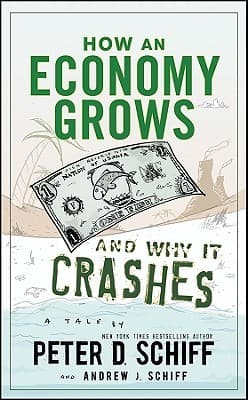
How an Economy Grows and Why It Crashes cover
Archivist's Choice

How an Economy Grows and Why It Crashes

Peter D. Schiff (2010)

Genre

Business / Politics / Economics / Finance / Science

Reading Time

240 min

Key Themes

See below

Track Your Reading

Sign in to track this book

This book uses illustrations and parables to explain how consumer credit and inflation create economic problems, showing that real prosperity comes from saving, producing, and investing, not from government actions.

Core Idea

Schiff says real economic growth comes from production, savings, and capital investment, not from spending or government help. He shows how a strong economy needs people to save instead of spending right away, so they can create tools and infrastructure that make them more productive later. The book criticizes fiat money, fractional reserve banking, and government involvement, saying these policies warp market signals, cause bad investments, inflate asset bubbles, and lead to economic crashes. Schiff supports free markets, sound money (like gold), and careful spending as the only way to lasting prosperity. He warns that current global economic practices will cause a severe downturn.
Reading time
240 min
Difficulty
Easy
✓ Read this if...
You are skeptical of modern monetary policy, believe in Austrian economics principles, or want a clear, accessible explanation of how economies *should* work from a hard-money perspective.
✗ Skip this if...
You are a proponent of Keynesian economics, believe government intervention is essential for economic stability, or are looking for a nuanced critique of various economic schools of thought.

Core idea

The central argument and framework that powers the entire book.

Schiff says real economic growth comes from production, savings, and capital investment, not from spending or government help. He shows how a strong economy needs people to save instead of spending right away, so they can create tools and infrastructure that make them more productive later. The book criticizes fiat money, fractional reserve banking, and government involvement, saying these policies warp market signals, cause bad investments, inflate asset bubbles, and lead to economic crashes. Schiff supports free markets, sound money (like gold), and careful spending as the only way to lasting prosperity. He warns that current global economic practices will cause a severe downturn.

At a glance

Reading time

240 min

Difficulty

Easy

Read this if...

You are skeptical of modern monetary policy, believe in Austrian economics principles, or want a clear, accessible explanation of how economies *should* work from a hard-money perspective.

Skip this if...

You are a proponent of Keynesian economics, believe government intervention is essential for economic stability, or are looking for a nuanced critique of various economic schools of thought.

Key Takeaways

1

The Root of True Wealth

Productivity, not consumption, is the engine of economic growth.

Quote

True wealth is not measured by how much we consume, but by how much we produce.

Schiff says that real economic growth comes from more production and capital, not from consumer spending, government stimulus, or debt. He shows how making more goods and services with less effort (more productivity) drives prosperity. When people save and invest in tools, infrastructure, or education, they improve their future ability to produce. This capital allows for more efficient production, which means more goods and services for everyone. The idea that spending drives growth is a dangerous mistake, as it encourages borrowing a...

Supporting evidence

The initial parable of the 'island economy' where inhabitants fish more efficiently by creating nets, thus increasing their productive output and leisure time. This simple example highlights how saving (not consuming all fish) and investing (building a net) directly lead to greater wealth and improved living standards.

Apply this

Focus on skill development, education, and investing in productive assets rather than solely on immediate consumption. For businesses, prioritize capital expenditures that enhance efficiency and output over short-term sales boosts fueled by debt.

capital-formationproductivitysavingsproduction
2

The Peril of Fiat Money

Unbacked currency leads to inflation and economic distortion.

Quote

When governments can create money out of thin air, they don't just steal from savers; they distort the entire economy.

Schiff criticizes fiat money systems, where currency is not backed by a physical commodity like gold. He explains that when central banks can print money, it causes inflation, which he defines as an increase in the money supply, not just rising prices. This inflation reduces the buying power of savings, harms producers, and unfairly moves wealth from productive people to those with political connections. Also, easy money encourages too much government spending and debt, creating boom-bust cycles and putting capital in the wrong places...

Supporting evidence

The book illustrates how adding more paper fish (representing unbacked currency) to the island economy does not create more real fish (goods). Instead, it just makes each paper fish worth less, leading to higher prices without any increase in actual wealth. This directly mirrors the effects of quantitative easing and monetary expansion.

Apply this

Individuals should protect their wealth by investing in real assets (e.g., commodities, productive businesses, land) that retain value during inflationary periods, rather than relying solely on cash or government bonds. Advocate for sound money policies and fiscal responsibility.

fiat-moneyinflationmonetary-policycentral-banking
3

The Illusion of Consumer Credit

Borrowing to consume depletes capital and hinders true growth.

Quote

Consumer credit is not a tool for prosperity; it's a crutch for an economy that has forgotten how to save and produce.

Schiff disproves the idea that consumer credit helps the economy. He says that borrowing to spend, especially on things that don't produce income, just pulls future spending into the present without creating new wealth. This reduces the nation's capital, as resources that could have been saved and invested in productive businesses are instead used for immediate wants. The resulting debt makes future spending harder and the economy weaker. A healthy economy comes from people saving and investing, which then allows for sustainable spend...

Supporting evidence

The islanders initially save extra fish to invest in a fishing net, increasing their future catch. If they instead borrowed fish from each other just to eat more now, they would have no net, no increased future production, and a debt to repay. This highlights the difference between productive (investment) and unproductive (consumption) debt.

Apply this

Prioritize saving and investing over consumer debt. Avoid using credit cards for non-essential purchases and focus on paying down existing high-interest consumer debt. Understand that personal financial stability contributes to overall economic health.

consumer-debtcreditsavingscapital-depletion
4

The Myth of Government Stimulus

Government spending diverts resources, it doesn't create them.

Quote

Government spending is not a source of wealth; it's a reallocation of existing wealth, often from productive hands to unproductive ones.

Schiff criticizes government intervention and stimulus packages. He says governments cannot create wealth; they only redistribute it. When the government spends, it must first get resources through taxes, borrowing, or printing money. All these methods take capital from the private sector, where individuals and businesses would have used it more efficiently based on market signals. Government projects, often driven by politics instead of economic efficiency, tend to be less productive and can lead to bad investments, creating 'bridges...

Supporting evidence

The book's analogy of the 'government' on the island taking fish from productive fishermen to pay unproductive 'fish-counters' or 'hole-diggers.' While these activities create 'jobs,' they don't increase the total number of fish (wealth) and actually reduce the amount available for productive investment.

Apply this

Be skeptical of calls for increased government spending as a solution to economic woes. Support policies that reduce government intervention and allow free markets to allocate resources. Focus on creating value in the private sector rather than relying on government employment or subsidies.

government-spendingfiscal-policymalinvestmentfree-markets
5

The Virtue of Savings and Investment

Saving provides the capital for future productivity and prosperity.

Quote

Savings are not merely deferred consumption; they are the lifeblood of capital formation and the foundation of all future economic progress.

Schiff says that savings are not just for personal financial security; they are necessary for economic progress. When people save some of their income, those savings become available for investment. This capital can then fund businesses, develop new technologies, build infrastructure, and create more efficient production methods. Without savings, there can be no capital, and without capital, there can be no lasting increase in productivity or living standards. Policies that discourage saving (like low interest rates or inflation) harm...

Supporting evidence

The islanders who save some of their daily fish catch and pool them together can then afford to commission a toolmaker to build a more efficient fishing net or boat. This collective saving leads to a significant increase in the entire community's productive capacity, benefiting everyone.

Apply this

Cultivate a strong habit of saving and investing a significant portion of your income. Seek out investments that genuinely contribute to productive capacity rather than speculative assets. Understand that your savings contribute to the broader economy's ability to grow.

savingsinvestmentcapital-formationeconomic-growth
6

Trade as Mutual Benefit

Free trade allows for specialization and increased overall wealth.

Quote

Trade is not a zero-sum game where one nation wins and another loses; it is a mutually beneficial exchange that enhances the wealth of all participants.

Schiff supports free trade as a key part of economic growth, going against protectionist ideas. He explains that trade allows people and nations to specialize in what they do best, leading to more efficiency and higher overall production. When people trade, they exchange goods and services they value less for those they value more, benefiting both sides. Protectionist policies, like tariffs and quotas, limit this natural flow of goods and services, forcing countries to produce inefficiently and limiting consumer choice. This reduces o...

Supporting evidence

The scenario where one islander is better at fishing and another is better at farming. By specializing and trading fish for crops, both individuals end up with more of both goods than if they had tried to produce everything themselves. This simple example highlights comparative advantage.

Apply this

Support policies that promote free trade and oppose protectionist measures. As a consumer, appreciate the benefits of diverse and affordable goods available through global trade. As a producer, focus on your comparative advantages.

free-tradespecializationcomparative-advantageprotectionism
7

The Importance of Risk and Entrepreneurship

Taking calculated risks is essential for innovation and progress.

Quote

Without the willingness to take risks, to innovate, and to endure the possibility of failure, an economy stagnates.

Schiff points out the important role of taking risks and starting businesses in economic development. Innovation and progress do not happen by chance; they come from people willing to invest their time, capital, and effort into new ventures, often without guaranteed success. Entrepreneurs find unmet needs, develop new products or services, and create more efficient ways of doing things. This process involves risk, and the chance of failure is a necessary part of a dynamic economy. Policies that stop risk-taking, such as too much regul...

Supporting evidence

The islander who decides to spend his saved fish to build a new, untested type of fishing boat. There's a risk it might not work, but if it does, it could revolutionize fishing and benefit everyone. This illustrates the entrepreneurial spirit and its potential rewards.

Apply this

Encourage and support entrepreneurial ventures, understanding that some failures are inevitable but necessary for overall progress. As an individual, be open to taking calculated risks in your career or investments, seeking opportunities for innovation and growth.

entrepreneurshiprisk-takinginnovationcreative-destruction
8

The Dangers of Central Planning

Market forces, not planners, efficiently allocate resources.

Quote

No central planner, no matter how intelligent, can ever possess the dispersed knowledge of millions of individuals acting in their own self-interest.

Schiff strongly supports free markets over central planning, following the Austrian School of economics. He says that markets, through prices, are very good at allocating resources based on supply and demand, reflecting the collective preferences and knowledge of millions of individuals. Central planners, however, lack this widespread information and always make inefficient decisions, leading to misallocation of capital, shortages, surpluses, and economic stagnation. Attempts to control the economy from the top down always lead to uni...

Supporting evidence

The book subtly contrasts the organic, efficient development of the island economy through individual choices and voluntary cooperation with the less efficient outcomes when a 'chief' tries to dictate who fishes, who farms, and who builds, without understanding the underlying individual preferences or skills.

Apply this

Support policies that reduce government interference in markets and allow prices to signal true supply and demand. Understand that attempts to 'fix' market outcomes often create new, larger problems. Prioritize individual economic freedom.

central-planningfree-marketsprice-mechanismaustrian-economics
9

The Nature of Economic Bubbles

Artificially low interest rates fuel malinvestment and eventual collapse.

Quote

Bubbles are not natural market phenomena; they are the predictable consequence of central banks distorting interest rates and encouraging malinvestment.

Schiff says that economic bubbles are not natural to capitalism but are a direct result of central bank policies, especially the manipulation of interest rates. When central banks artificially lower interest rates below their natural market level, they send false signals to entrepreneurs and investors. This leads to too much cheap credit, encouraging bad investments in unsustainable ventures and speculative assets, rather than truly productive businesses. This misallocation of capital creates a false sense of prosperity, but it is bui...

Supporting evidence

The boom and bust cycle on the island when the 'banker' (representing the central bank) starts lending out 'fish' at artificially low rates without enough real savings to back them, leading to too many 'net-building' projects that can't be sustained once the 'fish' become scarce.

Apply this

Be wary of investment opportunities that seem too good to be true, especially during periods of exceptionally low interest rates. Understand that market corrections, while painful, are essential for reallocating capital to productive uses. Diversify investments beyond assets fueled by speculative credit.

economic-bubblesinterest-ratesmalinvestmentcentral-banking
10

The Real Cost of Debt

Debt, especially for consumption, burdens future generations.

Quote

Debt is not a free lunch. Every dollar borrowed today must be repaid tomorrow, often by those who had no say in the borrowing.

Schiff often talks about the real cost of debt, especially government debt. He says that government borrowing to pay for current spending or unsustainable programs is effectively a tax on future generations. These future taxpayers will have to repay the principal and interest, taking their productive capacity away from creating new wealth. This transfer of wealth between generations is problematic and economically weakening. It creates a false sense of present prosperity at the expense of future living standards, leading to a less res...

Supporting evidence

The islanders' 'government' borrowing fish from an outside source or from their own future productivity to fund current expenditures, leaving the next generation with fewer resources and a repayment obligation, thus hindering their ability to save and invest.

Apply this

Support fiscal responsibility and balanced budgets at all levels of government. As an individual, strive to be debt-free, especially from consumption debt, to ensure your own financial freedom and contribute to a healthier overall economy.

national-debtfiscal-responsibilityintergenerational-debtsovereign-debt

Critical analysis

Notable Quotes

The only way to increase our standard of living is to increase our productivity.

Explaining the fundamental principle of economic growth through productivity.

Savings are the seed corn of capital formation.

Describing how savings enable investment and economic expansion.

Inflation is not rising prices; it is an increase in the money supply.

Clarifying the definition of inflation in contrast to common misconceptions.

Government stimulus is like giving a patient a shot of adrenaline; it might provide a temporary boost, but it doesn't cure the underlying disease.

Critiquing short-term government interventions in the economy.

The fish is the symbol of money in our story, but in the real world, money is just a medium of exchange.

Using the book's allegory of fish to explain the role of money.

When you borrow from the future, you have to pay it back with interest.

Warning about the consequences of debt and deficit spending.

True wealth is not measured in dollars but in the goods and services we can produce.

Distinguishing between monetary wealth and real economic output.

The business cycle is not a natural phenomenon; it is caused by government manipulation of interest rates.

Attributing economic booms and busts to central bank policies.

Free trade benefits all parties involved because it allows for specialization and efficiency.

Advocating for the advantages of unrestricted international trade.

Regulations often protect established businesses from competition, stifling innovation.

Criticizing excessive government regulation in markets.

The illusion of prosperity created by credit bubbles always ends in a crash.

Describing the unsustainable nature of credit-driven economic expansions.

Economic growth requires saving, investment, and time—not quick fixes from politicians.

Emphasizing the long-term nature of genuine economic development.

When government spends, it must tax, borrow, or print money—all of which have negative consequences.

Outlining the limited and harmful options for government financing.

The market is a discovery process, not something that can be centrally planned.

Defending the efficiency of free markets over government control.

Quiz

Test Your Knowledge

Ready to see how well you understood this book? Take our interactive quiz with 10 questions.

10
Questions
~5
Minutes
?
Best Score

Key Questions (FAQ)

The book uses storytelling, humor, and illustrations to explain economic growth, monetary systems, capital use, inflation, trade, savings, and risk. It exposes common economic fallacies and makes complex topics accessible to general readers.

About the author