BookBrief
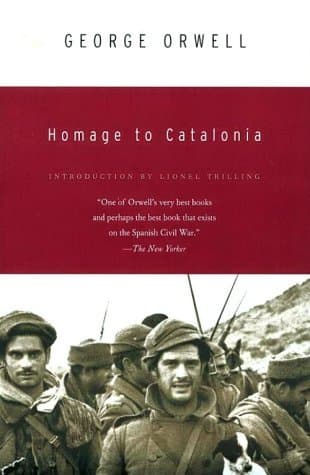
Homage to Catalonia cover
Archivist's Choice

Homage to Catalonia

George Orwell (1938)

Genre

Politics / Biography / Memoir / History

Reading Time

240 min

Key Themes

See below

Track Your Reading

Sign in to track this book

Orwell's memoir details his experiences in the Spanish Civil War, exposing the brutal realities and political betrayals that shaped his lifelong commitment to democratic socialism.

Core Idea

Orwell's "Homage to Catalonia" critiques the political maneuvering and betrayals that corrupted the Spanish Civil War. From the perspective of an ordinary soldier in the POUM militia, the book argues that revolutionary idealism, when faced with power struggles and propaganda, leads to infighting and state violence against allies. It shows how the 'fog of war' is a tool of political suppression, sacrificing truth to consolidate power and eliminate dissent. This leaves the individual soldier disillusioned and endangered by the forces they aimed to serve.
Reading time
240 min
Difficulty
Medium
✓ Read this if...
You are interested in the Spanish Civil War, the intersection of personal experience with political history, or a critical perspective on revolutionary movements and propaganda. This is also for those who appreciate Orwell's clear, honest prose and his commitment to truth.
✗ Skip this if...
You are looking for a comprehensive military history of the Spanish Civil War, a purely academic analysis, or prefer fiction over memoir. It can be dense with political details that might not appeal to all readers.

Core idea

The central argument and framework that powers the entire book.

Orwell's "Homage to Catalonia" critiques the political maneuvering and betrayals that corrupted the Spanish Civil War. From the perspective of an ordinary soldier in the POUM militia, the book argues that revolutionary idealism, when faced with power struggles and propaganda, leads to infighting and state violence against allies. It shows how the 'fog of war' is a tool of political suppression, sacrificing truth to consolidate power and eliminate dissent. This leaves the individual soldier disillusioned and endangered by the forces they aimed to serve.

At a glance

Reading time

240 min

Difficulty

Medium

Read this if...

You are interested in the Spanish Civil War, the intersection of personal experience with political history, or a critical perspective on revolutionary movements and propaganda. This is also for those who appreciate Orwell's clear, honest prose and his commitment to truth.

Skip this if...

You are looking for a comprehensive military history of the Spanish Civil War, a purely academic analysis, or prefer fiction over memoir. It can be dense with political details that might not appeal to all readers.

Key Takeaways

1

The Brutality of Idealism

Revolutionary fervor often crumbles under the weight of practical conflict and internal strife.

Quote

The thing that strikes one in all the Spanish militias, after a first glance, is the absence of any social distinction… There was a feeling of equality and comradeship that I have never seen anywhere else.

Orwell arrived in Catalonia with socialist ideals, seeing a society where class distinctions seemed to vanish. This initial excitement, however, soon gave way to a harsh truth: revolutionary ideals often fail against the realities of war and political infighting. Early days of true comradeship and equality, where officers and privates shared food and dangers, slowly disappeared under military hierarchy and bitter factionalism on the Republican side. The initial 'feeling of equality' became a memory, replaced by ambition, paranoia, and...

Supporting evidence

Orwell's initial descriptions of revolutionary Barcelona, where hotels were collectivized and workers' militias operated without traditional military ranks, contrasted sharply with his later experiences on the Aragón front, where the romanticism faded amidst the squalor, boredom, and constant danger, and eventually with the internal purges in Barcelona.

Apply this

When engaging in any collective action, be prepared for the erosion of initial idealism as practicalities and human nature assert themselves. Prioritize unity and common goals over ideological purity to prevent internal collapse.

revolutionary-idealisminternal-conflictspanish-civil-war
2

The Fog of War is Political

Truth becomes the first casualty, not just from enemy propaganda, but from internal political maneuvering.

Quote

I saw great battles reported where there had been no battles, and thousands of dead where there had been only a few wounded. I saw men in hospital with no wounds at all.

Orwell's experience shows how war distorts truth, not just through enemy lies, but through deliberate falsehoods from one's own side. The 'fog of war' is a political tool. As a journalist, Orwell was well-placed to see how official reports and newspaper headlines differed greatly from the grim, often static, reality he experienced at the front. This information manipulation reached its peak during the Barcelona May Days, when the Communist-controlled press falsely claimed the POUM and Anarchists were Fascist collaborators. This delibe...

Supporting evidence

Orwell's detailed comparison of actual frontline conditions (boredom, trench life, sporadic shelling) versus the heroic, often fabricated, battle reports in the Republican press. The most striking example is the official narrative of the May Days in Barcelona, which painted the POUM as traitors, despite Orwell's direct observation of their defensive actions.

Apply this

Always question official narratives, especially during times of conflict or political tension. Seek out multiple sources and prioritize firsthand accounts, even if inconvenient, to discern the truth amidst propaganda.

propagandatruth-in-warpolitical-manipulation
3

The Erosion of Comradeship

Initial revolutionary bonds fracture under the strain of prolonged conflict and ideological purges.

Quote

The classless society, which at first had seemed to be a reality, was already vanishing.

Orwell's initial time in the POUM militia introduced him to a strong sense of equality and comradeship, a stark contrast to class-divided England. Officers saluted privates, and everyone shared meager rations and dangers. This revolutionary ideal, however, was fragile. As the war continued, and especially with the rise of Communist influence and the suppression of groups like the POUM, this unity was systematically destroyed. Traditional military discipline, the return of social hierarchies, and the persecution of former allies turned...

Supporting evidence

The transition from the informal, egalitarian POUM militia to the more disciplined, hierarchical Popular Army; the reintroduction of saluting and class distinctions. Most powerfully, the persecution of POUM members, including Orwell's friends, and his own necessity to hide and escape after being branded a 'Trotskyist' by the Communist press.

Apply this

Recognize that maintaining unity in a movement requires constant vigilance against internal divisions and the corrosive effects of power struggles. Prioritize shared humanity over rigid ideological adherence to preserve collective strength.

political-purgesmilitary-disciplineideological-division
4

The Mundanity of Frontline War

War is less about heroics and more about boredom, discomfort, and the constant threat of the unseen.

Quote

The whole life of the front line was one of discomfort and boredom, punctuated by moments of extreme danger.

Orwell dispels romantic views of warfare, giving a plain account of life on the Aragón front. His experience centered not on grand battles, but on constant cold, hunger, lice, and the perpetual boredom of trench life. The 'heroism' often praised in propaganda was replaced by the grim reality of waiting, watching, and the low-level anxiety of unseen snipers or random shellfire. The enemy was often an abstract idea, sometimes glimpsed across desolate no-man's-land, but more often felt as an invisible, persistent threat. This focus on th...

Supporting evidence

Detailed descriptions of trench conditions: the cold, the mud, the lack of proper food and sleep, the infestation of lice. The constant, low-level danger from snipers and random shells, rather than large-scale engagements. The 'truce' where soldiers from opposing sides would occasionally shout insults or even exchange cigarettes.

Apply this

When considering conflict, move beyond sensationalized narratives. Understand the often-unseen, grinding realities of daily life for those involved, which are crucial for empathy and informed decision-making.

trench-warfarepsychological-tollanti-war-narrative
5

The Personal Cost of Witnessing History

Direct experience of political betrayal leaves deep, lasting scars and a profound sense of disillusionment.

Quote

I had come to Spain to fight Fascism, and I had seen what Fascism was. But I had also seen that the enemies of Fascism were not always what they seemed.

Orwell's journey through the Spanish Civil War was a personal transformation. He arrived as an idealistic socialist, eager to fight fascism, but left disillusioned by internal betrayals and purges within the Republican ranks. The wound he sustained was not just physical; the intellectual and emotional trauma of being hunted by former allies, of seeing truth systematically inverted, left a lasting mark. This experience solidified his lifelong commitment to exposing totalitarianism and defending objective truth, directly influencing his...

Supporting evidence

His near-fatal bullet wound to the throat. More significantly, his desperate flight from Barcelona, hiding from the Communist police after the POUM was declared illegal, and the fear for his life and the lives of his comrades. This direct experience of being branded a 'traitor' by those he fought alongside is central.

Apply this

Be aware that standing for principles in politically charged environments can come at a significant personal cost. Prepare for potential betrayal from unexpected quarters and prioritize self-preservation without compromising core values.

political-disillusionmenttotalitarianismpersonal-transformation
6

The Power of the Penny Press

Propaganda, even when crude, effectively shapes public opinion and justifies atrocities.

Quote

The most effective way of making people believe in your lies is to tell them over and over again.

Orwell, a writer, was keenly aware of the power of the press, especially the cheap, widely distributed newspapers that shaped public opinion during the war. He observed how the Communist-controlled press systematically demonized the POUM and Anarchists, fabricating stories of 'Trotsky-Fascist' conspiracies. These accusations, though clearly false to anyone on the ground, were repeated until they became accepted 'truth' for many, both in Spain and internationally. This relentless propaganda justified the violent suppression of these gr...

Supporting evidence

The systematic campaign in the Communist press (e.g., 'La Pasionaria') against the POUM, accusing them of being agents of Franco and Hitler. Orwell's direct comparison of these newspaper reports with his own experiences and observations during the May Days in Barcelona, where the POUM was clearly fighting *against* the government forces, not with them.

Apply this

Develop strong media literacy skills. Actively scrutinize headlines and 'official' reports, especially from sources with clear political affiliations, and be wary of information presented without verifiable evidence or alternative perspectives.

media-manipulationdisinformationtotalitarian-control
7

The Illusion of External Support

International intervention is often driven by self-interest and ideology, not pure humanitarianism.

Quote

The thing that really worried all the foreign anti-Fascists was not the military situation, but the political situation in the rear.

Orwell's account implicitly critiques international involvement in the Spanish Civil War. While many foreign volunteers, like him, were driven by anti-fascist ideals, larger geopolitical players had complex motivations of ideology and national interest. The Soviet Union's support for the Republic, for instance, came with conditions: promoting Communist party dominance and suppressing rival socialist and anarchist movements. The 'Non-Intervention Committee' by Western democracies was a cynical policy that disproportionately harmed the ...

Supporting evidence

The Soviet Union's insistence on the Popular Front strategy and its active role in strengthening the Communist Party in Spain, leading to the suppression of the POUM and Anarchists. The ineffectiveness and hypocrisy of the international Non-Intervention Agreement, which effectively crippled the Republic's ability to buy arms while Germany and Italy openly supplied Franco.

Apply this

When observing international conflicts, critically evaluate the stated motives of intervening powers. Understand that geopolitical interests often overshadow humanitarian concerns, leading to complex and often counterproductive interventions.

geopoliticsproxy-warinternational-relations
8

The Enduring Human Spirit

Despite horrors and betrayals, the capacity for comradeship and resilience persists.

Quote

In spite of it all, I am glad that I went to Spain. I saw wonderful things and I saw terrible things, but I saw what I believe to be the only glimpse of a classless society that I shall ever see.

Despite deep disillusionment, physical wounds, and the trauma of betrayal, Orwell's narrative shows respect for the ordinary people he fought alongside. The initial, brief experience of a truly egalitarian society, even amidst squalor and danger, left a lasting impression. His admiration for the courage, resilience, and simple decency of the Spanish militiamen, especially those from the POUM and Anarchist groups, comes through the grim realities. Even as he chronicles the political machinations that destroyed their unity, he never for...

Supporting evidence

Orwell's vivid descriptions of the camaraderie and shared hardship among the militiamen on the front line, where social distinctions disappeared. His personal bonds with specific comrades, like the Italian militiaman or his English friends, despite the eventual political purges that targeted them.

Apply this

Even amidst cynicism and adversity, actively seek and cultivate genuine human connections and shared purpose. Recognize that collective resilience often stems from these fundamental bonds, even when larger systems fail.

human-resiliencecomradeshipsocial-equality
9

The Moral Imperative of Bearing Witness

To speak truth to power, especially when inconvenient, is a fundamental duty.

Quote

I did not want to write about the Spanish war, but I did not want to remain silent either.

Orwell wrote 'Homage to Catalonia' not out of enthusiasm, but from a strong moral obligation. Having seen firsthand the systematic distortion of truth and the brutal suppression of his comrades by the very forces supposedly fighting for freedom, he felt he had to set the record straight. This book is his act of bearing witness, an attempt to counter the lies spread by the Communist press and to give a voice to the persecuted. It highlights the important role of the independent observer in challenging official narratives, especially wh...

Supporting evidence

Orwell's explicit statements in the book's preface and throughout, explaining his motivation to write despite the political sensitivities and personal dangers. His meticulous detailing of dates, locations, and newspaper reports to directly refute the official Communist narrative of the May Days and the POUM's alleged treachery.

Apply this

Cultivate the courage to speak truth, even when unpopular or risky. Recognize that silence can be a form of complicity, and that accurate, documented witness is crucial for historical integrity and justice.

moral-couragespeaking-truth-to-powerhistorical-integrity

Critical analysis

Notable Quotes

I had come to Spain with some notion of fighting for democracy against fascism, and I had not yet discovered that in modern warfare the difference between a hero and a murderer is about a year's training.

Early reflections on joining the POUM militia and the grim realities of war.

The thing that strikes one in all these early skirmishes is the quite extraordinary amateurishness of it all.

Describing the initial disorganization and lack of professional military training among the militias.

I was in a revolutionary community where the ordinary class-divisions of society had practically vanished.

Observing the egalitarian atmosphere and lack of social hierarchy within the POUM militia.

The Spanish people are in some ways a very reasonable people; they are not easily carried away by rhetoric.

Reflecting on the pragmatic and often stoic nature of the Spanish people he encountered.

I had been told that the Spanish were a dirty people. I had not found them so. They were merely poor.

Correcting a common misconception about the hygiene of the Spanish people, attributing conditions to poverty.

The essential point is that the people were in control. The workers were in control of the factories and the peasants were in control of the land.

Describing the initial revolutionary fervor and worker control in Catalonia.

It was the first time that I had ever been in a town where the working class was in the saddle.

His astonishment and admiration for the revolutionary atmosphere in Barcelona.

War is a thing of the imagination, and it is only in the imagination that it can be fought.

A philosophical observation on the psychological aspect of warfare and propaganda.

The most important thing for the civilian, in time of war, is to avoid being killed.

A stark and cynical realization about personal survival during wartime.

I recognized it as a revolutionary act. It was not a political gesture, but an emotional one.

Describing a moment of spontaneous solidarity or defiance among the people.

One of the most horrible effects of war is that it forces you to become a murderer.

Reflecting on the moral compromises and brutal necessities imposed by combat.

I had seen wonderful things and I had seen dreadful things, and I was glad to be going home.

His mixed feelings upon leaving Spain, having experienced both the ideals and horrors of the revolution and war.

The greatest service that can be rendered to any cause is to keep it free from the taint of lies and propaganda.

A strong assertion of the importance of truth and honesty, especially in political movements.

I saw great numbers of people who were not fighting for anyone but themselves, but who were fighting for the revolution.

Distinguishing between self-interest and genuine revolutionary commitment among the populace.

Quiz

Test Your Knowledge

Ready to see how well you understood this book? Take our interactive quiz with 10 questions.

10
Questions
~5
Minutes
?
Best Score

Key Questions (FAQ)

'Homage to Catalonia' is George Orwell's personal account of his experiences fighting for the Republican side in the Spanish Civil War. It blends memoir, political analysis, and historical reporting to describe the conflict and the complex political landscape within the anti-fascist forces.

About the author

George Orwell

Eric Arthur Blair, better known by his pen name George Orwell, was an English novelist, essayist, journalist, and critic. His work is characterised by lucid prose, social criticism, opposition to totalitarianism, and support of democratic socialism.