BookBrief
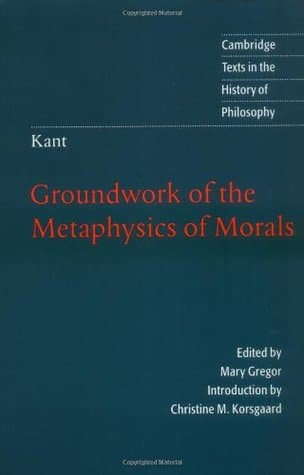
Groundwork of the Metaphysics of Morals cover
Archivist's Choice

Groundwork of the Metaphysics of Morals

Immanuel Kant (1964)

Genre

Philosophy

Reading Time

180-240 min

Key Themes

See below

Track Your Reading

Sign in to track this book

Kant examines the basis of human morality, arguing that ethical action comes from a universal, unconditional duty that respects every person as an end in themselves, not just a means.

Core Idea

Kant's "Groundwork" sets a rational basis for morality, stating that true moral worth comes only from a 'good will' acting from duty, not from desire or expected results. This good will follows the Categorical Imperative, a moral rule that requires acting only on principles that could become universal laws and always treating people, oneself included, as an end, never only as a means. Morality, then, is not based on experience but on reason, and assumes human autonomy—the ability to make laws for oneself under moral principles—as the core of a 'kingdom of ends' where all rational beings are both subjects and lawmakers.
Reading time
180-240 min
Difficulty
Hard
✓ Read this if...
You are a philosophy student or a serious reader interested in understanding the foundational principles of deontological ethics directly from one of its most influential proponents. This is essential for grasping Kant's ethical system.
✗ Skip this if...
You prefer a more accessible introduction to ethics, are looking for applied ethical dilemmas, or are averse to dense, abstract philosophical reasoning with highly technical language.

Core idea

The central argument and framework that powers the entire book.

Kant's "Groundwork" sets a rational basis for morality, stating that true moral worth comes only from a 'good will' acting from duty, not from desire or expected results. This good will follows the Categorical Imperative, a moral rule that requires acting only on principles that could become universal laws and always treating people, oneself included, as an end, never only as a means. Morality, then, is not based on experience but on reason, and assumes human autonomy—the ability to make laws for oneself under moral principles—as the core of a 'kingdom of ends' where all rational beings are both subjects and lawmakers.

At a glance

Reading time

180-240 min

Difficulty

Hard

Read this if...

You are a philosophy student or a serious reader interested in understanding the foundational principles of deontological ethics directly from one of its most influential proponents. This is essential for grasping Kant's ethical system.

Skip this if...

You prefer a more accessible introduction to ethics, are looking for applied ethical dilemmas, or are averse to dense, abstract philosophical reasoning with highly technical language.

Key Takeaways

1

The Good Will: Unconditionally Good

The only thing good without qualification is a good will.

Quote

It is impossible to conceive anything at all in the world, or even out of it, which can be taken as good without qualification, except a good will.

Kant begins his moral philosophy by stating that the only thing good in itself, without any conditions, is a good will. Mental abilities like intelligence, personality traits like courage, or good fortune like wealth can all be used for bad purposes. Even happiness, if not paired with a good will, can be undeserved or harmful. A good will, however, is valuable on its own; its goodness does not depend on its results or its success, but only on its own intention. This idea makes internal disposition and intention the base of morality, m...

Supporting evidence

Kant's initial argument contrasts the good will with other commonly valued attributes (intelligence, courage, wealth, happiness), demonstrating how each can be perverted or used for ill, whereas the good will retains its intrinsic value regardless of external factors.

Apply this

When evaluating the morality of an action, shift focus from the outcome to the underlying intention. Ask: Was the will behind this action truly good, irrespective of whether it succeeded or failed, or what benefits it brought?

good-willunconditional-goodintrinsic-value
2

Duty, Not Inclination

Moral actions derive their worth from being done out of duty, not mere inclination.

Quote

An action done from duty has its moral worth, not in the purpose to be attained by it, but in the maxim according to which it is decided upon.

For Kant, an action has true moral worth only if done out of duty, not from desire, self-interest, or emotion. If a shopkeeper charges fair prices because it helps business, that is not a moral action; it is practical. If they do it because it is their duty to be honest, regardless of business outcomes, then it has moral worth. This difference is important: it means acting morally often involves overcoming natural desires or personal feelings to follow a principle. The moral person is not praised for feeling good about doing right, bu...

Supporting evidence

Kant's examples of the shopkeeper who doesn't overcharge, the person who preserves their life (even if they wish for death), and the benefactor who acts from duty rather than sympathy, all illustrate the difference between actions in conformity with duty and actions done *from* duty.

Apply this

Before acting, reflect on your motivation. Are you doing this because you genuinely believe it's the right thing to do, regardless of personal gain or emotional satisfaction, or are you driven by a temporary feeling or external reward?

dutyinclinationmoral-worthmoral-action
3

The Categorical Imperative: Universal Law

Act only according to that maxim whereby you can at the same time will that it should become a universal law.

Quote

Act only according to that maxim whereby you can at the same time will that it should become a universal law.

The first rule of Kant's Categorical Imperative states that our actions should be based on principles that we could consistently want to become universal laws. This means asking if everyone were to act on that principle, would it still be possible and rational? For example, if you consider making a false promise, you must ask if you could want everyone to make false promises. The answer is no, because if false promises were universal, the idea of a promise would lose its meaning, and no one would believe them. This test shows the co...

Supporting evidence

Kant's famous example of the false promise: if lying promises were universalized, the institution of promising itself would collapse, making the maxim self-defeating and thus immoral.

Apply this

Before making a decision, especially one with ethical implications, ask yourself: 'What if everyone did this all the time?' If the world would become illogical, self-defeating, or undesirable, then your action is likely immoral.

categorical-imperativeuniversal-lawmaximuniversalizability
4

Humanity as an End in Itself

Treat humanity, whether in yourself or in others, always as an end and never merely as a means.

Quote

So act that you use humanity, whether in your own person or in the person of any other, always at the same time as an end, never merely as a means.

This second rule of the Categorical Imperative, often called the 'Formula of Humanity,' is perhaps Kant's most lasting contribution to moral philosophy. It states the inherent worth of every rational being. We must never use people (including ourselves) only as tools to reach our goals, but always recognize them as beings with their own value and ability to govern themselves rationally. This principle supports modern ideas of human rights and respect for people. It condemns slavery, exploitation, and manipulation, as these actions red...

Supporting evidence

Kant applies this by arguing that making a false promise to borrow money uses the lender merely as a means to one's financial gain, disregarding their rational capacity to consent or dissent based on truth. Similarly, suicide treats one's own person as a mere means to end suffering.

Apply this

When interacting with others, ensure you are respecting their autonomy and rationality. Are you being transparent and honest, allowing them to make informed decisions? Or are you manipulating them or using them without their genuine consent for your own ends?

humanity-as-endmeans-to-an-enddignityrespect-for-personsautonomy
5

Autonomy and the Kingdom of Ends

Rational beings are authors of the moral law, creating a 'kingdom of ends'.

Quote

A rational being must always regard himself as giving laws either as member or as sovereign in a kingdom of ends.

Kant's idea of autonomy says that moral agents are not just subject to external moral laws, but are themselves the creators of these laws through their own reason. This self-legislation gives moral law its power and importance. When we act morally, we are not just following an arbitrary command, but rather a law we have set for ourselves as rational beings. This leads to the idea of a 'kingdom of ends,' a hypothetical community where all rational beings treat each other as ends in themselves and together create the universal moral law...

Supporting evidence

Kant describes the 'kingdom of ends' as a systematic union of rational beings under common laws, where each individual is both a subject and a legislator of these laws, emphasizing the reciprocal nature of moral autonomy.

Apply this

When making moral decisions, consider yourself not just an individual actor, but also a legislator for a universal moral community. Ask: 'Would I want everyone in an ideal society to live by the principle I am about to adopt?'

autonomykingdom-of-endsself-legislationrational-beingmoral-freedom
6

Freedom as a Postulate of Morality

Moral action requires the assumption of freedom, even if it's empirically unknowable.

Quote

For if freedom of the will is presupposed, morality together with its principle follows from it by mere analysis of its concept.

Kant argues that for morality to be meaningful, we must assume human freedom. If our actions were fully determined by natural causes or outside forces, then moral responsibility, praise, and blame would not make sense. The 'ought' of a moral command implies 'can.' While we cannot prove freedom through observation (as all observable events follow cause and effect), reason requires us to assume it as a condition for moral action. We experience ourselves making choices and being morally responsible, and this experience needs the idea of ...

Supporting evidence

Kant's distinction between the phenomenal world (of appearances, governed by cause and effect) and the noumenal world (of things-in-themselves, where freedom might reside) underpins this argument. We can't *know* freedom empirically, but we must *act as if* we are free for morality to exist.

Apply this

When facing a difficult moral choice, remember that your capacity for moral action presupposes your freedom to choose. Embrace this freedom and the responsibility it entails, rather than succumbing to determinism or external pressures.

freedomdeterminismnoumenal-worldmoral-responsibilitypostulate
7

Perfect vs. Imperfect Duties

Duties are categorized by whether they admit of no exception or allow for some latitude.

Quote

Some actions are of such a kind that their maxim cannot even be conceived as a universal law of nature without contradiction; far from it, one cannot even will that it should be such.

Kant distinguishes between perfect and imperfect duties, both from the Categorical Imperative. Perfect duties are those with no exceptions; breaking them leads to a contradiction (e.g., lying promises would make promising meaningless) or a contradiction in the will (e.g., suicide, as it uses oneself as a mere means). These are usually negative duties, like 'do not lie' or 'do not murder.' Imperfect duties, on the other hand, allow some flexibility in how and when they are met. While it is a duty to develop one's talents or help others...

Supporting evidence

Kant's four examples used to test the Categorical Imperative illustrate this: the false promise (perfect duty to oneself, as it contradicts the concept of promising), suicide (perfect duty to oneself, as it uses humanity as a mere means), neglecting one's talents (imperfect duty to oneself, as one cannot will a world where talents are never developed), and not helping others (imperfect duty to others, as one cannot will a world where no one ever helps).

Apply this

When facing a moral dilemma, first identify if it involves a perfect duty (e.g., truthfulness, not harming). These are non-negotiable. Then consider if imperfect duties (e.g., benevolence, self-improvement) are also at play, recognizing that while important, their fulfillment might be more flexible.

perfect-dutyimperfect-dutycontradiction-in-conceptioncontradiction-in-the-will
8

Moral Law as Rationally Discovered

Moral principles are not external commands but are discovered through reason.

Quote

The moral law is not imposed on us from without, but is the product of our own reason.

Kant rejected the idea that morality comes from divine command, social custom, or personal feelings. Instead, he argued that moral law is something we find through pure practical reason. It is universally binding because it comes from the structure of rationality itself, which all rational beings share. This means morality is objective and necessary, not changeable or subjective. When we act morally, we are not just following rules, but acting according to our own rational nature. This focus on reason as the source of morality elevate...

Supporting evidence

The entire structure of the Groundwork, moving from common moral concepts to the derivation of the Categorical Imperative through a priori reasoning, serves as evidence for this. Kant systematically shows how reason, not empirical observation or divine revelation, leads to the supreme moral principle.

Apply this

Instead of seeking moral guidance from external sources (tradition, authority, emotion), engage in critical self-reflection. Use your own reason to test the universalizability and respect for humanity embedded in your actions and principles.

pure-practical-reasona-prioriobjective-moralityrationalitymoral-autonomy
9

Moral Feelings are Secondary

Feelings like sympathy are morally irrelevant; only respect for duty matters.

Quote

For it is not a question of whether this or that action occurred, but whether it occurred through duty and thus has moral worth.

While Kant knew that humans naturally feel emotions like sympathy or compassion, he strongly argued that these emotions do not give moral worth to an action. If you help someone out of pity, your action, while perhaps good, lacks true moral value in Kant's strict view because it is driven by feeling, not duty. True moral action comes from a conscious choice to act according to the moral law, out of respect for that law itself. This might seem cold, but Kant's point is that if morality were based on fleeting emotions, it would be unsta...

Supporting evidence

Kant's example of the person who, despite having no natural inclination or sympathy for others, helps them purely out of duty, is presented as having the highest moral worth, contrasting with the person who helps out of a kind heart. The latter is 'amiable' but not necessarily moral in the strict sense.

Apply this

When performing acts of kindness or charity, examine your underlying motivation. While feeling good is a pleasant side effect, strive for your primary driver to be a recognition of your duty to humanity, rather than just an emotional impulse.

moral-feelingssympathyrespect-for-lawmoral-worthduty-vs-inclination

Critical analysis

Notable Quotes

Act only according to that maxim whereby you can at the same time will that it should become a universal law.

Formulation of the Categorical Imperative (Universal Law).

So act as to treat humanity, whether in thine own person or in that of any other, in every case as an end withal, never as means only.

Formulation of the Categorical Imperative (Humanity as an End).

Nothing can possibly be conceived in the world, or even out of it, which can be called good without qualification, except a good will.

Opening statement on the nature of a good will.

A good will is good not because of what it effects or accomplishes, not because of its fitness to attain some proposed end, but only by virtue of willing, that is, it is good in itself.

Elaborating on the intrinsic value of a good will.

Duty is the necessity of acting from respect for the law.

Defining duty in relation to moral law.

For an action to have moral worth, it must be done from duty, not merely in accordance with duty.

Distinguishing actions performed from duty versus merely conforming to duty.

The moral law is a categorical imperative.

Stating the nature of the moral law.

All imperatives command either hypothetically or categorically.

Introducing the distinction between types of imperatives.

The will is therefore not merely subject to the law, but so subject that it must be regarded as itself giving the law and, on this account, only now really subject to the law.

Introducing the concept of autonomy of the will.

Act only so that the will could regard itself as at the same time giving universal law through its maxim.

Formulation of the Categorical Imperative (Autonomy/Kingdom of Ends).

Freedom of the will is autonomy, i.e., this property of the will to be a law to itself.

Directly defining freedom of the will as autonomy.

Morality is thus the relation of actions to the autonomy of the will, i.e., to the possible universal legislation by means of its maxims.

Connecting morality directly to the concept of autonomy.

The concept of freedom is the key to the explanation of the autonomy of the will.

Highlighting the foundational role of freedom in understanding autonomy.

For if reason does not itself determine the will with respect to its objects, then it must determine it by means of the inclinations.

Contrasting determination by reason versus inclinations.

Quiz

Test Your Knowledge

Ready to see how well you understood this book? Take our interactive quiz with 10 questions.

10
Questions
~5
Minutes
?
Best Score

Key Questions (FAQ)

The primary aim of Kant's Groundwork is to identify and establish the supreme principle of morality, which he famously calls the categorical imperative. It seeks to lay the foundational concepts for understanding moral obligation and human autonomy.

About the author