BookBrief
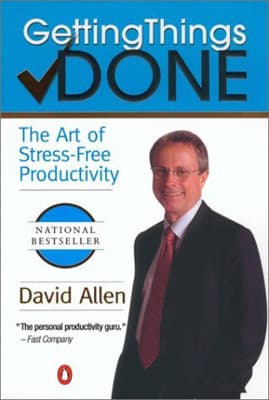
Getting Things Done: The Art of Stress-Free Productivity cover
Archivist's Choice

Getting Things Done: The Art of Stress-Free Productivity

David Allen (2001)

Genre

Business / Productivity / Reference / Leadership / Self-Help

Reading Time

12 Minutes

Key Themes

See below

Track Your Reading

Sign in to track this book

Master David Allen's "Getting Things Done" to improve your workflow by organizing your mind and boosting productivity through stress-free methods.

Core Idea

David Allen's 'Getting Things Done' (GTD) introduces a comprehensive, five-step methodology for managing all commitments and information, both professional and personal, to achieve a state of 'mind like water.' The core premise is that our brains are for having ideas, not holding them. By externalizing all open loops into a trusted system and processing them through a consistent workflow (capture, clarify, organize, reflect, engage), individuals can reduce mental clutter, increase focus, and make conscious decisions about what to work on at any given moment, leading to significantly reduced stress and enhanced productivity. The GTD system emphasizes breaking down projects into actionable next steps, organizing them by context, and regularly reviewing one's entire system. This allows for a clear overview of all commitments, enabling confident decision-making about priorities and ensuring that nothing falls through the cracks. The ultimate goal is to free up mental energy that would otherwise be spent on remembering tasks, allowing for greater creativity and presence.
Difficulty
Medium

Core idea

The central argument and framework that powers the entire book.

David Allen's 'Getting Things Done' (GTD) introduces a comprehensive, five-step methodology for managing all commitments and information, both professional and personal, to achieve a state of 'mind like water.' The core premise is that our brains are for having ideas, not holding them. By externalizing all open loops into a trusted system and processing them through a consistent workflow (capture, clarify, organize, reflect, engage), individuals can reduce mental clutter, increase focus, and make conscious decisions about what to work on at any given moment, leading to significantly reduced stress and enhanced productivity.

The GTD system emphasizes breaking down projects into actionable next steps, organizing them by context, and regularly reviewing one's entire system. This allows for a clear overview of all commitments, enabling confident decision-making about priorities and ensuring that nothing falls through the cracks. The ultimate goal is to free up mental energy that would otherwise be spent on remembering tasks, allowing for greater creativity and presence.

At a glance

Difficulty

Medium

Key Takeaways

1

The Mind is for Having Ideas, Not Holding Them

Offload all open loops from your brain into a trusted external system.

Quote

Your mind is for having ideas, not holding them.

Allen's main idea is that our brains are not good at storing tasks and commitments. Trying to remember everything creates 'open loops' that drain energy and cause stress. This mental burden makes it hard to think clearly and solve problems creatively. The solution is to write down everything that has your attention—from a project idea to a bill—in a reliable place. This 'mind sweep' frees up your mental capacity, letting your brain focus on processing information and finding solutions instead of constantly recalling obligations. This ...

Supporting evidence

The entire GTD methodology is built upon the premise that an uncluttered mind, free from the burden of remembering tasks, is essential for optimal performance and stress reduction. The initial 'capture' phase, where everything is written down, directly addresses this.

Apply this

Conduct a comprehensive 'mind sweep' by writing down every single thing, big or small, that has your attention onto a piece of paper or into a digital capture tool. Don't filter or organize at this stage; just get it out of your head.

2

The Two-Minute Rule for Swift Action

If a task takes less than two minutes, do it immediately.

Quote

If an action takes less than two minutes, it should be done at the moment it is defined.

This simple, effective rule is key to processing tasks efficiently. Allen argues that the time it takes to postpone, organize, and track a small task often takes longer than just doing it. By immediately handling anything that takes two minutes or less, you prevent minor items from building up and creating mental clutter. This rule applies everywhere, from answering a quick email to putting away a dish. It helps you act immediately on small things, preventing procrastination and keeping your inboxes clear of small but distracting task...

Supporting evidence

Allen cites numerous examples from his consulting work where clients found significant relief and improved flow by adopting this immediate action principle for small tasks, preventing them from becoming larger psychological burdens.

Apply this

When processing your inbox or captured items, if you identify an action that will take less than two minutes (e.g., sending a quick email, filing a document, making a short phone call), do it right then and there instead of deferring it.

3

Define the Next Action

Break down vague projects into concrete, physical, visible next steps.

Quote

Every outcome you’re committed to that will take more than one action to complete is a project.

In GTD, a 'project' is any goal that needs more than one action. Projects are often vague, which can lead to procrastination. Allen stresses the need to identify the specific 'next physical, visible action' for every project. Instead of 'Organize party,' the next action might be 'Email Sarah for guest list.' This clarity removes confusion and makes it easier to start. Without a defined next action, a project stays stalled, adding to stress and a feeling of being overwhelmed. This is a crucial step from capturing ideas to acting on the...

Supporting evidence

Allen's work with executives consistently showed that the primary reason projects stalled was the lack of a clearly defined 'next action.' Once clients identified this, progress became almost automatic.

Apply this

For every project on your list, ask yourself: 'What's the very next physical action I need to take to move this forward?' Write that specific action down, starting with a verb, and add it to your 'Next Actions' list.

4

The Weekly Review: Your System's Tune-Up

Regularly review and update your entire system to maintain clarity and control.

Quote

The weekly review is the critical success factor for the whole game.

This is the book's strongest idea about system maintenance. The Weekly Review is a required ritual where you clear your mind, check all outstanding projects and commitments, process all collected items, update your lists, and clarify your priorities for the week ahead. Without this regular check-in, even the best GTD system will slowly break down, leading back to stress and overwhelm. It's how you build trust in your system, allowing you to relax, knowing everything is handled. This structured reflection is essential for adapting to c...

Supporting evidence

Allen emphasizes that individuals who consistently perform the Weekly Review report significantly higher levels of control, clarity, and reduced stress compared to those who skip it, highlighting its role as the 'critical success factor.'

Apply this

Schedule a dedicated block of 1-2 hours each week for your Weekly Review. Go through all your inboxes, review your projects, next actions, waiting-for, and someday/maybe lists, and make any necessary updates or additions.

5

Context-Based Action Lists

Organize your next actions by the tool or location required to complete them.

Quote

The key is to organize action reminders in lists that are appropriate to how and when you’ll be doing them.

Instead of one large to-do list, GTD suggests organizing 'Next Actions' by context. This means creating lists like '@Office,' '@Home,' '@Calls,' '@Errands,' '@Computer,' or '@Anywhere.' This method is practical because it shows you only the relevant options when you are in a specific place or have a certain tool. For example, at your computer, you only see tasks that need a computer, avoiding the distraction of tasks you cannot do then. This reduces decision fatigue and helps you make productive choices based on your current situation...

Supporting evidence

Allen developed this method based on observing how people naturally work and the frustration caused by seeing irrelevant tasks. Grouping actions by context directly addresses this real-world operational challenge.

Apply this

Create separate lists for your 'Next Actions' based on context. For example, a physical list for '@Errands' in your wallet, a digital list for '@Computer' tasks, and a list for '@Calls' you need to make.

6

The Four-Criteria Model for Daily Action Selection

Choose what to do based on context, time, energy, and priority.

Quote

Once you have your lists of next actions, how do you decide what to do at any given moment?

Once your 'Next Actions' are organized by context, deciding what to do daily still needs a framework. Allen provides four criteria: 1) Context (what can I do where I am?), 2) Time Available (how much time do I have?), 3) Energy Available (how much mental/physical energy do I have?), and 4) Priority (what is most important based on my goals?). This model is important because it recognizes that productivity is not just about doing tasks, but doing the right tasks given your current internal and external conditions. It allows for flexi...

Supporting evidence

This model is a practical application of cognitive science principles, recognizing that human performance fluctuates. Allen's experience showed that rigid to-do lists fail when real-world conditions don't match ideal plans.

Apply this

Before starting work, look at your context-based lists. Then, consider how much time and energy you have. Finally, choose the highest priority task that fits those criteria. Don't force high-energy tasks on a low-energy moment.

7

The Natural Planning Model

Plan projects organically, mimicking how the mind naturally solves problems.

Quote

The natural planning model is how we plan anything we actually finish successfully.

For larger, more complex projects, Allen introduces the 'Natural Planning Model,' which mimics how we naturally plan a successful dinner party or vacation. It involves five steps: 1) Define Purpose and Principles, 2) Envision the Outcome (what does success look like?), 3) Brainstorm (all ideas, no judgment), 4) Organize (identify components and sequences), and 5) Identify Next Actions. This model differs from rigid, top-down planning by encouraging a more fluid, creative process initially. This approach helps overcome 'project paralys...

Supporting evidence

Allen argues that this model is derived from observing how successful individuals intuitively approach complex tasks, often without formal training, demonstrating its inherent effectiveness.

Apply this

When faced with a new project, start by defining its purpose and visualizing the successful outcome. Then, brainstorm all possible steps without censoring, organize them, and finally, identify the very first 'next action.'

8

The Someday/Maybe List: A Place for Dreams

Keep inspiring but non-urgent ideas in a dedicated list, freeing your mind without discarding them.

Quote

The 'Someday/Maybe' list is a place to keep track of any projects or project components that you’ve decided you’re not going to move on now, but that you don’t want to forget about entirely.

Not everything captured needs immediate action. The 'Someday/Maybe' list is a great way to relieve mental pressure. It's a place for aspirational projects, interesting ideas, potential hobbies, or long-term goals that you are not ready to start now but do not want to forget. This list is reviewed regularly (often during the Weekly Review), allowing you to move items into active projects if circumstances change. It prevents the guilt of discarding good ideas while also keeping them from cluttering your 'Next Actions' and creating false...

Supporting evidence

Many productivity systems fail to provide a structured place for non-urgent but valuable ideas. The Someday/Maybe list addresses this common oversight, preventing good ideas from being lost or becoming sources of stress.

Apply this

When you capture an idea or project that you're not ready to commit to, don't discard it. Instead, add it to a dedicated 'Someday/Maybe' list and review it during your Weekly Review to see if it's time to activate it.

9

Horizontal vs. Vertical Control

Manage both individual tasks (horizontal) and higher-level goals (vertical) for complete control.

Quote

Ultimately, the effectiveness of your GTD system depends on your ability to integrate horizontal and vertical control.

Allen differentiates between 'horizontal' and 'vertical' control. Horizontal control means managing all your commitments and actions across different areas of your life (e.g., all your next actions, projects, and someday/maybe items). Vertical control means managing the depth of individual projects, ensuring they are planned and completed effectively from purpose to next action. A truly effective GTD system needs both. You must know all your commitments (horizontal) and how to advance individual projects (vertical). This complete view...

Supporting evidence

This concept is a meta-level observation from Allen's extensive consulting, where he saw that partial systems (only horizontal or only vertical) inevitably led to breakdowns in productivity or clarity.

Apply this

Regularly zoom out to review your higher-level goals (vertical control) and ensure your current 'Next Actions' and projects (horizontal control) are aligned with them. Use the Weekly Review for this integration.

10

The Power of a Trusted System

Confidence in your system allows for 'mind like water' and stress-free productivity.

Quote

The ultimate goal of Getting Things Done is to have a mind like water.

The entire GTD method aims for a state Allen calls 'mind like water'—the ability to respond appropriately to anything that comes your way, without overreacting or feeling overwhelmed. This state is possible only when you completely trust your external system to hold all your commitments, ideas, and projects. When you know nothing is forgotten and everything is organized for action, your brain can relax and focus entirely on the task at hand or simply be present. The true value of GTD is not just about getting more done, but about achi...

Supporting evidence

The anecdotal evidence from GTD practitioners worldwide consistently points to a reduction in stress and an increase in mental clarity as a primary benefit, directly attributable to the trust developed in their GTD system.

Apply this

Consistently apply all GTD principles, especially the capture and weekly review steps, to build and maintain trust in your system. The more you trust it, the less your mind will worry, leading to greater mental clarity and calm.

Critical analysis

Notable Quotes

Quiz

Test Your Knowledge

Ready to see how well you understood this book? Take our interactive quiz with 10 questions.

10
Questions
~5
Minutes
?
Best Score

Key Questions (FAQ)

The core principle of Getting Things Done is that our productivity is directly proportional to our ability to relax. When our minds are clear and organized, we can achieve effective productivity and unlock our creative potential.

About the author

David Allen

David Allen is a renowned productivity expert and the author of the seminal work, "Getting Things Done: The Art of Stress-Free Productivity." His methodologies have revolutionized personal and professional organization for millions worldwide. Allen's approach emphasizes capturing tasks and ideas in a trusted system to achieve a state of relaxed control.