BookBrief
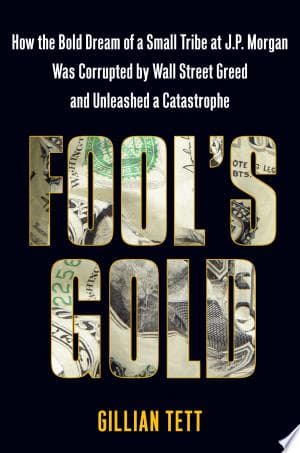
Fool's Gold cover
Archivist's Choice

Fool's Gold

Gillian Tett (2009)

Genre

General

Reading Time

6-8 hours

Key Themes

See below

Track Your Reading

Sign in to track this book

Gillian Tett shows how J.P. Morgan's credit derivatives, conceived at a Boca Raton poolside, sparked a banking revolution that ultimately fueled the 2008 financial crisis through a mix of ambition and greed.

Core Idea

Fool's Gold examines the 2008 financial crisis, arguing that its origins are in abstract financial instruments like Credit Default Swaps (CDSs) and Collateralized Debt Obligations (CDOs). The book suggests that too much specialization, along with a widespread failure to grasp the true risks of these 'unbundled' products, created a false sense of security. This led to dangerous amounts of leverage and exposure, causing a systemic collapse when the housing market failed. The book highlights the overconfidence and greed that marked the world of high finance.
Reading time
6-8 hours
Difficulty
Medium
✓ Read this if...
You want a detailed, character-driven narrative explaining the specific financial products (CDOs, CDSs) and the human decisions that led to the 2008 financial crisis. You are interested in how financial innovation can spiral into systemic risk.
✗ Skip this if...
You are looking for a high-level overview without getting into the technical specifics of financial instruments, or prefer a purely economic analysis over a journalistic, narrative approach.

Core idea

The central argument and framework that powers the entire book.

Fool's Gold examines the 2008 financial crisis, arguing that its origins are in abstract financial instruments like Credit Default Swaps (CDSs) and Collateralized Debt Obligations (CDOs). The book suggests that too much specialization, along with a widespread failure to grasp the true risks of these 'unbundled' products, created a false sense of security. This led to dangerous amounts of leverage and exposure, causing a systemic collapse when the housing market failed. The book highlights the overconfidence and greed that marked the world of high finance.

At a glance

Reading time

6-8 hours

Difficulty

Medium

Read this if...

You want a detailed, character-driven narrative explaining the specific financial products (CDOs, CDSs) and the human decisions that led to the 2008 financial crisis. You are interested in how financial innovation can spiral into systemic risk.

Skip this if...

You are looking for a high-level overview without getting into the technical specifics of financial instruments, or prefer a purely economic analysis over a journalistic, narrative approach.

Key Takeaways

1

The Genesis of Financial Alchemy

How a poolside brainstorm birthed credit derivatives and revolutionized banking.

Quote

The story begins with the intense Morgan brainstorming session in 1994 beside a pool in Boca Raton, where the team cooked up a dazzling new idea for the exotic financial product known as credit derivatives.

The 2008 financial crisis did not appear suddenly; its origins go back to the early 1990s and a specific moment at J.P. Morgan. A small group of bankers, later called the 'Morgan Mafia,' thought of credit derivatives during a strategic meeting. Their initial aim was to manage risk better by moving specific credit exposures off their balance sheet. This innovation allowed banks to separate and trade credit risk from the underlying loan, promising more liquidity and flexibility. Tett points out how this idea, meant for better risk manag...

Supporting evidence

The 1994 Boca Raton brainstorming session at J.P. Morgan where the concept of credit derivatives was first formulated by a small team seeking to manage the bank's exposure to a specific loan to Exxon.

Apply this

Understand how seemingly positive financial innovations, born from rational needs, can have unforeseen and destabilizing long-term consequences if not properly understood and regulated.


credit-derivativesfinancial-innovationrisk-management
2

The Unbundling of Risk

Credit derivatives allowed banks to dissect and trade risk, fundamentally changing financial architecture.

Quote

That idea would rip around the banking world, catapult Morgan to the top of the turbocharged derivatives trade, and fuel an extraordinary banking boom that seemed to have unleashed banks from ages-old constraints of risk.

The main innovation of credit derivatives was the ability to 'unbundle' risk. Instead of a bank holding a loan and all its risks until maturity, credit derivatives allowed them to sell the credit risk component to another party. This meant a bank could create a loan, package its credit risk into a Credit Default Swap (CDS) or Collateralized Debt Obligation (CDO), and sell it, effectively removing that risk from its balance sheet. This created an illusion of lower risk for the originating bank, freeing up capital and encouraging more l...

Supporting evidence

The rapid growth of the credit derivatives market from a niche product to a multi-trillion-dollar industry, and J.P. Morgan's initial dominance in this market due to their pioneering efforts.

Apply this

When evaluating complex financial instruments, always question where the risk truly goes and whether its new location is transparent and well-understood by all parties.

credit-default-swapcollateralized-debt-obligationrisk-transfer
3

The Illusion of Risk Mitigation

Derivatives promised safer banking but created a 'shadow banking' world of hidden dangers.

Quote

The deeply reported and lively narrative takes readers behind the scenes, to the inner sanctums of elite finance and to the secretive reaches of what came to be known as the 'shadow banking' world.

While credit derivatives were initially designed to reduce risk for individual institutions, their widespread use and later misuse created systemic weaknesses. Tett shows how the ability to offload risk led to complacency and encouraged greater leverage across the financial system. Many of these complex derivatives were traded 'over-the-counter' (OTC), outside traditional exchanges and without central clearing. This lack of transparency and regulation allowed a 'shadow banking' world to grow, where large amounts of risk accumulated mo...

Supporting evidence

The proliferation of OTC derivatives and the expansion of entities like Structured Investment Vehicles (SIVs) that operated largely outside traditional banking regulations, holding vast amounts of securitized assets.

Apply this

Be wary of solutions that promise to eliminate risk entirely; often, they merely transform and relocate it, potentially making it harder to track and manage.

shadow-bankingover-the-countersystemic-risk
4

Hubris, Delusion, and Greed

The moral decay of the banking world led to the perversion of financial innovation.

Quote

But when the Morgan team’s derivatives dream collided with the housing boom, and was perverted—through hubris, delusion, and sheer greed—by titans of banking that included Citigroup, UBS, Deutsche Bank, and the thundering herd at Merrill Lynch—even as J.P. Morgan itself stayed well away from the risky concoctions others were peddling—catastrophe followed.

Tett directly attributes blame for the crisis to the 'hubris, delusion, and sheer greed' that affected major banking institutions beyond J.P. Morgan. While the initial idea of credit derivatives made sense, other banks took the concept to dangerous extremes, creating increasingly complex and ultimately toxic products like CDOs of CDOs, often backed by subprime mortgages. The pursuit of short-term profits, driven by large bonuses linked to deal volume rather than long-term risk assessment, overshadowed any real concern for systemic sta...

Supporting evidence

The aggressive marketing and sale of subprime mortgage-backed securities and complex CDOs by banks like Merrill Lynch and Citigroup, despite internal warnings and deteriorating underlying asset quality.

Apply this

Recognize that technological or financial innovation, no matter how brilliant, can be corrupted by human factors like unchecked greed and a failure of ethical leadership. Always scrutinize incentives.

moral-hazardsubprime-mortgagebanking-ethics
5

J.P. Morgan's Prudent Escape

How one bank avoided the worst excesses through internal caution and skepticism.

Quote

Tett’s access to Dimon and the J.P. Morgan leaders who so skillfully steered their bank away from the wild excesses of others sheds invaluable light not only on the untold story of how they engineered their bank’s escape from carnage but also on how possible it was for the larger banking world, regulators, and rating agencies to have spotted, and heeded, the terrible risks of a meltdown.

A key part of Tett's story is the clear difference between J.P. Morgan's approach and that of its competitors. Despite being the innovators of credit derivatives, J.P. Morgan largely avoided the riskiest, most complex creations that fueled the bubble. Under Jamie Dimon's leadership, the bank remained somewhat skeptical about the growing market, especially concerning subprime mortgage-backed assets. They understood the complexities of the products they created and, importantly, understood their limits and potential for misuse. This int...

Supporting evidence

J.P. Morgan's early exit from the riskiest tranches of the CDO market and their decision to hold onto fewer subprime-related assets compared to competitors, often selling them off to other banks.

Apply this

Cultivate a culture of skepticism and independent analysis, even when faced with widespread market enthusiasm. Prioritize genuine risk assessment over chasing short-term profits.

risk-aversionconservative-bankingcorporate-culture
6

The Blinders of Specialization

Over-specialization created silos that prevented a holistic view of systemic risk.

Quote

The story...sheds invaluable light not only on the untold story of how they engineered their bank’s escape from carnage but also on how possible it was for the larger banking world, regulators, and rating agencies to have spotted, and heeded, the terrible risks of a meltdown.

Tett argues that a major factor in the collective blindness was the extreme specialization within financial institutions and regulatory bodies. Bankers became experts in narrow areas — whether mortgage origination, securitization, or derivatives trading — often without a full understanding of how these parts connected. Regulators were similarly isolated, with different agencies overseeing different aspects of the financial system, but no single entity had a complete view of the accumulating systemic risk. This 'silo mentality' meant t...

Supporting evidence

The disconnect between mortgage originators, who often didn't care about loan quality, and the derivative traders, who relied on the performance of those mortgages, and the various regulatory bodies with overlapping but incomplete jurisdictions.

Apply this

Foster interdisciplinary collaboration and communication within organizations to break down silos. Encourage a 'big picture' perspective that connects specialized knowledge to the broader context.

silo-mentalityregulatory-failuresystemic-interconnectedness
7

The Rating Agencies' Role

Flawed models and conflicts of interest rendered rating agencies useless, or worse.

Quote

how possible it was for the larger banking world, regulators, and rating agencies to have spotted, and heeded, the terrible risks of a meltdown.

The failure of credit rating agencies like Moody's and S&P is a clear problem highlighted by Tett. These agencies, meant to be independent evaluators of risk, regularly gave AAA ratings to highly complex and ultimately toxic mortgage-backed securities and CDOs. Their models were often insufficient, failing to account for correlated defaults in a nationwide housing downturn. More critically, a fundamental conflict of interest existed: the rating agencies were paid by the very institutions whose products they were rating. This encourage...

Supporting evidence

The widespread AAA ratings given to subprime mortgage-backed securities and CDOs that quickly collapsed in value during the crisis, and the subsequent investigations into the rating agencies' practices.

Apply this

Do not blindly trust 'independent' assessments without understanding their underlying methodologies and potential conflicts of interest. Always perform your own due diligence.

credit-rating-agenciesconflict-of-interestregulatory-oversight
8

The Dangers of Financial Abstraction

As finance grew more abstract, its connection to real-world assets faded, increasing risk.

Quote

A tale of blistering brilliance and willfully blind ambition, Fool’s Gold is both a rare journey deep inside the arcane and wildly competitive world of high finance and a vital contribution to understanding how the worst economic crisis since the Great Depression was perpetrated.

Tett implies that the increasing abstraction of finance played a significant role in the crisis. Credit derivatives, and especially CDOs, were several steps removed from the underlying assets — individual mortgages. As these products became more complex and were repackaged multiple times, their connection to the real-world performance of those mortgages became weak and hard to trace. This abstraction allowed bankers to trade 'risk' as a theoretical commodity, often losing sight of the actual homes, families, and economic realities it ...

Supporting evidence

The creation of synthetic CDOs that didn't even rely on actual mortgages but derived their value from the performance of other credit derivatives, further distancing them from tangible assets.

Apply this

Always strive to understand the underlying real-world assets and economic fundamentals behind any financial instrument, no matter how complex or abstract its structure.

financial-abstractionasset-backed-securitiesreal-economy
9

The Peril of Unseen Interconnections

The crisis revealed a deeply interconnected financial system where failure spread like wildfire.

Quote

The story...sheds invaluable light not only on the untold story of how they engineered their bank’s escape from carnage but also on how possible it was for the larger banking world, regulators, and rating agencies to have spotted, and heeded, the terrible risks of a meltdown.

One of Tett's most important contributions is showing the deep interconnectedness of the modern financial system, particularly through derivatives. The initial failure in the subprime mortgage market did not stay contained; it spread quickly through the network of CDOs and CDSs, affecting institutions globally. Banks were exposed to each other's failures through these instruments in ways that were largely invisible and poorly understood before the crisis. The 'shadow banking' system, in particular, created vast, unclear linkages that ...

Supporting evidence

The rapid spread of losses from subprime mortgages to major global banks through complex derivatives, leading to a liquidity crisis and the freezing of interbank lending markets.

Apply this

When assessing risk, consider not just direct exposures but also indirect, systemic interconnections. Assume that failures in one area can rapidly cascade through complex systems.

financial-contagioninterconnectednesssystemic-risk-management

Critical analysis

Notable Quotes

The price of anything is what someone else is prepared to pay for it.

Discussing the subjective nature of asset valuation, especially in financial markets.

When you have a situation where banks are lending to each other but don't really understand what's on each other's balance sheets, that's a recipe for disaster.

Explaining the dangers of opacity and interbank lending during the lead-up to the 2008 financial crisis.

The very tools designed to reduce risk can, in aggregate, create new and larger risks.

Referring to financial innovations like CDOs and credit default swaps, intended for risk management but contributing to systemic risk.

Sometimes, the most important things are the ones you can't see.

Highlighting the hidden risks and off-balance-sheet activities that contributed to the crisis.

The problem with models is that they are only as good as the assumptions built into them.

Critiquing the reliance on complex mathematical models that failed to account for extreme events or human behavior.

It was a failure of imagination, a failure to think about what could go wrong outside the established frameworks.

Reflecting on the inability of financial professionals and regulators to foresee the scale of the crisis.

The financial system had become a giant, interconnected web, where a problem in one corner could quickly unravel the whole thing.

Describing the interconnectedness of global finance and the concept of systemic risk.

In the world of finance, 'innovation' can often be a euphemism for 'complexity' and 'opacity'.

Questioning the true nature and benefits of certain financial innovations that made the system harder to understand.

The incentive structures in place often rewarded short-term gains over long-term stability.

Examining how executive compensation and bonuses encouraged excessive risk-taking.

Regulators were often fighting the last war, not the one that was actually unfolding.

Criticizing the reactive nature of financial regulation, which was slow to adapt to new financial products and risks.

Culture eats strategy for breakfast, and in finance, the culture of deal-making often overshadowed risk management.

Discussing the dominant culture within investment banks that prioritized transactions over prudence.

The story of modern finance is, in many ways, a story of categories – how we define them, how we group them, and how we sometimes ignore them.

Referring to the way financial products were categorized (or miscategorized) and how this obscured risk.

When everyone is doing the same thing, the risk is not diversified; it's concentrated.

Explaining the fallacy of diversification when many institutions are exposed to similar underlying risks.

The most dangerous phrase in the English language is 'We've always done it this way.'

Highlighting the resistance to questioning established practices and assumptions in finance.

Quiz

Test Your Knowledge

Ready to see how well you understood this book? Take our interactive quiz with 10 questions.

10
Questions
~5
Minutes
?
Best Score

Key Questions (FAQ)

'Fool's Gold' tells the inside story of the 2008 financial crisis, focusing on the role of J.P. Morgan and the invention of credit derivatives. It explores how these financial innovations, initially brilliant, were perverted by other banks, leading to the global meltdown.

About the author

Gillian Tett

Gillian Romaine Tett is a British author and journalist. She is the chair of the editorial board and editor-at-large, US of the Financial Times. She writes weekly columns, covering a range of economic, financial, political and social issues and co-founded Moral Money, the FT sustainability newsletter. She has written about the financial instruments that were part of the cause of the financial crisis that started in the fourth quarter of 2007, such as CDOs, credit default swaps, SIVs, conduits, and SPVs. She became renowned for her early warning that a financial crisis was looming. In February 2023, her election was announced as the next Provost of King's College, Cambridge. She is to take up the post in October 2023 in succession to Professor Michael Proctor. She will continue writing for the Financial Times.