“We were somewhere around Barstow on the edge of the desert when the drugs began to take hold.”
— The opening line, setting the chaotic tone for the road trip.

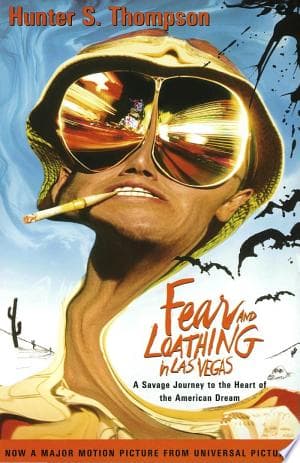
Hunter S. Thompson (2010)
Genre
Lifestyle
Reading Time
224 min
Key Themes
See below
Sign in to track this book
Two drugged-out men, a car full of illegal substances, and a lawyer speed through the Vegas desert, blurring the line between the American Dream and a hallucinatory nightmare in a quest for one last score.
The story begins with Raoul Duke, a journalist, and his attorney, Dr. Gonzo, speeding across the Nevada desert in a red convertible, called the 'Great Red Shark.' They are very high on illegal drugs, including ether, mescaline, and LSD. Duke is supposed to cover the Mint 400 motorcycle race for a sports magazine, but his and Gonzo's real goal quickly turns into a wild search for the 'American Dream' through extreme drug use and watching American culture. Their first interactions with normal people, like a hitchhiker they pick up, are full of paranoia and confusion, setting the tone for their confusing adventure.
Duke and Gonzo arrive in Las Vegas and check into the Mint Hotel, a main spot for the Mint 400. Duke tries half-heartedly to cover the motorcycle race, interviewing racers and officials, but his mind is very distorted by drugs. He struggles to focus, his notes make no sense, and he feels more and more separate from the 'normal' people around him. Dr. Gonzo, meanwhile, acts more erratically, pushing Duke deeper into their shared delusion. The race itself becomes a blurry, minor concern, overshadowed by their internal chaos and the strange things they do with the city's residents.
After the Mint 400, Duke is unexpectedly assigned to cover a conference on narcotics, also in Las Vegas. This job creates a dark, funny situation, as Duke and Gonzo are themselves deep in a drug-induced haze. They attend the conference, barely hiding their intoxication, and find themselves surrounded by the very people fighting drug use. The paranoia grows as Duke imagines being found out, while Gonzo acts even more wildly. He threatens to jump from their hotel balcony while on acid, forcing Duke to stop him.
After the conference, Duke and Gonzo, still in Las Vegas, decide to go to a 'Rave-Up' – a music festival in the desert – looking for a more real, counter-cultural experience than the mainstream events they have been covering. They continue to use many drugs, especially LSD, hoping for some kind of amazing discovery or connection to the 'spirit of the sixties' they feel is disappearing. The festival, however, turns out to be another source of confusion and disappointment. They find it filled with a mix of true free spirits and opportunistic people, further blurring the lines between reality and their drug-induced perceptions.
Throughout their adventures, Duke often thinks about the 'American Dream' and its perceived decline. He sees Las Vegas as a small example of this decline, a place where buying things, fakery, and a desperate chase for quick pleasures have replaced real ideals. His drug use is, in part, an attempt to see past society's surface and find a deeper truth, or perhaps just to escape the harsh realities he sees. This search becomes a main, though often hidden, theme of their journey, driving their constant pursuit of altered states and their critical observations of the world around them.
Duke and Gonzo's hotel rooms become the center of their growing madness. They trash rooms, use many drugs and alcohol, and do increasingly strange and destructive things. Their interactions with hotel staff, bellboys, and maids are often surreal and aggressive, fueled by paranoia and their distorted views. These incidents show their separation from normal society and their self-destructive path. The hotel rooms change from temporary places to stay into chaotic centers of excess, showing the internal trouble of their drug-addled minds and their rejection of society's rules.
As their drug journey continues, Duke has intense periods of fear and disgust. He deals with deep paranoia, believing that he and Gonzo are being watched or are about to be exposed. These moments of terror are mixed with cynical thoughts on American society, the counterculture, and his own place in it. He questions the meaning of their journey and if their methods work, often feeling stuck in a cycle of self-made madness. These thoughtful moments offer a brief look into the worries behind his excessive behavior.
Eventually, Duke and Gonzo decide it is time to leave Las Vegas, though their departure is as chaotic and drug-filled as their arrival. They are almost arrested, barely escape various fights, and leave behind a trail of destruction and unpaid bills. The 'Great Red Shark' is once again their escape vehicle, taking them away from the neon madness and back into the desert. Their exit is not a moment of clarity or relief, but rather a continuation of their wild, unpredictable journey, leaving the reader to wonder about the real impact of their experiences.
After returning from Las Vegas, Duke tries to make sense of his experiences and write his articles. However, the lasting effects of the drugs and the deep impact of his journey make it hard to return to any sense of normalcy. His writing is broken, filled with his subjective, drug-induced perceptions, blurring the line between objective journalism and personal hallucination. He struggles with the everyday parts of life, finding it boring and uninspiring after the intense highs and lows of Las Vegas. The trip has permanently changed his view, making him feel separate from normal society.
The novel ends with Duke thinking about what his Las Vegas adventure means. He considers the fate of the counterculture generation, the unclear nature of truth, and the widespread feeling of disappointment in America. There is no clear ending; instead, the conclusion emphasizes that their journey was not about finding answers but about experiencing the extreme decline of the American Dream. Duke is left with a feeling of unease, a sense that something important has been lost, and that his drug-fueled quest, though chaotic, offered a strange kind of insight into the soul of a nation.
The Protagonist
Duke's arc is less about traditional development and more about a deepening immersion into chaos and disillusionment, leading to a profound, if unsettling, understanding of societal decay.
The Supporting/Antagonist
Gonzo's character remains largely static in his chaotic nature, serving as a catalyst for Duke's experiences rather than undergoing significant personal change.
The Mentioned
The hitchhiker's arc is minimal, serving primarily as a plot device to establish the protagonists' extreme state.
The Supporting
Lacerda's character is static, serving as a external pressure point for Duke.
The Mentioned
Lucy's arc is short but impactful, moving from naive participant to terrified escapee, symbolizing the dangerous reality of Duke and Gonzo's world.
The Mentioned
This character is a static plot device, providing access to drugs.
The novel examines the decay of the American Dream, showing Las Vegas as a symbol of its corruption. Duke observes how the ideals and countercultural hopes of the 1960s have turned into a hollow pursuit of money, shallow entertainment, and drug-fueled escape. The Mint 400 and the conference, at first seen as symbols of American business or justice, are shown through Duke's drug-addled mind as absurd, hypocritical, and ultimately meaningless events. The search for a real 'dream' is replaced by a desperate, often destructive, pursuit of excitement.
“We were somewhere around Barstow on the edge of the desert when the drugs began to take hold. I remember saying something like 'I feel a bit lightheaded; maybe you should drive...' And suddenly there was a terrible roar all around us and the sky was full of what looked like huge bats, all swooping and screeching and diving around the car, which was going about a hundred miles an hour with the top down to Las Vegas.”
A main theme is the blurred line between real life and subjective, drug-induced perception. Duke's heavy drug use is not just for pleasure; it is a deliberate attempt to break through society's perceived illusions and uncover a 'truer' reality. However, this often leads to intense paranoia, hallucinations, and a deep inability to tell what is real from what is imagined. The story constantly challenges the reader to question what is true, suggesting that 'reality' is often made up, especially when seen through altered states of mind. The Mint 400 coverage, for example, is less about the race and more about Duke's internal, drug-fueled experience of it.
“The only way to make sense out of change is to plunge into it, move with it, and join the dance.”
Thompson, through Duke, reflects on the end of the 1960s counterculture movement. What started as a hopeful, revolutionary movement for peace and freedom is now seen as having turned into aimless pleasure-seeking, commercial exploitation, and a cynical retreat from political action. The 'wave' of idealism that Duke remembers from his past has broken, leaving only the 'aftermath' of drug problems and disappointed people. The book suggests that the counterculture failed to make lasting change, instead falling victim to the very excesses it first tried to avoid. The Las Vegas 'Rave-Up' shows this, presenting a commercialized, weaker version of real countercultural gatherings.
“There was no turning back. We had to go on. And we were going to Las Vegas.”
Fear and paranoia are common feelings throughout the novel, fueled by Duke and Gonzo's extreme drug use and their constant awareness of their illegal actions. Duke often describes a growing sense of dread, the feeling of being watched, and the constant threat of arrest or exposure. This paranoia is not entirely baseless, given what they do, but it is made much worse by their drug use, reaching hallucinatory levels. This theme highlights the psychological cost of their lifestyle and the natural anxiety of living outside society's rules. The conference, in particular, becomes a test for Duke's increasing fears.
“No, this is not a good town for psychedelic drugs. Reality itself is too twisted.”
Raoul Duke's drug-addled perspective distorts reality for the reader.
Raoul Duke serves as a quintessential unreliable narrator. His constant state of intoxication means that his perceptions, descriptions, and interpretations of events are heavily skewed. The reader is never entirely sure what is objectively happening versus what is a hallucination or a paranoid delusion. This device forces the reader to question the narrative, creating a sense of disorientation and empathy for Duke's altered state, while also highlighting the subjective nature of 'truth' in the story. It is central to the gonzo journalism style, where the journalist's subjective experience is paramount.
Las Vegas represents the corrupted American Dream and societal excess.
Las Vegas functions as a powerful symbol throughout the novel. It is not merely a setting but a character in itself, embodying the grotesque excesses, superficiality, and ultimate failure of the American Dream. Its neon lights, casinos, and constant pursuit of fleeting pleasures represent a society that has lost its moral compass. For Duke, Las Vegas is a 'bad trip' made manifest, a place where reality is already so distorted that his drugs merely amplify its inherent madness. It serves as a microcosm for the larger societal decay Thompson is critiquing.
The author becomes a central, subjective character in the story.
Gonzo journalism is the overarching stylistic device. Rather than maintaining objective distance, the journalist (Duke/Thompson) is fully immersed in and becomes a central, subjective character within the story. The narrative is driven by his personal experiences, emotions, and drug-induced perceptions. This blurs the lines between reporter and subject, fact and fiction, allowing for a highly personal and often chaotic exploration of events. The book is less about reporting on Las Vegas and more about the experience of reporting on Las Vegas while completely unhinged.
Recurring imagery of bats, lizards, and other creatures symbolizes paranoia and hallucination.
Throughout the narrative, Duke frequently hallucinates or perceives people as various animals or monsters, particularly bats and lizards. This motif serves to illustrate his drug-addled state and his deep-seated paranoia. These creatures represent the encroaching chaos and the 'fear' he experiences. The initial 'huge bats' in the desert, the 'lizard lounge' full of reptiles, and other such visions underscore the surreal, threatening nature of his environment as filtered through his altered consciousness, making the reader feel the disorientation and terror alongside him.
“We were somewhere around Barstow on the edge of the desert when the drugs began to take hold.”
— The opening line, setting the chaotic tone for the road trip.
“No, this is not a good town for psychedelic drugs. Too many cops.”
— Raoul Duke's early assessment of Las Vegas's suitability for their drug-fueled escapades.
“One of the things you learn after a while is that you can have a lot more fun if you don't take your mind with you.”
— Duke reflecting on the nature of their journey and the detachment it requires.
“The only way to make sense out of change is to plunge into it, move with it, and join the dance.”
— A broader philosophical statement about embracing the unpredictable.
“He who makes a beast of himself gets rid of the pain of being a man.”
— A dark, cynical observation on the escapism sought through extreme behavior.
“In a nation of frightened dullards, we are the lords of the new--”
— Duke's self-perception of himself and Dr. Gonzo amidst the perceived mediocrity of society.
“The possibility of physical and mental collapse is not a pretty thing, but it is a necessary part of getting to where you want to go.”
— Reflecting on the toll their extreme lifestyle takes.
“There was a fantastic universal sense that whatever we were doing was right, that we were on a roll.”
— Describing the initial high and feeling of invincibility during their trip.
“We had two bags of grass, seventy-five pellets of mescaline, five sheets of high-powered blotter acid, a salt shaker half full of cocaine, and a whole galaxy of multi-colored uppers, downers, screamers, laughers... and also a quart of tequila, a quart of rum, a case of beer, a pint of raw ether, and two dozen amyl nitrites.”
— A detailed inventory of their extensive drug supply, highlighting the sheer excess.
“The Edge... There is no honest way to explain it because the only people who really know where it is are the ones who have gone over.”
— A profound reflection on pushing boundaries and the indescribable nature of extreme experiences.
“History is hard to know, because of all the hired liars.”
— A cynical take on the manipulation of historical narratives.
“So we bought the goddamn thing. And then the next question was: How to get rid of it?”
— Duke's impulsive decisions often lead to immediate, humorous problems.
“It was the Law of the Jungle, and it applied to all of us.”
— Describing the chaotic and cutthroat nature of their environment and interactions.
“There he goes. One of God's own prototypes. A high-powered mutant of some kind never even considered for mass production. Too weird to live, too rare to die.”
— A famous description of Dr. Gonzo, encapsulating his unique and extreme nature.
“We are all wired into a survival trip now. No choice but to ride it out.”
— A fatalistic view of their situation, emphasizing the lack of control.
Ready to see how well you understood this book? Take our interactive quiz with 10 questions.
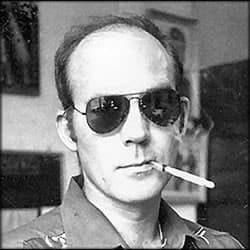
Hunter Stockton Thompson was an American journalist and author who founded the gonzo journalism movement. He rose to prominence with the publication of Hell's Angels (1967), a book for which he spent a year living and riding with the Hells Angels motorcycle club to write a first-hand account of their lives and experiences.