BookBrief
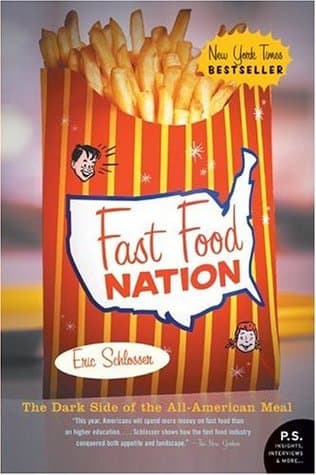
Fast Food Nation: The Dark Side of the All-American Meal cover
Archivist's Choice

Fast Food Nation: The Dark Side of the All-American Meal

Eric Schlosser (2001)

Genre

Business / Politics / History / Health / Science

Reading Time

10-12 hours

Key Themes

See below

Track Your Reading

Sign in to track this book

This book exposes how fast food's pursuit of convenience has reshaped our landscapes, health, economy, and culture with lasting impact.

Core Idea

Fast Food Nation examines the many negative effects of the American fast food industry on modern society. It argues that the demand for cheap, convenient food has changed American land, economy, and diet. It has also exploited workers, harmed public health, damaged traditional farming, and given immense power to a few large companies. The book suggests that eating fast food supports a system built on labor exploitation, environmental damage, and the steady decline of food safety and public well-being, both in the U.S. and globally.
Reading time
10-12 hours
Difficulty
Medium
✓ Read this if...
You want to understand the profound and often disturbing societal, economic, and health consequences of the fast food industry, from labor practices to food production and marketing.
✗ Skip this if...
You prefer to remain unaware of the grim realities behind your convenient meals, or are looking for a light, unchallenging read.

Core idea

The central argument and framework that powers the entire book.

Fast Food Nation examines the many negative effects of the American fast food industry on modern society. It argues that the demand for cheap, convenient food has changed American land, economy, and diet. It has also exploited workers, harmed public health, damaged traditional farming, and given immense power to a few large companies. The book suggests that eating fast food supports a system built on labor exploitation, environmental damage, and the steady decline of food safety and public well-being, both in the U.S. and globally.

At a glance

Reading time

10-12 hours

Difficulty

Medium

Read this if...

You want to understand the profound and often disturbing societal, economic, and health consequences of the fast food industry, from labor practices to food production and marketing.

Skip this if...

You prefer to remain unaware of the grim realities behind your convenient meals, or are looking for a light, unchallenging read.

Key Takeaways

1

The McDonaldization of America

Fast food's blueprint for efficiency and standardization permeated every facet of American life.

Quote

The great success of McDonald's has been its ability to create a highly efficient and standardized system for preparing and serving food, a system that has been adopted by countless other businesses.

Schlosser details how the fast food industry, especially McDonald's, perfected a model of efficiency, predictability, and control. This 'McDonaldization' spread beyond burgers and fries; it became a model for other businesses, from retail to healthcare. The drive for consistency meant breaking down jobs into simple tasks, standardizing processes, and creating an easily copied business model. This change greatly affected how Americans work, consume, and even view quality. Often, speed and low cost were more important than craftsmanship...

Supporting evidence

The detailed account of the Kroc-era McDonald's operational manual and its impact on franchising, emphasizing precise measurements, cooking times, and customer interaction scripts.

Apply this

Recognize how standardization influences consumer choices and labor practices in various industries beyond fast food. Seek out products and services that prioritize quality and human skill over pure efficiency, supporting local and artisanal businesses.

mcdonaldizationstandardizationefficiency
2

The Unseen Costs of Cheap Food

The low prices at the drive-thru mask significant environmental, social, and health externalities.

Quote

The real price of a Big Mac, when you factor in all the hidden costs, is far greater than the few dollars you pay at the counter.

Schlosser shows the hidden subsidies and costs that make fast food seem cheap. The low price does not reflect the true environmental impact of industrial farming, the public health burden of obesity and related diseases, or the suppressed wages of workers. From the large single-crop farms for potatoes and beef to the energy-intensive supply chains and the massive waste, the fast food model shifts its true costs onto society and the environment. This economic trick creates an illusion of affordability while disproportionately affecting...

Supporting evidence

Discussion of the environmental degradation caused by feedlots and industrial agriculture (e.g., water pollution from animal waste), and the public health costs associated with diet-related illnesses.

Apply this

Critically evaluate the 'cheapness' of products by considering their full lifecycle impact. Support policies that internalize environmental and social costs into product pricing, and opt for food sources that practice sustainable and ethical production.

externalitiesindustrial-agriculturehidden-costs
3

Labor's Disposable Nature

Fast food thrives on a low-wage, high-turnover workforce, often exploiting vulnerable populations.

Quote

The fast food industry has perfected the art of deskilling labor, turning complex jobs into simple, repetitive tasks that require little training and pay low wages.

Schlosser explains the fast food industry's deliberate strategy to create a workforce that is easily replaced and poorly paid. By breaking tasks into simple, repeated actions, the need for skilled labor is removed. This lowers wages and makes employees disposable. This system affects teenagers, immigrants, and low-income people most, as they often have few other job options. High turnover rates are not a problem but a design feature, allowing companies to avoid benefits, prevent unions, and keep a constant supply of cheap labor. This ...

Supporting evidence

Interviews with fast food workers detailing low wages, lack of benefits, dangerous working conditions, and the high rate of teenage employment. The discussion of the industry's historical resistance to unionization.

Apply this

Advocate for fair wages, better working conditions, and the right to organize for fast food workers. Support businesses that prioritize employee well-being and offer living wages. Be mindful of the human cost behind convenience.

labor-exploitationlow-wagesdeskilling
4

The Flavor Industry's Deception

The 'natural' flavors in fast food are often complex chemical concoctions designed to manipulate taste.

Quote

The flavor industry has become adept at creating highly addictive tastes that bear little resemblance to natural food, making junk food irresistible.

Schlosser uncovers the secret flavor industry, showing how fast food's distinct tastes are not natural but created in labs. 'Natural flavors' on ingredient lists often refer to highly processed chemical compounds from unexpected sources. These are designed to create specific tastes. This industry manipulates our palates, making foods that are overly tasty and bypass natural fullness signals, leading to overeating. Relying on artificial and 'natural' flavors disconnects consumers from real food, making healthy, unprocessed options seem...

Supporting evidence

The detailed exploration of the flavor factories in New Jersey, specifically mentioning companies like International Flavors & Fragrances (IFF) and the chemical processes used to create 'strawberry' or 'beef' flavors.

Apply this

Read ingredient labels carefully, especially for 'natural flavors.' Prioritize whole, unprocessed foods with inherent flavors. Be skeptical of foods that taste 'too good to be true' or are overtly engineered for maximum palatability.

flavor-industryfood-engineeringhyper-palatability
5

The Cattle Rancher's Demise

Independent ranchers were systematically squeezed out by consolidated meatpackers, leading to a less diverse and more dangerous food supply.

Quote

The era of the independent cattle rancher, a symbol of American rugged individualism, has been largely replaced by a highly concentrated, corporate-controlled meatpacking industry.

Schlosser documents the decline of the independent cattle rancher, a direct result of the fast food industry's demand for cheap, uniform beef. The consolidation of the meatpacking industry into a few powerful companies gave them great power over producers. This drove down prices and forced ranchers into unsustainable practices or out of business. This vertical integration led to less competition, lower animal welfare standards, and a system where a few major players controlled most of the nation's beef supply. This change not only des...

Supporting evidence

The historical account of the rise of large meatpacking corporations like ConAgra and IBP, and their aggressive tactics against smaller ranchers and competitors, leading to a near-monopoly.

Apply this

Support local ranchers and farmers who practice ethical and sustainable animal husbandry. Seek out meat from transparent supply chains. Advocate for antitrust regulations to prevent excessive consolidation in the food industry.

meatpacking-industrycattle-ranchingconsolidation
6

The Perils of Centralized Slaughter

Concentrated meat processing facilities create ideal conditions for pathogen proliferation and foodborne illness.

Quote

The speed and scale of modern slaughterhouses, while efficient, create perfect conditions for the spread of dangerous pathogens like E. coli.

Schlosser describes the unsanitary and dangerous conditions in large, centralized slaughterhouses. The huge number of animals processed quickly, combined with often poor sanitation, makes these facilities breeding grounds for bacteria like E. coli O157:H7. The practice of 'downer' animals entering the food supply and mixing meat from thousands of animals in one batch significantly increases the risk of widespread contamination. This industrial model prioritizes speed and profit over safety, directly causing foodborne illness outbreaks...

Supporting evidence

The detailed account of the Jack in the Box E. coli outbreak in 1993, tracing the contaminated meat back to a single slaughterhouse, and the industry's subsequent resistance to stricter safety regulations.

Apply this

Be aware of the risks associated with industrial meat production. Cook ground meat thoroughly. Advocate for stronger government oversight and mandatory safety regulations in meat processing plants. Support smaller, local abattoirs with transparent practices.

foodborne-illnesse-colislaughterhouses
7

Marketing to Children: A Predatory Practice

Fast food companies aggressively target children, shaping their preferences and driving lifelong consumption habits.

Quote

The fast food industry has successfully cultivated an entire generation of loyal customers by targeting children with sophisticated marketing campaigns.

Schlosser exposes the harmful marketing tactics fast food companies use to attract children from a young age. From cartoon mascots and toy giveaways to playgrounds and school partnerships, the industry invests heavily in forming emotional ties with children. This deliberate strategy bypasses parents and builds brand loyalty that often lasts a lifetime. By linking their products with fun, happiness, and popular culture, fast food giants effectively 'brand' children. This contributes to childhood obesity and shapes food preferences towa...

Supporting evidence

Examples of McDonald's and Burger King's marketing strategies, including Happy Meals with toys, playgrounds, and partnerships with Disney and other children's entertainment brands.

Apply this

Educate children about marketing tactics. Limit exposure to fast food advertising. Prioritize home-cooked meals and healthy snacks. Advocate for stricter regulations on food marketing to children.

child-marketingbrand-loyaltychildhood-obesity
8

The Global Reach of American Fast Food

Fast food chains act as agents of American cultural and economic imperialism, often at the expense of local cultures and economies.

Quote

The golden arches have become a symbol not just of fast food, but of American power and influence around the world, often flattening local food traditions in their wake.

Schlosser shows how American fast food chains are not just food sellers but also spread cultural and economic globalization. Their expansion into international markets often replaces local eateries, makes culinary traditions uniform, and introduces unhealthy eating habits. While seen as symbols of progress and modernity, they often exploit local workers for low wages and send profits back to corporate headquarters, hindering local economic growth. This 'Americanization' of global diets and landscapes represents a form of cultural impe...

Supporting evidence

Descriptions of McDonald's expansion into countries like Germany and Japan, and the resulting impact on local food markets and dietary customs, including the adoption of American-style eating habits.

Apply this

Support local businesses and traditional foodways when traveling or in your own community. Be critical of the cultural implications of global brands. Advocate for policies that protect local economies and cultural heritage from corporate overreach.

cultural-imperialismglobalizationamericanization
9

The Illusion of Choice and the Reality of Oligopoly

Despite numerous brands, the fast food and food processing industries are controlled by a handful of powerful corporations.

Quote

The vast array of fast food options gives the illusion of choice, but behind the different logos, a few powerful corporations control nearly everything we eat.

Schlosser effectively breaks down the idea of abundant consumer choice within the fast food industry. He shows that beneath the many brand names and menus, the entire food supply chain — from seeds and livestock to processing plants and distribution networks — is controlled by a small group of powerful corporations. This concentration of power limits real competition, stops innovation that does not align with corporate interests, and gives these giants immense political influence. Consumers are given an illusion of variety while their...

Supporting evidence

The discussion of the consolidation within the meatpacking industry, the potato processing industry (e.g., Simplot), and the flavor industry, showing how a few companies supply multiple seemingly competing fast food brands.

Apply this

Research the parent companies behind popular brands to understand true market concentration. Support independent food producers and retailers. Advocate for stronger antitrust laws to foster genuine competition and break up monopolies.

oligopolycorporate-powerfood-monopoly
10

The Erosion of Public Health and Safety

Industry lobbying and deregulation have systematically weakened government oversight, endangering consumers.

Quote

The fast food industry's powerful lobbying efforts have consistently undermined attempts to strengthen food safety regulations, prioritizing profits over public health.

Schlosser reveals a disturbing pattern of industry influence over government regulation. This has led to a steady weakening of public health and safety standards. Through aggressive lobbying, campaign contributions, and people moving between industry and government jobs, fast food and its related industries (meatpacking, flavor) have consistently fought against stricter food safety laws, environmental protections, and workers' rights. This deregulation has allowed companies to cut corners, shift costs to others, and operate with littl...

Supporting evidence

The industry's successful lobbying against mandatory E. coli testing in meat plants and the consistent underfunding of agencies like the USDA and FDA, limiting their enforcement capabilities.

Apply this

Contact elected officials to advocate for stronger food safety laws and increased funding for regulatory agencies. Support consumer advocacy groups. Vote for politicians who prioritize public health over corporate interests.

deregulationlobbyingpublic-health

Critical analysis

Notable Quotes

The sociologist Max Weber once remarked that a modern capitalist economy is an 'immense cosmos into which the individual is born, and which presents itself to him, at least as an individual, as an unalterable order of things.' Americans now spend more money on fast food than on higher education, personal computers, computer software, or new cars. They spend more on fast food than on movies, books, magazines, newspapers, videos, and recorded music—combined.

Opening of the book, establishing the pervasive influence of fast food.

The real price of most foods does not include the environmental costs of producing them. It does not include the social costs of a low-wage labor force. It does not include the health costs of food-borne illnesses or obesity.

Discussing the hidden costs and externalities of the fast food industry.

The flavor industry is a highly secretive trade, and its leading firms are unwilling to divulge the precise formulas of their most popular flavors. The secrecy is deemed essential for protecting trade secrets and the competitive advantages of individual firms. A typical artificial strawberry flavor, for example, contains nearly 50 chemicals.

Exploring the science and secrecy behind artificial flavors in fast food.

Fast food has become a highly profitable sector of the American economy by systematically externalizing costs, by pushing them off onto other people.

Summarizing a key economic critique of the fast food business model.

The typical fast food worker is a teenager, earning the minimum wage, with no benefits, and few prospects for advancement. They are easily replaceable, and the industry has a high turnover rate.

Describing the labor practices and workforce demographics of the fast food industry.

The meatpacking industry has the highest injury rate of any industry in America. It is more dangerous than mining, construction, or logging. And yet, these dangers are largely invisible to the consumer.

Highlighting the hazardous conditions for workers in the meatpacking industry, a supplier to fast food.

The Golden Arches are now more widely recognized than the Christian cross.

Illustrating the global reach and cultural dominance of fast food brands.

Fast food is not just a diet; it's a way of life. It's about speed, uniformity, and low prices. It's about convenience and instant gratification.

Defining the broader cultural implications and appeal of fast food.

The obesity epidemic is not merely a consequence of individual choices; it is also a product of powerful economic and social forces that encourage overeating and discourage physical activity.

Discussing the societal factors contributing to the rise in obesity, linked to fast food consumption.

Today, a handful of giant corporations control the movement of cattle, from the ranch to the slaughterhouse to the supermarket shelf. They decide what an animal will eat, when it will be slaughtered, and how its flesh will be processed.

Detailing the consolidation and power dynamics within the beef industry.

The most important thing I learned in school was how to get along with others. I learned that on the playground. And the most important thing I learned about business was how to make money. I learned that working at McDonald's.

A quote from a former McDonald's employee, reflecting on early life lessons.

The greatest threat to public health in America today is not some exotic foreign germ, but the food that we eat at home, in restaurants, and in school cafeterias.

Emphasizing the significant public health risks associated with the modern food system.

In the United States, about 90 percent of all food poisoning outbreaks are never investigated by public health officials.

Highlighting a critical flaw in public health oversight and food safety.

The hamburger has a dark side. It is a symbol of America's industrial might, its technological prowess, its economic dominance. But it is also a symbol of America's hidden costs, its exploitation of workers, its environmental degradation, its public health crisis.

A concluding reflection on the symbolic duality of the hamburger and the fast food industry.

Quiz

Test Your Knowledge

Ready to see how well you understood this book? Take our interactive quiz with 10 questions.

10
Questions
~5
Minutes
?
Best Score

Key Questions (FAQ)

Fast Food Nation explores the hidden costs and societal impacts of the American fast food industry. It delves into the industry's origins, its influence on labor practices, food production, public health, and global culture, revealing the darker side of a seemingly convenient meal.

About the author