BookBrief
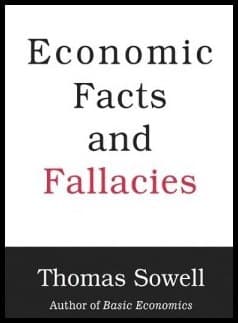
Economic Facts and Fallacies cover
Archivist's Choice

Economic Facts and Fallacies

Thomas Sowell (2007)

Genre

Business / History / Economics / Finance / Philosophy

Reading Time

5-7 hours

Key Themes

See below

Track Your Reading

Sign in to track this book

Sowell examines common economic myths, revealing their subtle appeal, from urban decay to gender pay gaps, and provides readers with accessible, real-world explanations.

Core Idea

Economic Facts and Fallacies takes apart common misunderstandings in economic and social policy. Thomas Sowell argues that many accepted beliefs, often driven by emotion, political goals, or incomplete analysis, lead to bad policies and a poor understanding of how economies and societies work. By looking at evidence in labor markets, income distribution, urban planning, and international trade, the book shows how faulty thinking, such as confusing correlation with causation, ignoring trade-offs, or focusing only on intentions instead of results, distorts public discussion and hinders good decision-making. Sowell stresses the need to tell the difference between facts and unsupported claims, and between a policy's immediate effects and its long-term impacts.
Reading time
5-7 hours
Difficulty
Medium
✓ Read this if...
You want to sharpen your critical thinking about economic and social policies, understand common logical pitfalls in public discourse, and see how empirical data often contradicts popular narratives. It's ideal for those seeking a conservative perspective on economic analysis.
✗ Skip this if...
You are looking for a detailed introduction to economic theory, prefer a more progressive or interventionist economic viewpoint, or find Sowell's direct and often critical tone challenging.

Core idea

The central argument and framework that powers the entire book.

Economic Facts and Fallacies takes apart common misunderstandings in economic and social policy. Thomas Sowell argues that many accepted beliefs, often driven by emotion, political goals, or incomplete analysis, lead to bad policies and a poor understanding of how economies and societies work. By looking at evidence in labor markets, income distribution, urban planning, and international trade, the book shows how faulty thinking, such as confusing correlation with causation, ignoring trade-offs, or focusing only on intentions instead of results, distorts public discussion and hinders good decision-making. Sowell stresses the need to tell the difference between facts and unsupported claims, and between a policy's immediate effects and its long-term impacts.

At a glance

Reading time

5-7 hours

Difficulty

Medium

Read this if...

You want to sharpen your critical thinking about economic and social policies, understand common logical pitfalls in public discourse, and see how empirical data often contradicts popular narratives. It's ideal for those seeking a conservative perspective on economic analysis.

Skip this if...

You are looking for a detailed introduction to economic theory, prefer a more progressive or interventionist economic viewpoint, or find Sowell's direct and often critical tone challenging.

Key Takeaways

1

The Zero-Sum Fallacy

Wealth creation is often misunderstood as merely redistribution, ignoring productivity.

Quote

Many economic policies are based on the fallacy that wealth is a fixed pie to be divided, rather than something that can be created.

Sowell often disproves the zero-sum fallacy, the idea that one person's gain must come at another's expense. This thinking often supports policies aimed at 'redistributing' wealth or income, instead of creating conditions for its growth. He argues that economic activity, especially in a free market, is mostly about increasing overall societal wealth through innovation, efficiency, and trade, where both sides often benefit. For example, when a company becomes more profitable, it often means it is providing more value to consumers, crea...

Supporting evidence

Sowell frequently references historical examples of market economies generating unprecedented wealth, contrasting them with centrally planned economies where the focus on redistribution led to stagnation. He might cite the post-WWII economic boom in Western nations driven by production and trade, as opposed to the Soviet Union's command economy.

Apply this

When evaluating economic policies or business decisions, ask whether the proposed action aims to create new value or merely reallocate existing resources. Prioritize solutions that expand the 'pie' rather than just re-slicing it. Support policies that incentivize productivity, innovation, and voluntary exchange.
zero-sum-fallacywealth-creationeconomic-growthmarket-efficiency
2

The 'Snapshot' vs. 'Process' Fallacy

Income disparities are often misconstrued by ignoring individual mobility over time.

Quote

Many statistics on income distribution are like a snapshot of a parade, showing different people at different stages, rather than the same people moving through those stages.

A major fallacy Sowell discusses is the misinterpretation of income statistics. Critics often point to single 'snapshots' of income distribution, showing large differences between income groups at one time, and conclude there is systemic inequality or lack of opportunity. Sowell argues this ignores the dynamic 'process' of economic life: individuals and households often move between income groups over their lifetimes. A young person starting their career might be in a lower group, while the same person later, with more experience and ...

Supporting evidence

Sowell cites studies from the University of Michigan and the U.S. Treasury Department showing that a significant percentage of individuals in the lowest income quintile move to higher quintiles within a decade, and many in the highest quintile fall to lower ones. He also mentions how age and lifecycle stages heavily influence income, with peak earning years typically in middle age.

Apply this

When analyzing income data, always seek longitudinal studies that track individuals or households over time, not just cross-sectional data. Recognize that income differences often reflect life-cycle stages, skill acquisition, and personal choices rather than immutable class divisions. Focus on policies that enhance upward mobility and skill development, rather than just redistributing current income.

income-mobilityincome-inequalitylongitudinal-dataeconomic-opportunity
3

The Fallacy of Intent vs. Effect

Well-intentioned policies often have counterproductive and unseen consequences.

Quote

The road to hell is paved with good intentions, especially in economics, where the actual consequences often diverge sharply from the desired ones.

Sowell consistently highlights the important difference between a policy's stated intentions and its actual, often unintended, effects. Many economic fallacies come from judging policies only by their good goals without carefully analyzing their real-world results. He argues that politicians and activists often prioritize the appearance of 'doing something' over understanding the complex, often negative, results of their actions. Minimum wage laws, rent control, and occupational licensing are clear examples where the stated goal (help...

Supporting evidence

Sowell extensively discusses rent control policies, illustrating how they lead to housing shortages, deterioration of existing units, and black markets, despite the stated aim of making housing more affordable. He also critiques minimum wage laws for reducing employment opportunities for low-skilled workers.

Apply this

Before supporting any new policy, always ask: 'What are the likely *unintended* consequences of this action?' and 'Who might be negatively affected, even if not directly targeted?' Prioritize policies that align incentives with desired outcomes, rather than relying solely on good intentions. Demand data on actual results, not just promises.

unintended-consequencespolicy-analysisincentiveseconomic-effects
4

The Fallacy of Composition

What is true for an individual is not necessarily true for the group.

Quote

What makes sense for one individual to do, such as standing up in a crowd to see better, can become self-defeating if everyone does it.

Sowell identifies the fallacy of composition as a common error in economic thinking: assuming that what is true or good for one part must also be true or good for the whole. This fallacy often supports misguided government interventions. For example, while saving money is smart for an individual, widespread, simultaneous saving during an economic downturn can make a recession worse (Keynes' paradox of thrift). Similarly, an individual firm might benefit from higher prices, but if all firms in an industry raise prices at once, demand m...

Supporting evidence

Sowell often uses the example of tariffs: while a specific domestic industry might benefit from protection against foreign competition, widespread tariffs across many industries typically lead to higher prices for consumers, reduced overall trade, and retaliatory tariffs, ultimately harming the national economy.

Apply this

When considering a policy or economic argument, always ask if the reasoning holds when scaled up to the entire population or economy. Be wary of solutions that seem intuitively correct for a single entity but might break down when universally applied. Look for systemic effects and feedback loops.

fallacy-of-compositionaggregate-demandmacroeconomicssystemic-thinking
5

The 'Experts' Fallacy and Knowledge Problem

Centralized planning by 'experts' is inherently limited by dispersed, localized knowledge.

Quote

The fatal conceit is to believe that a small group of central planners can possess and process the vast, dispersed knowledge of an entire society more effectively than the decentralized mechanisms of the market.

Sowell, like Hayek, criticizes the 'experts' fallacy: the belief that a select group of intellectuals or government planners can effectively manage complex economies. He argues that economic knowledge is not held in one place but is spread among millions of individuals, each with unique, local, and often unspoken information about their preferences, skills, and opportunities. Market prices, through supply and demand, act as important signals that combine this dispersed knowledge, allowing for efficient resource allocation without cent...

Supporting evidence

Sowell frequently contrasts the economic performance of market economies with centrally planned ones (e.g., Soviet Union, Cuba), highlighting the chronic shortages, poor quality, and lack of innovation in the latter due to the inability of planners to manage vast amounts of information.

Apply this

Be skeptical of claims that a small group of 'experts' can effectively plan or micromanage an entire economy or industry. Advocate for policies that empower decentralized decision-making and allow market prices to signal information. Recognize that individuals, not central planners, are best positioned to make decisions about their own economic lives.

knowledge-problemcentral-planningmarket-efficiencyhayek
6

The Demographic Fallacy

Economic disparities between groups often reflect age, geography, and culture, not inherent discrimination.

Quote

Many economic disparities attributed to invidious discrimination can be largely, if not entirely, explained by demographic differences in age, location, and cultural factors affecting human capital.

Sowell systematically addresses the assumption that all economic differences between different groups (e.g., racial, ethnic, gender) are mainly due to discrimination. He points out that such differences often strongly relate to variations in age distribution, geographic location, education level, work experience, and cultural factors that influence skills and career choices. For example, groups with a younger average age will, on average, have lower incomes due to less work experience. Similarly, groups living in regions with fewer ec...

Supporting evidence

Sowell provides extensive data showing that when controlling for age, education, and hours worked, many racial and gender income gaps shrink significantly or even disappear. He points to immigrant groups who, despite facing initial prejudice, achieve economic success over generations by accumulating human capital and adapting to new economic environments.

Apply this

When encountering statistics on group disparities, always inquire about confounding variables such as age, education, geographic location, and family structure. Avoid immediate assumptions of discrimination as the sole or primary cause. Focus on policies that enhance human capital development and economic opportunity for all individuals, regardless of group identity.

demographic-disparitiesdiscriminationhuman-capitalincome-gaps
7

The Fallacy of Causation vs. Correlation

Observing two things together doesn't mean one causes the other.

Quote

Correlation is not causation, a fundamental truth often ignored when people seek simple explanations for complex social phenomena.

A repeated idea in Sowell's analysis is the important difference between correlation and causation. He argues that many economic fallacies come from observing two things happening together (correlation) and mistakenly concluding that one directly causes the other. For instance, an increase in social spending might correlate with a reduction in poverty, but this does not automatically mean the spending caused the reduction; other factors could be involved, or the causation could even be reversed (less poverty leading to more social s...

Supporting evidence

Sowell often discusses the correlation between minimum wage increases and poverty rates. While proponents argue minimum wage reduces poverty, he points out that many minimum wage earners are not poor (e.g., teenagers from middle-class families) and that minimum wage increases can lead to job losses, which *increase* poverty for those affected. He also cites examples where increased spending on certain programs did not lead to the desired outcomes.

Apply this

When presented with data showing two trends moving together, always ask: 'Is there a direct causal link, or could there be a third variable influencing both?' or 'Could the causation run in the opposite direction?' Demand evidence of causal mechanisms, not just statistical associations. Avoid drawing hasty conclusions from simple correlations.

causation-correlationstatistical-fallacieseconomic-reasoningcritical-thinking
8

The Urban Planning Fallacy

Top-down urban policies often ignore market signals and the organic evolution of cities.

Quote

Urban problems are often exacerbated by policies based on abstract theories rather than on the concrete realities and incentives faced by people in cities.

Sowell pays close attention to fallacies surrounding urban problems, arguing that many well-intentioned city planning efforts and housing policies are deeply flawed. He criticizes the tendency to see cities as static things to be designed from above, rather than dynamic, changing places shaped by millions of individual decisions and market forces. Rent control, for example, is a classic urban fallacy that, despite aiming to make housing affordable, always leads to housing shortages and decay. Similarly, strict zoning laws and 'smart g...

Supporting evidence

Sowell repeatedly uses the example of rent control in cities like New York and San Francisco, detailing how it leads to landlords withdrawing properties from the market, neglecting maintenance, and discouraging new construction, ultimately harming the very tenants it purports to help. He also discusses how restrictive zoning increases housing costs.

Apply this

When evaluating urban policies, consider the incentives they create for residents, developers, and businesses. Be wary of top-down mandates that ignore market signals. Advocate for policies that promote flexibility, allow for organic growth, and remove artificial barriers to housing supply and economic activity.

urban-planningrent-controlzoning-lawsmarket-signals
9

The 'Compassion' Fallacy

Emotional appeals often bypass rational analysis of economic policy effectiveness.

Quote

Compassion is a noble human trait, but when it becomes the sole criterion for economic policy, it can lead to devastating consequences because emotion is no substitute for analysis.

Sowell often highlights the 'compassion' fallacy, where a policy's appeal relies almost entirely on its stated good intentions, often presented with moral urgency, while avoiding careful economic analysis of its actual results. This fallacy is particularly dangerous because it frames any opposition to the policy as a lack of compassion or empathy, effectively stopping rational debate. Sowell argues that true compassion in policy-making requires a clear assessment of what actually works to reduce suffering and improve lives, not just...

Supporting evidence

Sowell often refers to various welfare programs or 'anti-poverty' initiatives that, despite massive spending and good intentions, have failed to significantly reduce poverty or have created long-term dependency, as seen in some inner-city communities in the US.

Apply this

When evaluating policies, separate the emotional appeal from the economic analysis. Always demand evidence of effectiveness and consider potential negative consequences, even for policies presented as 'compassionate.' Prioritize solutions that empower individuals and create sustainable opportunities, rather than those that merely offer symbolic gestures.

compassion-fallacypolicy-effectivenessemotional-reasoningrational-analysis
10

The 'Solution' vs. 'Trade-off' Fallacy

Most economic decisions involve trade-offs, not perfect solutions without costs.

Quote

There are no solutions, only trade-offs. This fundamental reality is ignored by those who promise to solve complex problems without acknowledging the costs and sacrifices involved.

Sowell consistently reminds readers that economics is about allocating scarce resources, meaning almost every decision involves trade-offs. The 'solution' fallacy arises when politicians or commentators present policies as perfect cures to problems, without any costs or negative consequences. This ignores opportunity cost – the value of the next best alternative given up. For example, spending more on healthcare means less money for education or infrastructure. Imposing environmental regulations might improve air quality but could inc...

Supporting evidence

Sowell frequently discusses environmental regulations, showing how they impose costs on industries and consumers, even while providing benefits. He also points to government spending programs where the 'solution' to one problem (e.g., unemployment benefits) comes with the 'trade-off' of reduced work incentives or increased taxes.

Apply this

When presented with any policy proposal, always ask: 'What are the trade-offs involved?' and 'What are we giving up by choosing this option?' Be wary of anyone promising 'solutions' without acknowledging costs. Demand a clear articulation of both benefits and opportunity costs.

trade-offsopportunity-costscarcityeconomic-decision-making

Critical analysis

Notable Quotes

The first lesson of economics is scarcity: There is never enough of anything to satisfy all those who want it. The first lesson of politics is to disregard the first lesson of economics.

Introducing the fundamental conflict between economic reality and political rhetoric.

Many economic policies are justified on the basis of what things are 'worth' -- rather than on how much it costs to produce them or what price they will fetch in a free market.

Critiquing the subjective valuation often used in policy-making versus market realities.

The real minimum wage is zero. That is the wage that many workers receive when minimum wage laws price them out of jobs.

Discussing the unintended consequences of minimum wage laws on employment.

Much of the social history of the Western world over the past three decades has been a history of replacing what worked with what sounded good.

A broad criticism of policy trends prioritizing idealism over proven effectiveness.

It is amazing how many people think that they can improve the world by simply saying that things should be better.

Highlighting the difference between good intentions and practical solutions.

Prices are not just a way of transferring money. They are a way of transferring information.

Explaining the crucial role of prices in conveying economic signals and coordinating economic activity.

People who talk about the need for 'balance' in the media usually mean that they want the media to be biased in their direction.

Skeptical view on calls for media impartiality, suggesting a hidden agenda.

The next time some politician, pundit, or professor tells you that the rich are not paying their 'fair share' of taxes, ask them what that 'fair share' is, and how they arrived at that particular figure.

Challenging the often vague and subjective concept of 'fair share' in taxation debates.

The great tragedy of the modern welfare state is that it has created a moral hazard by subsidizing irresponsibility.

Criticizing the unintended negative incentives created by certain welfare policies.

Much of the 'knowledge' dispensed in our schools and colleges today consists of opinions and emotions rather than facts and logic.

Lamenting the decline of objective education in favor of subjective viewpoints.

It is hard to imagine a more stupid or more dangerous way of making decisions than by putting those decisions in the hands of people who pay no price for being wrong.

Critiquing the lack of accountability for decision-makers in government and other institutions.

Many of the 'solutions' to our problems are simply ways of transferring the costs of those problems to others.

Highlighting how some policies merely shift burdens rather than genuinely resolving issues.

Competition is not just a matter of who wins and who loses. It is a matter of who gets to try.

Emphasizing the importance of open access and opportunity in competitive systems.

Facts do not speak for themselves. They must be interpreted by theories or assumptions.

Underscoring that data interpretation is always guided by underlying frameworks, which can introduce bias.

Quiz

Test Your Knowledge

Ready to see how well you understood this book? Take our interactive quiz with 10 questions.

10
Questions
~5
Minutes
?
Best Score

Key Questions (FAQ)

'Economic Facts and Fallacies' aims to debunk common misconceptions and popular fallacies surrounding various economic issues. It provides clear, evidence-based arguments to expose the flaws in widely held beliefs often spread by media and politicians, making complex topics accessible to the general reader.

About the author