“The greatest enemy of a good plan is the dream of a perfect plan.”
— Jack Ryan often reflects on the practicalities of governance and military strategy.

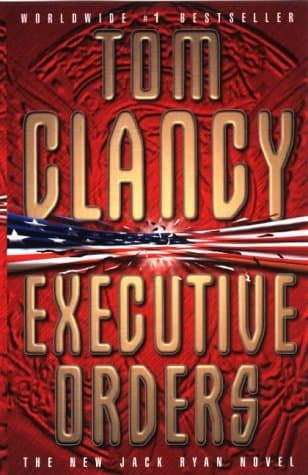
Tom Clancy (1996)
Genre
Politics / Thriller / Mystery
Reading Time
2121 min
Key Themes
See below
Sign in to track this book
After a devastating attack on the U.S. government, Jack Ryan becomes president and must navigate global chaos and domestic enemies exploiting America's weakness.
On the day of a joint session of Congress, a rogue jumbo jet crashes into the U.S. Capitol Building. This attack, by a terrorist group, instantly kills the President, nearly all Cabinet members, Supreme Court justices, and most of Congress. Jack Ryan, confirmed as the new Vice President moments before but delayed from attending, is among the few survivors. He becomes president by line of succession, a role he never wanted, as the nation falls into chaos.
President Jack Ryan, working from a makeshift command center, faces the huge task of governing a nation without a government. He relies on his staff, including chief of staff Gerry Hendley, and military leaders like General Scott Adler, to manage the immediate aftermath. Ryan's first goals are to restore order, confirm casualties, and reassure a traumatized public. He begins the difficult process of appointing a new Cabinet and Supreme Court, often making controversial choices because of the urgent situation.
While the U.S. recovers, several hostile nations see a chance to advance their agendas. The Islamic Republic of Iran, led by Ayatollah Mahmoud Haji Daryaei, forms a secret alliance with Indonesia, Malaysia, and other radical states. Their plan, 'Sword of Islam,' aims to unite the Muslim world under Iran and destabilize global order by attacking weakened American interests and creating regional conflicts, especially in Saudi Arabia. Daryaei believes America is too crippled to respond, underestimating Ryan's resolve.
A highly virulent, weaponized Ebola strain, 'Ebola Mayinga,' enters the United States. The initial outbreak in cities like Chicago spreads quickly, causing panic and death. This biological attack is part of Daryaei's strategy to further cripple America and divert its resources. The CDC and military medical teams struggle to contain the epidemic, leading to quarantines, martial law in affected areas, and a desperate search for a cure.
Despite pressure and personal grief, President Ryan shows strong leadership. He brings together top medical and intelligence experts, including his wife, Dr. Cathy Ryan, a renowned eye surgeon, to address the Ebola crisis. Under Ryan's direction, intelligence agencies, especially the CIA, intensify efforts to find the bio-weapon's origin. Their investigation quickly points to Iran, showing the sophisticated nature of the attack. Ryan aims to contain the virus and hold those responsible accountable.
While Ebola spreads, Iran and its allies launch a major military offensive against Saudi Arabia. Their goal is to seize Saudi oil fields, disrupting global oil supplies and further crippling the world economy, especially the struggling U.S. economy. This is a calculated risk, betting on America's inability to project power abroad. U.S. forces, though depleted, are in the region, and their response tests Ryan's leadership and the military's remaining capabilities. The world watches to see if America can defend its allies.
As Iran attacks, China, led by President Xu Kun Piao, sees an opportunity to expand its influence. Though not allied with Daryaei, China makes aggressive moves in Southeast Asia, particularly towards Taiwan, believing the U.S. is too distracted to intervene. This creates a complex geopolitical challenge for Ryan, who must balance immediate threats from Iran with the long-term strategic implications of Chinese expansionism, while trying to rebuild diplomatic relations.
Through diligent intelligence gathering, including efforts by former CIA analyst John Clark and Domingo Chavez, U.S. agencies piece together Daryaei's conspiracy. They discover Iran's direct involvement in the Ebola attack and the Saudi invasion, as well as the broader network of groups supporting him. This intelligence gives President Ryan proof of the attacks' deliberate nature, strengthening his resolve for a decisive response. Uncovering the conspiracy is vital for justifying retaliation to the international community.
With the Ebola crisis slowly controlled and clear intelligence, President Ryan authorizes a counter-offensive. He mobilizes remaining U.S. military assets, including naval carrier groups and special operations forces. The plan involves precision strikes against key Iranian military and intelligence targets, and infrastructure responsible for the biological attack. Ryan's strategy aims to show America's power and punish attackers, while minimizing civilian casualties and avoiding a wider war.
U.S. military forces carry out devastating, coordinated strikes against Iran. Special forces, led by Clark and Chavez, infiltrate key sites to gather intelligence and neutralize biological weapons facilities. Air and missile strikes target Daryaei's command centers, military bases, and infrastructure supporting his regional ambitions. The precision and overwhelming force of the American response surprise Daryaei and his allies, showing that America, even wounded, remains powerful. The strikes effectively dismantle Daryaei's network and neutralize immediate threats.
After the successful counter-offensive, the Ebola epidemic gradually subsides thanks to containment and experimental treatments. President Ryan focuses on rebuilding the federal government, restoring public trust, and healing the nation. He delivers a televised address, outlining his vision for America and emphasizing unity. The process is long, but Ryan's leadership offers hope for recovery and a return to normalcy.
The decisive American response, despite its weakened state, reasserts the U.S.'s global position. China, seeing American resolve, backs down from its aggressive stance in Southeast Asia. International allies, initially hesitant, rally around the U.S. President Ryan, having led the nation through its darkest hour, strengthens his presidency and gains respect from domestic and international audiences. The book ends with Ryan facing the challenges of governing a post-crisis America, having proven himself a true leader, ready for the long road ahead.
The Protagonist
From an insecure, accidental Vice President, Ryan evolves into a decisive and respected President, demonstrating extraordinary leadership and resilience in the face of unprecedented national crises.
The Antagonist
Daryaei rises as a formidable global threat, only to be decisively defeated and his ambitions crushed by American retaliation.
The Supporting
Cathy supports her husband through his unexpected presidency and contributes her medical expertise to combating the national health crisis.
The Supporting
Clark serves as a crucial field asset, executing dangerous missions that directly contribute to neutralizing the threats against the U.S.
The Supporting
Chavez proves his competence and bravery as a key member of the special operations team that strikes back at the terrorists.
The Supporting
Hendley provides indispensable support and organizational stability, helping Ryan build and manage a new government from scratch.
The Supporting
Adler helps rebuild America's international standing and diplomatic relations, ensuring the U.S. is not isolated during its crisis.
The Mentioned
His death is the inciting incident that sets the entire plot in motion.
The Supporting
Xu attempts to exploit America's weakness but retreats when faced with a reasserted U.S. presence.
The novel explores leadership under extreme stress. Jack Ryan, an academic, becomes president after a catastrophic attack, forcing him to learn on the job. His journey shows the personal and professional sacrifices of a leader, the burden of life-or-death decisions, and the importance of moral courage. Ryan's ability to stay calm, delegate, and inspire his government is key to the nation's survival, as when he addresses the nation after the Ebola outbreak or decides to retaliate against Iran.
“Leadership is not about being the smartest guy in the room. It's about knowing how to get the smartest guys to work together.”
The book shows the resilience of a nation and its people facing tragedy and multiple threats. From the Capitol attack to the Ebola epidemic and foreign invasions, the story emphasizes American endurance and determination to rebuild. The collective effort of citizens, medical professionals, and military personnel to overcome adversity highlights this theme. The focus is on societal will to heal and reconstruct, shown by the long process of rebuilding government and infrastructure after the attacks.
“America would rebuild, as it always had. It would hurt, it would cost, but it would be done.”
Executive Orders examines the changing nature of global conflict, showing how terrorism can escalate to biological warfare and geopolitical destabilization. The attacks are not random but a sophisticated strategy by hostile states. The novel illustrates the destructive power of unconventional warfare, like weaponized pathogens, and the complex intelligence needed to counter such threats. It highlights the blurred lines between state-sponsored aggression and terrorism, as seen in Iran's use of a bio-weapon and its orchestration of regional conflicts.
“This wasn't just an attack. It was a declaration of a new kind of war.”
The U.S. crisis creates a power vacuum that hostile nations try to exploit. Iran, China, and other states see America's vulnerability as a chance to advance their agendas, whether through military expansion, economic disruption, or spreading radical ideologies. This theme highlights the fragile balance of international power and how quickly it can shift when a major player weakens. The novel shows the constant vigilance needed to maintain global stability and deter aggression, even when a nation deals with internal crises.
“When the lion stumbles, the jackals gather.”
Jack Ryan's reluctant presidency highlights the personal and moral burden of ultimate power. He grapples with responsibility for millions of lives, the ethical dilemmas of retaliation, and the constant pressure to make decisions with incomplete information. The theme explores how power can isolate an individual, forcing choices no one else can truly understand. Ryan's internal struggles and his reliance on his moral compass under overwhelming pressure are central to this theme.
“The Oval Office was a lonely place, even with a hundred people just outside the door.”
The unlikely survival of Jack Ryan.
The initial premise of Jack Ryan's survival, having been confirmed as Vice President but delayed from attending the joint session of Congress, serves as a crucial plot device. It is an improbable stroke of luck that allows the protagonist, who is not a career politician, to be thrust into the highest office. This device is essential for setting up the entire narrative, as without Ryan's survival, the story would either end or follow a completely different character and trajectory. It's a convenient narrative twist that enables the core conflict and Ryan's character arc.
The rapid spread of the Ebola virus.
The Ebola epidemic functions as a powerful ticking clock. The virus's high contagion rate and lethality create an immediate and escalating threat that forces President Ryan and his team to act with extreme urgency. The race against time to contain the outbreak, find a cure, and identify the source of the biological attack adds immense tension and stakes to the narrative. This device elevates the domestic crisis from mere political recovery to a desperate fight for survival, paralleling the external geopolitical threats.
The specific strain of weaponized Ebola.
While not a traditional MacGuffin that drives the entire plot, the weaponized Ebola strain acts as a critical, high-stakes objective for the U.S. intelligence and medical community. Its unique properties and the need to identify its origin and create a countermeasure drive significant portions of the intelligence gathering and scientific efforts. The search for the virus's source directly leads to uncovering the broader Iranian conspiracy, making it a crucial element that pushes the plot forward and reveals the antagonists' full scope.
Multiple simultaneous threats facing the U.S.
The novel employs parallel crises as a core plot device, presenting President Ryan with an unprecedented array of simultaneous threats: the domestic devastation from the Capitol attack, the Ebola epidemic, Iran's invasion of Saudi Arabia, and China's opportunistic moves. This multi-front attack amplifies the sense of chaos and the immense pressure on Ryan, showcasing his ability to manage complex, interconnected problems. This device prevents the narrative from becoming linear and highlights the interconnectedness of global politics and health crises.
“The greatest enemy of a good plan is the dream of a perfect plan.”
— Jack Ryan often reflects on the practicalities of governance and military strategy.
“Democracy is a messy business, but it's the only one worth having.”
— Jack Ryan dealing with the complexities and frustrations of leading a democratic nation.
“There are no easy answers, only hard choices.”
— Ryan facing difficult decisions as President, often with high stakes.
“You don't get to choose your enemies, but you do get to choose how you fight them.”
— Reflecting on the nature of conflict and the moral obligations of power.
“Power is a dangerous thing. It corrupts the weak and tempts the strong.”
— A recurring theme about the corrupting influence of power, even on good people.
“The price of freedom is eternal vigilance.”
— Emphasizing the constant need for readiness and awareness to protect national security.
“Sometimes, the best offense is a good defense, and sometimes the best defense is a good offense.”
— Discussing military strategy and the dynamic nature of warfare.
“The truth is a weapon, and like all weapons, it can be misused.”
— Considering how information and truth can be manipulated in politics and espionage.
“Fear is a powerful motivator, but it's a poor master.”
— Characters dealing with fear in high-pressure situations, both personally and politically.
“It's not about winning every battle, but about winning the war.”
— Focusing on the long-term objectives and strategic goals rather than short-term victories.
“Every decision has a consequence, intended or not.”
— Reminding leaders of the far-reaching impact of their choices.
“The world doesn't stop just because you're tired.”
— Jack Ryan's relentless work ethic and the constant demands of his presidency.
“Trust is earned, not given, and easily lost.”
— Building and maintaining relationships with allies and subordinates in a high-stakes environment.
“The only thing worse than a bad plan is no plan at all.”
— Highlighting the necessity of having a strategy, even if imperfect, in chaotic situations.
Ready to see how well you understood this book? Take our interactive quiz with 10 questions.

Biography coming soon.

Brett Casper
5.0

Dirk Uffelmann
4.7

Winston S. Churchill
4.5

Chimamanda Ngozi Adichie
4.5
Will Durant
4.4
Thomas Sowell
4.4
W.E.B. Du Bois
4.3
Alan Moore
4.3