BookBrief
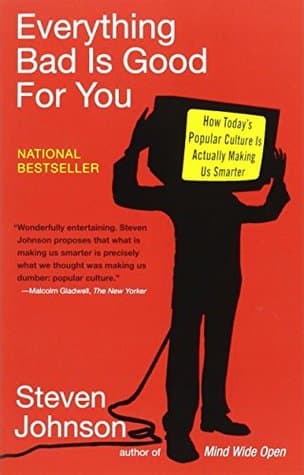
Everything Bad is Good for You cover
Archivist's Choice

Everything Bad is Good for You

Steven Johnson (2004)

Genre

Business / Psychology / Technology / Science / Philosophy

Reading Time

254 min

Key Themes

See below

Track Your Reading

Sign in to track this book

Steven Johnson argues that video games and modern television, far from harming our minds, actually improve our thinking skills.

Core Idea

Popular culture, often seen as shallow and bad for thinking, has become much more complex and mentally challenging over the last few decades. This increased complexity in TV shows, video games, and internet use exercises our brains, improving skills like problem-solving, pattern recognition, hypothetical reasoning, attention, and executive function. Engaging with current media makes us smarter by requiring us to follow complicated stories, manage many variables, and explore new ideas.
Reading time
254 min
Difficulty
Medium
✓ Read this if...
You believe popular culture is making society dumber and are open to a well-argued counter-perspective, or you are interested in how media consumption can foster cognitive development.
✗ Skip this if...
You are looking for a practical self-help book, or you are firmly convinced that all popular media is inherently detrimental and are not open to challenging that view.

Core idea

The central argument and framework that powers the entire book.

Popular culture, often seen as shallow and bad for thinking, has become much more complex and mentally challenging over the last few decades. This increased complexity in TV shows, video games, and internet use exercises our brains, improving skills like problem-solving, pattern recognition, hypothetical reasoning, attention, and executive function. Engaging with current media makes us smarter by requiring us to follow complicated stories, manage many variables, and explore new ideas.

At a glance

Reading time

254 min

Difficulty

Medium

Read this if...

You believe popular culture is making society dumber and are open to a well-argued counter-perspective, or you are interested in how media consumption can foster cognitive development.

Skip this if...

You are looking for a practical self-help book, or you are firmly convinced that all popular media is inherently detrimental and are not open to challenging that view.

Key Takeaways

1

The Sleeper Curve

Pop culture's hidden cognitive demands are making us smarter.

Quote

The Sleeper Curve is the idea that the most debased forms of pop culture are actually getting more sophisticated, not less.

Johnson introduces the 'Sleeper Curve' to counter the idea that pop culture makes us less intelligent. He suggests that popular media, from TV shows to video games, has grown more complex, demanding greater mental effort and analytical skills from its audience. This complexity is often hidden in story structures, character development, and game strategy. Modern media often requires active engagement, pattern recognition, and testing ideas, thus exercising our brains in new ways. The Sleeper Curve implies that what we often see as triv...

Supporting evidence

The evolution of television narratives from simplistic, episodic shows like 'Starsky & Hutch' to multi-threaded, complex dramas like 'The Sopranos' or 'The West Wing,' which demand attention to multiple plotlines and character arcs over many seasons.

Apply this

Re-evaluate your media consumption habits. Instead of dismissing 'guilty pleasures,' consider the cognitive skills they might be honing. Engage with complex narratives actively, trying to predict outcomes or analyze character motivations. Encourage children to play video games that require strategic thinking and problem-solving, rather than viewing all screen time as inherently detrimental.

sleeper-curvecognitive-loadnarrative-complexity
2

Narrative Complexity's Brain Boost

Complex TV shows build our cognitive muscles for pattern recognition and memory.

Quote

The most important cognitive workout isn't learning a new skill; it's being forced to think in new ways.

Modern television, especially shows with many intertwined plots, large casts, and non-linear stories, acts as a 'mental workout.' Unlike simpler, older episodic shows, these programs require viewers to follow many plot lines, remember details across episodes, and infer relationships and motives without clear explanations. This process uses our working memory, improves our ability to spot subtle patterns, and enhances our capacity to 'follow' complex arguments or situations in real life. It helps us develop a more sophisticated underst...

Supporting evidence

The intricate plot structures of shows like '24,' which required viewers to follow multiple, simultaneous storylines within a compressed timeframe, or 'The Sopranos,' with its deep psychological explorations and long-term character arcs.

Apply this

When watching complex TV shows, actively try to predict plot developments, identify recurring themes, and connect seemingly disparate events. Discuss the show with others to reinforce memory and explore different interpretations. This active engagement transforms passive viewing into an exercise in critical thinking and memory retention.

narrative-complexityworking-memorypattern-recognition
3

The Power of Puzzles

Video games are sophisticated problem-solving environments, not just time-wasters.

Quote

Games are fundamentally about problem-solving, and the problems they pose are getting harder, not easier.

Johnson challenges the idea of video games as mindless entertainment, seeing them instead as advanced problem-solving environments. Unlike traditional puzzles with set solutions, many modern games present changing challenges that require players to adapt, experiment, and plan. They often involve understanding complex rule systems, managing many variables, making quick decisions under pressure, and learning from mistakes. This cycle of forming ideas, testing them, and refining them sharpens mental skills like inductive reasoning, strat...

Supporting evidence

The complex economic and strategic decisions required in 'SimCity,' the intricate puzzle-solving and environmental manipulation in 'Myst,' or the tactical real-time strategy of games like 'StarCraft.'

Apply this

Embrace video games that demand strategic thinking and problem-solving. Pay attention to the underlying mechanics and systems of the game. If you have children, encourage them to play games that require planning, resource management, and collaboration, and discuss their strategies with them to reinforce learning.

problem-solvingstrategic-thinkinginductive-reasoningcognitive-challenge
4

The Joy of Exploration and Experimentation

Open-world games foster curiosity and systematic exploration.

Quote

Games are not about following a linear narrative, but about exploring a space, understanding its rules, and experimenting with its possibilities.

Many modern video games, especially open-world titles, encourage exploration and experimentation similar to scientific investigation. Players enter vast, often rule-based environments and must learn through trial and error, observation, and testing ideas. There is no single 'right way' to play; success often comes from understanding the game's underlying systems and creatively using them. This process develops curiosity, systematic exploration, and the ability to infer rules from what is observed. It is a form of active learning where...

Supporting evidence

The freedom and emergent gameplay of 'Grand Theft Auto,' where players can explore a vast city, experiment with different vehicles and interactions, and discover hidden aspects of the game world without a strict linear path.

Apply this

When playing open-world games, consciously try to understand the underlying 'physics' or 'rules' of the game world. Don't just follow objectives; experiment with different approaches, test boundaries, and see what unexpected outcomes you can create. This cultivates a more scientific and exploratory mindset.

open-world-gamesexplorationexperimentationsystem-thinking
5

The Social Brain Workout

Online gaming and complex narratives enhance social intelligence.

Quote

Understanding a complex fictional character or navigating a multiplayer game requires sophisticated social intelligence.

Beyond individual thinking skills, Johnson suggests that modern pop culture also exercises our social intelligence. Complex stories, whether in TV shows or books, require us to understand characters' feelings, motivations, and predict their actions. Multiplayer online games, meanwhile, require real-time teamwork, negotiation, and understanding other players' intentions and strategies. These activities train social thinking, improving our ability to read social cues, form alliances, and navigate group dynamics—skills directly useful in...

Supporting evidence

The intricate social dynamics and shifting alliances required in online multiplayer games like 'World of Warcraft,' or the deep psychological insight needed to understand characters like Don Draper in 'Mad Men.'

Apply this

Engage with multiplayer games that require teamwork and communication. When consuming narratives, actively try to put yourself in the characters' shoes, considering their perspectives and motivations. Discuss these aspects with friends to deepen your understanding of social dynamics.

social-intelligenceempathycollaborationtheory-of-mind
6

The Attentional Demands

Pop culture is training us for focused, distributed attention.

Quote

The cognitive benefits of pop culture often come from its demands on our attention, not its ability to distract us.

Contrary to the idea that pop culture shortens attention spans, Johnson argues that it often demands a more complex and distributed form of attention. Modern media often presents multiple information streams at once—consider a news channel with a ticker, a split screen, and a talking head, or a video game requiring management of a mini-map, health bar, and multiple enemies. This trains our brains to process diverse information at the same time and to quickly shift focus as needed. It is not about holding a single, steady focus, but ab...

Supporting evidence

The interface of a modern video game, which often presents a wealth of information (health, map, inventory, objectives, enemy positions) that players must monitor and integrate simultaneously. Also, the multi-layered information display on cable news channels.

Apply this

When consuming media with multiple information streams, consciously practice processing different inputs simultaneously. Try to identify key information from each stream without getting overwhelmed. This can improve your ability to multitask effectively and filter relevant information in real-world scenarios.

distributed-attentionmultitaskinginformation-processingcognitive-load
7

Learning to 'Grok' Complex Systems

Games and simulations build an intuitive understanding of complex systems.

Quote

Games are perfect models for understanding complex systems because they force you to interact with those systems and learn their rules through trial and error.

Johnson argues that games and simulations offer a unique training ground for understanding complex systems—intricate networks of interacting parts where cause and effect are not always clear. By interacting with these systems, players develop an intuitive 'grokking'—a deep, almost subconscious understanding—of how they work. This is not just about memorizing facts; it is about developing a feel for the system's dynamics, anticipating new behaviors, and understanding key points. This skill is valuable in fields from economics to enviro...

Supporting evidence

The intricate economic and ecological simulations in 'SimCity' or 'Civilization,' where players must manage resources, population, and infrastructure, and observe the long-term consequences of their decisions on a complex, evolving system.

Apply this

Seek out games and simulations that involve complex systems (e.g., strategy games, city builders, resource management games). Pay attention not just to winning, but to understanding the underlying mechanics and how different elements interact. Try to predict how changes in one variable will affect the entire system.

system-thinkingcomplex-systemssimulationemergent-behavior
8

The Reward of Mental Exertion

Our brains are wired to enjoy cognitive challenges, making 'hard fun' appealing.

Quote

The brain, like any muscle, gets stronger with use. And crucially, we enjoy exercising it.

Johnson suggests that humans naturally enjoy mental effort, calling this 'hard fun.' The satisfaction from solving a difficult puzzle, mastering a complex game, or following an intricate plot is a strong motivator. This enjoyment comes because of the challenge, not despite it. Our brains are wired to seek out and respond positively to mental challenges, releasing dopamine and other feel-good chemicals when we succeed. This natural desire for a mental workout explains why increasingly complex pop culture finds an eager audience, and wh...

Supporting evidence

The immense popularity of challenging video games like 'Dark Souls' or intricate logic puzzles, which are known for their difficulty but also their intensely satisfying reward upon completion.

Apply this

Actively seek out mentally challenging activities, whether it's a complex book, a strategic game, or a new skill. Embrace the struggle and the initial frustration, knowing that the brain finds reward in overcoming these challenges. Frame difficulties as opportunities for growth and enjoyment.

hard-funcognitive-challengedopamine-rewardmental-exertion
9

Beyond Passive Consumption

Modern media demands active engagement, transforming viewers into participants.

Quote

We are not simply consuming culture; we are actively engaging with it, shaping it, and being shaped by it.

The time of purely passive media consumption is largely over. Johnson argues that contemporary pop culture, especially interactive forms like video games, but also complex stories in TV and film, requires active participation from its audience. Viewers are no longer just taking in information; they are interpreting, forming ideas, strategizing, and even collaborating. This shift from passive reception to active engagement changes the audience from mere spectators to participants, creating a more dynamic and mentally demanding relation...

Supporting evidence

The rise of fan theories and online discussions around complex TV shows, where audiences actively try to piece together clues and predict future plotlines, demonstrating an active, interpretive engagement with the narrative.

Apply this

Approach all media, even traditionally 'passive' forms, with an active mindset. Ask questions, make predictions, and look for deeper meanings. Discuss content with others to refine your interpretations and engage in a more interactive form of consumption.

active-engagementinteractive-mediaaudience-participationcognitive-engagement
10

The Historical Arc of Improvement

Pop culture has consistently evolved towards greater complexity and cognitive challenge.

Quote

The general trend in popular culture has been towards increasing cognitive demands, not decreasing ones.

Johnson provides a historical view, showing that the trend of increasing complexity in popular culture is not new but a long-standing pattern. From the novel's first appearance, which demanded sustained attention and imagination, to the intricate plots of Shakespearean plays, and now to the multi-layered stories of modern television and the strategic depth of video games, each new popular medium has, after an initial simple period, evolved to present greater mental challenges. This continuous upward curve suggests a natural human driv...

Supporting evidence

Tracing the evolution of board games from simple 'Chutes and Ladders' to highly strategic games like 'Settlers of Catan' or complex role-playing games, or the increasing complexity of musical forms over centuries.

Apply this

When evaluating new forms of media or technology, resist the immediate urge to dismiss them as 'dumbing down.' Instead, look for the underlying cognitive challenges and potential for growth. Recognize that cultural evolution often involves an increase in complexity, not a decrease.

cultural-evolutionhistorical-trendsmedia-complexitycognitive-progress

Critical analysis

Notable Quotes

The most important trend in the last thirty years has been the increasing cognitive complexity of our popular culture.

Introducing the central thesis that popular culture has become more intellectually demanding.

The Sleeper Curve is, in essence, the reverse of the common wisdom that tells us that the media is getting dumber.

Defining the 'Sleeper Curve' concept, which argues for increasing complexity.

The most popular games are not, as a rule, easy to master. They’re just easy to learn.

Distinguishing between ease of learning and mastery in video games.

Gaming involves multiple challenges: managing resources, navigating spatial environments, and solving problems, often under time pressure.

Highlighting the cognitive demands and benefits of playing video games.

What makes a show like The Sopranos or The Wire so compelling is precisely its resistance to easy interpretation.

Discussing the appeal of complex, multi-layered television narratives.

The cognitive workout that comes from making sense of these complex plots has real-world benefits.

Connecting the mental effort of engaging with complex media to practical advantages.

The challenge of following multiple interweaving plotlines and characters requires a different kind of intelligence than the linear narratives of the past.

Comparing modern complex narratives to older, simpler storytelling structures.

We've been training our minds to think in parallel, to hold multiple variables in our heads at once, without even realizing it.

Describing the unconscious cognitive training provided by modern media.

The popular culture of today is, in fact, making us smarter, not dumber.

A direct statement of the book's central, provocative claim.

The brain, like a muscle, grows stronger with exercise.

Using an analogy to explain how engaging with complex media improves cognitive function.

We are becoming better at extracting patterns, at inferring social and emotional information, at navigating complex rule systems.

Listing specific cognitive skills enhanced by modern popular culture.

The problem isn't that we're passive consumers; it's that we're not passive enough.

A nuanced take on media consumption, suggesting active engagement rather than pure passivity.

The mistake is to assume that the content itself is the primary source of the cognitive workout.

Clarifying that the structure and demands of media, not just its explicit content, are key.

The kind of focused, sustained attention that games demand is a valuable skill in a world increasingly filled with distractions.

Highlighting the benefit of video games in cultivating attention and focus.

Quiz

Test Your Knowledge

Ready to see how well you understood this book? Take our interactive quiz with 10 questions.

10
Questions
~5
Minutes
?
Best Score

Key Questions (FAQ)

Steven Johnson argues that popular culture, including television shows and video games, has become increasingly complex and demanding over time. Far from making us dumber, this growing sophistication actually hones our cognitive skills and makes our minds sharper by posing new intellectual challenges.

About the author