BookBrief
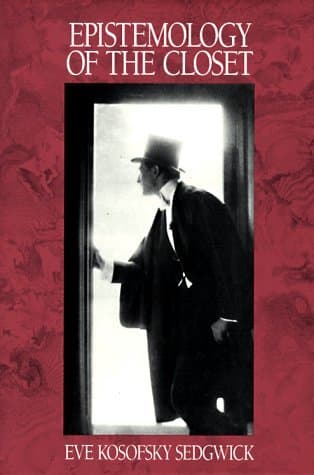
Epistemology of the Closet cover
Archivist's Choice

Epistemology of the Closet

Eve Kosofsky Sedgwick (1990)

Genre

Philosophy

Reading Time

600 min

Key Themes

See below

Track Your Reading

Sign in to track this book

Sedgwick shows how defining male homo/heterosexuality is an unavoidable, often difficult, way 20th-century knowledge is built and understood.

Core Idea

Eve Kosofsky Sedgwick's "Epistemology of the Closet" states that the 'closet' is not just a private space for homosexual people. It is a fundamental idea that shapes modern Western thought and social rules. Sedgwick says that the confusion about defining homosexuality in the late 19th and 20th centuries created a widespread 'homo/heterosexual definition' that affects public and private life, knowledge, and power. She explains how this division is not just about sexual orientation but is a main way to understand identity, truth, and secrecy. This often happens through 'open secrets' and the constant threat of 'homosexual panic' that enforces its limits. The book criticizes both 'minoritizing' views (which see homosexuality as a separate issue for a specific group) and 'universalizing' views (which try to make all experience implicitly queer). Instead, it supports understanding the closet's broad effects on everyone, no matter their sexual identity.
Reading time
600 min
Difficulty
Hard
✓ Read this if...
You are interested in queer theory, literary criticism, the history of sexuality, or the ways in which power structures are embedded in language and social norms. Essential for understanding the origins of modern queer theory.
✗ Skip this if...
You prefer straightforward historical accounts or introductory texts to queer theory; this book is dense, highly theoretical, and assumes familiarity with critical theory.

Core idea

The central argument and framework that powers the entire book.

Eve Kosofsky Sedgwick's "Epistemology of the Closet" states that the 'closet' is not just a private space for homosexual people. It is a fundamental idea that shapes modern Western thought and social rules. Sedgwick says that the confusion about defining homosexuality in the late 19th and 20th centuries created a widespread 'homo/heterosexual definition' that affects public and private life, knowledge, and power. She explains how this division is not just about sexual orientation but is a main way to understand identity, truth, and secrecy. This often happens through 'open secrets' and the constant threat of 'homosexual panic' that enforces its limits. The book criticizes both 'minoritizing' views (which see homosexuality as a separate issue for a specific group) and 'universalizing' views (which try to make all experience implicitly queer). Instead, it supports understanding the closet's broad effects on everyone, no matter their sexual identity.

At a glance

Reading time

600 min

Difficulty

Hard

Read this if...

You are interested in queer theory, literary criticism, the history of sexuality, or the ways in which power structures are embedded in language and social norms. Essential for understanding the origins of modern queer theory.

Skip this if...

You prefer straightforward historical accounts or introductory texts to queer theory; this book is dense, highly theoretical, and assumes familiarity with critical theory.

Key Takeaways

1

The Closet as a Foundational Structure

Homosociality and homosexuality are not discrete categories but deeply intertwined, shaping modern knowledge.

Quote

The closet is the defining structure for gay oppression in this century.

Sedgwick says that 'the closet' is not just a metaphor for personal secrecy but a basic structure of 20th-century Western thought. It controls not just the hiding of same-sex desire, but also how sexuality is understood, categorized, and controlled. 'Coming out' or staying 'in' is not a simple choice but a dynamic, power-filled act that greatly affects self-perception, social interaction, and the creation of knowledge in all fields. The closet creates widespread anxiety about homo/heterosexual definition, affecting even heterosexual p...

Supporting evidence

Sedgwick’s analysis of the 'open secret' in various literary texts, where homosexual desire is both widely known and ritually unacknowledged, exemplifies the closet's structural power.

Apply this

When analyzing social dynamics or power structures, consider how unspoken assumptions or 'open secrets' about identity (sexual or otherwise) might be shaping the discourse, even when they are not explicitly named.


closetepistemologyhomosocialityopen-secret
2

Definitional Crisis of Homosexuality

The instability of 'homosexual' and 'heterosexual' categories reveals their social construction.

Quote

It is not the question 'What is homosexuality?' but 'What is it about homosexuality that makes it such an insistent site of definitional crisis?'

Sedgwick states that 'homosexual' and 'heterosexual' are not natural or fixed categories. Instead, they are always being defined. This instability is not a flaw, but a key part of their power. Trying to pinpoint these definitions shows the social and historical conditions that create them. The changing meanings of 'homosexual' over different times (from a medical problem to a social identity) show it is a created idea. This definition crisis is important because it shows how identity categories are not just descriptions but rules, sha...

Supporting evidence

Sedgwick discusses the historical evolution of the term 'homosexual' itself, noting its relatively recent coinage and how it brought together disparate practices under a single, pathologizing rubric, creating a new identity where none had existed before.

Apply this

Challenge seemingly stable identity categories by examining their historical origins, shifting definitions, and the social power dynamics they enable. Ask who benefits from such classifications.

social-constructionidentity-politicsdefinitional-crisis
3

Minority vs. Universalizing Views

Two competing models of homosexuality shape our understanding and political strategies.

Quote

The choice between a 'minority' and a 'universalizing' view of homosexuality has profound implications for political and theoretical work.

Sedgwick separates two main ways of thinking about homosexuality: the 'minority' model and the 'universalizing' model. The minority model sees homosexuals as a distinct group with specific traits and needs, like an ethnic minority. This idea often supports identity politics and demands for specific rights. The universalizing model, in contrast, sees homosexuality not as an identity of a few, but as a potential or range of desire present in all people, questioning the very division of homo/heterosexuality. Sedgwick argues that both mod...

Supporting evidence

Sedgwick illustrates this through the example of how different literary critics might interpret a text: one focusing on the representation of a 'gay character' (minority view), the other on the 'homosocial bonds' or 'homosexual panic' that pervade the entire narrative, affecting all characters (universalizing view).

Apply this

When engaging in advocacy or analysis, consider whether your approach implicitly adopts a 'minority' or 'universalizing' framework, and how that choice shapes the potential outcomes and scope of your work.

minority-modeluniversalizing-modelidentity-politics
4

Homosexual Panic and Its Pervasiveness

The fear of being perceived as gay shapes male homosocial bonds and societal norms.

Quote

Homosexual panic is a mechanism of social control that structures male homosocial bonds.

Sedgwick explains the idea of 'homosexual panic,' a widespread anxiety, especially among men, about being identified as gay or seen as having same-sex desires. This panic is not limited to individuals; it is a strong social force that greatly shapes male relationships — bonds between men that are not sexual but can be very intense. The fear of 'looking gay' or being 'found out' often leads to very masculine behaviors, avoiding closeness with other men, and even homophobia. This panic works as a way of social control, strengthening het...

Supporting evidence

Sedgwick's reading of Herman Melville's *Billy Budd* explores the intense, unspoken homoerotic tension and the catastrophic consequences of 'homosexual panic' in a closed, all-male environment, culminating in violence and death.

Apply this

Observe how men interact in various social settings. Identify subtle cues or behaviors that might be driven by an underlying fear of being misidentified as gay, and consider how this shapes their relationships and expressions of emotion.

homosexual-panichomosocialityheteronormativitymale-bonds
5

The Dangers of Proscriptive Definition

Attempts to definitively categorize sexuality are inherently limiting and often violent.

Quote

The impulse to make the definition of homosexuality clear and distinct is always already a proscriptive one.

Sedgwick argues that trying to create a strict, 'clear' definition of homosexuality (or heterosexuality) is always prescriptive — meaning it dictates what is not allowed or what should not be. Such definitions are not neutral descriptions but tools of power that exclude, pathologize, and control. When society insists on drawing sharp lines around sexual identity, it creates outcasts and fosters an environment where those who do not fit neatly into categories are marginalized or punished. This prescriptive drive is behind historical me...

Supporting evidence

Sedgwick traces the historical shift in medical discourse where 'homosexuality' moved from being about specific acts to defining an entire 'kind of person,' leading to the pathologization and persecution of individuals based on an inherent identity.

Apply this

Be wary of any system or discourse that seeks to impose overly rigid definitions on complex human experiences, especially those related to identity. Question who benefits from such rigid classifications and who is harmed.

proscriptivepathologizationmedicalizationsexual-taxonomy
6

Beyond the Gender Binary: Proust's Insight

Proust's work reveals sexuality as a complex, non-binary spectrum beyond simple male/female pairings.

Quote

Proust's vision of sexuality is one of an endlessly proliferating set of possibilities, not reducible to simple gender pairing.

Sedgwick focuses on Marcel Proust's In Search of Lost Time, saying his long story offers a deep, complex understanding of sexuality that goes beyond simple divisions. Proust's characters, especially his look at Albertine and the narrator's desires, show a world where sexual attraction is not neatly confined to male-female or male-male pairings. Instead, it works along a complex range of desire, attraction, and identification. Sedgwick highlights how Proust's work anticipates much of queer theory by showing that gender and sexual ori...

Supporting evidence

Sedgwick's analysis of Proust's character Albertine, whose sexuality is persistently ambiguous and resists definitive categorization, serving as a 'hinge' between homo and hetero desire for the narrator.

Apply this

When interpreting complex narratives or human behavior, resist the urge to force characters or individuals into neat, binary sexual categories. Look for ambiguity, fluidity, and the interplay of multiple forms of desire.

proustgender-fluiditysexual-spectrumqueer-theory
7

The Power of the 'Open Secret'

Knowledge that is known but unspoken sustains social power structures.

Quote

The structure of the 'open secret' is one of the most powerful and pervasive forms of knowledge in the modern world.

Sedgwick introduces the idea of the 'open secret' — information that is widely known or can be guessed, but which, by unspoken agreement, cannot be openly acknowledged or spoken. This is not about complete ignorance, but about a collective act of not knowing. The open secret is central to how the closet works, as it allows for both the presence and denial of homosexuality. This dynamic maintains a fragile social order, where certain truths are understood on one level but actively suppressed on another. The power of the open secret is ...

Supporting evidence

Sedgwick explores the 'open secret' in Oscar Wilde's trials, where his homosexuality was an open secret in certain social circles long before it became a public scandal, demonstrating how the performance of ignorance was key to its power.

Apply this

Identify situations in your own life or in broader society where a 'truth' is implicitly understood by many but remains explicitly unspoken. Consider what power dynamics are sustained by this collective silence.

open-secretdiscoursesilencepower-dynamics
8

Reading Against the Grain

Sedgwick models a critical approach that uncovers suppressed homosexual meanings.

Quote

To read 'against the grain' is to make visible the mechanisms by which certain knowledges are produced and others suppressed.

Sedgwick's method throughout the book is an example of 'reading against the grain.' She shows how to find the hidden, suppressed, or unspoken homosexual meanings in classic literary texts and wider cultural discussions. This is not about putting a modern queer reading onto historical texts, but about carefully analyzing the silences, anxieties, narrative gaps, and seemingly harmless details that reveal the widespread influence of homosexual panic and the closet. By doing so, she reveals how seemingly neutral or universal narratives ar...

Supporting evidence

Her detailed textual analyses of authors like Henry James, particularly in *The Turn of the Screw*, where she argues that the governess's 'ghosts' can be read as projections of her own homosexual anxieties or the unspoken homosexual desires within the narrative.

Apply this

When encountering any text or cultural phenomenon, practice 'symptomatic reading': look for what is absent, what is excessively emphasized, what creates narrative tension or ambiguity, as these can be clues to underlying, unspoken meanings or anxieties.

symptomatic-readingdeconstructionliterary-criticismqueer-reading
9

The Universality of Homo/Heterosexual Definition

The binary of homo/heterosexuality has become central to all forms of modern knowledge.

Quote

The male homo/heterosexual definition has been the site of a persistent, if not always explicit, crisis in every important form of knowledge of the twentieth century.

This is a main point of the book: Sedgwick argues that the difference between male homosexuality and heterosexuality is not a minor concern, but a central principle for almost all modern knowledge. From psychology and sociology to literature and law, the need to define and separate these categories has shaped disciplinary limits, research questions, and interpretive ways of thinking. It has influenced how we understand gender, family, citizenship, mental health, and even art. The confusion around this definition is not limited to 'gay...

Supporting evidence

Sedgwick's wide-ranging textual examples from philosophy (Nietzsche), literature (Melville, James, Wilde, Proust), and even early sexology demonstrate how this binary underpins diverse intellectual projects.

Apply this

When studying any field, consider how the underlying assumptions about sexuality and gender might be influencing its theories, methodologies, and conclusions. Challenge whether these assumptions are truly universal or historically contingent.

epistemological-crisisinterdisciplinaritydisciplinary-boundariesknowledge-production

Critical analysis

Notable Quotes

The closet is not a static, contained space, but rather a dynamic and constitutive element of modern Western identity.

Introducing the central metaphor of the closet and its pervasive influence.

The 'open secret' is one of the most powerful and characteristic forms of knowledge in Western cultures.

Discussing the paradoxical nature of information that is widely known but cannot be openly acknowledged.

To be out of the closet is not, then, to be in a single, unproblematic space, but to be in a differently structured set of closets.

Challenging the simplistic notion of 'coming out' as a singular, definitive event.

The closet is a defining structure for gay and lesbian identity, but it also shapes heterosexual identity in profound ways.

Emphasizing that the closet's influence extends beyond non-heterosexual individuals.

Silence itself, in this context, is a speech act, a strategic deployment of meaning.

Analyzing how the absence of explicit communication can convey significant information within the closet.

The language of 'know' and 'don't know' becomes highly charged and strategically deployed in contexts of homosexual panic.

Examining how knowledge and ignorance are manipulated in situations of fear surrounding homosexuality.

Performativity is not a matter of a subject's free play, but of the reiteration of norms.

Discussing how gender and sexual identities are constructed through repeated adherence to societal norms.

The very categories that purport to describe sexual identities are themselves products of specific historical and cultural formations.

Arguing that seemingly natural categories of sexuality are socially constructed.

Coming out is not a single, transparent act but a dense, multiply determined, and often contradictory process.

Further elaborating on the complexity and non-linearity of the coming out experience.

To analyze the closet is to analyze the very structures of modern Western epistemology.

Highlighting the fundamental role of the closet in shaping how knowledge is produced and understood.

Sexual definition has been a site of unusually intense, sustained, and consequential epistemological crisis.

Pointing out the profound challenges and uncertainties involved in defining and understanding sexuality.

The project of 'knowing' one's own sexuality is often entangled with the project of 'not knowing' it.

Exploring the internal conflicts and ambivalences individuals face regarding their own sexual identity.

The closet's effects are not only repressive but also productive, generating specific forms of subjectivity and knowledge.

Arguing that the closet, while restrictive, also actively shapes identities and ways of understanding.

Minority discourse is not simply a matter of content, but of a distinctive relation to the dominant culture's structures of knowledge.

Discussing how marginalized groups engage with and challenge mainstream ways of knowing.

Quiz

Test Your Knowledge

Ready to see how well you understood this book? Take our interactive quiz with 10 questions.

10
Questions
~5
Minutes
?
Best Score

Key Questions (FAQ)

Sedgwick argues that the distinction between male homo- and heterosexuality is not merely a private matter but has become a foundational element in shaping how we understand knowledge itself in the 20th century. She posits that the imperative to define and categorize these identities profoundly influences various forms of social and intellectual inquiry.

About the author