BookBrief
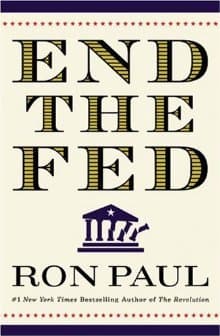
End the Fed cover
Archivist's Choice

End the Fed

Ron Paul (2009)

Genre

Business / History / Economics / Finance / Philosophy

Reading Time

180 min

Key Themes

See below

Track Your Reading

Sign in to track this book

Ron Paul explains the Federal Reserve's origins, constitutional standing, and economic effects, arguing it is a corrupt, unconstitutional entity that harms ordinary Americans and causes inflation.

Core Idea

Ron Paul calls for the Federal Reserve System's complete removal. He says it is an unconstitutional, privately owned group that harms American economic stability and individual freedom. He believes the Fed's control over money policy through fiat currency causes inflation, boom-and-bust cycles, and less buying power, acting as a hidden tax. Paul details the Fed's history, its role in funding wars, and its creation of moral hazard through bailouts. He suggests returning to a market-based money system, like one backed by gold, to restore prosperity and financial freedom.
Reading time
180 min
Difficulty
Medium
✓ Read this if...
You are skeptical of central banking, interested in Austrian economics, or concerned about government overreach in financial markets. This book is for those who want a clear, concise argument for dismantling the Federal Reserve and understanding its historical and economic impact.
✗ Skip this if...
You believe the Federal Reserve is a necessary and beneficial institution for economic stability, or if you are looking for a nuanced defense of modern monetary policy. This book offers a strong, singular perspective rather than a balanced debate on central banking.

Core idea

The central argument and framework that powers the entire book.

Ron Paul calls for the Federal Reserve System's complete removal. He says it is an unconstitutional, privately owned group that harms American economic stability and individual freedom. He believes the Fed's control over money policy through fiat currency causes inflation, boom-and-bust cycles, and less buying power, acting as a hidden tax. Paul details the Fed's history, its role in funding wars, and its creation of moral hazard through bailouts. He suggests returning to a market-based money system, like one backed by gold, to restore prosperity and financial freedom.

At a glance

Reading time

180 min

Difficulty

Medium

Read this if...

You are skeptical of central banking, interested in Austrian economics, or concerned about government overreach in financial markets. This book is for those who want a clear, concise argument for dismantling the Federal Reserve and understanding its historical and economic impact.

Skip this if...

You believe the Federal Reserve is a necessary and beneficial institution for economic stability, or if you are looking for a nuanced defense of modern monetary policy. This book offers a strong, singular perspective rather than a balanced debate on central banking.

Key Takeaways

1

The Fed's Unconstitutional Origins

The Federal Reserve was established through a secretive process, bypassing legitimate constitutional mechanisms.

Quote

The Federal Reserve Act of 1913 was passed on December 23, 1913, when many members of Congress had already left for Christmas recess, a tactic designed to minimize opposition.

Ron Paul says the Federal Reserve's beginning is not valid. He argues it started in a secret meeting on Jekyll Island, Georgia, by powerful bankers and politicians, then forced through Congress quickly. This origin story, not a clear government process, suggests a private group took control of the nation's money policy. Paul stresses that the Constitution gives Congress the power to make money and set its value, not to give this power to a private, unelected group. The Fed's creation, then, shows a basic betrayal of constitutional rul...

Supporting evidence

The historical account of the Jekyll Island meeting in 1910, where key figures like Nelson Aldrich, Frank Vanderlip, and Paul Warburg drafted the framework for what would become the Federal Reserve, is presented as compelling evidence of its private origins.

Apply this

Citizens should research the historical context of the Federal Reserve's creation and critically evaluate claims of its independence and legitimacy, rather than accepting its existence as an immutable fact.

constitutional-authorityjekyll-islandfederal-reserve-act-1913
2

Inflation: A Hidden Tax

The Federal Reserve's monetary policy of expanding the money supply acts as a regressive tax, eroding purchasing power.

Quote

Inflation is not an increase in prices; it is an increase in the money supply. Price increases are merely the symptom.

Paul argues that the Fed's main tool—increasing the money supply through fractional reserve banking and quantitative easing—is a way to cause inflation. He defines inflation as an increase in the amount of money and credit, not just rising prices. The price increases are just a sign of this money growth. This process hurts the poor and middle class most, as their savings and fixed incomes lose value, while those who get the new money first (banks, government contractors) benefit. He calls it a hidden tax, quietly taking wealth without...

Supporting evidence

Paul frequently cites historical examples of hyperinflation, such as Weimar Germany and Zimbabwe, to illustrate the devastating consequences of unchecked monetary expansion. He also points to the erosion of the dollar's purchasing power since the Fed's inception.

Apply this

Individuals should consider diversifying their assets into inflation-resistant forms, such as precious metals, and advocate for sound money policies that limit government and central bank intervention in the money supply.

monetary-policyfractional-reserve-bankingquantitative-easingpurchasing-power
3

Boom and Bust Cycles

The Fed's manipulation of interest rates creates artificial booms and inevitable busts, causing economic instability.

Quote

The Fed's meddling with interest rates is the primary cause of the business cycle, creating malinvestments that inevitably lead to economic downturns.

Paul says the Federal Reserve, by making interest rates artificially low, distorts market signals and encourages bad investments. Cheap credit makes businesses start projects that would not be profitable otherwise, creating an unsustainable boom. This wrong use of resources, caused by the Fed, always ends in a bust when the artificial conditions cannot continue. The recession that follows, Paul argues, is not a failure of free markets but a needed correction of the Fed's distortions. The Fed then tries to 'fix' the bust by printing mo...

Supporting evidence

Paul attributes the dot-com bubble of the late 1990s and the housing bubble of the 2000s directly to the Fed's loose monetary policies and artificially low interest rates following previous downturns.

Apply this

Investors should be wary of periods of exceptionally low interest rates and consider them as potential indicators of impending market distortions and future corrections, rather than signals for aggressive leveraging.

interest-ratesmalinvestmentbusiness-cycleseconomic-bubbles
4

Moral Hazard and Bailouts

The Fed's role as a lender of last resort encourages reckless behavior and socializes losses while privatizing gains.

Quote

The Fed's bailout culture teaches financial institutions that they can take excessive risks because the government will always step in to save them.

A major problem with the Federal Reserve, Paul states, is its role as a lender of last resort, which creates a serious moral hazard. This means large financial institutions, seen as 'too big to fail,' can take big risks knowing the Fed will use taxpayer money to stop them from collapsing. This creates a bad system where profits are private during good times, but losses are public during bad times. This supports irresponsible financial practices. Paul argues this harms market discipline, stops natural corrections, and makes the public ...

Supporting evidence

The book heavily references the 2008 financial crisis and the subsequent bailouts of major banks and financial institutions, such as AIG and Bear Stearns, as prime examples of the Fed's moral hazard problem.

Apply this

Advocate for policies that allow failing financial institutions to undergo orderly liquidation without taxpayer bailouts, promoting true market accountability and reducing systemic risk.

lender-of-last-resorttoo-big-to-failmoral-hazardfinancial-crisis-2008
5

War and the Printing Press

The Fed enables endless wars by providing an easy mechanism for governments to finance expenditures without direct taxation.

Quote

War is the health of the state, and the Federal Reserve is the engine that allows the state to wage war without the immediate pain of direct taxation.

Paul directly links the Federal Reserve to the government's ability to fund large and often unpopular military actions. Without the Fed's power to print money and turn debt into cash, governments would have to raise taxes or borrow directly from the public. This would make the real cost of war clearer and harder for politicians. The Fed offers a hidden way to pay for wars through inflation, reducing the value of existing currency instead of directly taxing citizens. This lets politicians commit to long conflicts without immediate publ...

Supporting evidence

Paul cites the financing of World War I, the Vietnam War, and the Iraq War as examples where the Fed's ability to expand the money supply allowed for massive government spending without immediate tax increases.

Apply this

Support political leaders who advocate for fiscal responsibility in military spending and demand transparency regarding the true costs of foreign interventions, challenging the notion that wars can be financed without economic consequence.

war-financemonetization-of-debtforeign-policygovernment-spending
6

The Gold Standard Solution

Returning to a gold standard would impose fiscal discipline and prevent unchecked monetary expansion.

Quote

The gold standard is not a perfect system, but it is the best mechanism we have found to limit government and central bank power over the money supply.

Paul suggests returning to a gold standard to restore sound money and careful spending. He argues that tying currency to a physical asset like gold stops governments and central banks from randomly increasing the money supply, which limits inflation and forces more accountability in spending. With a gold standard, the money supply is limited by the amount of gold available. This makes it impossible to print money to pay for deficits or bailouts without immediate, clear consequences. While no system is perfect, Paul believes a gold sta...

Supporting evidence

Paul references periods in American history when the gold standard was in effect, arguing that these eras were characterized by greater price stability and less government debt, despite occasional economic fluctuations.

Apply this

Educate yourself on the principles of sound money and the historical performance of the gold standard. Advocate for monetary reforms that introduce hard constraints on currency creation, even if not a full gold standard.

gold-standardsound-moneyfiat-currencyfiscal-discipline
7

The Illusion of Control

The belief that the Fed can 'manage' the economy is a dangerous delusion that leads to greater instability.

Quote

The idea that a small group of unelected economists can centrally plan an economy of hundreds of millions of people is pure hubris.

Paul strongly rejects the idea that the Federal Reserve, or any central planner, can effectively run a complex modern economy. He sees the Fed's attempts to 'fine-tune' the economy with interest rate changes and quantitative easing as pointless, like trying to steer a large ship with a small paddle. The economy is too big and complicated, driven by billions of individual choices, for any small group to predict or control accurately. Such actions, he argues, always cause unintended results, distort market signals, and lead to more inst...

Supporting evidence

Paul often highlights the Fed's consistent failure to prevent recessions or accurately forecast economic trends, despite its sophisticated models and expert economists.

Apply this

Question the authority and efficacy of central banks in economic management. Support policies that reduce government and central bank intervention, allowing market forces to guide economic activity.

central-planningeconomic-managementmarket-distortionunintended-consequences
8

The Path to Financial Freedom

Ending the Fed is a crucial step towards restoring individual liberty and economic prosperity.

Quote

True economic freedom cannot exist as long as a private banking cartel controls our money supply.

For Ron Paul, the main goal is not just economic stability but also restoring individual freedom. He argues that the Federal Reserve, by controlling the money supply, has too much influence over every part of economic life, from savings value to living costs. Ending the Fed, then, is not just an economic change but a philosophical need. It would give control over currency back to the people, through their elected leaders, and remove the power of a private group to manipulate the economy for its own gain. This, he believes, would lead ...

Supporting evidence

Paul frequently draws on the principles of Austrian economics and the ideas of the Founding Fathers regarding sound money and limited government to bolster his arguments for individual liberty and economic freedom.

Apply this

Engage in local and national political discourse to advocate for monetary reform and the auditing, and ultimately, the abolition of the Federal Reserve. Support candidates who champion sound money principles.

individual-libertyeconomic-freedomsound-money-advocacyaustrian-economics
9

The Danger of a Single World Currency

The Fed's actions are paving the way for a global monetary system that further erodes national sovereignty.

Quote

The ultimate goal of many globalists is a single world currency, and the Federal Reserve is a key player in this dangerous agenda.

Paul extends his criticism of the Federal Reserve to a broader concern about global financial management. He suggests that the Fed, with groups like the IMF and World Bank, is quietly pushing for a single world currency or a very centralized global money system. This, he argues, would mean a huge loss of national independence and further concentrate power in the hands of unelected global elites. A world currency would remove any remaining limits on money growth, making it easier to fund global actions and control people through financ...

Supporting evidence

Paul points to discussions among international financial institutions and global leaders about special drawing rights (SDRs) and proposals for a global reserve currency as evidence of this long-term agenda.

Apply this

Be skeptical of proposals for increased international monetary cooperation that could lead to a loss of national control over currency. Support policies that prioritize national sovereignty in economic and monetary affairs.

world-currencynational-sovereigntyinternational-monetary-fundglobalization
10

The Information Advantage

The Fed operates with an information asymmetry that benefits insiders at the expense of the general public.

Quote

Those who create the money supply and have first access to it always benefit most, while the rest of society bears the cost.

Paul points out the natural information advantage held by those inside and close to the Federal Reserve. When the Fed increases the money supply, the new money enters the economy through specific paths, benefiting those who get it first—usually large banks, financial institutions, and government groups. These 'first receivers' can spend the new money at its original value before prices across the economy go up. By the time the increased money supply reaches the general public, prices have risen, and their buying power is lower. This p...

Supporting evidence

The Cantillon Effect, an economic theory explaining how the introduction of new money into an economy benefits those who receive it first, is implicitly and explicitly referenced by Paul as a mechanism of wealth transfer.

Apply this

Understand the Cantillon Effect to recognize how monetary policy can create winners and losers. Advocate for greater transparency and accountability within the Federal Reserve to reduce information asymmetry.

cantillon-effectinformation-asymmetrywealth-transfermonetary-transparency

Critical analysis

Notable Quotes

The Federal Reserve, through its creation of money out of thin air, is a primary cause of inflation, boom-and-bust cycles, and the erosion of the dollar's purchasing power.

Explaining the core economic critique of the Fed.

The very existence of the Federal Reserve is a violation of the Constitution.

Arguing the unconstitutionality of the central bank.

When the government can create money at will, it has an irresistible incentive to spend more than it collects in taxes.

Discussing the link between central banking and government spending.

Inflation is a tax on the poor and middle class, who have less ability to protect their assets from its ravages.

Highlighting the regressive nature of inflation.

The idea that a small group of unelected officials can manage an entire economy is both arrogant and dangerous.

Critiquing the power and scope of the Federal Reserve's influence.

The gold standard provided a natural check on government spending and monetary expansion.

Advocating for a return to a commodity-backed currency.

Ending the Fed is not about destroying the economy; it is about restoring a sound economy based on honest money.

Clarifying the ultimate goal of abolishing the Fed.

The Fed's actions have consistently benefited the wealthy and powerful at the expense of everyone else.

Addressing the distributional effects of Federal Reserve policy.

True prosperity comes from production and savings, not from artificial credit expansion.

Contrasting genuine economic growth with Fed-fueled bubbles.

The myth of the Fed's independence is shattered by its close ties to Wall Street and the political establishment.

Exposing the lack of true independence of the central bank.

We need a monetary system that respects individual liberty and property rights.

Framing the debate about monetary policy in terms of fundamental rights.

The solution to our economic woes is not more government intervention, but less.

Advocating for a free-market approach to economic problems.

The Federal Reserve is an engine of war, financing endless conflicts through inflation and debt.

Connecting the Fed's monetary policy to foreign policy and military spending.

The greatest danger to our financial future is not a lack of liquidity, but a lack of honesty in our money.

Prioritizing integrity in currency over artificial monetary injections.

Quiz

Test Your Knowledge

Ready to see how well you understood this book? Take our interactive quiz with 10 questions.

10
Questions
~5
Minutes
?
Best Score

Key Questions (FAQ)

Ron Paul argues that the Federal Reserve is an unconstitutional and corrupt institution that actively works against the economic interests of the American people. He contends that its policies, particularly currency inflation, threaten to lead the country into a catastrophic inflationary depression.

About the author