BookBrief
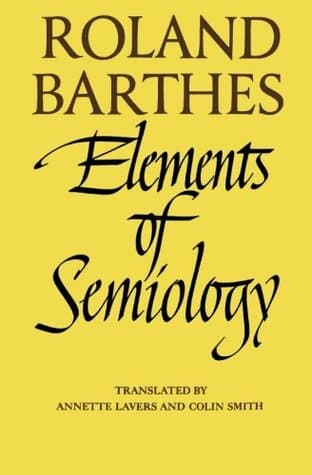
Elements of Semiology cover
Archivist's Choice

Elements of Semiology

Roland Barthes (1964)

Genre

Philosophy

Reading Time

90-120 min

Key Themes

See below

Track Your Reading

Sign in to track this book

Barthes takes Saussure's language theories and creates a powerful tool, showing how everything from a gesture to a musical note acts as a sign within human culture's unspoken languages.

Core Idea

Roland Barthes' "Elements of Semiology" uses Ferdinand de Saussure's language ideas to propose a broader study of signs, semiology, which can analyze all cultural events as language. Barthes says meaning is not natural but built through sign systems. Each sign has a signifier (the form) and a signified (the concept). He shows how these signs work in linear combinations (syntagmatic) and associative choices (paradigmatic). This reveals that the link between form and concept is not fixed, and that connotation can add more, often ideological, meanings to basic ones. The book's main point is that any cultural practice, like fashion or food, can be broken down as a semiological system. This exposes its basic structures and the 'myths' it spreads.
Reading time
90-120 min
Difficulty
Hard
✓ Read this if...
You are interested in understanding the foundational concepts of semiotics and structuralism, and how language-based analysis can be applied to diverse cultural phenomena.
✗ Skip this if...
You prefer practical how-to guides or are looking for a light, accessible introduction to cultural theory without dense philosophical language.

Core idea

The central argument and framework that powers the entire book.

Roland Barthes' "Elements of Semiology" uses Ferdinand de Saussure's language ideas to propose a broader study of signs, semiology, which can analyze all cultural events as language. Barthes says meaning is not natural but built through sign systems. Each sign has a signifier (the form) and a signified (the concept). He shows how these signs work in linear combinations (syntagmatic) and associative choices (paradigmatic). This reveals that the link between form and concept is not fixed, and that connotation can add more, often ideological, meanings to basic ones. The book's main point is that any cultural practice, like fashion or food, can be broken down as a semiological system. This exposes its basic structures and the 'myths' it spreads.

At a glance

Reading time

90-120 min

Difficulty

Hard

Read this if...

You are interested in understanding the foundational concepts of semiotics and structuralism, and how language-based analysis can be applied to diverse cultural phenomena.

Skip this if...

You prefer practical how-to guides or are looking for a light, accessible introduction to cultural theory without dense philosophical language.

Key Takeaways

1

Unpacking the Sign

Language is a system of signs, each with two inseparable parts: the signifier and the signified.

Quote

The sign is a two-sided psychological entity, a 'psychological unity' with two constituents: the concept and the sound-image.

Barthes, using much from Saussure, states that a sign is not just a word or image. It is a full unit with two linked parts: the signifier and the signified. The signifier is the physical form—the sound of a word, a visual cue, a gesture. The signified is the idea or concept the signifier brings to mind. Importantly, this link is not natural; there is no clear reason why the sound 'tree' means a large woody plant. This non-natural but agreed-upon link makes communication work. Understanding this basic pair is key to analyzing any semio...

Supporting evidence

Saussure's original linguistic model, where the sign is likened to a sheet of paper, with the signifier on one side and the signified on the other, neither existing without the other.

Apply this

When analyzing any cultural artifact, break it down into its constituent signs. For each sign, identify what is the physical form (signifier) and what concept it communicates (signified). This helps deconstruct seemingly natural meanings into constructed ones.

signifiersignifiedarbitrary-sign
2

Language vs. Speech

Distinguishing between the collective system of language and individual acts of speech reveals the rules of meaning-making.

Quote

Language is the social institution, the system of conventions, and speech is the individual act of selection and actualization.

Barthes uses Saussure's important difference between langue (language) and parole (speech). Langue is the abstract, basic system of rules, agreements, and words shared by a group. It is the grammar and vocabulary that make communication possible. It is a shared, potential system. Parole, in contrast, is the real, individual act of using language in a certain situation—a spoken sentence, a written text, a specific gesture. Barthes argues that semiology should mainly focus on langue to find the systematic structures of meaning...

Supporting evidence

The example of a language dictionary and grammar book (representing *langue*) versus a specific conversation between two people (representing *parole*).

Apply this

When encountering a cultural text (e.g., a fashion advertisement), identify the underlying 'language' (the shared codes of beauty, status, gender roles) that makes the individual 'speech act' (the specific ad) comprehensible. This helps reveal systemic biases or cultural norms.

langueparolestructuralism
3

The Syntagmatic Chain

Meaning is constructed sequentially through the combination of signs in a linear order.

Quote

The syntagm is a combination of signs which has space as its support.

The syntagm refers to the linear, ordered combination of signs. In language, this is a sentence where words are arranged in a specific order to make meaning. In other sign systems, it could be the order of images in a film, the order of dishes in a meal, or the arrangement of clothes in an outfit. The meaning of a syntagm comes not just from the individual signs but from their specific arrangement and relationship to each other. Barthes stresses that these combinations follow rules (like grammar rules in language) that say what can fo...

Supporting evidence

A sentence like 'The cat sat on the mat.' Each word is a sign, and their specific order forms a meaningful syntagm. Changing the order ('Mat sat the on cat') destroys or alters the meaning.

Apply this

When analyzing narratives, advertisements, or rituals, map out the sequence of elements. How does the order of events, images, or actions contribute to the overall message? Look for deviations from expected syntagmatic structures and their effects.

syntagmsyntaxlinearity
4

The Paradigmatic System

Signs derive meaning from their selection from a set of possible alternatives.

Quote

The system is the reservoir of virtual signs, from which a choice is made to form a syntagm.

The paradigm (or associative relation) complements the syntagm. While the syntagm deals with the 'horizontal' arrangement of signs, the paradigm deals with the 'vertical' set of choices from which a sign is picked. Every time a sign is used, it is chosen from a mental 'storehouse' of similar signs that could have been used instead but were not. For example, when someone says 'cat,' they are implicitly not saying 'dog,' 'tiger,' 'mouse,' etc. The meaning of 'cat' is thus partly defined by what it is not as much as by what it is. This...

Supporting evidence

In fashion, choosing a t-shirt instead of a button-down shirt for a particular occasion. Both are garments, but the choice carries different connotations based on the paradigm of available clothing types.

Apply this

When analyzing any choice within a system (e.g., a specific color in a brand logo, a particular musical instrument in a score), consider what other options were available but rejected. What does the chosen element signify in contrast to its paradigmatic alternatives?

paradigmselectiondifference
5

Denotation and Connotation

Signs operate on multiple levels of meaning, from literal to cultural.

Quote

Connotation is a second-order semiological system, where the sign of the first system (denotation) becomes the signifier of the second.

Barthes introduces a key difference between denotation and connotation, saying that signs work on at least two levels. Denotation is the literal, clear, and commonly understood meaning of a sign—what a dictionary would say. For example, the denotation of 'rose' is a specific type of flower. Connotation, however, refers to the secondary, associated meanings, often cultural, emotional, or ideological, that a sign brings to mind. A 'rose' can suggest love, passion, romance, or even secrecy. Barthes says that the denotative sign (signifie...

Supporting evidence

A photograph of a soldier saluting a flag. Denotatively, it's a man in uniform performing a specific gesture towards a piece of cloth. Connotatively, it evokes patriotism, sacrifice, national identity, and duty.

Apply this

When analyzing media or cultural texts, first identify the literal (denotative) meaning of images, words, or objects. Then, delve into the broader cultural, emotional, and ideological associations (connotations) they trigger. This reveals deeper layers of persuasive or ideological messaging.

denotationconnotationmythideology
6

The Arbitrary Nature of the Sign

The link between a signifier and its signified is conventional, not natural.

Quote

The bond between the signifier and the signified is arbitrary.

One of Saussure's most radical ideas, which Barthes adopted, is that the sign is not naturally linked to its meaning. This means there is no built-in, logical, or natural connection between the sound-image (signifier) and the concept it stands for (signified). The word 'tree' does not sound like a tree, nor does it look like one (unless written in a specific font). The link is purely agreed upon, set by cultural consensus within a language group. This non-natural link allows signs to be powerful tools for creating reality, as their me...

Supporting evidence

Different languages using completely different sound-images to refer to the same concept (e.g., 'dog' in English, 'chien' in French, 'perro' in Spanish).

Apply this

When encountering a sign that seems 'natural' or 'obvious' in its meaning (e.g., red for danger, white for purity), question its arbitrariness. What cultural conventions have established this link? How might it be different in another culture or context?

arbitrary-signconventionalismsocial-construction
7

Semiology Beyond Linguistics

The linguistic model offers a powerful framework for analyzing all systems of signification.

Quote

Semiology aims to take in any system of signs, whatever their substance and limits; images, gestures, musical sounds, objects...

While Barthes's 'Elements' mainly takes ideas from Saussurean linguistics, his final goal is to use this analysis method for all sign systems, not just spoken language. He says that the rules of language and speech, signifier and signified, syntagm and system, and denotation and connotation can be used for various cultural events like fashion, food, advertising, rituals, and even mythology. This goal makes semiology a broad interdisciplinary field for understanding how meaning is made and used in various human activities. This expan...

Supporting evidence

Barthes's later work, *Mythologies*, where he applies semiological analysis to phenomena like wrestling, steak and chips, and plastic, showing how these everyday objects and events function as signs.

Apply this

Choose a non-linguistic cultural phenomenon (e.g., a meal, a traffic light system, a sporting event) and attempt to analyze its elements using Barthes's semiological concepts. Identify its 'language' (rules), its 'speech acts' (individual instances), its signs, and their denotative/connotative meanings.

semioticscultural-analysisinterdisciplinarity
8

The Myth-Making Machine

Connotation is the mechanism through which cultural myths and ideologies are naturalized.

Quote

Myth is a second-order semiological system... it transforms history into nature.

Building on denotation and connotation, Barthes introduces 'myth' not as old stories, but as a second-level sign system where connotation makes specific cultural values and ideas seem natural. In this system, the connotative meaning of a sign becomes so deeply set that it seems natural and obvious, rather than a built cultural meaning. For example, a certain type of car might suggest 'freedom' or 'success,' and this suggestion, through repeated exposure, becomes a 'myth' that supports capitalist ideas. Barthes argues that semiology's ...

Supporting evidence

The example of a magazine cover showing a young Black soldier saluting the French flag. Denotatively, it's a soldier. Connotatively, it evokes 'Frenchness' and 'imperial pride,' naturalizing the idea of a diverse empire serving the nation, obscuring colonial history.

Apply this

Identify cultural 'myths' in advertising, political discourse, or popular culture. Trace how specific signs (images, words) move from denotation to connotation, and how these connotations contribute to a larger, often unstated, ideological message that is presented as 'common sense' or 'natural'.

mythideologynaturalizationcultural-critique
9

The Analyst's Role

Semiology provides tools for deconstructing meaning and revealing its constructed nature.

Quote

The semiologist's task is to reconstruct the system of the message, to describe the rules of the game of meaning.

Barthes sees the semiologist as a critical analyst, with the tools to break down and understand the complex ways meaning is made in society. The goal is not just to say what something means, but how it means—to find the basic structures, agreements, and ideological operations at work. By separating language and speech, signifier and signified, syntagm and system, and denotation and connotation, the semiologist can show that what seems natural is often cultural, what seems universal is specific, and what is obvious often has ideologi...

Supporting evidence

Barthes's own meticulous analysis of various cultural artifacts in *Mythologies*, where he systematically breaks down their signs and structures to expose their hidden meanings.

Apply this

Adopt a critical, analytical mindset when consuming media and cultural products. Instead of passively accepting meanings, actively question how they are constructed. Ask: What signs are being used? What are their denotations and connotations? How are they arranged? What underlying system or ideology do they reinforce?

critical-analysisdeconstructionmeaning-making
10

Provisionality and Evolution

Semiological concepts are a starting point, not a definitive, immutable framework.

Quote

It is not presupposed that they will remain intact during the course of research; nor that semiology will always be forced to follow the linguistic model closely.

Despite the strong framework Barthes presents, he clearly states that the 'Elements' are meant as a temporary set of analysis concepts, a starting point for semiological research rather than strict rules. He admits that these concepts may change, be adjusted, or even be replaced as semiology grows and meets new types of sign systems. This modesty and openness to future change are important. It highlights that semiology is a dynamic field of study, not a fixed theory. This view encourages more theoretical development and practical use,...

Supporting evidence

Barthes's own later theoretical shifts and expansions, moving beyond a purely structuralist position to incorporate post-structuralist ideas, demonstrating the very evolution he anticipated.

Apply this

When applying semiological concepts, remain open to their limitations or nuances in specific contexts. Be willing to adapt, refine, or even challenge the framework based on the unique characteristics of the sign system being analyzed, rather than rigidly forcing all phenomena into pre-defined categories.

provisionalitytheoretical-evolutionadaptability

Critical analysis

Notable Quotes

Semiology aims to take in any system of signs, whatever their substance and limits; images, gestures, musical sounds, objects, and complexes of these, all of which are so many signifying systems.

Defining the scope and ambition of semiology.

Language is a system of signs that express ideas, and is therefore comparable to writing, the alphabet of deaf-mutes, symbolic rites, polite formulas, military signals, etc. But it is the most important of all these systems.

Placing language within a broader semiotic framework while acknowledging its primacy.

The sign is thus a two-sided psychological entity, a concept and a sound-image.

Introducing Saussure's foundational concept of the sign.

The linguistic sign is arbitrary.

Referring to the arbitrary relationship between the signifier and the signified.

What is arbitrary is the link between signifier and signified.

Clarifying the specific aspect of arbitrariness in the linguistic sign.

The signifier, being auditory, is unfolded solely in time.

Describing the temporal nature of the acoustic signifier.

Language is a system of differences.

Highlighting the differential nature of linguistic meaning.

The relation between signifier and signified is internal to the sign.

Emphasizing the inseparable nature of the two components of the sign.

The signified is not a 'thing' but a mental representation of the 'thing'.

Distinguishing the signified from a material object.

Syntagm and system are the two axes of language.

Introducing the fundamental structural axes of linguistic analysis.

The syntagm is a combination of signs, which has space as a support.

Defining the syntagmatic relation as sequential and spatial.

The system is a virtual set of items which are mutually exclusive.

Defining the paradigmatic (systematic) relation as one of choice and opposition.

Myth is a second-order semiological system.

Introducing the concept of myth as a meta-language built upon pre-existing signs.

The signifier of myth is already a sign in the first system.

Explaining how myth re-appropriates existing signs for new meanings.

The goal of semiological research is to reconstruct the functioning of signifying systems.

Stating the ultimate objective of semiological inquiry.

Quiz

Test Your Knowledge

Ready to see how well you understood this book? Take our interactive quiz with 10 questions.

10
Questions
~5
Minutes
?
Best Score

Key Questions (FAQ)

According to Roland Barthes in 'Elements of Semiology', semiology is the general science of signs, an expansion of Saussure's concept. It aims to analyze any system of signs, encompassing images, gestures, sounds, and objects, to understand how they create meaning in culture and society.

About the author