“Human beings cannot stand in isolation and take pleasure in themselves, but must be active and productive, and, in their activity, become again aware of themselves.”
— A reflection on human nature and the need for engagement.


Johann Wolfgang von Goethe (2005)
Genre
Philosophy / Romance
Reading Time
320 min
Key Themes
See below
Sign in to track this book
When an aristocratic couple invites two guests to their estate, the balance of their marriage shatters under the pull of forbidden love, mirroring nature's 'elective affinities.'
Eduard and Charlotte, a wealthy aristocratic couple, live a comfortable but somewhat unchanging life on their country estate. Eduard, prone to sudden decisions, suggests that his intelligent and practical friend, the Captain, come to live with them. Charlotte, at first hesitant, agrees, hoping the Captain's organizational skills will help manage their estate and relieve Eduard's boredom. The Captain's arrival brings new energy. He immediately begins improving the estate, surveying the land, and starting projects that Eduard finds interesting. This period begins a subtle shift in the dynamic between the three, as new intellectual and emotional bonds form, setting the stage for future complications.
As the Captain's presence becomes more ingrained and helpful, Charlotte, seeing the growing intellectual connection between Eduard and the Captain, suggests bringing her orphaned niece, Ottilie, to live with them. Ottilie is a quiet, diligent, and sensitive young woman, currently at a boarding school. Charlotte believes Ottilie could benefit from their influence and provide companionship. Eduard, though initially uninterested, agrees. Upon her arrival, Ottilie's gentle nature and striking beauty immediately captivate Eduard. A subtle, unspoken attraction begins to develop between them, mirroring the intellectual bond Charlotte is forming with the Captain. The household now consists of four individuals, each with growing, complex relationships that begin to challenge the established marriage.
With the Captain and Ottilie now permanent residents, the four individuals start various projects around the estate. The Captain and Charlotte work closely on landscaping and architectural improvements, finding common ground in practical matters and shared intellectual interests. Meanwhile, Eduard and Ottilie are drawn to each other through shared artistic tastes and a growing emotional connection, often working together on less strenuous, more aesthetic tasks. They spend hours together, reading, discussing, and simply being in each other's presence. This period seems harmonious, yet beneath the surface, the 'elective affinities' are taking root. Their individual talents and preferences align, drawing them into new, emotionally resonant pairings, like chemical elements seeking ideal partners.
One night, during an intimate moment between Eduard and Charlotte, their thoughts are consumed by their new attractions. Charlotte imagines the Captain by her side, while Eduard fantasizes about Ottilie. They unconsciously project these images onto each other, resulting in a dream-like sequence where their physical intimacy is mentally shared with their desired partners. The story describes this as a moment where their 'spirits' are divided, even as their bodies are united. This scene is central, showing the psychological and emotional infidelity that has already occurred. It highlights the powerful, almost chemical pull of their new affections, suggesting that their marriage has been fundamentally undermined by these unspoken, yet deeply felt, desires. The results of this spiritual separation will soon appear in their waking lives.
Following the unsettling 'chamber scene,' Charlotte discovers she is pregnant. This unexpected development complicates the already complex emotional situation on the estate. While it might typically be a cause for celebration, for Charlotte, it brings a deep sense of unease and moral conflict. She recognizes the child is technically Eduard's, but the spiritual infidelity of that night leaves her deeply troubled. The pregnancy forces her to confront the reality of their dissolving marriage and the potential implications for the child. It also raises questions about duty, responsibility, and the sanctity of marriage, further entangling the lives of all four characters in a web of forbidden desires and social expectations. The unborn child becomes a symbol of their fractured relationships.
Driven by his intense attraction to Ottilie and increasingly unhappy with his marriage, Eduard tries to convince Charlotte to agree to a radical solution: a divorce, allowing him to marry Ottilie and Charlotte to marry the Captain. He presents this idea, referencing 'elective affinities' as a natural justification for their desires. Charlotte, however, is horrified by the proposal, citing moral and societal objections, especially given her pregnancy. Unable to persuade her, and frustrated by her refusal, Eduard impulsively decides to leave the estate. He joins the army, seeking distraction and distance, hoping his absence will eventually make Charlotte more open to his wishes. His departure leaves Charlotte, Ottilie, and the Captain in a strained and uncertain situation.
With Eduard gone, a fragile new dynamic settles over the estate. Charlotte and the Captain continue their practical management of the property, their intellectual connection deepening into a strong, respectful bond, though never becoming romantic. Ottilie, meanwhile, remains on the estate, diligently assisting Charlotte and taking on new responsibilities. She struggles internally with her feelings for Eduard, trying to suppress them out of loyalty and a sense of duty to Charlotte. She dedicates herself to her work and studies, maintaining an outward calm despite her inner turmoil. This period is marked by a subdued atmosphere, a sense of waiting, and the quiet suffering of unfulfilled desires, as each character grapples with the results of Eduard's impulsive decision and the weight of their own affections.
Charlotte gives birth to a son, whom she names Otto. To everyone's astonishment and unspoken discomfort, the infant strongly resembles not Eduard, but the Captain and Ottilie. The child has the Captain's eyes and Ottilie's facial features. This physical manifestation of the 'elective affinities' that had been developing among the four characters is deeply unsettling. It confirms the spiritual infidelity that occurred during the chamber scene, suggesting the child is a product of their collective, intertwined desires rather than a simple marital union. The birth of Otto further complicates the moral situation and intensifies the sense of predestined entanglement among the characters.
After some time serving in the military, Eduard returns to the estate. His experience has not lessened his passion for Ottilie; if anything, his separation has intensified his resolve to be with her. He is now more insistent than ever that Charlotte agree to a divorce. His return immediately reignites the emotional turmoil that had been simmering. He openly expresses his love for Ottilie, pressuring both her and Charlotte. The presence of young Otto, with his uncanny resemblance to the Captain and Ottilie, adds another layer of complexity and unspoken guilt to their interactions. Eduard's renewed efforts to force the issue create an unbearable tension, pushing the characters toward an inevitable climax.
One day, while Ottilie is taking the infant Otto for a walk by the lake, Eduard approaches her, passionately declaring his love and pressing his case for their union. Distracted and emotionally overwhelmed by Eduard's intensity, Ottilie momentarily loses her grip on the child. Otto falls into the water and drowns. This tragic accident is a devastating blow, shattering any remaining illusions of a simple resolution. Ottilie is consumed by guilt and despair, viewing the child's death as divine retribution for her forbidden love and a direct result of their shared transgression. The accident marks a turning point, leading the story into a deeper exploration of sin, atonement, and unchecked passion's destructive power.
Following Otto's tragic death, Ottilie is utterly broken. Consumed by guilt and convinced that her love for Eduard is a sin that led to the child's demise, she enters a deep state of self-denial and asceticism. She refuses to eat, speaks only when necessary, and withdraws from all social interaction. She sees her suffering as a form of penance, a way to atone for her perceived transgressions. Her beauty, once so striking, fades as she wastes away. Her actions reflect a deep spiritual crisis, as she attempts to purify herself through suffering. This period highlights the novel's exploration of morality, duty, and the crushing weight of guilt in the face of social and religious expectations.
Eduard, watching Ottilie's self-imposed torment, is devastated. He tries desperately to revive her spirit, to convince her that her guilt is unfounded, and to persuade her to live. He brings her food, reads to her, and tries to engage her in conversation, but his efforts are in vain. Ottilie remains unresponsive, her resolve to starve herself unwavering. Eduard himself begins to waste away, his despair mirroring Ottilie's. He realizes the futility of his desires and the destructive path they have taken. The tragic irony is that his passionate pursuit, which once brought so much life, now brings only death and desolation to both himself and the woman he loves, ending in a shared, silent demise.
Despite Eduard's desperate attempts to save her, Ottilie's will to live has completely vanished. She continues her refusal of food, her body weakening daily. Her spiritual and emotional suffering appears physically, and she eventually succumbs to her self-imposed starvation. Her death is portrayed as a release, a final act of atonement for her perceived sins. It is a quiet, profound end to her tragic journey, leaving behind a legacy of beauty, innocence, and the devastating results of forbidden love. Her death solidifies the novel's tragic conclusion, emphasizing passions' destructive power when they defy moral and societal boundaries, and the deep guilt that can follow.
Not long after Ottilie's death, Eduard, consumed by grief and despair, also passes away. His spirit broken and his will to live extinguished by the loss of Ottilie, he simply wastes away, unable to recover from the successive tragedies. In a final, symbolic act, Charlotte arranges for Eduard and Ottilie to be buried side-by-side in the chapel. This shared resting place, a union in death, fulfills the 'elective affinity' that could not be realized in life due to moral and societal constraints. Their shared grave is a poignant and tragic reminder of their powerful, yet ultimately destructive, love, and the enduring force that bound them together despite all obstacles.
Following the deaths of Eduard and Ottilie, Charlotte and the Captain are left to manage the estate and their lives, forever changed by the tragic events. Their relationship remains one of deep respect, intellectual companionship, and shared responsibility, but it never progresses into romantic love. They continue their work, maintaining the estate and honoring the memory of those lost. Their ending is one of quiet resignation and duty, a stark contrast to the passionate, destructive path taken by Eduard and Ottilie. Their resolution highlights different forms of affinity – one based on practical compatibility and stoicism, the other on intense, yet ultimately tragic, emotional connection.
The Protagonist
From a somewhat complacent husband, Eduard transforms into a man consumed by a forbidden love, leading to his moral decline and eventual death.
The Protagonist
Charlotte starts as a content wife, then endures emotional betrayal and loss, emerging as a figure of dignified suffering and moral strength.
The Protagonist/Foil
From a shy, dutiful ward, Ottilie becomes the tragic embodiment of forbidden love and profound guilt, leading to her self-sacrifice.
The Supporting
The Captain remains a consistent figure of reason and duty, offering a contrast to the emotional turmoil around him, finding a quiet, duty-bound companionship with Charlotte.
The Supporting/Mentioned
Luciane remains a static character, representing external societal norms and expectations.
The Supporting
The Architect serves a functional role, contributing to the physical setting without a personal emotional arc.
The Supporting
The Tutor consistently embodies moral rectitude and social responsibility throughout the narrative.
The Mentioned/Symbolic
Otto's short life and tragic death serve as a potent symbol of the destructive consequences of forbidden passions.
The novel explores love's complexities, contrasting passionate, instinctual attraction ('elective affinities') with dutiful, conventional marriage. Eduard and Charlotte's marriage, initially one of convenience, is tested by new affections. The story questions whether marriage, as a social institution, can withstand the powerful, almost chemical pull of natural attractions. The tragic outcome suggests that while passion can be immensely powerful, pursuing it outside of established moral and social bounds can lead to destruction, highlighting the tension between individual desire and social order. The 'chamber scene' vividly portrays the spiritual infidelity that precedes physical acts.
“One finds oneself in a strange situation, which one has not chosen, to which one has not accustomed oneself, and which one would gladly get rid of.”
Central to the novel is the concept of 'elective affinities,' borrowed from chemistry, suggesting that certain individuals are naturally and irresistibly drawn to one another, like chemical elements. This theme explores how much humans are governed by innate attractions beyond their control. The relationships between Eduard and Ottilie, and Charlotte and the Captain, are presented as examples of these powerful, almost deterministic forces. The novel questions free will versus destiny, implying that some attractions are so fundamental they are nearly impossible to resist, even if they lead to moral transgression and tragedy. The child Otto's resemblance to the Captain and Ottilie is a clear symbol of these intertwined destinies.
“Man is a being that is born free, and finds himself everywhere in chains.”
The novel examines the conflict between individual desires and the demands of duty, morality, and social custom. Charlotte embodies duty and conventional morality, resisting Eduard's radical proposals and upholding marriage's sanctity. Ottilie, despite her deep love for Eduard, is ultimately consumed by guilt over her perceived transgression against moral and religious principles, leading to her self-sacrifice. The tragic ending suggests that while natural affinities may exist, society places immense pressure on individuals to conform to established norms, and breaking these norms can lead to deep suffering and destruction. The novel does not necessarily condemn passion, but highlights the severe consequences of acting on it when it defies social order.
“There are situations where it is easier to break with the whole world than with a single person.”
Eduard's unbridled passion for Ottilie, and Ottilie's inability to resist it, ultimately leads to a series of tragic events. The novel shows how intense, unchecked emotional desires, when allowed to override reason, duty, and moral considerations, can destroy not only the individuals involved but also those around them. The death of the child Otto is the most poignant symbol of this destructive power, a direct result of the lovers' distraction and emotional entanglement. The novel is a cautionary tale, suggesting that while passion can be a powerful force for good, it can also cause immense suffering and irreversible loss when not tempered by self-control and moral responsibility.
“What we desire, that we think, and what we think, that we do.”
Goethe often uses the natural landscape and architectural projects on the estate to mirror the characters' inner states and relationships. The landscaping, the construction of the pleasure house, and the changing paths and views reflect the shifting dynamics and emotional entanglements. For instance, new paths and vistas can symbolize new possibilities and connections, while the destruction of old structures can represent the breakdown of existing relationships. The lake, where Otto drowns, becomes a symbol of danger and tragic consequence. The order and harmony sought in the physical environment contrast sharply with the emotional chaos unfolding within the characters.
“One does not build for eternity, but for the moment, and for the short span of life.”
A scientific concept used as a central metaphor for human attraction.
Goethe employs the concept of 'elective affinities' from chemistry, referring to the tendency of certain elements to abandon their current partners to combine with others they are more strongly drawn to. This serves as the primary metaphor for the irresistible, almost deterministic pull between Eduard and Ottilie, and Charlotte and the Captain. It provides a pseudo-scientific framework for understanding the characters' attractions, suggesting they are natural and beyond conscious control, thereby exploring the tension between fate and free will, and the natural versus the moral order of human relationships.
An intimate scene where characters' subconscious desires manifest.
During a seemingly intimate moment between Eduard and Charlotte, their individual thoughts drift to their respective objects of affection – Ottilie for Eduard, the Captain for Charlotte. This scene, described as a shared dream or fantasy, vividly portrays the psychological and spiritual infidelity occurring within the marriage before any physical act. It is a powerful device for illustrating the immediate and profound impact of the 'elective affinities' on the characters' inner lives, demonstrating that the marital bond is already fractured at a fundamental, spiritual level, and foreshadowing the tragic events to come.
A symbolic manifestation and tragic consequence of the 'elective affinities'.
The birth of Charlotte and Eduard's son, Otto, who bears a striking resemblance to the Captain and Ottilie, is a potent symbolic device. It serves as a physical manifestation and supernatural confirmation of the 'elective affinities' that have developed between the four adults, suggesting that the child is a product of their intertwined spiritual desires. His subsequent accidental drowning, caused by Ottilie's distraction while conversing with Eduard, is the ultimate tragic consequence, acting as a catalyst for Ottilie's profound guilt and self-destruction, and underscoring the destructive power of unchecked passion.
The estate's physical environment reflects the characters' emotional states.
The changing landscape and architectural projects on the estate (e.g., the pleasure house, new paths, the lake) are used symbolically to mirror the evolving relationships and emotional states of the characters. The creation of new vistas and structures can represent new possibilities or the characters' attempts to shape their environment to suit their desires, while the eventual decay or tragic use of these spaces reflects the breakdown of their relationships. This device integrates the physical setting with the psychological and moral drama, making the environment an active participant in the narrative's themes.
“Human beings cannot stand in isolation and take pleasure in themselves, but must be active and productive, and, in their activity, become again aware of themselves.”
— A reflection on human nature and the need for engagement.
“Every condition is good, every condition is bad. It is only the right choice that makes one good, and the wrong choice that makes one bad.”
— Charlotte's pragmatic view on circumstances and decisions.
“What we call a 'romantic' is a man who is always in love with a woman, and yet never quite knows what he wants from her.”
— Eduard's somewhat flippant, yet revealing, definition of a romantic.
“One often hears of people who, when they have attained a certain age, no longer wish to learn anything new, and this is a great mistake. For life is a perpetual school, and we are always learning.”
— A general observation on lifelong learning and personal growth.
“We believe we are acting freely, and yet we are drawn along by an irresistible force.”
— A comment on the powerful, almost fated, nature of attraction and circumstance.
“It is not always necessary for a man to be in love to feel the need of a woman's company.”
— The Captain's more rational perspective on companionship.
“The most beautiful thing we can experience is the mysterious. It is the source of all true art and science.”
— A broader philosophical statement on the nature of wonder and discovery, echoing Goethe's general views.
“Every separation is a foretaste of death, and every reunion a symbol of resurrection.”
— A poignant reflection on the cyclical nature of relationships and loss.
“One must be careful not to confuse what one wishes with what is possible.”
— Charlotte's practical advice, often contrasting with Eduard's impulsiveness.
“When we treat people merely as they are, they will remain as they are. When we treat them as if they were what they should be, they will become what they should be.”
— A profound statement on the power of belief and aspiration in human interaction.
“The most important thing for a man of the world is to be able to wait.”
— The Captain's emphasis on patience and strategic thinking.
“True love is like the most beautiful flower that blooms in the garden of life.”
— A more poetic expression of the ideal of love, often contrasted with the complex realities in the novel.
“There are certain affinities which, even if they do not entirely change our nature, at least have a strong influence on it.”
— Directly referencing the central theme of the 'elective affinities' and their impact.
“It is not good for man to be alone, but it is also not good for him to be always in company.”
— A nuanced view on solitude and companionship, highlighting the need for balance.
Ready to see how well you understood this book? Take our interactive quiz with 10 questions.
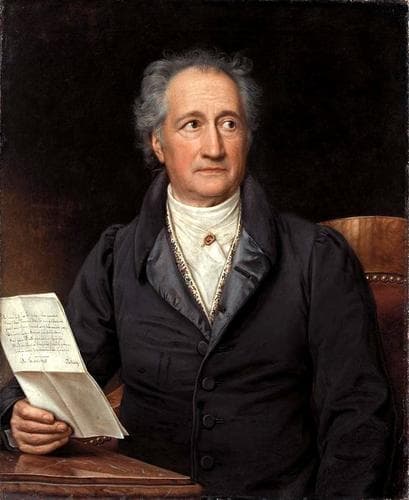
Johann Wolfgang von Goethe was a German poet, playwright, novelist, scientist, statesman, theatre director, and critic. His works include plays, poetry, literature, and aesthetic criticism, as well as treatises on botany, anatomy, and colour. He is widely regarded as the greatest and most influential writer in the German language, his work has a profound and wide-ranging influence on Western literary, political, and philosophical thought from the late 18th century to the present day.

Jeff Olson
4.4
Thomas Sowell
4.4
Walter Brueggemann
4.3

Rhonda Byrne
4.3

Robin Wall Kimmerer
4.3
George S. Clason
4.3
Elliot Aronson
4.3
Joseph Campbell
4.3