“We have learned to live with our forests, our rivers, our wild animals, our land. They are not just resources; they are our relatives.”
— A character explains Ecotopia's ecological philosophy to the protagonist.

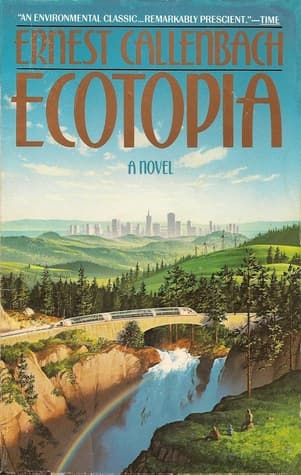
Ernest Callenbach (1975)
Genre
Politics / Fantasy / Science Fiction
Reading Time
240 min
Key Themes
See below
Sign in to track this book
A skeptical American journalist visits a seceded Pacific Northwest nation. He finds an ecologically focused society where tree worship, a twenty-hour workweek, and ritual war games challenge his ideas. He must choose between two vastly different futures.
Will Weston, a New York Times-Post reporter, receives access to Ecotopia. This nation formed when Northern California, Oregon, and Washington seceded twenty years ago. His trip begins with a train ride from Reno, Nevada, through a guarded border. Dr. Vera Allwen, his official Ecotopian guide, meets him. Weston immediately notices the differences: clean landscapes, advanced sustainable technology, and a clear sense of peace. He learns his job is to report objectively on Ecotopian society, and his reports will go to the US for publication. His first thoughts are a mix of professional doubt and a growing interest in this society that has separated itself from the world.
Weston's first days in Ecotopia involve observing its culture. He sees advanced recycling, widespread solar energy, and no private cars in cities, replaced by public transport and bicycles. He learns about their twenty-hour workweek, focus on craft and local production, and communal living. Socially, Ecotopians are direct and emotionally open, especially about physical intimacy and personal relationships, which contrasts with his American views. He also learns about 'ritual war games,' a way to channel aggression and stay fit, and the strong presence of women in leadership.
During his travels, Weston examines Ecotopian education. It focuses on hands-on learning, environmental care, and individual pacing, not competitive grading. Children are encouraged to explore interests and develop practical skills. He also looks at their healthcare system, which emphasizes preventative medicine, natural remedies, and mental well-being, rather than treating illness after it occurs. Hospitals are less common; community health centers and personal health responsibility are more important. These systems aim for a deep connection to nature and a holistic view of human well-being, fitting with Ecotopia's ecological principles.
Weston observes that Ecotopian society is largely matriarchal. Women hold power in government and business. This has led to policies that prioritize social welfare, environmental protection, and non-violence. He also learns about their open approach to sexuality, seen as a natural and healthy part of life, free from American taboos and commercialization. He notes the presence of 'stable relationships' rather than traditional marriage, and acceptance of different forms of intimacy. This aspect of Ecotopian life challenges Weston's conservative background and starts to change his views on relationships and gender roles.
Weston travels through Ecotopia's managed forests. These are carefully maintained and seen as sacred. He learns about their sustainable logging practices, which prioritize ecological balance over profit, and the respect Ecotopians have for trees and nature. He visits farms that use organic agriculture, growing many crops without pesticides or artificial fertilizers. Food is local, fresh, and often prepared communally. This deep connection to the land reinforces Ecotopia's commitment to a 'stable-state' ecosystem, where human activity works with natural processes, and waste is minimal.
One of the most confusing parts of Ecotopian society for Weston is the 'ritual war games.' These are not actual wars but organized, intense physical fights between groups, often using mock weapons and strategies. He learns these games let out human aggression and competition in a controlled way, stopping it from becoming destructive in society. Participants get injured, sometimes seriously, but the games focus on catharsis and group bonding, not conquest. This practice shows Ecotopia's practical approach to human nature, recognizing inherent drives and redirecting them for social benefit.
Weston looks into Ecotopia's economy. It works without traditional capitalism or central planning. Businesses are mostly employee-owned cooperatives, which creates a sense of shared responsibility. Production is local, reducing the need for long-distance transport and promoting self-sufficiency. There is a focus on durable and repairable goods, different from the planned obsolescence of American consumerism. The twenty-hour workweek and a guaranteed basic income ensure everyone's needs are met, allowing for leisure time and personal growth. This system aims to stop economic exploitation and create a more equal society.
As Weston's stay continues, he forms a deep relationship with Marissa, an Ecotopian woman. Their intimacy is deep and open, challenging his ideas about love and sex. Marissa helps him understand the emotional and spiritual depth of Ecotopian life, showing him the possibilities of human connection and environmental harmony. Through their relationship, Weston begins to lose his journalistic detachment and experiences Ecotopia as a participant, not just an observer. This personal connection becomes a big part of his changing view of both Ecotopia and his American identity.
The longer Weston stays in Ecotopia, the more he questions his American values and the society he came from. He sees the environmental damage, social inequalities, and spiritual emptiness of the United States clearly against Ecotopia's sustainable culture. His reports, initially doubtful, become more sympathetic and even supportive of Ecotopian ways. He feels torn between his reporting duty and his growing belief that Ecotopia offers a good way of life. This internal conflict is a turning point in his journey, making him face his own biases and beliefs.
As his reporting job ends, Will Weston faces a personal decision. His experiences in Ecotopia, especially his relationship with Marissa, have changed him. He can no longer accept the values and lifestyle of the United States. Weston decides to leave America and seek Ecotopian citizenship, committing to this new life. His final report to the New York Times-Post, which he secretly writes but might never send, expresses his admiration for Ecotopia and his hope that its message of sustainability and harmony can inspire the world.
The Protagonist
Weston transforms from a detached, skeptical observer into an emotionally engaged participant who ultimately chooses to defect and become an Ecotopian citizen.
The Supporting
Remains a steadfast and informative guide, representing Ecotopian ideals to Weston.
The Supporting
Helps Weston connect emotionally with Ecotopian life, serving as a catalyst for his personal transformation.
The Mentioned
Their collective existence provides the context and examples for Weston's learning and transformation.
The Mentioned
Represents the unchanging American establishment contrasted with Ecotopian ideals.
The main theme of 'Ecotopia' is the possibility of a sustainable society. This shows in every part of Ecotopian life: their solar-powered mini-cities, zero-waste policies, and recycling programs, to their respect for forests and organic farming. The Ecotopians respect natural systems, seeing humans as part of the ecosystem, not its rulers. Will Weston's observations of their clean environment, efficient resource use, and rejection of consumerism show how a society can thrive in balance with nature, as he notes their public transport and lack of private cars.
“''We are not trying to be a utopia, Mr. Weston. We are trying to be an ecotopia. A place where humans and nature can live in harmony.''”
Will Weston's journey is about identity and self-discovery. He starts as an American journalist, detached and objective. But his time in Ecotopian culture, especially his relationship with Marissa, makes him face his own values, desires, and emotions. He struggles with the difference between his American upbringing and the Ecotopian way of life, leading to a deep internal conflict. This theme ends with his decision to leave his old identity and become an Ecotopian citizen, meaning he completely re-evaluates who he is and where he belongs, as his reports become less objective and more personal.
“''I was afraid to admit it, even to myself, but Ecotopia was changing me. Not just my opinions, but my very being.''”
The novel looks at different ways of organizing society and politics than traditional Western models. Ecotopia is a matriarchal society with a decentralized government, focusing on communal decisions and local control. Its economy uses employee-owned cooperatives and local production, rejecting both capitalism and state socialism. Socially, it promotes sexual freedom, communal living, and ritualized aggression outlets, like the war games. These structures aim to create social unity, reduce conflict, and prioritize well-being over economic growth, offering a plan for a society built on different ideas than those in the United States.
“''Our goal is not to maximize production, but to maximize human satisfaction and ecological stability.''”
Ecotopia recognizes human aggressive tendencies but provides constructive ways to express them, rather than suppressing them. The 'ritual war games' are an example. They are a controlled, cathartic release for competition and violence, stopping it from becoming destructive in society. This approach shows a practical understanding of human psychology, integrating these drives into a healthy social structure. Weston at first finds these games barbaric, but later understands their role in keeping Ecotopian peace and social order.
“''We believe that aggression, like any other human drive, must be channeled, not eliminated. Suppress it, and it will find uglier outlets.''”
Ecotopia shows a balanced view of technology, advocating for its use to help sustainability and human well-being, not for endless consumption or convenience. While Ecotopians use advanced solar power, efficient public transport, and sophisticated recycling, they reject technologies that cause pollution, deplete resources, or lead to social isolation. There is a focus on simplicity, craft, and direct interaction with the physical world, different from the consumerist, gadget-driven culture of America. This theme is clear in their durable goods, local production, and the absence of disposable items, showing a deliberate choice for appropriate technology.
“''We use technology to free ourselves, not to enslave ourselves to endless production and consumption.''”
Weston's personal thoughts and reflections, offering deeper insight into his transformation.
Interspersed with Will Weston's official newspaper dispatches are his private journal entries. These entries serve as a crucial plot device, revealing his true, unfiltered thoughts, doubts, and emotional responses to Ecotopia. While his dispatches are initially objective and later increasingly sympathetic, his journal provides an intimate window into his internal conflict, his growing affection for Marissa, and his ultimate decision to defect. This dual narrative perspective allows the reader to witness his transformation on both an intellectual and emotional level, tracking his journey from skepticism to full embrace of Ecotopian values.
Will Weston's role as an American reporter, highlighting the contrast between two societies.
The narrative is primarily told through the eyes of Will Weston, an 'outsider' to Ecotopian society. This device allows the author to present Ecotopia through a lens of initial skepticism and gradual enlightenment, making the society's radical ideas more accessible and persuasive to the reader. By having Weston constantly compare Ecotopian practices to those of the United States, the novel effectively critiques modern American society while simultaneously showcasing Ecotopia's strengths. His outsider status makes his eventual conversion all the more impactful, demonstrating the transformative power of the Ecotopian way of life.
The stark comparison between Ecotopia and the external 'polluted' world.
The novel heavily relies on the contrast between the idealized, sustainable society of Ecotopia and the implied, environmentally degraded, and socially fragmented United States. This contrast is a key plot device for demonstrating the feasibility and benefits of Ecotopian principles. Will Weston's observations constantly highlight the differences in everything from air quality and urban planning to social interactions and economic systems. This serves to both critique contemporary society and present Ecotopia as a hopeful, albeit radical, alternative, pushing the reader to consider what kind of world they inhabit versus what could be.
The foundational principle of Ecotopian society and its guiding philosophy.
The concept of a 'stable-state' ecosystem is not just a thematic element but a core plot device that dictates all aspects of Ecotopian life and governance. It provides the logical framework for their policies on resource management, population control, economic models, and even social customs. This principle explains why Ecotopia is so isolated, why they prioritize ecological balance over economic growth, and why they have such strict environmental regulations. It serves as the driving force behind every decision made by the Ecotopian people, shaping the world Will Weston observes and ultimately chooses to join.
“We have learned to live with our forests, our rivers, our wild animals, our land. They are not just resources; they are our relatives.”
— A character explains Ecotopia's ecological philosophy to the protagonist.
“In Ecotopia, we measure wealth not in money, but in the health of our people and the richness of our environment.”
— Describing the economic principles of the secessionist society.
“The stability-state economy is not about growth, but about balance—a steady state with nature.”
— Discussing Ecotopia's alternative to capitalist growth models.
“War games are our national sport; they keep us fit and remind us of the horrors we have left behind.”
— Explaining the role of ritualized conflict in Ecotopian culture.
“We have no advertising because we have no need to create desires for things we do not truly need.”
— Commenting on the absence of commercial marketing in society.
“The personal is political, and the political is personal—in Ecotopia, every choice reflects our values.”
— Reflecting on the integration of individual and collective life.
“Our cities are gardens, not concrete jungles; we build with nature, not against it.”
— Describing urban planning and architecture in Ecotopia.
“Technology serves life, not the other way around. We use only what harmonizes with our ecosystem.”
— Outlining the principles guiding technological development.
“In the old world, they feared scarcity; here, we have learned that sharing creates abundance.”
— Contrasting Ecotopian resource management with former systems.
“We do not have leaders in the traditional sense; we have facilitators who help the community decide.”
— Explaining the decentralized, participatory governance model.
“The forest is our cathedral, the river our hymn. Nature is our spiritual guide.”
— Describing the spiritual and religious aspects of Ecotopian life.
“Work is not a burden here; it is a way to contribute to the whole, and everyone finds meaning in it.”
— Discussing the role of labor and vocation in society.
“We recycle everything, not out of duty, but because waste is a crime against the future.”
— Emphasizing the cultural attitude towards waste and resources.
“In Ecotopia, children learn from the land first, books second. Education is rooted in experience.”
— Describing the educational system and its priorities.
“Our laws are few, but they are deep—based on respect for all life, human and non-human.”
— Explaining the legal and ethical framework of the society.
Ready to see how well you understood this book? Take our interactive quiz with 10 questions.

Biography coming soon.

Brett Casper
5.0

Dirk Uffelmann
4.7

Winston S. Churchill
4.5
Chimamanda Ngozi Adichie
4.5
Will Durant
4.4
Thomas Sowell
4.4
W.E.B. Du Bois
4.3

Alan Moore
4.3