“The cows thought Farmer Brown was a little bossy. And the chickens agreed.”
— Introducing the animals' dissatisfaction with Farmer Brown.

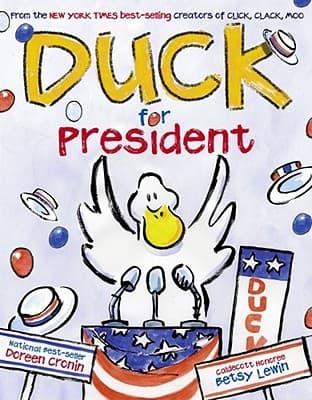
Doreen Cronin (2004)
Genre
Politics / Fantasy / Children's
Reading Time
5 min
Key Themes
See below
Sign in to track this book
A duck, fed up with farm chores, runs for office, rising from farmer to president, only to discover that leading the country is more tedious than he imagined.
Duck lives on Farmer Brown's farm, where he mows the lawn, weeds the garden, and cleans the barn. He finds the work unfair, especially compared to Farmer Brown, who naps in his hammock. One day, Duck decides he has had enough. He types a list of demands for better working conditions and fairer treatment, posting it on the barn door. Farmer Brown dismisses the demands at first, but Duck's actions soon grow, leading to a strike among all the farm animals.
Following Duck's lead, the other farm animals join the strike. The cows refuse to give milk, the pigs stop wallowing, and the chickens will not lay eggs. The farm stops, much to Farmer Brown's concern. He tries to ignore them, but the lack of farm production quickly affects his income. Realizing he cannot run the farm alone, Farmer Brown faces the striking animals. He tries to reason with them, but Duck, speaking for the animals, holds firm on their demands for better conditions. Farmer Brown eventually gives in, agreeing to Duck's terms, which include a washing machine for dirty clothes.
After the successful strike, Duck sees Farmer Brown's continued napping and what he sees as poor management. Duck feels he could do a much better job managing the farm. Inspired, Duck decides to run for the position of Farmer. He creates campaign posters and gathers the other animals, promising them a more efficient and enjoyable farm. Farmer Brown, confident in his position, sees Duck's candidacy as a joke. However, Duck's campaign gains support, with the animals enthusiastically backing him, drawn to his promises of change and better treatment for everyone on the farm.
Election day arrives, and the farm animals cast their votes. Duck campaigns hard, while Farmer Brown remains largely relaxed, believing his position is safe. When the votes are counted, to everyone's surprise, Duck wins by a large margin. Farmer Brown is shocked, forced to give up his position to the newly elected Duck. Duck, now the official farmer, takes over management of the farm, ready to start his plan for a more organized and fair environment for all the animals. Farmer Brown is left to think about his loss.
Duck, as the new farmer, immediately begins reorganizing the farm. He creates a detailed schedule for the animals, making sure everyone has fair work and free time. He even installs a hot tub for the cows and a trampoline for the pigs, keeping some of his campaign promises. The farm runs smoothly under his leadership, and the animals are happy. However, after a few weeks, Duck finds himself getting bored. The routine of managing the farm, even a well-run one, lacks the excitement he felt during his campaign and the initial takeover. He wants a new challenge.
Feeling restless as farmer, Duck looks beyond the farm for his next goal. He sees a poster for the upcoming gubernatorial election and realizes that being governor would offer a much greater challenge and more excitement than managing a farm. He decides to run for governor, leaving the farm to the cows, who he tells to follow his schedule. Duck then starts his campaign, traveling through the state, giving speeches, and meeting people, much like he did when he ran for farmer. His unusual candidacy quickly gets attention.
Duck campaigns hard across the state, promising to improve conditions for everyone, just as he did on the farm. His unique approach and relatable message connect with voters. The current governor, a human, at first sees Duck as a novelty candidate, but as election day nears, Duck's popularity grows quickly. When the votes are counted, Duck again wins, becoming governor. The state is surprised by the result, and Duck prepares for his new role, leaving his farm duties behind.
As governor, Duck quickly makes state operations more efficient, just as he did on the farm. He organizes meetings, signs bills, and ensures government efficiency. He even installs a hot tub in the governor's mansion and a trampoline in the state park, bringing his farm-based perks to more people. The state runs smoothly under his leadership, and citizens generally approve of his practical approach. However, like with farming, the routine of governing eventually sets in, and Duck finds himself increasingly bored. He realizes that the daily tasks of a governor are not as thrilling as he had imagined.
Driven by his desire for new challenges and a cure for his constant boredom, Duck aims for the highest office: President of the United States. He announces his candidacy, leaving the state in the care of his lieutenant governor, a pig. Duck then starts a nationwide campaign, traveling from state to state, giving speeches, and making promises to improve the country. His campaign is even more ambitious than his previous runs, and he quickly gains national attention, becoming a serious presidential candidate.
Duck's presidential campaign captivates the nation. He debates opponents, participates in rallies, and continues to promise practical improvements for all citizens. His unusual background and charm appeal to many voters. On election day, the country watches as the votes are counted. In a historic win, Duck is elected President of the United States, making him the first animal to hold the highest office. The nation celebrates, and Duck prepares to move into the White House, ready for the ultimate challenge.
As President, Duck quickly sets up routines and carries out his policies, making sure the country runs efficiently. He holds meetings, signs treaties, and makes important decisions, much like he did as governor and farmer. However, the grandeur of the White House and the power of the presidency do not cure his basic boredom. He finds the endless paperwork and diplomatic functions surprisingly dull. Instead of focusing on his presidential duties, Duck spends more and more time writing letters to Farmer Brown, remembering the simpler days on the farm and complaining about how boring his current role is.
The many letters from President Duck to Farmer Brown show Duck's growing unhappiness with the presidency. He admits his boredom with the responsibilities and his wish for the simpler life he once knew. One day, Duck makes a big decision. He resigns from the presidency, leaving the White House and the nation's leadership. He packs his bags and, to Farmer Brown's surprise, returns to the farm. He settles back into his old life, enjoying the familiar routines and the peace of the countryside, finding happiness in a role far less demanding than the ones he had pursued.
After Duck's return, life on the farm goes back to normal. Farmer Brown, however, has been greatly affected by Duck's journey through politics. Seeing Duck's rise from farm animal to president, and then his return, gives Farmer Brown an idea. He realizes that if a duck can become president, then he, a human farmer, certainly can. Inspired by Duck's political adventures, Farmer Brown decides it is his turn to run for president, aiming for the very office Duck just left. The cycle of ambition continues, but this time with a human candidate.
The Protagonist
Duck transforms from a discontented farm worker to the President of the United States, only to realize that even the highest office is not enough to cure his boredom, ultimately returning to a simpler life.
The Supporting/Antagonist
Farmer Brown goes from a complacent farmer to being repeatedly replaced by Duck, eventually becoming inspired by Duck's journey to pursue his own political aspirations.
The Supporting
They remain loyal supporters of Duck, benefiting from his leadership and briefly taking on managerial roles.
The Supporting
They consistently support Duck and benefit from his policies, with one pig even rising to a political office.
The Supporting
They consistently support Duck's initiatives and benefit from the changes he implements.
The Mentioned
His role is static, serving as a conduit for communication.
The Mentioned
He is defeated by Duck in the gubernatorial election, marking a transition of power.
The story shows how seeking higher office can be driven by a desire for challenge and change, but also how the reality of power can become boring. Duck constantly seeks greater challenges, moving from farmer to governor to president. However, each role, once achieved, quickly becomes routine for him. This is clear when he finds himself bored as farmer, then as governor, and finally as president, preferring to write letters to Farmer Brown instead of doing presidential duties. The book suggests that true satisfaction might not be in the highest positions of power.
“Running a country is an awful lot like running a farm. There were too many meetings, too many bills, and too many decisions.”
The story supports the idea that anyone, regardless of their background, can achieve great things and cause change. Duck, starting as a farm animal, successfully challenges and replaces his human employer, then rises through state and national politics. His journey shows that determination and the ability to get others involved can overcome traditional barriers. The farm animals' initial strike and their consistent support for Duck's campaigns highlight the collective power of people (or animals) to elect their leaders and demand better conditions.
“Farmer Brown was furious. All the animals were on strike.”
The book quietly examines different leadership styles. Farmer Brown is a complacent, less involved leader, while Duck is proactive, organized, and popular. Duck's success comes from his ability to find problems, suggest solutions, and gather support by promising real improvements for his constituents. However, it also shows that effective leadership does not always mean personal happiness for the leader. Duck is an effective leader, but his personal boredom suggests that leadership, while important, can be an unrewarding task for the one in charge.
“Duck organized a vote. The animals voted for Duck.”
The story presents a repeating view of ambition. Duck continuously seeks new challenges, climbing the political ladder, only to find himself bored and wanting something else. His eventual return to the farm means he is looking for happiness outside of important roles. The ending, with Farmer Brown, once lazy, now inspired to run for president, suggests that ambition is a powerful force. It implies that while one person (or duck) might find peace in stepping down, another will always be eager to step up, continuing the cycle of seeking power and purpose.
“Running a country is an awful lot like running a farm. There were too many meetings, too many bills, and too many decisions. 'I miss the farm,' thought Duck.”
Giving human characteristics and behaviors to animals.
The primary plot device, anthropomorphism, is central to the entire narrative. Duck and the other farm animals speak, organize, write, and engage in complex political processes like striking, campaigning, and voting. This device allows the story to satirize human politics and ambition in a lighthearted, accessible way for children. By presenting animals in these roles, the book simplifies complex societal structures and motivations, making the themes of power, leadership, and boredom relatable and humorous.
The use of humor, irony, exaggeration, or ridicule to expose and criticize political and societal follies.
The book employs satire to comment on the nature of politics and ambition. Duck's meteoric rise from farm animal to president, his promises of hot tubs and trampolines for constituents, and his eventual boredom with the highest office, all serve as humorous critiques of political campaigns, the motivations of leaders, and the often-mundane reality of governance. It playfully pokes fun at the idea that any candidate, no matter how unconventional, can capture public imagination and win elections, and that the grass isn't always greener at the top.
A recurring sequence of events that builds in intensity.
The story follows a clear repetitive structure where Duck identifies a problem/boredom, decides to run for a higher office, campaigns, wins, implements his changes, gets bored, and then seeks an even higher office. This pattern escalates from farm, to state, to national level, creating a predictable yet engaging rhythm. This repetition highlights Duck's core character trait of being easily bored and constantly seeking new challenges, while also reinforcing the satirical commentary on the cyclical nature of political ambition.
A literary device where the intended meaning is different from the actual meaning of the words.
Irony is evident throughout the narrative. The most prominent example is Duck, an animal, successfully navigating the human political system and achieving the presidency, only to find it less fulfilling than his previous, simpler life. Another layer of irony is Farmer Brown's transformation from being the complacent 'boss' to being inspired by his former 'employee' (Duck) to pursue the very position Duck abandoned. This contrast between expectation and reality, and the reversal of roles, provides both humor and thematic depth.
“The cows thought Farmer Brown was a little bossy. And the chickens agreed.”
— Introducing the animals' dissatisfaction with Farmer Brown.
“Duck was tired of Farmer Brown's bossiness. He wanted to be in charge.”
— Duck's motivation for seeking leadership.
“The election was close. Very close. The animals waited anxiously for the results.”
— Building suspense before the election results are announced.
“Duck won! He was the new farmer.”
— Duck's first electoral victory.
“Being farmer was a lot of hard work. Duck had to wake up early, milk the cows, feed the chickens, and slop the hogs.”
— Duck realizes the responsibilities of his new role.
“He decided to run for governor.”
— Duck's decision to seek higher office after finding farming too demanding.
“The polls were open from 6 a.m. to 7 p.m. Everyone voted.”
— Emphasizing the importance of participation in elections.
“Duck won again! He was the new governor.”
— Duck's second electoral victory.
“Being governor was a lot of hard work. Duck had to sign bills, veto bills, and listen to very long speeches.”
— Duck realizes the challenges of being governor.
“He decided to run for president.”
— Duck's decision to seek the highest office.
“The whole country voted. Everyone waited anxiously for the results.”
— The national election, mirroring previous local elections.
“Duck won! He was the new president.”
— Duck achieves his ultimate political goal.
“Being president was a lot of hard work. Duck had to make important decisions, meet with important people, and listen to even longer speeches.”
— Duck experiences the overwhelming demands of the presidency.
“He decided to go back to the farm.”
— Duck's decision to return to a simpler life after experiencing the top political office.
“Farmer Brown was finally relaxing on the porch. He was tired of politics.”
— Farmer Brown reflecting on his brief foray into politics.
Ready to see how well you understood this book? Take our interactive quiz with 10 questions.

Doreen Cronin is the author of the award-winning picture book "Diary of a Worm" and the New York Times bestseller "Duck for President." Her work often features animal protagonists and humor, appealing to young readers. Cronin has received numerous accolades for her contributions to children's literature.

Brett Casper
5.0
Dirk Uffelmann
4.7

Winston S. Churchill
4.5
Chimamanda Ngozi Adichie
4.5
Will Durant
4.4
Thomas Sowell
4.4
W.E.B. Du Bois
4.3
Alan Moore
4.3